Spigold
Apple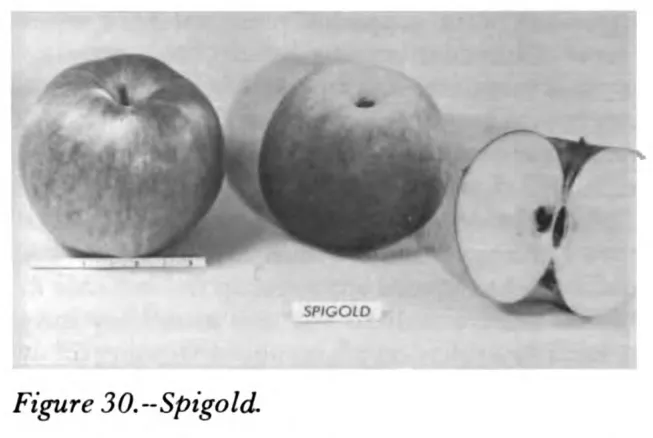
Spigold
Origin / History
Spigold is a cross of Red Spy x Golden Delicious, made in 1943 and developed in New York at the New York State Agricultural Experiment Station (breeding record number 43201, seedling number N.Y. E6). Way (1979) gives the parents as "Spy and Golden Delicious". It was selected on chromosome count in 1944, a few weeks after the seed had germinated. Einset had found that New York's commercial apple acreage held a higher proportion of triploid cultivars than occurs in nature, so triploid types appeared to have special attributes especially suited for commercial production. A search was therefore made for triploid seedlings in populations from controlled crosses. Tips of growing roots were sectioned and examined under the microscope to determine ploidy. Chromosomes were counted on 200 seedlings of the Red Spy x Golden Delicious population. Most were diploid; the few triploids were specially grown and followed to maturity, and N.Y. E6 was one of them. It was selected before it fruited. After its fruits were examined it was selected for further propagation in 1955, and it was introduced in 1962. The name is a combined word indicating its two parents.
The introductory description was published in 1962 by Klein, Way, and Einset. Brief descriptions followed in the Register of New Fruit and Nut Varieties and in 1963 by Brooks and by Way. It was described before the New York State Horticultural Society in 1964 and again two years later.
Nursery trees were sold by the New York State Fruit Testing Association for 11 years, 1958-68, four of them before introduction. In 1960-68 nine commercial nurseries sold it, which Way (1971) takes to show quick acceptance by commercial fruit growers. In 1968 it was under test at experiment stations in Arkansas, Colorado, Kansas, New York, North Carolina, Pennsylvania, Vermont, and Washington. In 1965 it ranked 11th among the important cultivars newly planted in New York. Way lists it among his 20 choicest apple cultivars. Way (1971) calls it "a very high quality, very large apple", probably most useful for processing markets, and recommends it for planting in areas where Northern Spy grows well.
Zielinski (1964) describes it for Oregon as a potential replacement for Northern Spy, which it closely resembles. Way (1979) calls it a very large fruited Spy type.
Tree
Very strong, vigorous grower, possibly larger than any other cultivar; upright, tall, of medium density, round-topped. Trunk stocky; bark smooth and gray. Zielinski lists the large trees among its disadvantages. On EM VII rootstocks trees sometimes break at the bud union in the first few years after initial fruiting. Way (1979) says that on seedling roots the trees are too vigorous and unproductive, while on M.7 roots, kept annually cropping with branch spreaders and chemical thinning, they bear heavy crops of beautiful fruit.
Trees begin bearing at a later age than many cultivars, heavily productive (Way, 1971) but tending to crop only in alternate years; biennial bearing is also named a disadvantage by Zielinski. Zielinski alone gives bearing on younger trees than Northern Spy as a major advantage over that variety. A commercial New York grower found it a poor yielder, late beginning to bear, and biennial.
Blooms rather late in spring, nearly a day later than Delicious. A triploid; the pollen is not viable and is not useful to set fruit on other varieties or on itself, so the variety is of no value as a pollinizer. A nearby late-blooming diploid cultivar must pollinate it, and a second diploid cultivar must be in the same planting to pollinate the first.
Bitter pit is less than in Northern Spy (Zielinski; Way, 1971), but can be very severe on young trees bearing light crops. Way (1979) lists bitter pit among its faults.
Fruit
Size: Very large, mostly more than 3 inches and often more than 4 inches in diameter. Large even on heavily cropping trees. Specific gravity high, 55 lb/bu against 40 lb/bu for most cultivars. Way (1979) says fruits may be too large.
Form: Roundish, ribbed, somewhat irregular in shape, tending to be five-sided.
Stem: Variable in length, long to short; thick.
Cavity: Medium in depth, rather broad, somewhat obtuse to acute, russeted. Nearly symmetrical, sometimes slightly compressed or lipped. On fully ripe fruits sometimes with large, vertical skin cracks.
Calyx: Small, closed. Lobes short, narrow, acuminate. Calyx tube long to short (5 to 25 mm), narrow (4 mm), funnel-shaped to conic. Stamens basal.
Basin: Deep, narrow, abrupt, rather smooth; sometimes symmetrical, sometimes compressed.
Skin: Thin, tender, smooth, dull; susceptible to limb-rub blemishes. Color 70 per cent distinct stripe and attractive, similar to that of Northern Spy. With heavy nitrogen fertilization fruits are less than 70 per cent red, and under these conditions they are not sufficiently attractive for the fresh market. Way (1979) lists fruit color not fully red among its faults.
Dots: Few, small, russet or green, obscure.
Flesh and flavor: Yellowish cream, semifirm, medium grained, crisp, very juicy; subacid, aromatic, sprightly. Zielinski gives the same fine texture, pleasant flavor, and flesh color as Northern Spy and "exceptionally high" fresh fruit quality. Way (1971) rates eating quality excellent, "perhaps better than any other cultivar", though good eating quality develops only under good growing conditions. Way (1979) says some people hold it to have the best eating quality of any apple variety, combining the best of the flavors of its two parents. Nitschke, testing many cultivars for eating quality, stated: "Spigold is certainly one of the finest apples of all time. It is crisp, juicy, and its flavor is hard to describe. Its flavor is a delicate blend of the Northern Spy and Golden Delicious flavors that is like nothing else." He later said its quality is superior to the old standard of quality, Esopus Spitzenburg, and that it is "superb".
Core and seeds: Core small for such large fruits (18 mm wide), open. Carpels round, tufted. Seeds few, the variety being a triploid; long, flat, acuminate.
Season
Picks a week before Northern Spy and in the same season as Red Delicious (Zielinski). At Geneva, New York, the average ripening date is October 19, 9 days later than Delicious, and the average interval from full bloom to harvest is 153 days, 8 more than Delicious. Fruits adhere fairly well on the tree after ripening; a commercial New York grower found they hung well. They store very well, about 140 days at 31°F. Shelf life after storage is very good.
Uses
Very good for applesauce, canned slices, and frozen slices. A commercial New York grower found it an excellent processor, useful only for processing markets because of poor red color, and Way (1971) judges it probably most useful for processing markets. Way (1979) says that on M.7 roots, kept annually cropping, the trees bear heavy crops of beautiful fruit.
Subtypes / Variants
Not described in source.
Other
Not described in source.
Book Sources
Described in 3 period pomological works
View original book sources (3)
— Quentin B. Zielinski, Apple Varieties for Oregon (1964)Spigold†
This new variety, developed in New York, is derived from the cross of Red Spy x Golden Delicious. It is described here as a potential replacement for Northern Spy which it closely resembles. It is large-fruited with exceptionally high fresh fruit quality, having the same fine texture, pleasant flavor, and flesh color as Northern Spy. It reaches picking maturity a week before Northern Spy and in the same season as Red Delicious. Spigold is a triploid needing a pollinizer. Consequently, it is of no value as a pollinizer. The trees are strong, vigorous, and upright growing. The major advantages of Spigold over Northern Spy are its bearing of fruit on younger trees and less susceptibility to bitter pit. Disadvantages are the large trees and large fruit size and biennial bearing.
— Roger D. Way, Apple Cultivars Introduced by the New York State Agricultural Experiment Station, 1914–1968 (1971)Spigold
Origin. Spigold resulted from a cross made in 1943, Red Spy x Golden Delicious. The breeding record number was 43201, and the seedling number was N.Y. E6. It was selected on the basis of its chromosome count in 1944, just a few weeks after the seed had germinated.
Einset (69) found that the commercial acreage of apples in New York contained a higher proportion of triploid cultivars than occurs in nature. Thus, triploid types appeared to have special attributes especially suited for commercial production. For this reason, a search was made for triploid seedlings in populations resulting from controlled crosses. The tips of growing roots were sectioned and examined under the microscope to determine ploidy. Chromosomes were counted on 200 seedlings of this Red Spy x Golden Delicious population (68). Most were diploid, but the few that were triploid were specially grown and followed to maturity. N.Y. E6 was one of these triploids (74). It was selected even before it fruited (168). After examination of its fruits, in 1955 it was selected for further propagation, and in 1962 it was introduced (Table 2). Its name is a combined word to indicate its two parents.
The introductory description for Spigold was published in 1962 by Klein, Way, and Einset (131, 132). It was briefly described in the Register of New Fruit and Nut Varieties (39). It was also briefly described in 1963 by Brooks (30) and by Way (216). It was described before the annual sessions of the New York State Horticultural Society in 1964 (224) and again before the same Society 2 years later (214, 215).
Tree. The tree characteristics of Spigold are summarized in Table 5. Ten tree characteristics of Spigold have been listed by Way (217, 221). The tree is a very strong grower, possibly larger than any other cultivar. It is upright, tall, of medium density, and round-topped. Trees begin bearing at a later age than many cultivars. Trees are heavily productive (Table 5), but they tend to crop only in alternate years (21). The trunk is stocky. The bark is smooth and gray.
Spigold trees on EM VII rootstocks sometimes break at the bud union in the first few years after initial fruiting.
Pollination. Spigold trees bloom rather late in the spring, nearly a day later than Delicious (Table 6). It is a triploid (Table 4), and the pollen is not viable. Provision must be made for a nearby late blooming diploid cultivar to pollinate it. Then, a second diploid cultivar must be in the same planting to pollinate the pollinating cultivar.
Fruit. Spigold fruits are illustrated in Figure 30. They were also illustrated in previous publications (131, 132, 217). The fruit characteristics are summarized in Table 8. Ten fruit characteristics of Spigold have been listed by Way (217, 221). The average ripening date at Geneva is October 19, 9 days later than Delicious (Table 7). The average number of days between full bloom and harvest is 153, 8 more than Delicious. The fruits adhere fairly well on the tree after they have ripened.
Spigold fruits are very large, mostly more than 3 inches and often more than 4 inches in diameter. They are large even on heavily cropping trees. They are roundish, ribbed, somewhat irregular in shape, and tend to be five-sided. Their specific gravity (55 lb/bu) is higher than that of most cultivars (40 lb/bu). Stems are variable in length from long to short, and they are thick. The cavity is medium in depth, rather broad, somewhat obtuse to acute, and russeted. The cavity is nearly symmetrical but sometimes slightly compressed or lipped. On fully ripe fruits, the cavity sometimes has large, vertical skin cracks. The calyx is small and closed. The calyx lobes are short, narrow, and acuminate. The basin is deep, narrow, abrupt, rather smooth, sometimes symmetrical, and sometimes compressed. The skin is thin, tender, smooth, dull, and susceptible to limb-rub blemishes. The skin color is 70 per cent distinct stripe and attractive, similar to that of Northern Spy. Fruits are less than 70 per cent red when trees are heavily fertilized with nitrogen, and under these conditions, they are not sufficiently attractive for the fresh market. The dots are few, small, russet color or green, and they are obscure. The calyx tube is long to short (5 to 25 mm), narrow (4 mm), and funnel-shaped to conic. The stamens are basal. The core is small for such large fruits (18 mm wide), and it is open. The carpels are round and tufted. The seeds are few, Spigold being a triploid. They are long, flat, and acuminate. The flesh is yellowish cream, semifirm, medium grained, crisp, very juicy, subacid, aromatic, and sprightly. The eating quality is excellent, perhaps better than any other cultivar. Spigold is very good for applesauce, canned slices, and frozen slices (Table 9). The fruits store very well, about 140 days at 31°F (Table 10). The shelf life after storage is very good. It has less bitter pit than Northern Spy (213). However, bitter pit can be very severe on young trees bearing light crops.
Commercial Usefulness. Nursery trees of Spigold were sold by the New York State Fruit Testing Association for 11 years, 1958-68 (Table 2). It was sold for 4 years before it was introduced. In the 1960-68 period, it was sold by nine commercial nurseries (Table 3). This illustrates that it has been quickly accepted by commercial fruit growers.
In 1968 (184), Spigold was tested at experiment stations in Arkansas, Colorado, Kansas, New York, North Carolina, Pennsylvania, Vermont, and Washington.
Spigold has been listed by the author (218) as one of his 20 choicest apple cultivars.
In an evaluation by a commercial New York grower (141), Spigold was an excellent processor, poor yielder, late beginning to bear, biennial bearing, large fruited, hung well on the tree, had a higher specific gravity than most cultivars, and lacked good red color, making it useful only for processing markets.
Nitschke (167) tested many apple cultivars to determine which had the best eating quality. He stated, "Spigold is certainly one of the finest apples of all time. It is crisp, juicy, and its flavor is hard to describe. Its flavor is a delicate blend of the Northern Spy and Golden Delicious flavors that is like nothing else." He later said that Spigold has quality which is superior to the old standard of quality, Esopus Spitzenburg (169), and that its quality is superb (170).
Good eating quality, of course, will develop only under good growing conditions.
In summary: Spigold is a very high quality, very large apple. It probably is most useful for processing markets and is recommended for planting in areas where Northern Spy grows well.
Table 1 shows that in 1965 Spigold ranked 11th among the important cultivars newly planted in New York.
— Roger D. Way, Apple Varieties Grown in New York State (1979)Spigold is a very large fruited Spy type, which some people say has the best eating quality of any apple variety. It is a cross between Spy and Golden Delicious and it combines the best of the flavors of its two parents. Spigold has some faults: fruits may be too large, trees can grow too big (too vigorous on seedling roots, they are unproductive), biennial bearing, bitter pit, fruit color not fully red. However, if Spigold is grown on M.7 roots and trees are kept annually cropping through the use of branch spreaders and chemical thinning, they bear heavy crops of beautiful fruit. Being triploid, its pollen is not useful to set fruit on other varieties or on itself.