Parlin
Apple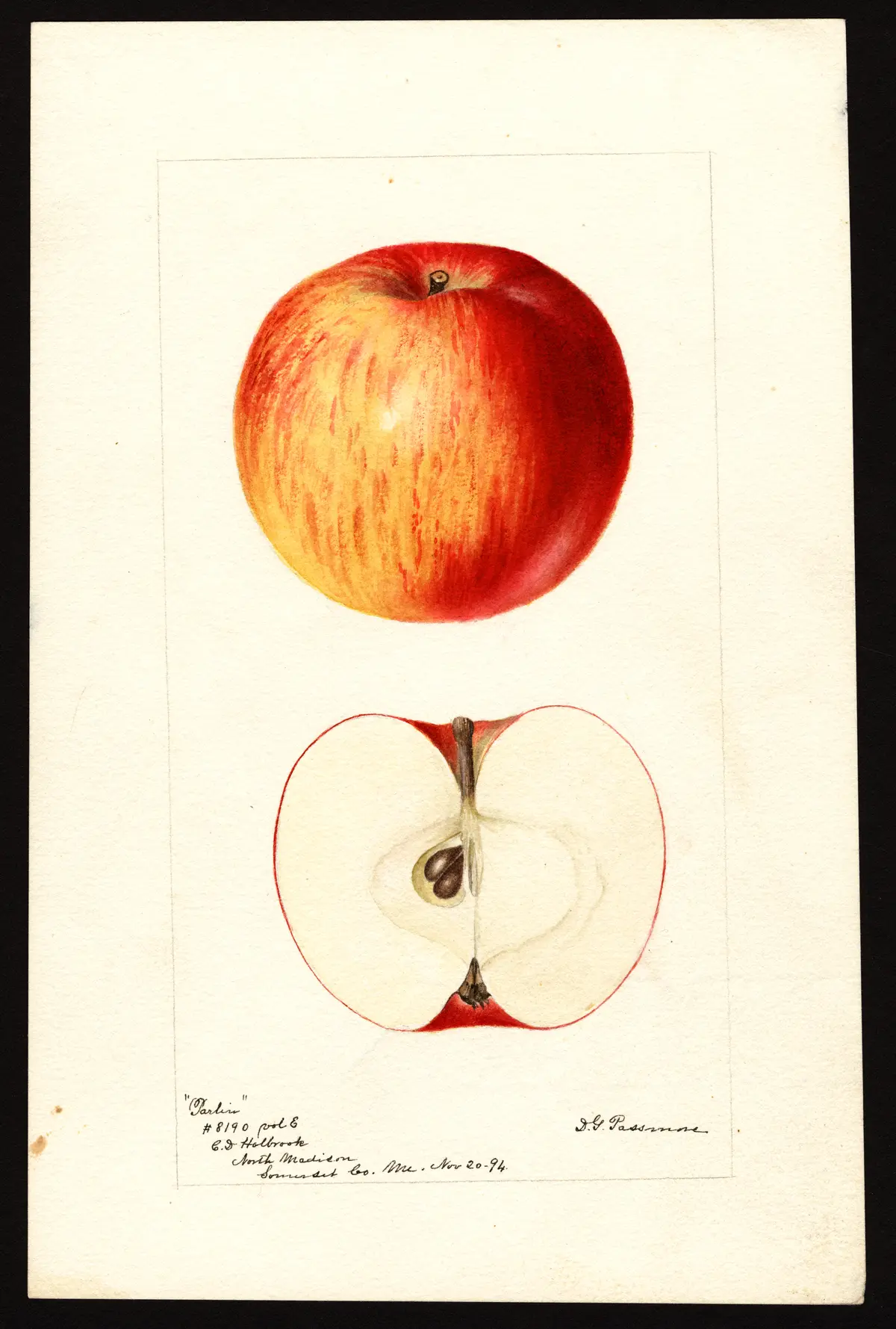
USDA Pomological Watercolor Collection
Parlin
Origin and History
The original tree, over fifty years old, was documented standing at Norridgewock, Maine in 1894, at which time it was still vigorous, healthy, and productive. The variety had not been widely disseminated in New York as of 1905.
Tree Characteristics
Not a strong grower; below medium size. Branches rather short and moderately stout. Form upright and somewhat spreading or roundish. Twigs short, straight, moderately stout with large terminal buds; internodes long or medium. Bark brown tinged with red, partly overlaid with rather thick scarf-skin; pubescent near tips. Lenticels scattering, medium to small, roundish or elongated, raised but slightly if at all. Buds large to medium, prominent, broad, plump, acute, free, pubescent.
Fruit
Size and Form: Medium to large, pretty uniform in size. Form rather variable, roundish to oblate, often inclined to conic, more or less irregular, somewhat angular; sides sometimes unequal.
Stem: Medium or sometimes long, rather slender.
Cavity: Acute, usually deep, moderately wide or wide, often furrowed or compressed, marked with yellowish-russet which sometimes extends beyond the cavity, sometimes lipped.
Calyx: Small, closed or partly open; lobes small, narrow, reflexed.
Basin: Rather small, deep, narrow to moderately wide, very abrupt, nearly symmetrical or slightly furrowed, sometimes wrinkled.
Skin: Rather thin, tough, smooth. Bright pale yellow blushed and mottled with pinkish-red and striped with darker red. Highly colored specimens nearly overspread with bright red, becoming on the exposed cheek nearly as dark red as Jonathan or Gano. Often irregularly veined with russet.
Dots: Usually small, yellowish or pale gray, sometimes large.
Calyx Tube: Funnel-form.
Core: Medium to small, axile; cells closed or nearly so; core lines clasping or meeting. Carpels smooth, wide at the middle, emarginate, often approaching obcordate.
Seeds: Below medium or small, irregular, dark, obtuse.
Flesh and Flavor: Whitish with yellow tinge, moderately firm, tender, moderately fine-grained, not crisp, moderately juicy. Sweet or very mildly subacid, slightly aromatic. Quality good or sometimes very good.
Season
October to midwinter or later.
Uses and Value
An attractive red apple of pretty good quality for dessert. Mildly sweet in flavor, making it less suitable for culinary uses. Not yet tested sufficiently as of 1905 to determine its full value for the region.
References
- Heiges, U.S. Pomological Report, 1894:21
- Illinois Horticultural Society Report, 1899 (cited in 4)
- Macoun, Canadian Department of Agriculture Report, 1901:97
- Ragan, U.S. Bureau of Plant Industry Bulletin 56:225 (1905)
Book Sources
Described in 1 period pomological work
Nursery Catalog Sources
Found in 1 catalog (1913) from Illinois
- Benjamin Buckman (personal inventory) , Farmingdale , Illinois — 1913
View original book sources (1)
— S.A. Beach, The Apples of New York, Vol. 1 (1905)PARLIN.
REFERENCES. 1. Heiges, U. S. Pom. Rpt., 1894:21. 2. Ill. Hort. Soc. Rpt., 1899. (cited by 4). 3. Macoun, Can. Dept. Agr. Rpt., 1901:97. 4. Ragan, U. S. B. P. I. Bul., 56:225. 1905.
SYNONYM. PARLIN'S BEAUTY (3). Parlin's Beauty (4).
An attractive red apple of pretty good quality for dessert but being mildly sweet in flavor is less suitable for culinary uses. It has not as yet been tested sufficiently to determine its value for this region.
Historical. In 1894 the original tree over fifty years old was still standing at Norridgewock, Maine, still vigorous, healthy and productive (1). The variety has as yet been but little disseminated in New York.
TREE.
Tree not a strong grower, below medium size; branches rather short and moderately stout. Form upright and somewhat spreading or roundish. Twigs short, straight, moderately stout with large terminal buds; internodes long or medium. Bark brown tinged with red, partly overlaid with rather thick scarf-skin; pubescent near tips. Lenticels scattering, medium to small, roundish or elongated, raised but slightly if at all. Buds large to medium, prominent, broad, plump, acute, free, pubescent.
FRUIT.
Fruit medium to large, pretty uniform in size. Form rather variable, roundish to oblate, often inclined to conic, more or less irregular, somewhat angular; sides sometimes unequal. Stem medium or sometimes long, rather slender. Cavity acute, usually deep, moderately wide or wide, often furrowed or compressed, marked with yellowish-russet which sometimes extends beyond the cavity, sometimes lipped. Calyx small, closed or partly open; lobes small, narrow, reflexed. Basin rather small, deep, narrow to moderately wide, very abrupt, nearly symmetrical or slightly furrowed, sometimes wrinkled. Skin rather thin, tough, smooth, bright pale yellow blushed and mottled with pinkish-red and striped with darker red, highly colored specimens being nearly overspread with bright red becoming on the exposed cheek nearly as dark red as Jonathan or Gano, often irregularly veined with russet. Dots usually small, yellowish or pale gray, sometimes large. Calyx tube funnel-form. Core medium to small, axile; cells closed or nearly so; core lines clasping or meeting. Carpels smooth, wide at the middle, emarginate, often approaching obcordate. Seeds below medium or small, irregular, dark, obtuse. Flesh whitish with yellow tinge, moderately firm, tender, moderately fine-grained, not crisp, moderately juicy, sweet or very mildly subacid, slightly aromatic, good or sometimes very good.
Season October to midwinter or later.