Gano
Apple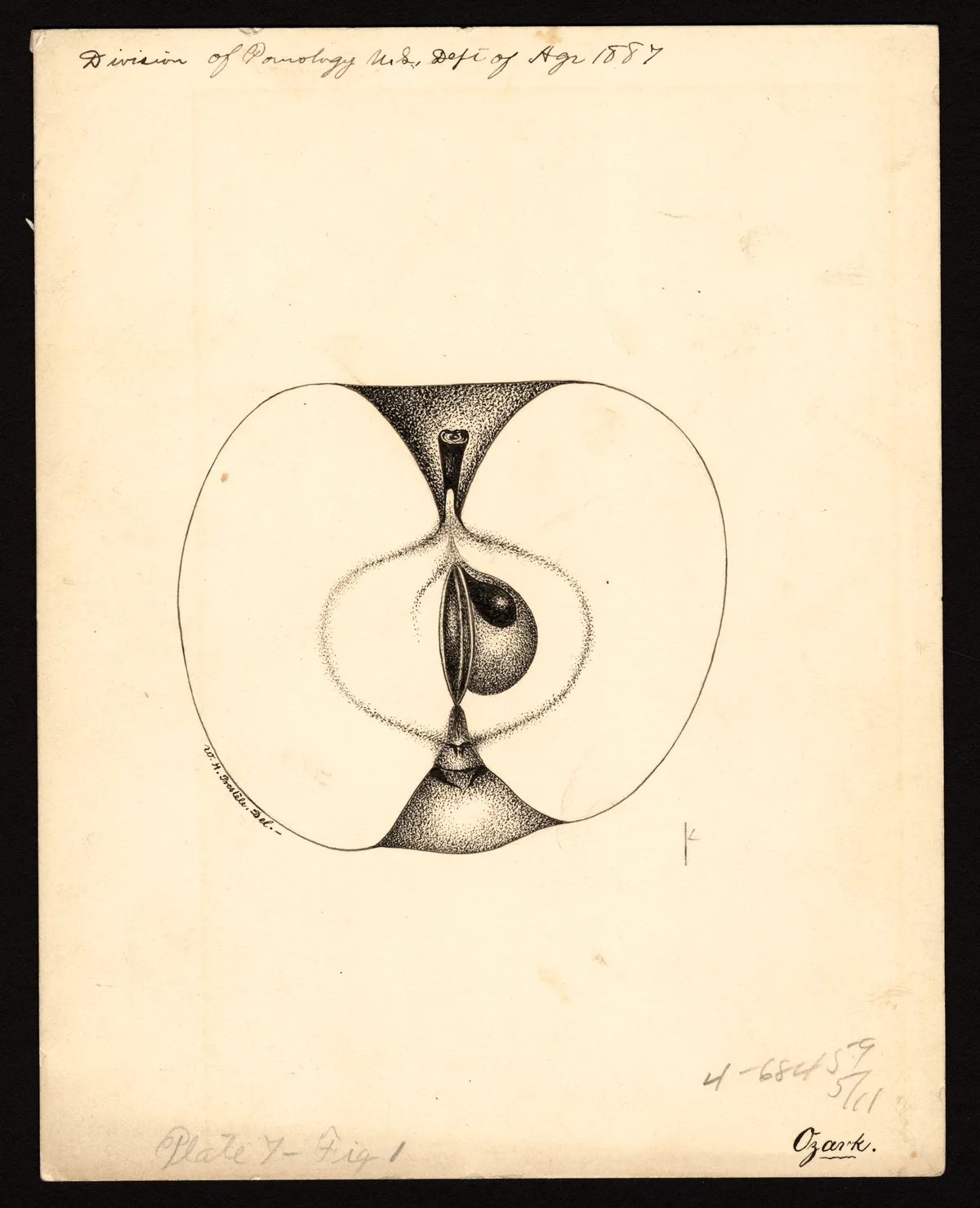
USDA Pomological Watercolor Collection
Gano
Origin/History
Origin obscure. Gano was brought to notice in Missouri about twenty-five years before 1905 and disseminated under the name Gano (Beach). Budd-Hansen states the origin is Missouri and describes Gano as a seedling of Ben Davis, much grown in its native state. It is supposed by some that the original stock came from Kentucky (Beach, citing Van Deman).
Some believed Gano to be identical with Black Ben Davis. The two resemble each other very closely, and for a time were considered identical (Budd-Hansen). The preponderance of evidence at the time of Beach (1905) and Budd-Hansen (1914) favored the opinion that Gano and Black Ben Davis are of distinct origin. Hedrick (1922), however, states that despite the evidence seeming to show distinct origin, Black Ben Davis and Gano may be considered identical, and that Black Ben Davis is either a seedling or a bud-mutation of Ben Davis. Black Ben Davis is said to have originated about 1880 on the farm of M. Black in Washington County, Arkansas (near Lincoln per Budd-Hansen); Reagan was at first given preference as a name, but Black Ben Davis was given priority because Reagan resembled too closely Ragan, an old Indiana variety. It now appears that Mr. Reagan bought the farm from Mr. Black after the tree came into bearing.
Gano is grown for market in the Middle West (Thomas). Its culture, as an apple of commerce, is restricted (in Hedrick's account, applied to the Black Ben Davis/Gano complex) to its native state and nearby states.
Tree
Tree moderately vigorous; branches long, moderately stout and inclined to droop; laterals willowy, short, slender. Form like that of Ben Davis, upright spreading becoming somewhat drooping, rather dense. In the nursery the tree resembles Ben Davis very closely.
Twigs short to rather long, slightly curved, markedly geniculate, moderately stout; internodes short to rather long. Bark bright brownish-red mingled with olive-green, lightly overcast with mottled and streaked gray scarf-skin; pubescent. Lenticels not conspicuous, scattering, medium, round to ovate or often elongated, slightly raised. Buds small to medium with prominent shoulder, plump, obtuse, appressed, decidedly pubescent, deeply set in bark.
The tree comes into bearing young and is an excellent cropper, bearing regularly and abundantly. It appears to be adapted to about the same region as Ben Davis.
Fruit
Size
Medium large (Thomas); medium to sometimes large (Beach); large (Lowther). As grown in Western New York, on the average somewhat smaller than Ben Davis (Beach).
Form
Oblate, irregular (Thomas); roundish conic, usually regular, symmetrical; uniform in size and shape (Beach); roundish (oblate) (Lowther).
Stem
Medium to long and slender.
Cavity
Acute, deep, rather broad, symmetrical, sometimes slightly furrowed or compressed, usually with radiating green russet or red russet.
Calyx
Medium or above, closed or partly open; pubescent; lobes rather broad, acute to acuminate.
Basin
Abrupt, moderately narrow to rather wide, often deep. Budd-Hansen notes that the basin of Gano is nearly smooth and more abrupt (in distinguishing Gano from Black Ben Davis). In its deep, abrupt basin (and at times in its brilliant, deep red or purplish color) it suggests Jonathan (Beach).
Skin
Smooth, waxy, clear light yellow, mottled and blushed with bright light pinkish-red often deepening to a purplish-red, more or less obscurely striped. Red striped, handsome (Thomas); yellow-red (Lowther). As grown in Western New York the fruit is more highly colored than Ben Davis. It is less striped in appearance and more of a solid, deep red color, often with a contrasting spot of clear yellow where it has been closely covered by a leaf or twig (Beach). Budd-Hansen describes Gano in brief as a solid-colored Ben Davis, the broad dark crimson splashes being lost in the depth of coloring, and a fruit of very attractive appearance. Dots numerous, small, inconspicuous. Prevailing color fine red.
Flesh/Flavor
Flesh whitish slightly tinged with yellow, firm, moderately tender, rather coarse, moderately crisp, juicy, mild subacid, good or nearly good in quality (Beach). Sub-acid, brisk, good (Thomas). Budd-Hansen: flesh like that of Ben Davis. In quality, perhaps a little superior to Ben Davis (Beach); many regard Gano somewhat superior to Ben Davis in quality (Budd-Hansen). Quality good (Lowther).
Core/Seeds
Calyx tube short, cone-shape with fleshy pistil point projecting into its base, or sometimes elongated funnel-form (Beach). Budd-Hansen: the calyx tube is funnel-shaped with usually a long slender stem to the funnel. Stamens median to marginal (Beach); stamens marginal (Budd-Hansen). Core below medium to large, somewhat abaxile with a comparatively rather wide hollow cylinder at the axis; cells closed, or partly open, usually symmetrical but often not uniformly developed; core lines meeting when the calyx tube is cone-shape but clasping the funnel cylinder when it is funnel-form (Beach). Budd-Hansen: cells obovate, nearly entire. Carpels broadly roundish or elongated, slightly tufted, emarginate (Beach). Seeds numerous, broad, obtuse, large, dark, sometimes tufted (Beach); the seeds are larger (Budd-Hansen, distinguishing Gano from Black Ben Davis).
Season
Medium to late (Thomas); winter (Lowther). About the same as Ben Davis, extending from December to May in Western New York (Beach); season the same as Ben Davis (Budd-Hansen). Commercial limit in common storage March, in cold storage April (Beach). Stands handling well and is a good keeper (Beach).
Uses
Grown for market in the Middle West (Thomas); use: market (Lowther). Very attractive in appearance (Beach); a fruit of very attractive appearance (Budd-Hansen).
Subtypes/Variants
Not described in source.
Other
Gano is a variety of the Ben Davis type. Black Ben Davis is closely related (Hedrick considers them identical; Beach and Budd-Hansen consider them distinct but very similar): Black Ben Davis is intermediate in size and color between Jonathan and Ben Davis; sometimes obscurely striped but more often showing a solid, deep red color somewhat like that of Jonathan; about as good a keeper as Ben Davis; in quality, as grown in New York, but little better than Ben Davis (Beach). Hedrick describes Black Ben Davis as bearing dark red apples scarcely broken in color, whereas in Ben Davis the red fruits are striped, splashed, and mottled.
Budd-Hansen's description of Black Ben Davis: Fruit large, form much like Ben Davis, the skin also becoming unctuous like that variety; surface very handsomely colored, a dark solid crimson, almost black crimson on sunny side, on shaded side the yellow ground-color shows through, no true stripes nor splashes, but shading varies in depth of coloring; dots distinct, few, minute, yellow; cavity obtuse, medium deep, with stellate russet; stem short; basin deep, abrupt, sharp-rimmed, somewhat ribbed; calyx open. Core closed, small, pointed; cells obovate, axile, entire; tube funnel-shaped; stamens marginal; seeds few, long, pointed, large, some imperfect; flesh yellowish white, moderately juicy, mild, pleasant subacid; quality good, better than Ben Davis. Winter. Quality good (Budd-Hansen).
Beach's description of Black Ben Davis tree characteristics (offered as comparison to Gano): Young trees are upright and vigorous, becoming somewhat spreading, rather dense; branches moderately stout, curved. Does not resemble Ben Davis so closely in tree as Gano does, being more upright and having less willow-like lateral twigs. Twigs medium in length, straight, stout; internodes medium. Bark dark brown, tinged with olive-green, mottled with scarf-skin; pubescent; as grown in New York is darker than Gano. Lenticels scattering, large, round, raised, conspicuous. Buds large, broad, obtuse, appressed, set deep in bark, pubescent. Leaves medium, broad. Beach's description of Black Ben Davis fruit: medium to above, sometimes large, averaging marketable size; form roundish ovate to roundish conic, pretty regular; stem medium to rather long and slender; cavity acute, moderately deep to deep, of medium width, nearly symmetrical, usually with some greenish or orange-red russet which often spreads beyond the cavity in broken rays; calyx rather large, usually open or partly so, lobes rather broad, obtuse; basin often somewhat oblique, rather shallow and obtuse to moderately deep and abrupt, often slightly furrowed and somewhat wrinkled; skin thin, tough, smooth, somewhat glossy, brilliant red almost completely overspreading a clear pale yellow ground color, becoming dark purplish-red on the exposed cheek; dots numerous, very small, red or gray, sometimes with russet point; prevailing effect brilliant red, often with some contrasting clear pale yellow; calyx tube varies from short cone-shape to somewhat funnel-form, with fleshy pistil point projecting into the base; stamens median to marginal; core medium to rather small, axile or nearly so, closed; core lines clasping the funnel cylinder, or when the calyx tube is cone-shaped, nearly meeting; carpels roundish, elongated, emarginate; seeds rather long, obtuse to acute, dark brown; flesh whitish, firm, somewhat coarse, moderately crisp, not tender, moderately juicy, mild subacid, a little aromatic, good in quality; season January to April or May.
Book Sources
Described in 5 period pomological works
- Beach, The Apples of New York Vol. 1 (1905)
- Budd & Hansen, Systematic Pomology (1914)
- Lowther (ed.), Encyclopedia of Practical Horticulture (1914) — listed as Gano (Payton)
- Thomas, The American Fruit Culturist (1903)
- Hedrick, Cyclopedia of Hardy Fruits (1922) — listed as BLACK BEN DAVIS
Nursery Catalog Sources
Found in 64 catalogs (1890–1932) from California, Illinois, Kansas, Maryland, Massachusetts, Missouri, Nebraska, New Jersey, Oregon, Pennsylvania, Washington
- William H. Moon Co. , Morrisville, Bucks County , Pennsylvania — 1890
- Missouri Nursery Co. , Louisiana , Missouri — 1891
- Puyallup & Yakima Nurseries , Puyallup, Washington (Lock Box 191) and North Yakima , Washington — 1892
- Milwaukie-Canby Nurseries , Canby, OR (and Milwaukie, OR) — 1893
- Rogers Nursery Co. , Moorestown , New Jersey — 1893
- Multnomah Nurseries , Russellville , Oregon — 1894
- The Vineland Nurseries (Kelsey & Co. , Proprietors), St. Joseph, Missouri (Office: 13th and Atchison Sts., 2 Blocks East of the Citizens St. Car Line) — 1894
- Woodburn Nurseries , Woodburn, Marion Co. , Oregon — 1894
- Stark Bros. Nurseries & Orchards Co. , Louisiana , Missouri — 1896 — listed as Black Ben Davis
- Stark Bros. Nurseries & Orchards Co. , Louisiana , Missouri — 1896
- Stark Bros. Nurseries & Orchards Co. , Louisiana , Missouri — 1898 — listed as Black Ben Davis
- J.V. Cotta (Cotta Nursery) , Carroll County , Illinois — 1898
- Reading Nursery , Jacob W. Manning, Proprietor, Reading , Massachusetts — 1898
- Stark Bros. Nurseries & Orchards Co. , Louisiana , Missouri — 1898
- Brown Brothers Co. , Continental Nurseries, Rochester, NY (also operated from Toronto, Canada) — 1899
- Central Experimental Farm , Dominion Department of Agriculture, Agassiz, British Columbia (under test; Bulletin No. 3, Second Series) — 1900 — listed as Black Ben
- Central Experimental Farm , Dominion Department of Agriculture, Agassiz, British Columbia (under test; Bulletin No. 3, Second Series) — 1900
- Central Experimental Farm , Dominion Department of Agriculture, Agassiz, British Columbia (under test; Bulletin No. 3, Second Series) — 1900 — listed as Ozark
- Benjamin Buckman (personal inventory) , Farmingdale , Illinois — 1901 — listed as Black Ben Davis
- The Dalles Nurseries , The Dalles , Oregon — 1901
- Washington Nursery Co. , Toppenish , Washington — 1901
- Benjamin Buckman (personal inventory) , Farmingdale , Illinois — 1901
- Brown Brothers Co. , Continental Nurseries, Rochester, NY (also operated from Toronto, Canada) — 1901
- Mountain Grove Nurseries (Tippin & Moore , Proprietors; Geo. T. Tippin, J. W. Tippin, J. C. Moore), Mountain Grove , Missouri — 1901
- Benjamin Buckman (personal inventory) , Farmingdale , Illinois — 1901 — listed as Ozark
- Benjamin Buckman (personal inventory) , Farmingdale , Illinois — 1901 — listed as Reagan
- Russellville Nursery Co. , Russellville, OR (three miles east of Portland, one mile from Montavilla car line) — 1903
- Pacific Nursery Company (W. O. Hudson & A. D. Hudson) , Tangent , Oregon — 1903
- Phoenix Nursery Company (W. E. Rossney , President; Sidney Tuttle, Vice-President), Bloomington , Illinois — 1904
- Stark Bros. Nurseries & Orchards Co. , Louisiana , Missouri — 1906 — listed as Black Ben
- Stark Bros. Nurseries & Orchards Co. , Louisiana , Missouri — 1906
- J.B. Pilkington , Portland , Oregon — 1907
- Russellville Nursery Co. , Montavilla Station, Portland, OR (three miles east of Portland, one mile from Montavilla car line) — 1907
- Carlton Nursery Co. , Carlton , Oregon — 1909
- Milton Nursery Co. (A. Miller & Sons , Proprietors), Milton , Oregon — 1909
- Wm. J. Corse (successor to Robert Sinclair / Sinclair Nurseries) , Baltimore , Maryland — 1909
- Washington Nursery Company , Toppenish , Washington — 1909
- Stark Bros. Nurseries & Orchards Co. , Louisiana , Missouri — 1910 — listed as Black Ben Davis
- C.F. Lansing , Salem , Oregon — 1910
- *Better Fruit* magazine mentions — 1911 — listed as Black Ben Davis
- Stark Bros. Nurseries & Orchards Co. , Louisiana , Missouri — 1911 — listed as Black Ben Davis
- Galbraith Nursery Co. (DeWitt Hansen , Pres.-Mgr.), Fairbury , Nebraska — 1911
- Stark Bros. Nurseries & Orchards Co. , Louisiana , Missouri — 1912 — listed as Black Ben Davis
- Vineland Nurseries Company , Clarkston , Washington — 1912 — listed as Black Ben Davis
- Washington Nursery Company , Toppenish , Washington — 1912 — listed as Black Ben Davis
- Ballygreen Nurseries , Hanford , Washington — 1912
- Pacific Nursery Company , Portland , Oregon — 1912
- Vineland Nurseries Company , Clarkston , Washington — 1912
- Washington Nursery Company , Toppenish , Washington — 1912
- Benjamin Buckman (personal inventory) , Farmingdale , Illinois — 1913 — listed as Black Ben
- Van Holderbeke Nursery Co. , Incorporated, Spokane, Washington (nurseries at Otis Orchards WA, Pasadena WA, Kennewick WA) — 1913 — listed as Black Ben Davis
- J. B. Pilkington , Nurseryman, Portland, OR (nurseries near Newberg, forty miles from Portland) — 1913
- Benjamin Buckman (personal inventory) , Farmingdale , Illinois — 1913
- Benjamin Buckman (personal inventory) , Farmingdale , Illinois — 1913 — listed as Ozark
- Union Nurseries , J.B. Weaver & Sons, Union , Oregon — 1915
- Holsinger Bros. Nurseries (Holsinger Brothers Nursery) , Rosedale , Kansas — 1916 — listed as Black Ben Davis
- Holsinger Bros. Nurseries (Holsinger Brothers Nursery) , Rosedale , Kansas — 1916
- Stark Bros. Nurseries & Orchards Co. , Louisiana , Missouri — 1918 — listed as Black Ben Davis
- Oregon Nursery Co. , Orenco , Oregon — 1920
- Benedict Nursery Co. , Portland , Oregon — 1921
- Fresno Nursery Co. , Fresno , California — 1924
- Columbia & Okanogan Nursery Co. , Wenatchee , Washington — 1925
- Stark Bro's Nurseries , Louisiana , Missouri — 1932 — listed as Black Ben Davis
- North-Western Nurseries , Walla Walla , Washington
View original book sources (5)
— John J. Thomas, The American Fruit Culturist (1903)Gano.* (Ozark Reagan.) Fruit medium large, oblate, irregular; red striped, handsome; sub-acid, brisk, good; season medium to late. Grown for market in Middle West.
— S.A. Beach, The Apples of New York, Vol. 1 (1905)GANO.
REFERENCES. 1. Am. Pom. Soc. Rpt., 1885:156. 2. Am. Pom. Soc. Cat., 1889:6. 3. Stayman, Am. Gard., 11:272. 1890. 4. Bailey, An. Hort., 1892:239. 5. Van Deman, Am. Gard., 20:81. 1899. 6. Mo. Hort. Soc. Rpt., 43:187, 270, 271. 1900. 7. Ont. Fr. Stas. An. Rpt., 8:40. 1901. 8. Va. Sta. Bul., 130:132. 1901. fig. of tree. 9. Macoun, Can. Dept. Agr. Bul., 37:43, 44. 1901. 10. Stinson, Mo. Fr. Sta. Bul., 3:24. 1902. 11. Kan. Sta. Bul., 106:53. 1902. 12. Budd-Hansen, 1903:86. fig. 13. Thomas, 1903:326. 14. Powell and Fulton, U. S. B. P. I. Bul., 48:42. 1903. 15. Beach and Clark, N. Y. Sta. Bul., 248:121. 1904. 16. Wickson, Western Fruit Grower, 1904:124. 17. Ragan, U. S. B. P. I. Bul., 56:116. 1905.
SYNONYMS. Black Ben Davis (17). Jack's Red (5). Ozark (13). Payton (17). Reagan (13). Red Ben Davis (17).
This is a variety of the Ben Davis type. In the nursery the tree resembles Ben Davis very closely. As grown in Western New York the fruit is more highly colored but on the average is somewhat smaller than that of Ben Davis. It is less striped in appearance and more of a solid, deep red color, often with a contrasting spot of clear yellow where it has been closely covered by a leaf or twig. In this respect and in its deep, abrupt basin it suggests Jonathan, as at times it also does by its brilliant, deep red or purplish color. It is very attractive in appearance, stands handling well and is a good keeper. In quality it is perhaps a little superior to Ben Davis. The tree comes into bearing young and is an excellent cropper, bearing regularly and abundantly. It has not been tested very many years in New York, but it appears to be adapted to about the same region as Ben Davis.
Historical. Origin obscure. Brought to notice in Missouri about twenty-five years ago and disseminated under the name Gano (1, 5, 6). It is supposed by some that the original stock came from Kentucky (5). Some believe that Gano is the same as Black Ben Davis. It certainly resembles Black Ben Davis very closely but the preponderance of evidence at present seems to favor the opinion that it is of distinct origin (16).
TREE. Tree moderately vigorous; branches long, moderately stout and inclined to droop; laterals willowy, short, slender. Form like that of Ben Davis, upright spreading becoming somewhat drooping, rather dense. Twigs short to rather long, slightly curved, markedly geniculate, moderately stout; internodes short to rather long. Bark bright brownish-red mingled with olive-green, lightly overcast with mottled and streaked gray scarf-skin; pubescent. Lenticels not conspicuous, scattering, medium, round to ovate or often elongated, slightly raised. Buds small to medium with prominent shoulder, plump, obtuse, appressed, decidedly pubescent, deeply set in bark.
FRUIT. Fruit medium to sometimes large. Form roundish conic, usually regular, symmetrical; uniform in size and shape. Stem medium to long and slender. Cavity acute, deep, rather broad, symmetrical, sometimes slightly furrowed or compressed, usually with radiating green russet or red russet. Calyx medium or above, closed or partly open; pubescent; lobes rather broad, acute to acuminate. Basin abrupt, moderately narrow to rather wide, often deep. Skin smooth, waxy, clear light yellow, mottled and blushed with bright light pinkish-red often deepening to a purplish-red, more or less obscurely striped. Dots numerous, small, inconspicuous. Prevailing color fine red. Calyx tube short, cone-shape with fleshy pistil point projecting into its base, or sometimes elongated funnel-form. Stamens median to marginal. Core below medium to large, somewhat abaxile with a comparatively rather wide hollow cylinder at the axis; cells closed, or partly open, usually symmetrical but often not uniformly developed; core lines meeting when the calyx tube is cone-shape but clasping the funnel cylinder when it is funnel-form. Carpels broadly roundish or elongated, slightly tufted, emarginate. Seeds numerous, broad, obtuse, large, dark, sometimes tufted. Flesh whitish slightly tinged with yellow, firm, moderately tender, rather coarse, moderately crisp, juicy, mild subacid, good or nearly good in quality. Season about the same as that of Ben Davis, extending from December to May in Western New York. Commercial limit in common storage March, in cold storage April.
[Additional entry in this volume: "BLACK BEN DAVIS", pp. 119–122]
BLACK BEN DAVIS.
REFERENCES. 1. Amer. Gard., 23:403. 1902. 2. Van Deman, Rural N. Y., 61:717. 1902. 3. Van Deman, Rural N. Y., 62:500. 1903. 4. Budd-Hansen, 1903:50. 5. Ark. Hort. Soc. Rpt., 1904. 6. Nat. Nurseryman, 12:18, 19. 1904. 7. Wickson, Western Fruit Grower, 1904:124.
This is a variety of the Ben Davis type, very brilliant in color and decidedly attractive in appearance. In size and color it is intermediate between Jonathan and Ben Davis. It is sometimes obscurely striped, but more often it shows a solid, deep red color somewhat like that of the Jonathan. As grown in this state it is but little better than Ben Davis in quality. It appears to be as good a keeper as Ben Davis. It has not yet been sufficiently tested in New York state to demonstrate whether or not it will be valuable in this region, but it appears sufficiently promising for commercial purposes to merit attention in those parts of the state where Ben Davis succeeds best.
Historical. It is said to have originated about 1880 on the farm of M. Black in Washington county, Arkansas (5, 7). It has been claimed by some that it is identical with Gano. It certainly resembles Gano very closely, but the preponderance of evidence seems to favor the opinion that these two varieties are of distinct origin (7).
TREE.
Young trees are upright and vigorous, becoming somewhat spreading, rather dense; branches moderately stout, curved. Does not resemble Ben Davis so closely in tree as Gano does, being more upright and having less willow-like lateral twigs. Twigs medium in length, straight, stout; internodes medium. Bark dark brown, tinged with olive-green, mottled with scarf-skin; pubescent. As grown here is darker than Gano. Lenticels scattering, large, round, raised, conspicuous. Buds large, broad, obtuse, appressed, set deep in bark, pubescent. Leaves medium, broad.
FRUIT.
Fruit medium to above, sometimes large, averaging marketable size. Form roundish ovate to roundish conic, pretty regular. Stem medium to rather long and slender. Cavity acute, moderately deep to deep, of medium width, nearly symmetrical, usually with some greenish or orange-red russet which often spreads beyond the cavity in broken rays. Calyx rather large, usually open or partly so; lobes rather broad, obtuse. Basin often somewhat oblique, rather shallow and obtuse to moderately deep and abrupt, often slightly furrowed and somewhat wrinkled. Skin thin, tough, smooth, somewhat glossy, brilliant red almost completely overspreading a clear pale yellow ground color, becoming dark purplish-red on the exposed cheek. Dots numerous, very small, red or gray, sometimes with russet point. Prevailing effect brilliant red, often with some contrasting clear pale yellow. Calyx tube varies from short cone-shape to somewhat funnel-form, with fleshy pistil point projecting into the base. Stamens median to marginal. Core medium to rather small, axile or nearly so, closed; core lines clasping the funnel cylinder, or when the calyx tube is cone-shaped, nearly meeting. Carpels roundish, elongated, emarginate. Seeds rather long, obtuse to acute, dark brown. Flesh whitish, firm, somewhat coarse, moderately crisp, not tender, moderately juicy, mild subacid, a little aromatic, good in quality. Season January to April or May.
[Additional entry in this volume: "Gang", pp. 226–227]
GANG.
REFERENCES. 1. Am. Pom. Soc. Rpt., 1885:156. 2. Am. Pom. Soc. Cat., 1889:6. 3. Stayman, Am. Gard., 11:272. 1890. 4. Bailey, An. Hort., 1892:239. 5. Van Deman, Am. Gard., 20:81. 1899. 6. Mo. Hort. Soc. Rpt., 43:187, 270, 271. 1900. 7. Caston, Out. Fr. Stas. An. Rpt., 8:40. 1901. 8. Va. Sta. Bul., 130:132. 1901. fig. of tree. 9. Macoun, Can. Dept. Agr. Bul., 37:43, 44. 1901. 10. Stinson, Mo. Fr. Sta. Bul., 3:24. 1902. 11. Kan. Sta. Bul., 106:53. 1902. 12. Budd-Hansen, 1903:86. fig. 13. Thomas, 1903:326. 14. Powell and Fulton, U. S. B. P. I. Bul., 48:42. 1903. 15. Beach and Clark, N. Y. Sta. Bul., 248:121. 1904. 16. Wickson, Western Fruit Grower, 1904:124. 17. Ragan, U. S. B. P. I. Bul., 56:116. 1905.
SYNONYMS. Black Ben Davis (17). Jacks Red (5). Ozark (13). Payton (17). Reagan (13). Red Ben Davis (17).
This is a variety of the Ben Davis type. In the nursery the tree resembles Ben Davis very closely. As grown in Western New York the fruit is more highly colored but on the average is somewhat smaller than that of Ben Davis. It is less striped in appearance and more of a solid, deep red color, often with a contrasting spot of clear yellow where it has been closely covered by a leaf or twig. In this respect and in its deep, abrupt basin it suggests Jonathan, as at times it also does by its brilliant, deep red or purplish color. It is very attractive in appearance, stands handling well and is a good keeper. In quality it is perhaps a little superior to Ben Davis. The tree comes into bearing young and is an excellent cropper, bearing regularly and abundantly. It has not been tested very many years in New York, but it appears to be adapted to about the same region as Ben Davis.
Historical. Origin obscure. Brought to notice in Missouri about twenty-five years ago and disseminated under the name Gano (1, 5, 6). It is supposed by some that the original stock came from Kentucky (5). Some believe that Gano is the same as Black Ben Davis. It certainly resembles Black Ben Davis very closely but the preponderance of evidence at present seems to favor the opinion that it is of distinct origin (16).
TREE. Tree moderately vigorous; branches long, moderately stout and inclined to droop; laterals willowy, short, slender. Form like that of Ben Davis, upright spreading becoming somewhat drooping, rather dense. Twigs short to rather long, slightly curved, markedly geniculate, moderately stout; internodes short to rather long. Bark bright brownish-red mingled with olive-green, lightly overcast with mottled and streaked gray scarf-skin; pubescent. Lenticels not conspicuous, scattering, medium, round to ovate or often elongated, slightly raised. Buds small to medium with prominent shoulder, plump, obtuse, appressed, decidedly pubescent, deeply set in bark.
FRUIT. Fruit medium to sometimes large. Form roundish conic, usually regular, symmetrical; uniform in size and shape. Stem medium to long and slender. Cavity acute, deep, rather broad, symmetrical, sometimes slightly furrowed or compressed, usually with radiating green russet or red russet. Calyx medium or above, closed or partly open; pubescent; lobes rather broad, acute to acuminate. Basin abrupt, moderately narrow to rather wide, often deep. Skin smooth, waxy, clear light yellow, mottled and blushed with bright light pinkish-red often deepening to a purplish-red, more or less obscurely striped. Dots numerous, small, inconspicuous. Prevailing color fine red. Calyx tube short, cone-shape with fleshy pistil point projecting into its base, or sometimes elongated funnel-form. Stamens median to marginal. Core below medium to large, somewhat abaxile with a comparatively rather wide hollow cylinder at the axis; cells closed, or partly open, usually symmetrical but often not uniformly developed; core lines meeting when the calyx tube is cone-shape but clasping the funnel cylinder when it is funnel-form. Carpels broadly roundish or elongated, slightly tufted, emarginate. Seeds numerous, broad, obtuse, large, dark, sometimes tufted. Flesh whitish slightly tinged with yellow, firm, moderately tender, rather coarse, moderately crisp, juicy, mild subacid, good or nearly good in quality. Season about the same as that of Ben Davis, extending from December to May in Western New York. Commercial limit in common storage March, in cold storage April.
— J.L. Budd & N.E. Hansen, American Horticultural Manual, Part II: Systematic Pomology (1914)Gano. — Origin, Missouri; a seedling of Ben Davis, much grown in its native state. It may be described in brief as a solid-colored Ben Davis, the broad dark crimson splashes being lost in the depth of coloring, and is a fruit of very attractive appearance. The Black Ben Davis resembles Gano closely and for a time the two were considered identical. The basin of Gano is nearly smooth and more abrupt; the seeds are larger ; the calyx tube is funnel-shaped with usually a long slender stem to the funnel ; stamens marginal ; cells obovate, nearly entire; flesh like that of Ben Davis, season the same. Many regard Gano somewhat superior to Ben Davis in quality.
[Additional entry in this volume: "Black Ben Davis", pp. 57–57]
Black Ben Davis.—Originated about thirty years ago on the farm of the Rev. M. Black, near Lincoln, Washington County, Arkansas. Reagan was at first given preference, but the above name has priority, and the name Reagan resembles too closely Ragan, an old Indiana variety. It now appears that Mr. Reagan bought the farm from Mr. Black after the tree came into bearing. Recently introduced; promising. Fruit large, form much like Ben Davis, the skin also becoming unctuous like that variety; surface very handsomely colored, a dark solid crimson, almost black crimson on sunny side, on shaded side the yellow ground-color shows through, no true stripes nor splashes, but shading varies in depth of coloring; dots distinct, few, minute, yellow; cavity obtuse, medium deep, with stellate russet; stem short; basin deep, abrupt, sharp-rimmed, somewhat ribbed; calyx open. Core closed, small, pointed; cells obovate, axile, entire; tube funnel-shaped; stamens marginal; seeds few, long, pointed, large, some imperfect; flesh yellowish white, moderately juicy, mild, pleasant subacid; quality good, better than Ben Davis. Winter.
[Additional entry in this volume: "Reagan", pp. 167–167]
Reagan. — See Black Ben Davis.
— Granville Lowther (ed.), Encyclopedia of Practical Horticulture (1914)Gano (synonym Payton). Size: large. Form: roundish (oblate). Color: yellow-red. Quality: good. Use: market. Season: winter. N. Div.: not reported. C. Div.: not reported. S. Div.: not reported.
— U.P. Hedrick, Cyclopedia of Hardy Fruits (1922)BLACK BEN DAVIS. Black Ben Davis is either a seedling or a bud-mutation of Ben Davis, from which it differs in bearing dark red apples scarcely broken in color, whereas in Ben Davis the red fruits are striped, splashed, and mottled. Despite the fact that the evidence seems to show that they are of distinct origin, Black Ben Davis and Gano may be considered identical. The variety is said to have originated on the farm of M. Black, Washington County, Arkansas, about 1880. Its culture, as an apple of commerce at least, is restricted to its native state and the nearby states.