Black Ben Davis
Apple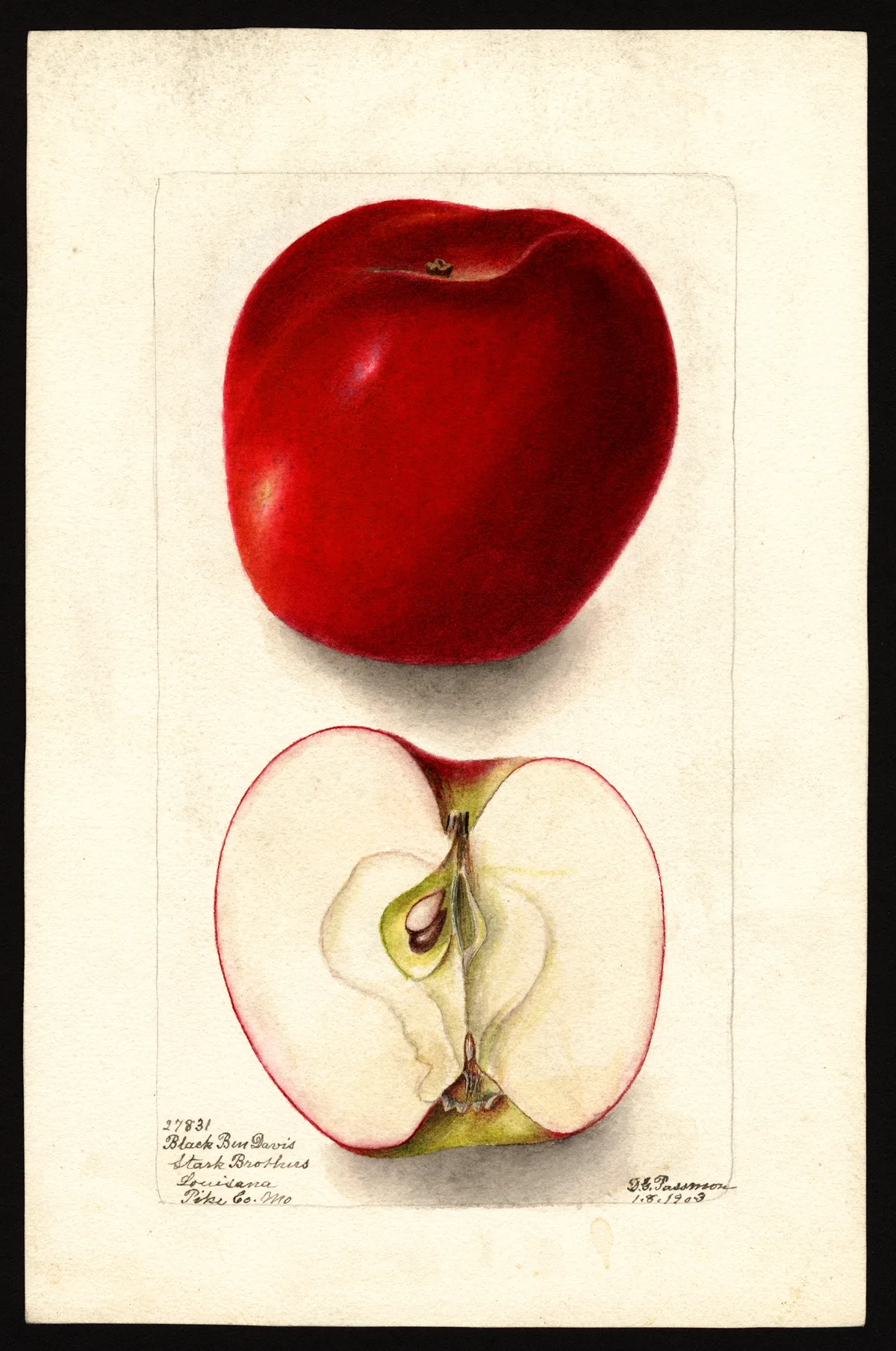
USDA Pomological Watercolor Collection
Black Ben Davis
Origin and History
Originated about 1880 on the farm of M. Black in Washington county, Arkansas. Some have claimed it to be identical with Gano, to which it bears a close resemblance; however, evidence strongly suggests these are two distinct varieties of separate origin.
Tree
Young trees are upright and vigorous, becoming somewhat spreading and rather dense with moderately stout, curved branches. It differs from Ben Davis in tree form, being more upright and having less willow-like lateral twigs; it does not resemble Ben Davis as closely as Gano does.
Twigs: Medium in length, straight, stout; internodes medium.
Bark: Dark brown, tinged with olive-green, mottled with scarf-skin; pubescent. As grown in New York, darker than Gano.
Lenticels: Scattering, large, round, raised, conspicuous.
Buds: Large, broad, obtuse, appressed, set deep in bark, pubescent.
Leaves: Medium, broad.
Fruit
Size: Medium to above, sometimes large; averages marketable size.
Form: Roundish ovate to roundish conic, pretty regular.
Stem: Medium to rather long and slender.
Cavity: Acute, moderately deep to deep, of medium width, nearly symmetrical. Usually contains some greenish or orange-red russet, which often spreads beyond the cavity in broken rays.
Calyx: Rather large, usually open or partly so; lobes rather broad, obtuse.
Basin: Often somewhat oblique, rather shallow and obtuse to moderately deep and abrupt; often slightly furrowed and somewhat wrinkled.
Skin: Thin, tough, smooth, somewhat glossy. Brilliant red almost completely overspreading a clear pale yellow ground color, becoming dark purplish-red on the exposed cheek. Dots numerous, very small, red or gray, sometimes with russet point. Prevailing effect is brilliant red, often with contrasting clear pale yellow patches. The variety shows an intermediate coloration between Jonathan and Ben Davis—sometimes obscurely striped, but more often displaying a solid, deep red color resembling Jonathan.
Calyx Tube: Varies from short cone-shape to somewhat funnel-form, with fleshy pistil point projecting into the base. Stamens median to marginal.
Core: Medium to rather small, axile or nearly so, closed. Core lines clasping the funnel cylinder, or when the calyx tube is cone-shaped, nearly meeting. Carpels roundish, elongated, emarginate.
Seeds: Rather long, obtuse to acute, dark brown.
Flesh and Flavor: Whitish, firm, somewhat coarse, moderately crisp, not tender, moderately juicy. Mild subacid with a little aromatic character. Quality is good, though as grown in New York, it is but little better than Ben Davis in quality.
Season and Storage
Season January to April or May. Appears to be as good a keeper as Ben Davis.
Uses and Suitability
Shows sufficient promise for commercial purposes to merit attention in those parts of New York state where Ben Davis succeeds best. Has not yet been sufficiently tested in New York to fully demonstrate its regional value, but the variety is decidedly attractive in appearance and very brilliant in color.
Book Sources
Described in 1 period pomological work
Nursery Catalog Sources
Found in 12 catalogs (1896–1932) from Kansas, Missouri, Washington
- Stark Bros. Nurseries & Orchards Co. , Louisiana , Missouri — 1896
- Stark Bros. Nurseries & Orchards Co. , Louisiana , Missouri — 1898
- Stark Bros. Nurseries & Orchards Co. , Louisiana , Missouri — 1910
- *Better Fruit* magazine mentions — 1911
- Stark Bros. Nurseries & Orchards Co. , Louisiana , Missouri — 1911
- Stark Bros. Nurseries & Orchards Co. , Louisiana , Missouri — 1912
- Vineland Nurseries Company , Clarkston , Washington — 1912
- Washington Nursery Company , Toppenish , Washington — 1912
- Van Holderbeke Nursery Co. , Incorporated, Spokane, Washington (nurseries at Otis Orchards WA, Pasadena WA, Kennewick WA) — 1913
- Holsinger Bros. Nurseries (Holsinger Brothers Nursery) , Rosedale , Kansas — 1916
- Stark Bros. Nurseries & Orchards Co. , Louisiana , Missouri — 1918
- Stark Bro's Nurseries , Louisiana , Missouri — 1932
View original book sources (1)
— S.A. Beach, The Apples of New York, Vol. 1 (1905)BLACK BEN DAVIS.
REFERENCES. 1. Amer. Gard., 23:403. 1902. 2. Van Deman, Rural N. Y., 61:717. 1902. 3. Van Deman, Rural N. Y., 62:500. 1903. 4. Budd-Hansen, 1903:50. 5. Ark. Hort. Soc. Rpt., 1904. 6. Nat. Nurseryman, 12:18, 19. 1904. 7. Wickson, Western Fruit Grower, 1904:124.
This is a variety of the Ben Davis type, very brilliant in color and decidedly attractive in appearance. In size and color it is intermediate between Jonathan and Ben Davis. It is sometimes obscurely striped, but more often it shows a solid, deep red color somewhat like that of the Jonathan. As grown in this state it is but little better than Ben Davis in quality. It appears to be as good a keeper as Ben Davis. It has not yet been sufficiently tested in New York state to demonstrate whether or not it will be valuable in this region, but it appears sufficiently promising for commercial purposes to merit attention in those parts of the state where Ben Davis succeeds best.
Historical. It is said to have originated about 1880 on the farm of M. Black in Washington county, Arkansas (5, 7). It has been claimed by some that it is identical with Gano. It certainly resembles Gano very closely, but the preponderance of evidence seems to favor the opinion that these two varieties are of distinct origin (7).
TREE.
Young trees are upright and vigorous, becoming somewhat spreading, rather dense; branches moderately stout, curved. Does not resemble Ben Davis so closely in tree as Gano does, being more upright and having less willow-like lateral twigs. Twigs medium in length, straight, stout; internodes medium. Bark dark brown, tinged with olive-green, mottled with scarf-skin; pubescent. As grown here is darker than Gano. Lenticels scattering, large, round, raised, conspicuous. Buds large, broad, obtuse, appressed, set deep in bark, pubescent. Leaves medium, broad.
FRUIT.
Fruit medium to above, sometimes large, averaging marketable size. Form roundish ovate to roundish conic, pretty regular. Stem medium to rather long and slender. Cavity acute, moderately deep to deep, of medium width, nearly symmetrical, usually with some greenish or orange-red russet which often spreads beyond the cavity in broken rays. Calyx rather large, usually open or partly so; lobes rather broad, obtuse. Basin often somewhat oblique, rather shallow and obtuse to moderately deep and abrupt, often slightly furrowed and somewhat wrinkled. Skin thin, tough, smooth, somewhat glossy, brilliant red almost completely overspreading a clear pale yellow ground color, becoming dark purplish-red on the exposed cheek. Dots numerous, very small, red or gray, sometimes with russet point. Prevailing effect brilliant red, often with some contrasting clear pale yellow. Calyx tube varies from short cone-shape to somewhat funnel-form, with fleshy pistil point projecting into the base. Stamens median to marginal. Core medium to rather small, axile or nearly so, closed; core lines clasping the funnel cylinder, or when the calyx tube is cone-shaped, nearly meeting. Carpels roundish, elongated, emarginate. Seeds rather long, obtuse to acute, dark brown. Flesh whitish, firm, somewhat coarse, moderately crisp, not tender, moderately juicy, mild subacid, a little aromatic, good in quality. Season January to April or May.