Florence
Apple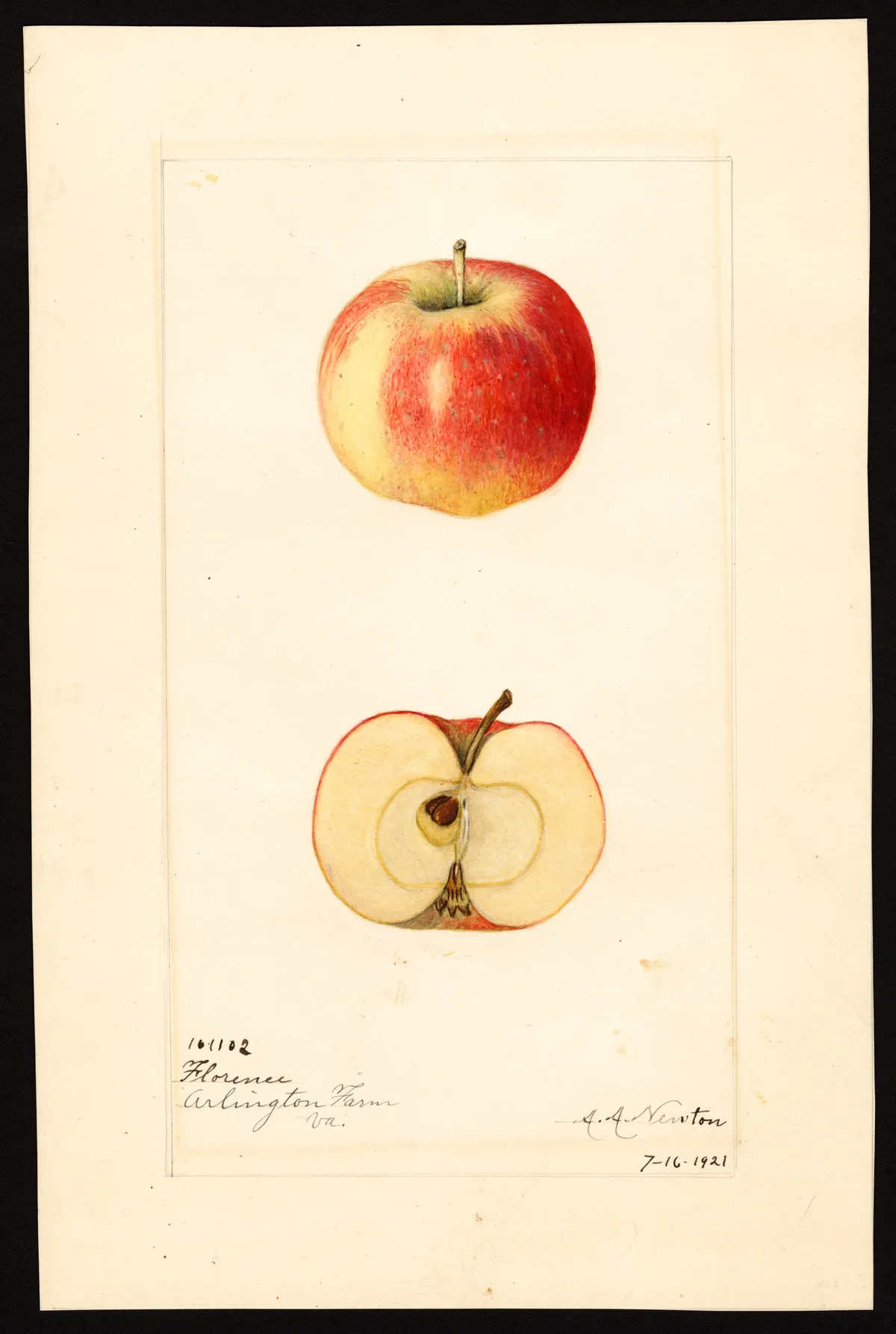
USDA Pomological Watercolor Collection
Florence
Origin/History
Two distinct varieties appear in the historical record under the name Florence.
The Arkansas Florence (Beach Vol. 1) originated in Benton County, Arkansas. It is of the Ben Davis type, strongly resembling Gano. As grown at the Geneva (New York) Experiment Station from stock received from M. Butterfield of Lee Summit, Missouri, it proved a good keeper, moderately vigorous, coming into bearing young, and bearing annually, though only moderately productive under the rather unfavorable conditions of that station. Stinson, writing in the Arkansas Station Bulletin of 1899, observes that it is in season with Jonathan; however, at the Geneva Station it was found to keep much better than Jonathan. As of 1905 it had not been tested at Geneva sufficiently to indicate whether it would prove valuable in New York, though it was considered potentially valuable in those portions of the state where Ben Davis does well, provided it proved sufficiently productive.
The Minnesota Florence (Beach Vol. 2) originated with Peter M. Gideon of Excelsior, Minnesota. It was regarded as very desirable for commercial planting because the trees commence bearing very young, are reliable croppers, and very prolific, and the fruit is of good size, very attractive in appearance, and of good quality. Although not considered superior to Martha in quality, Florence is described as more beautiful and more prolific than Martha.
The Central Experimental Farm at Agassiz, British Columbia (1900), planted a Florence in spring 1896 and recorded observations published in Bulletin No. 3; which of the two varieties this represents is not specified.
Tree
The two varieties differ considerably in tree character.
Arkansas Florence (Beach Vol. 1): Tree moderately vigorous; branches short, rather slender. Form roundish, upright, rather dense. Twigs rather short, straight, slender; internodes rather short to medium. Bark bright, rather dark brownish-red; scarf-skin hardly noticeable; pubescence scarce or none. Lenticels not numerous, clear and bright in color, small, roundish to elongated. Buds medium, rather flat, acute to obtuse, pubescent, free, appressed, point often deflected.
Minnesota Florence (Beach Vol. 2): Tree moderately vigorous. Form at first upright spreading but eventually inclined to droop. Twigs long, curved, moderately stout; internodes long. Bark bright reddish-brown, slightly tinged with olive-green, mottled with scarf-skin; slightly pubescent. Buds large, broad, plump, obtuse, free, not pubescent.
The Central Experimental Farm (1900) describes the tree as a vigorous grower, without further detail.
Fruit
Size
The Arkansas Florence (Beach Vol. 1) is medium, sometimes large; pretty uniform in size but somewhat variable in shape.
The Minnesota Florence (Beach Vol. 2) is medium in size, uniform in size and shape.
The Central Experimental Farm (1900) describes the fruit as small — smaller than either Beach account indicates for its respective variety.
Form
Arkansas Florence (Beach Vol. 1): roundish ovate to roundish conic, flattened at the base, irregular, often broadly ribbed or angular, sides unequal, sometimes compressed. Compared with Gano it is more angular.
Minnesota Florence (Beach Vol. 2): oblate, faintly ribbed.
Central Experimental Farm (1900): oblate.
Stem
Arkansas Florence (Beach Vol. 1): medium.
Minnesota Florence (Beach Vol. 2): very long, slender.
Cavity
Arkansas Florence (Beach Vol. 1): acute or obtuse, deep, wide, often furrowed, sometimes lipped, seldom symmetrical, usually with outspreading rays of yellow russet.
Minnesota Florence (Beach Vol. 2): acute, deep, medium in width, symmetrical, sometimes slightly russeted.
Calyx
Arkansas Florence (Beach Vol. 1): medium to small, partly open or sometimes closed; lobes rather narrow, acuminate.
Minnesota Florence (Beach Vol. 2): variable, usually small, closed.
Basin
Arkansas Florence (Beach Vol. 1): very abrupt, usually deep, moderately narrow to moderately broad, often somewhat furrowed, sometimes compressed, usually oblique. Compared with Gano the basin is more often oblique.
Minnesota Florence (Beach Vol. 2): very shallow, rather wide, obtuse, slightly furrowed.
The two varieties are sharply contrasted in basin depth: the Arkansas Florence has a very abrupt, usually deep basin; the Minnesota Florence has a very shallow one.
Skin
Arkansas Florence (Beach Vol. 1): tough, smooth, clear; ground pale or whitish-yellow, washed and blushed with a bright deep pinkish-red, in well-colored specimens becoming solid red, mottled and striped with purplish-carmine — more conspicuously striped with purplish-carmine than Gano. Overspread with a thin bluish bloom which gives it a slightly dull appearance, but when polished the prevailing effect is glossy bright red. Dots whitish, scattering.
Minnesota Florence (Beach Vol. 2): moderately thin, moderately tough, smooth; yellowish-white ground mostly overspread with brilliant pinkish-red, sometimes with whitish bands radiating from the cavity; overspread with faint bloom. Dots minute, whitish.
Central Experimental Farm (1900): dull yellow with a dull red blush — considerably less vivid than either Beach description.
Flesh and Flavor
Arkansas Florence (Beach Vol. 1): tinged with yellow, rather firm, crisp, not very tender, moderately fine-grained, juicy, subacid, aromatic, pleasant; good to very good.
Minnesota Florence (Beach Vol. 2): tinged with yellow, coarse, crisp, rather tender, juicy, very brisk subacid, somewhat astringent; good.
Central Experimental Farm (1900): white, not juicy, sub-acid; quality poor.
Core and Seeds
Arkansas Florence (Beach Vol. 1): Calyx tube large, cone-shape. Core rather small, closed or slightly open; core lines meeting or slightly clasping. Carpels concave, roundish inclined to obcordate. Seeds few, below medium to above, rather dark, irregular, obtuse or sometimes acute. The pistils do not persist in the form of a fleshy projection into the base of the calyx tube — a distinction from Gano, which does exhibit this feature.
Minnesota Florence (Beach Vol. 2): Calyx tube moderately long, moderately wide, varying from somewhat urn-shape to funnel-form. Stamens marginal. Core large; cells closed; core lines clasping. Carpels broadly obovate, emarginate. Seeds medium to rather small, moderately wide, flat, obtuse.
Season
Arkansas Florence (Beach Vol. 1): December to May — a late-keeping winter apple.
Minnesota Florence (Beach Vol. 2): late August and early September — a summer apple.
Central Experimental Farm (1900): autumn.
Uses
Beach Vol. 2 recommends the Minnesota Florence as very desirable for commercial planting on account of its precocity, reliable and prolific cropping, attractive appearance, and good quality. Beach Vol. 1 suggests the Arkansas Florence may prove valuable in portions of New York State where Ben Davis does well, should it prove sufficiently productive.
Other
Beach Vol. 1 provides detailed comparisons between the Arkansas Florence and Gano: Florence is more angular than Gano; more conspicuously striped with purplish-carmine; the basin is more often oblique; and unlike Gano, the pistils do not persist as a fleshy projection into the base of the calyx tube.
Beach Vol. 2 notes that although Florence (Minnesota) is not superior to Martha in quality, it is more beautiful and more prolific.
Book Sources
Described in 2 period pomological works
Nursery Catalog Sources
Found in 1 catalog (1900)
- Central Experimental Farm , Dominion Department of Agriculture, Agassiz, British Columbia (under test; Bulletin No. 3, Second Series) — 1900
View original book sources (3)
— S.A. Beach, The Apples of New York, Vol. 1 (1905)FLORENCE.
REFERENCE. 1. Stinson, Ark. Sta. Bul., 60:129. 1899.
As grown at this Station from stock received from M. Butterfield, Lee Summit, Missouri, the fruit is of the Ben Davis type, strongly resembling Gano, very attractive in size and appearance and a good keeper. As compared with Gano it is more angular, and more conspicuously striped with purplish-carmine; the basin is more often oblique; and the pistils do not persist in the form of a fleshy projection into the base of the calyx tube. As tested at this Station it is a moderately vigorous grower, comes into bearing young, bears annually and is only moderately productive, but it has been grown here under rather unfavorable conditions. Stinson (1) observes that it is in season with Jonathan, but we find it keeps much better than Jonathan. It has not been tested here sufficiently to indicate whether or not it promises to be a valuable variety in New York. Should it prove to be sufficiently productive it may prove valuable in those portions of the state where Ben Davis does well.
Historical. Originated in Benton county, Ark.
TREE.
Tree moderately vigorous; branches short, rather slender. Form roundish, upright, rather dense. Twigs rather short, straight, slender; internodes rather short to medium. Bark bright, rather dark brownish-red; scarf-skin hardly noticeable; pubescence scarce or none. Lenticels not numerous, clear and bright in color, small, roundish to elongated. Buds medium, rather flat, acute to obtuse, pubescent, free, appressed, point often deflected.
FRUIT.
Fruit medium, sometimes large. Form roundish ovate to roundish conic, flattened at the base, irregular, often broadly ribbed or angular, sides unequal, sometimes compressed; pretty uniform in size but somewhat variable in shape. Stem medium. Cavity acute or obtuse, deep, wide, often furrowed, sometimes lipped, seldom symmetrical, usually with outspreading rays of yellow russet. Calyx medium to small, partly open or sometimes closed; lobes rather narrow, acuminate. Basin very abrupt, usually deep, moderately narrow to moderately broad, often somewhat furrowed, sometimes compressed, usually oblique. Skin tough, smooth, clear, pale or whitish-yellow, washed and blushed with a bright deep pinkish-red, in well colored specimens becoming solid red, mottled and striped with purplish-carmine, overspread with a thin bluish bloom which gives it a slightly dull appearance, but when polished the prevailing effect is glossy bright red. Dots whitish, scattering. Calyx tube large, cone-shape. Core rather small, closed or slightly open; core lines meeting or slightly clasping. Carpels concave, roundish inclined to obcordate. Seeds few, below medium to above, rather dark, irregular, obtuse or sometimes acute. Flesh tinged with yellow, rather firm, crisp, not very tender, moderately fine-grained, juicy, subacid, aromatic, pleasant, good to very good.
Season December to May.
— S.A. Beach, The Apples of New York, Vol. 2 (1905)FLORENCE.
REFERENCES. 1. Stark, Mo. Hort. Soc. Rpt., 1886:233. 2. Am. Pom. Soc. Rpt., 1887:134. 3. Lyon, Mich. Sta. Bul., 118:59, 60. 1895. 4. Thomas, 1897:298. 5. Lyon, Mich. Sta. Bul., 152:219, 224. 1898. 6. Budd-Hansen, 1903:219.
SYNONYMS. None.
This variety seems to be very desirable for commercial planting because the trees commence bearing very young, are reliable croppers and very prolific and the fruit is of good size, very attractive in appearance and of good quality. Although not superior to Martha in quality, Florence is more beautiful and more prolific.
Historical. Originated by Peter M. Gideon, Excelsior, Minn.
TREE.
Tree moderately vigorous. Form at first upright spreading but eventually inclined to droop. Twigs long, curved, moderately stout; internodes long. Bark bright reddish-brown, slightly tinged with olive-green, mottled with scarf-skin; slightly pubescent. Buds large, broad, plump, obtuse, free, not pubescent.
FRUIT.
Fruit medium in size, uniform in size and shape. Form oblate, faintly ribbed. Stem very long, slender. Cavity acute, deep, medium in width, symmetrical, sometimes slightly russeted. Calyx variable, usually small, closed. Basin very shallow, rather wide, obtuse, slightly furrowed. Skin moderately thin, moderately tough, smooth, yellowish-white mostly overspread with brilliant pinkish-red, sometimes with whitish bands radiating from the cavity, overspread with faint bloom. Dots minute, whitish. Calyx tube moderately long, moderately wide, varying from somewhat urn-shape to funnel-form. Stamens marginal. Core large; cells closed; core lines clasping. Carpels broadly obovate, emarginate. Seeds medium to rather small, moderately wide, flat, obtuse. Flesh tinged with yellow, coarse, crisp, rather tender, juicy, very brisk subacid, somewhat astringent, good. Season late August and early September.
— Central Experimental Farm, Central Experimental Farm, Agassiz BC — Catalogue of Fruit Trees under Test (Bulletin No. 3, 1900) (1900)Planted Spring 1896. Tree a vigorous grower. Fruit small, oblate. Skin dull yellow, with a dull red blush. Flesh white, not juicy, sub-acid, quality poor. Season autumn.