Newfane
Apple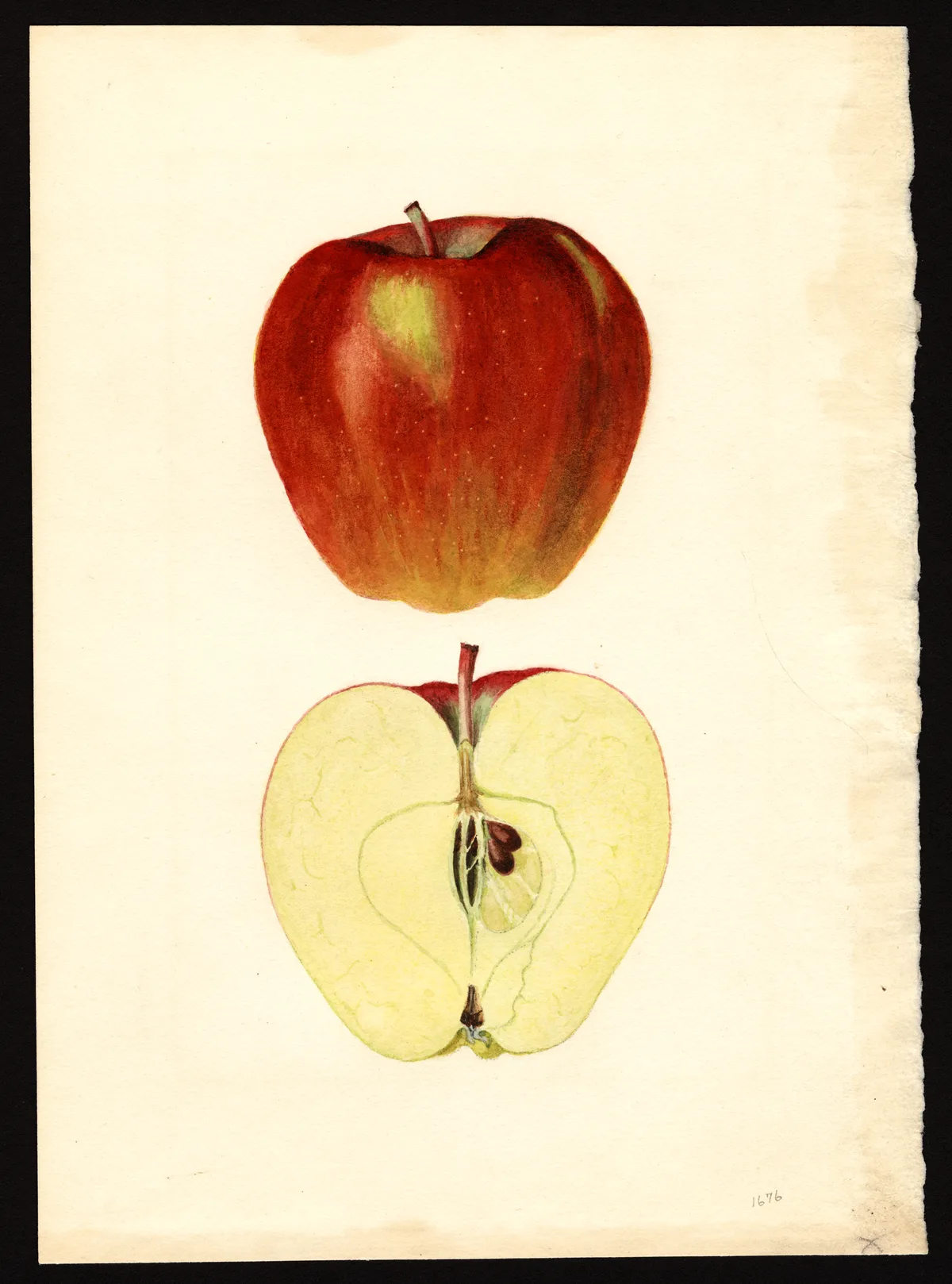
USDA Pomological Watercolor Collection
Newfane
Origin / History
Newfane originated from the cross Deacon Jones x Delicious, made in 1911. It is a sister seedling of Medina, Orleans, and Sweet Delicious. The breeding record number was 12490, and the seedling number was Station 2236. It was selected in 1920 from a population of 351 seedlings, grown in second test for 7 years, and introduced in 1927. It was named for the village of Newfane in Niagara County, New York.
A comprehensive description of Newfane was published in 1929 by Howe (100). It was briefly described in the Register of New Fruit and Nut Varieties (31).
Nursery trees of Newfane were sold by the New York State Fruit Testing Association for 33 years, 1928-60. In the 1960-68 period, Newfane trees were sold by two commercial nurseries. In 1954 (186), Newfane was tested at experiment stations in Colorado, Nova Scotia, and West Virginia. A survey of apple clones in the United States (79) showed that in 1963 Newfane was tested at stations in Minnesota, New York, Oklahoma, Oregon, and Wyoming. In 1968 (184), it was tested at stations in New York, North Carolina, and West Virginia.
In 1941, a New York circular (103) described Newfane as one of the best and most important cultivars. In 1956, it was one of the cultivars recommended for planting in New York (10). However, it was never planted extensively and was soon removed from the recommended list. Newfane tested in Wisconsin (182) has been liked by some growers, but it has not met with general favor.
Tree
The tree is large, vigorous, upright, tall, medium dense, and round-topped. It is medium in productivity and bears annually. The trunk is medium stocky. The trunk bark is gray and shaggy. The twigs are thick, long, and somewhat pubescent.
Newfane trees bloom in midseason, about half a day after Delicious (Table 6). The tree is diploid, and the pollen is viable (238).
Following the severe winter of 1933-34 in New York, Newfane trees survived without injury (3). In the severe 1966 freeze in British Columbia (143), fruit spurs of Newfane, like those of Delicious, were tender. After a severe freeze in Kansas in November 1940 (179), trees of Newfane were very tender, showing little or no recovery.
In a German study of the susceptibility of apple cultivars to powdery mildew (190), Newfane was found to be resistant or only slightly attacked. In Iowa (62), 25 to 30 per cent of branches contracted fire blight. Newfane trees produced light crops in Iowa.
Fruit
Size: Fruits are large, up to 3 inches in diameter, and the size is variable.
Form: Conic, ribbed, sometimes deeply ribbed, and very irregular.
Stem: Thick, medium in length, and flaring at the base.
Cavity: Acute, medium in depth and width, smooth, nonsymmetrical, and sometimes lipped.
Calyx: Small and closed. Calyx lobes medium in length and width, and acuminate. The calyx tube is long (9 mm), narrow (5 mm), and conic. The stamens are median.
Basin: Medium in depth, narrow, obtuse, deeply furrowed, and strongly compressed.
Skin: Thick, medium in toughness, smooth, and glossy, and covered with light bloom. The color is 90 per cent dull red, not striped, with greenish yellow ground color and slight scarfskin.
Dots: Small, russet, numerous, and conspicuous.
Flesh and flavor: Light yellow with a greenish tinge, firm, medium grained, tender, and slightly dry, sometimes with severe water core. Flavor is nearly sweet. The eating quality is good. Exposed flesh oxidizes rather quickly.
Core and seeds: The core is medium sized (15 to 25 mm wide), slightly open, and set in the fruit as described. The carpels are cordate. The seeds are numerous, large, wide, plump, acute, and sometimes tufted.
Season
Newfane fruits ripen at Geneva on average October 17, 7 days after Delicious. The average number of days from full bloom to harvest is 152, 7 more than Delicious. In Iowa, fruits ripened 1 week after Jonathan. Newfane fruits adhere well to the tree after they ripen.
The storage life is fair, approximately 90 days at 31° F. The shelf life after storage is good.
Uses
Newfane is a dessert type and is not suitable for processing. In Iowa, fruits were large and red, and the variety was of poor commercial value. In 1941, a New York circular (103) described Newfane as one of the best and most important cultivars. It was never planted extensively. Newfane is not recommended for planting.
Subtypes / Variants
Not described in source.
Other
Newfane contains 15 mg ascorbic acid per 100 gm fruit, which compares with 37 mg for Calville Blanc and 4 mg for McIntosh (105). Newfane fruits are illustrated in Figure 20. Newfane fruits resemble their sisters, Medina, Orleans, and Sweet Delicious.
Book Sources
Described in 1 period pomological work
View original book sources (1)
— Roger D. Way, Apple Cultivars Introduced by the New York State Agricultural Experiment Station, 1914–1968 (1971)Newfane
Origin. The cross, Deacon Jones x Delicious, made in 1911 produced Newfane. It is a sister seedling of Medina, Orleans, and Sweet Delicious. The breeding record number was 12490, and the seedling number was Station 2236. It was selected in 1920 from a population of 351 seedlings. It was grown in second test for 7 years and was introduced in 1927 (Table 2). It was named for the village of Newfane in Niagara County, New York.
A comprehensive description of Newfane was published in 1929 by Howe (100). It was briefly described in the Register of New Fruit and Nut Varieties (31).
Winter Hardiness. Following the severe winter of 1933-34 in New York, Newfane trees survived without injury (3). In the severe 1966 freeze in British Columbia (143), fruit spurs of Newfane, like those of Delicious, were tender. After a severe freeze in Kansas in November 1940 (179), trees of Newfane were very tender, showing little or no recovery.
Tree. The tree characteristics of Newfane are summarized in Table 5. The tree is large, vigorous, upright, tall, medium dense, and round-topped. They are medium in productivity and bear annually (Table 5). The trunk is medium stocky. The trunk bark is gray and shaggy. The twigs are thick, long, and somewhat pubescent.
Pollination. Newfane trees bloom in midseason, about half a day after Delicious (Table 6). It is diploid (Table 4), and the pollen is viable (238).
Fruit. Newfane fruits are illustrated in Figure 20. The fruit characteristics of Newfane are summarized in Table 8.
Figure 20.--Newfane.
The average ripening date for Newfane at Geneva is October 17, 7 days after Delicious (Table 7). The average number of days from full bloom to harvest is 152, 7 more than Delicious.
Newfane fruits adhere well to the tree after they ripen.
Newfane fruits are large, up to 3 inches in diameter, and the size is variable. They are conic, ribbed, sometimes deeply ribbed, and very irregular. The stem is thick, medium in length, and flaring at the base. The cavity is acute, medium in depth and width, smooth, nonsymmetrical, and sometimes lipped. The calyx is small and closed. The calyx lobes are medium in length and width, and acuminate. The basin is medium in depth, narrow, obtuse, deeply furrowed, and strongly compressed. The skin is thick, medium in toughness, smooth, glossy, and covered with light bloom. The color is 90 per cent dull red, not striped, has greenish yellow ground color, and slight scarfskin. The dots are small, russet, numerous, and conspicuous. The calyx tube is long (9 mm), narrow (5 mm), and conic. The stamens are median. The core is medium sized (15 to 25 mm wide) and slightly open. The carpels are cordate. The seeds are numerous, large, wide, plump, acute, and sometimes tufted. The flesh is light yellow with a greenish tinge, firm, medium grained, tender, slightly dry, sometimes with severe water core, and nearly sweet. The eating quality is good. It is a dessert type and is not suitable for processing. Exposed flesh oxidizes rather quickly. The storage life is fair, approximately 90 days at 31° F. The shelf life after storage is good. Newfane contains 15 mg ascorbic acid per 100 gm fruit, which compares with 37 mg for Calville Blanc and 4 mg for McIntosh (105).
Newfane fruits resemble their sisters, Medina, Orleans, and Sweet Delicious (see Medina for distinguishing features of each).
Diseases. In a German study of the susceptibility of apple cultivars to powdery mildew (190), Newfane was found to be resistant or only slightly attacked.
Commercial Usefulness. Nursery trees of Newfane were sold by the New York State Fruit Testing Association for 33 years, 1928-60 (Table 2). In the 1960-68 period, Newfane trees were sold by two commercial nurseries (Table 3). In 1954 (186), Newfane was tested at experiment stations in Colorado, Nova Scotia, and West Virginia. A survey of apple clones in the United States (79) showed that in 1963 Newfane was tested at stations in Minnesota, New York, Oklahoma, Oregon, and Wyoming. In 1968 (184), it was tested at stations in New York, North Carolina, and West Virginia. In 1941, a New York circular (103) described Newfane as one of the best and most important cultivars. In 1956, it was one of the cultivars recommended for planting in New York (10). However, it was never planted extensively and was soon removed from the recommended list.
In Iowa (62), Newfane trees produced light crops; 25 to 30 per cent of branches contracted fire blight; fruits ripened 1 week after Jonathan; fruits were large and red; and it was of poor commercial value.
Newfane tested in Wisconsin (182) has been liked by some growers, but it has not met with general favor.
In summary: Newfane is not recommended for planting.