Deacon Jones
Apple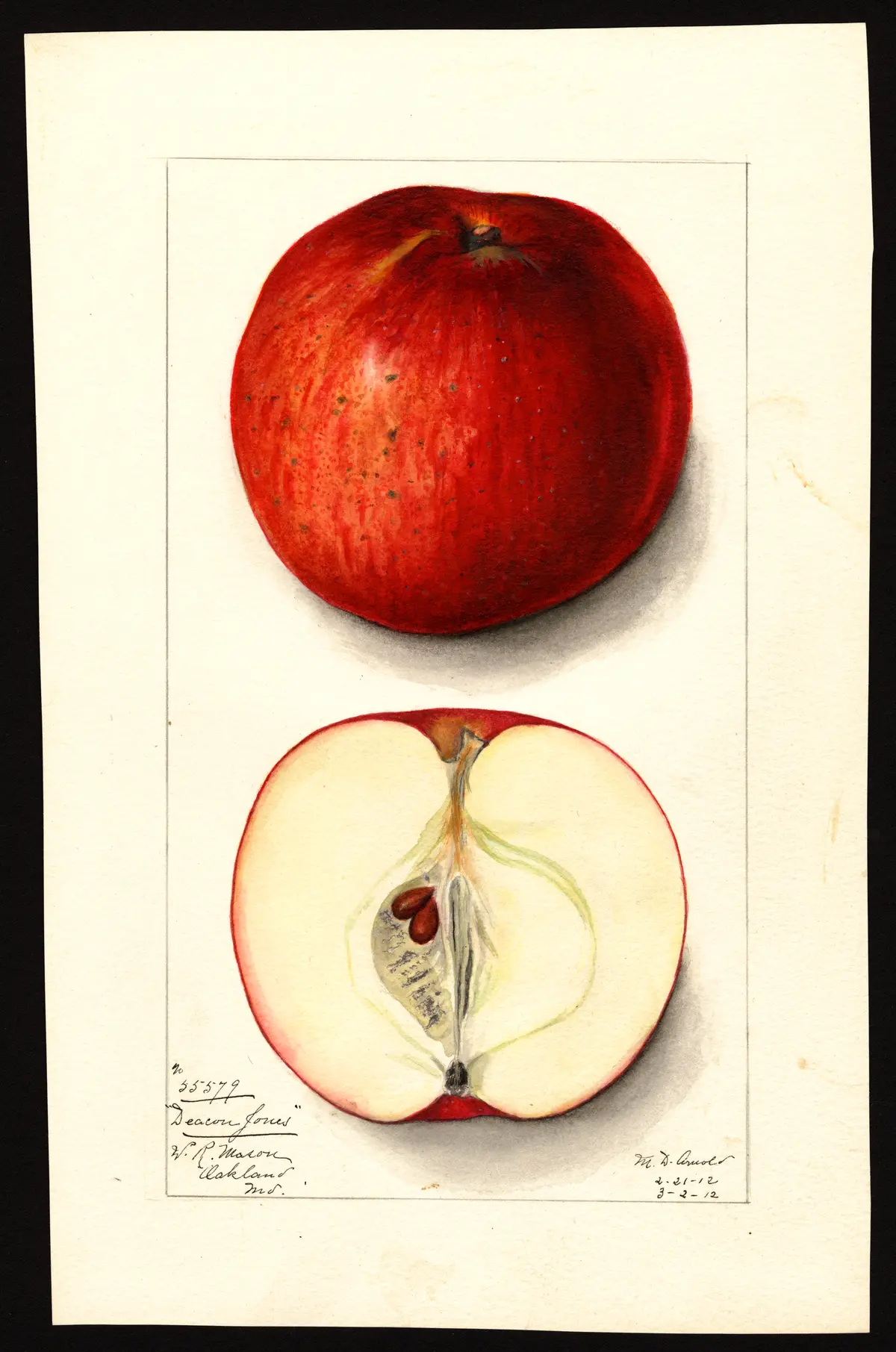
USDA Pomological Watercolor Collection
Deacon Jones
Origin/History
Deacon Jones originated in Pennsylvania as a chance seedling. Beach (1905) received it in 1892 for testing from J. S. Ford of Pittsford, N.Y., by whom it was being introduced. Hedrick (1922) places the origin somewhat earlier, noting it arose in Pennsylvania some time previous to 1890, and that by his time it was grown only in New York. Beach suggests, based on the form of the fruit and the character of the core, that Deacon Jones may be a seedling of the Yellow Bellflower.
References: Powell and Fulton, U.S.B.P.I. Bul., 48:40 (1903); Beach and Clark, N.Y. Sta. Bul., 248:116 (1904).
Tree
The two sources differ slightly on vigor: Beach describes the tree as moderately vigorous, while Hedrick calls it vigorous. Both agree the form is upright spreading, with branchlets that are willowy, long, slender, and drooping. Beach additionally notes the form is dense.
Twigs long, nearly straight, moderately stout, with large terminal buds; internodes long to below medium. Bark clear brownish-red, lightly streaked with scarf-skin; pubescent. Lenticels numerous, generally medium in size, roundish or oval, raised, conspicuous. Buds small to medium, projecting, obtuse to somewhat acute, appressed, quite pubescent, deeply set in bark. (Tree details beyond branchlet habit from Beach only.)
In the nursery the tree is a fine grower and "delivers" well. In the orchard it is thrifty, comes into bearing young, is almost an annual bearer, and very productive. The fruit hangs well to the tree, with little waste from drops and culls.
Fruit
Size and Form
Large to very large; pretty uniform in size, somewhat variable in shape. Form roundish conic varying to oblong conic, ribbed; axis sometimes oblique.
Stem
Short.
Cavity
Beach: obtuse to acute or sometimes slightly acuminate, shallow to moderately deep, usually smooth, often prominently lipped. Hedrick: obtuse, shallow to deep, smooth, often prominently lipped.
Calyx
Small (Beach adds "to above medium"), closed or partly open, often leafy; lobes sometimes separated at the base.
Basin
Shallow to moderately deep, usually rather narrow, distinctly furrowed and wrinkled.
Skin
Thick, tough, smooth or slightly rough, waxen yellow, mottled and blushed with red and with irregular dashes of carmine; in highly colored specimens almost completely covered with an attractive deep red. Covered with a whitish bloom which gives the fruit a somewhat dull appearance. When well colored it is handsome and showy, of good marketable size, averaging larger than Baldwin.
Dots conspicuous, mingled small and large, whitish, many areolar with russet point; numerous toward the eye.
Flesh and Flavor
The two sources differ on flesh color: Beach describes it as whitish, somewhat tinged with yellow; Hedrick describes it simply as yellow. Both agree it is firm, coarse, crisp, tender, and subacid with a mild, aromatic character, though Beach qualifies these as "rather firm," "somewhat crisp," "moderately juicy," and "slightly aromatic," while Hedrick presents them without qualification as firm, crisp, juicy, and aromatic.
Quality rated fair to good by both sources. Beach elaborates: "not high in quality, but probably it would generally be rated superior to Ben Davis for dessert." Hedrick places quality as much better than Ben Davis but hardly as good as Baldwin.
Core and Seeds
Calyx tube variable in size; Beach describes it as urn-shape to conic, Hedrick as urn-shape only. Stamens: Beach places them median or below; Hedrick at median. Core abaxile; cells symmetrical, wide open, very large. Core lines: Beach says nearly meeting; Hedrick says meeting.
Seeds numerous, medium to small (Hedrick: small), rather dark brown, plump, obtuse, somewhat irregular. Carpels much tufted, emarginate, mucronate, elongated and rather broadly ovate.
Season
November to March, or later. Beach specifies that in ordinary storage the season for home use extends from November to March. In cold storage, the commercial limit for barrel stock appears to be March 1, but the fruit has been kept free from scald and rot until May (Powell and Fulton).
Uses
The fruit has a tough skin and firm texture and stands handling well, making it a good shipper. Beach considers it not good enough in quality to be recommended for home use but notes it may be of value as a commercial variety. Its appeal lies primarily in its attractive appearance, large size, productivity, annual bearing, strong tree habit, and keeping ability rather than in flavor.
Subtypes/Variants
Not described in source.
Book Sources
Described in 2 period pomological works
Nursery Catalog Sources
Found in 1 catalog (1913) from Illinois
- Benjamin Buckman (personal inventory) , Farmingdale , Illinois — 1913
View original book sources (2)
— S.A. Beach, The Apples of New York, Vol. 1 (1905)DEACON JONES.
REFERENCES. 1. Powell and Fulton, U. S. B. P. I. Bul., 48:40. 1903. 2. Beach and Clark, N. Y. Sta. Bul., 248:116. 1904.
Fruit showy and of good marketable size, averaging larger than Baldwin. When well colored it is handsome, the yellow ground color being mostly overlaid with good red, relieved with dots of a contrasting color. The tree is a fine grower in the nursery and "delivers" well. In the orchard it is thrifty, comes into bearing young, is almost an annual bearer and very productive. The fruit hangs well to the tree. There is little waste from drops and culls. The flesh is rather coarse; the flavor is mild and the quality is not high, but probably it would generally be rated superior to Ben Davis for dessert. It has a tough skin and firm texture, and stands handling well. In ordinary storage its season for home use extends from November to March. So far as tested in cold storage, the commercial limit for barrel stock appears to be March first, but the fruit has kept free from scald and rot till May (1). It is not good enough in quality to be recommended for home use, but it may possibly be of value as a commercial variety.
Historical. Originated in Pennsylvania as a chance seedling. Received here in 1892 for testing from J. S. Ford, Pittsford, N. Y., by whom it is being introduced. The form of the fruit and the character of the core indicate that this variety may be a seedling of the Yellow Bellflower.
TREE. Tree moderately vigorous; branchlets willowy, long, slender, drooping. Form dense, upright spreading. Twigs long, nearly straight, moderately stout, with large terminal buds; internodes long to below medium. Bark clear brownish-red, lightly streaked with scarf-skin; pubescent. Lenticels numerous, generally medium in size, roundish or oval, raised, conspicuous. Buds small to medium, projecting, obtuse to somewhat acute, appressed, quite pubescent, deeply set in bark.
FRUIT. Fruit large to very large; pretty uniform in size, somewhat variable in shape. Form roundish conic varying to oblong conic, ribbed; axis sometimes oblique. Stem short. Cavity obtuse to acute or sometimes slightly acuminate, shallow to moderately deep, usually smooth, often prominently lipped. Calyx small to above medium, closed or partly open, often leafy; lobes sometimes separated at the base. Basin shallow to moderately deep, usually rather narrow, distinctly furrowed and wrinkled. Skin thick, tough, smooth or slightly rough, waxen yellow, mottled and blushed with red and with irregular dashes of carmine, in highly colored specimens being almost completely covered with an attractive deep red. It is covered with a whitish bloom which gives the fruit a somewhat dull appearance. Dots conspicuous, mingled small and large, whitish, many areolar with russet point; numerous toward the eye. Calyx tube variable in size, urn-shape to conic. Stamens median or below. Core abaxile; cells symmetrical, wide open, very large; core lines nearly meeting. Seeds numerous, medium to small, rather dark brown, plump, obtuse, somewhat irregular. Carpels much tufted, emarginate, mucronate, elongated and rather broadly ovate. Flesh whitish, somewhat tinged with yellow, rather firm, coarse, somewhat crisp, tender, moderately juicy, mild subacid, slightly aromatic, not high in quality, fair to possibly good. Season November to March or later (1, 2).
— U.P. Hedrick, Cyclopedia of Hardy Fruits (1922)DEACON JONES. The fruits of Deacon Jones are of large size and when well colored are handsome, the yellow ground-color being overlaid with an attractive red, relieved with numerous prominent dots. The apples hang exceptionally well to the tree, there is almost no waste from windfalls and culls, and they are uniform in size and shape. The quality is much better than that of Ben Davis, but hardly as good as that of Baldwin. A tough skin and firm texture make the apples good shippers. The tree in nursery and in orchard is most thrifty, comes into bearing young, is very productive, and is an annual bearer. The variety originated in Pennsylvania some time previous to 1890. It is now grown only in New York. Tree vigorous, upright-spreading; branchlets willowy, long, slender, drooping. Fruit large to very large, uniform in size, round-conic to oblong-conic, ribbed, axis sometimes oblique; stem short; cavity obtuse, shallow to deep, smooth, often prominently lipped; calyx small, closed or partly open, often leafy; lobes sometimes separated at the base; basin shallow to deep, usually narrow, distinctly furrowed and wrinkled; skin thick, tough, smooth or rough, waxen yellow, mottled and blushed with red and with irregular dashes of carmine, in highly colored specimens deep red, with a bloom which gives the fruit a dull appearance; dots conspicuous, small and large, white, many areolar with russet point, numerous toward the eye; calyx-tube variable in size, urn-shape; stamens median; core abaxile; cells symmetrical, wide open, very large; core-lines meeting; seeds numerous, small, dark brown, plump, obtuse, irregular; carpels much tufted, emarginate, mucronate, elongated and broadly ovate; flesh yellow, firm, coarse, crisp, tender, juicy, mild subacid, aromatic; fair to good; November to March.