Yellow Bellflower
Apple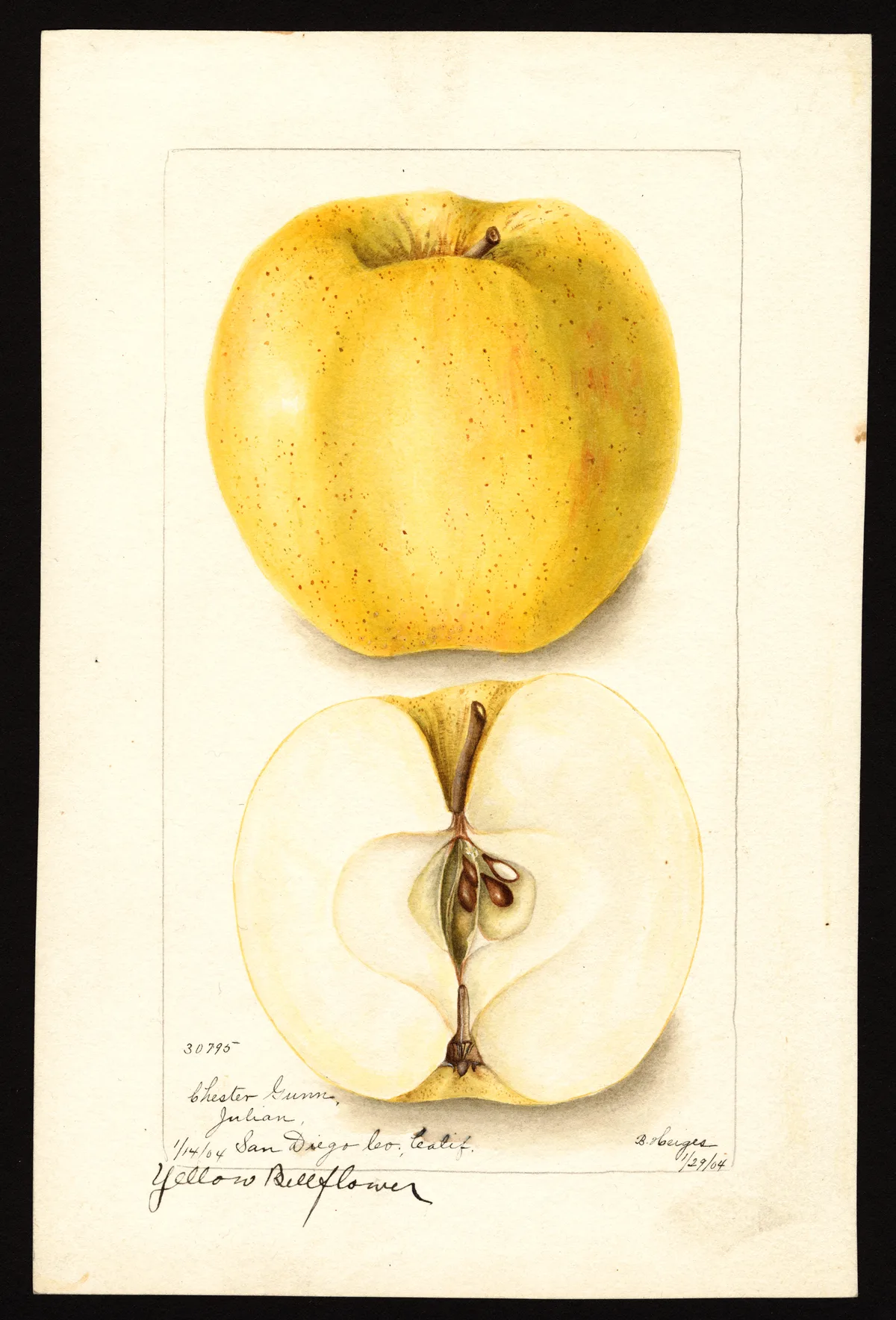
USDA Pomological Watercolor Collection
Yellow Bellflower
Origin / History
Yellow Bellflower originated in Burlington County, New Jersey, where it was first described by Coxe in 1817 (Warder, Downing, Budd-Hansen, Beach, Hedrick). Coxe reported that the original tree — very large and old — was said to be still standing on a farm near Crosswicks, Burlington County, New Jersey (Beach, Hedrick). Hovey remarked in 1852 that the Bellflower was then extensively cultivated in New Jersey, but its cultivation in New England was as yet extremely limited (Beach). A century or more ago it was being grafted into the farm orchards and propagated in the nurseries throughout New York, and it is well known among fruit growers in most parts of the state but is nowhere extensively cultivated there (Beach). It was early introduced into cultivation through the Middle West and within recent years has come to be one of the important commercial varieties in certain apple-growing districts in the Pacific states; it is now offered by nurserymen in nearly all of the more important apple-growing sections of the country (Beach). Wickson observed that "The Yellow Bellflower, as grown in California, has such conspicuous excellence that during its season it is hardly likely to be misplaced for any other variety" (Beach). Downing notes that it is most abundantly seen in the markets of Philadelphia, as it thrives well in the sandy soils of New Jersey. The most suitable regions for its culture are the coast valleys of California (Hedrick). Lowther notes the variety is now fairly well distributed throughout the United States. The variety has strong local attachments, and, though widely distributed, is now being planted in but few localities (Hedrick).
Yellow Bellflower belongs to a group of apples most of which have fruit predominantly yellow. The fruit of the group is characteristically oblong or roundish oblong and often markedly ovate or conic, with the core large and remarkably abaxile, cells wide open and carpels elongated, rather narrow and much concave. The oldest members of which we have any record in this country are Yellow Bellflower and Ortley, both of which originated in New Jersey. Varieties more or less closely identified with the Yellow Bellflower group are Dickinson, Flory, Kirkland, Mason Orange, Minister, Moyer, Newman, Occident, Ortley, Titus Pippin, and Yellow Bellflower itself (Beach, Lowther).
Tree
Vigor and form: Sources broadly agree the tree is hardy, productive, and long-lived in favorable conditions, though they differ on vigor and habit. Elliott describes the tree as of slender, yet healthy growth, with yellowish, rather upright shoots; fruit borne on ends of limbs, very hardy; grafted on pieces of roots, does not bear well, but otherwise very productive. Warder calls it vigorous, thrifty, hardy, large, spreading, drooping. Downing describes a moderately vigorous grower forming a spreading, roundish, rather drooping head, and a regular and excellent bearer; young wood yellowish brown. Thomas notes shoots yellowish, rather slender, with growth of the tree rather upright; succeeds best on rather light soils. Budd-Hansen also describes the tree as moderately vigorous, with spreading, roundish, rather drooping head. Beach gives the tree as medium to large, vigorous to very vigorous, form upright spreading with laterals drooping, particularly after they have borne heavy crops. Hedrick describes the tree as medium to large, vigorous, upright-spreading, with laterals drooping; vigorous, healthy, hardy, long-lived, and productive in warm, well-drained, fertile soils. Lowther gives medium to large, vigorous, upright, with spreading branches. The Central Experimental Farm catalogue (Agassiz BC, planted Spring 1890) records a strong grower and regular bearer.
Twigs: Slender, brown (Warder). Medium to long, rather stocky, geniculate; internodes medium to large (Beach).
Bark: Dull brownish-red with shades of green, uniformly overlaid with moderately thick scarf-skin; more or less pubescent (Beach, Lowther).
Lenticels: Rather inconspicuous, above medium in size, roundish to elliptical; rather numerous, dull, not raised (Beach).
Buds: Above medium to large, rather prominent, acute to roundish acute, free or nearly so, quite pubescent (Beach).
Foliage: Abundant, long, wavy (Warder). Fruit and foliage are very susceptible to injury by the apple-scab fungus (Hedrick).
Blossoms: Very large, on long stems, exposed to the weather and not protected by the leaves; consequently the blossoms are often destroyed by spring frosts (Warder).
Soil and conditions: The quality of the fruit varies with the soil, being best and most highly flavored and colored on exposed ridges of rather thin soil, while those on rich low bottoms or prairies are slow in bearing, and then produce very large fruit; in such situations crops are not always satisfactory, though the trees become very large (Warder). Succeeds best on rather light soils (Thomas); thrives particularly well on warm, well-drained soils (Beach); vigorous, healthy, hardy, long-lived, and productive in warm, well-drained, fertile soils (Hedrick).
Fruit
Size
Large to very large, but markedly variable. Coxe calls it remarkably large, beautiful, and excellent. Elliott: large. Warder: large to very large. Downing: very large. Thomas: large, often quite large. Beach: variable in size, small to large or very large, so that the marketable grades are not very uniform and there is a relatively large percentage of apples that are too small for market — Lowther echoes this, especially when grown where rainfall is scarce during the growing season. Budd-Hansen: large to very large. Hedrick: large or very large. The Central Experimental Farm reports above medium size.
Form
Oblong, somewhat pointed at the blossom end, both ends deeply indented (Coxe). Oblong, a little irregular, tapering to the eye (Elliott, Downing). Oblong, ovate, angular, ribbed (Warder). Oblong-ovate, apex quite narrow and conical, more or less irregular (Thomas). Oblong, somewhat angular and ribbed, tapering to the calyx (Budd-Hansen). Beach: roundish oblong narrowing toward the basin varying to oblong conic, frequently somewhat ovate, irregularly elliptical and more or less ribbed, often with prominent ridges at the apex; sides usually unequal. Hedrick: large or very large, round-oblong, oblong-conic, or ovate, irregularly elliptical, ribbed, often with prominent ridges at the apex; sides usually unequal. (Lowther's separate "Yellow Bellefleur" entry lists form as oblate, conflicting with all other sources which consistently describe an oblong/oblong-conic form.) Central Experimental Farm: oblong, tapering to eye.
Stem / Stalk
Long, slender, curved (Elliott, Warder; Downing notes long and slender). Slender (Thomas). Medium to long, very stout (Budd-Hansen). Medium to rather long, rather slender to moderately stout (Beach). Long, slender (Hedrick).
Cavity
Deep (Elliott, Downing). Deep, acute or wide, wavy (Warder). Regular, deep, obtuse, with a faint trace of russet (Budd-Hansen). Beach: medium to large, acute to acuminate, deep to very deep, moderately narrow to wide, furrowed, sometimes compressed, sometimes lipped, usually with outspreading broken rays of brownish russet. Hedrick: large, acute, deep, wide, furrowed, sometimes compressed, sometimes lipped, usually with outspreading broken rays of brownish-red russet.
Calyx / Eye
Calyx closed (Elliott, Downing, Budd-Hansen). Eye small, closed (Warder). Calyx closed; segments erect convergent (Budd-Hansen). Calyx below medium to above, closed or partly so; lobes narrow, acuminate, pubescent (Beach, Hedrick).
Basin
Plaited, deep (Elliott). Shallow or moderately deep, plaited or folded (Warder). Rather narrow, plaited (Downing). Ribbed (Thomas). Narrow, shallow, much corrugated and ribbed (Budd-Hansen). Small, oblique, abrupt, narrow, shallow to rather deep, distinctly ridged and wrinkled (Beach, Hedrick).
Skin
Pale yellow, with a blush next the sun (Coxe, Elliott). Smooth, rich yellow, sometimes blushed (Warder). Smooth, pale lemon yellow, often with a blush next the sun (Downing). Pale yellow, often with a blush (Thomas). Smooth, pale, lemon yellow, often with bronze red blush (Budd-Hansen). At time of picking it is generally a greenish yellow, but as it ripens it becomes a light golden yellow (Lowther). Beach: smooth, bright, pale lemon-yellow varying to whitish in the shade and often with a shade of brownish-red in the sun which in highly colored specimens deepens to a pinkish-red blush; prevailing effect bright pale yellow. Hedrick: smooth, delicate, pale, lemon-yellow, waxen skin usually beautifully blushed on the cheek to the sun; the same fuller description as Beach. The color improves in storage, becoming more clearly yellow as the fruit matures (Beach). Central Experimental Farm: smooth, pale yellow, sometimes with a faint blush.
Dots
Scattered, gray (Warder). Obscure, numerous, minute, whitish and russet (Budd-Hansen). Whitish or russet, numerous and small toward the basin, larger, irregular and scattering toward the cavity (Beach). White or russet, numerous and small toward the basin, large, irregular and scattering toward the cavity (Hedrick).
Flesh / Flavor
Coxe: rich, juicy, tender, and sprightly. Elliott: tender, juicy, crisp, sprightly, sub-acid. Warder: yellow, breaking, fine-grained, juicy; flavor acid to sub-acid, aromatic, very rich and satisfying; quality best. Downing: tender, juicy, crisp, with a sprightly subacid flavor; before fully ripe it is considerably acid; very good. Thomas: very tender when ripe, fine grained, crisp, juicy, acid, becoming sub-acid, excellent; more tart and less rich in cold summers, and far north. Budd-Hansen: yellow, with yellow veinings, tender, juicy, crisp, spicy, sprightly subacid, very good or best. Beach: whitish tinged with pale yellow, firm, crisp, moderately fine-grained, rather tender, juicy, aromatic, very good for culinary use, rather too acid for dessert early in the season but later its acidity becomes somewhat subdued. Hedrick: yellow, firm, crisp, fine-grained, tender, juicy, aromatic, very good — and notes the apples are not suitable for dessert, the flavor being a little too austere, but are unsurpassed for culinary purposes. Lowther: rather acid until well ripened, when it is pleasant and luscious. Central Experimental Farm: yellowish, coarse, tender, juicy, pleasantly acid, quality good. Beach notes it is rather too briskly subacid to suit the tastes of some, particularly during the early part of its season, and does not reach its best condition for dessert use till January or later, when its acidity becomes somewhat subdued.
Core / Seeds
Coxe describes "uncommonly large full seeds, which are lodged in a pericarpium of unusual size, and if shaken can be distinctly heard." Elliott: core large; capsules long, hollow; seeds large, ovate pyriform, angular at broad end. Warder: core large, oval, open, clasping; seeds dark, large, angular, imperfect. Downing: seeds in a large hollow capsule or core. Thomas: seeds long. Budd-Hansen: core large, wide open, clasping; cells large, roomy, elliptical, much and widely slit; tube funnel-shaped, long; stamens marginal; seeds large, angular, imperfect. Beach: calyx tube yellowish, elongated funnel-shape, sometimes extending to the core; stamens median to basal; core large, long, remarkably abaxile; cells sometimes unsymmetrical, wide open or partly closed; core lines clasping the funnel cylinder; carpels long, narrow, roundish obovate, much concave, much tufted; seeds large, long, obtuse to acute. Hedrick: calyx-tube elongated funnel-shape, sometimes extending to the core; stamens median; core large, long, remarkably abaxile; cells unsymmetrical, wide open or partly closed; core-lines clasping; carpels long, narrow, round-obovate, concave, much tufted; seeds large, long, obtuse.
Season
Sources vary somewhat on season. Elliott: December to March (October to February, South). Warder: December. Downing: December, February. Thomas: keeps through winter. Budd-Hansen: December, February. Beach: as grown at Geneva it is in season from December to April with January or February as the commercial limit; in cold storage it keeps about with Tompkins King, but not as well as Rhode Island Greening. Hedrick: October to March. Central Experimental Farm: December and January. Lowther's separate "Yellow Bellefleur" entry gives season as winter.
Storage and handling: It must be handled very carefully because it very easily shows bruises; it does not stand heat well before going into storage, and when it begins to deteriorate goes down quickly (Beach). Some do not regard it as a good keeper, while others find that it keeps pretty well; to get best results in storage the fruit must be thoroughly protected from scab in the orchard, picked and handled with extra care, and kept from heat from the time it is picked till it is stored as well as while it is in storage (Beach). Tender and easily bruised, yet when grown in some sections, if carefully handled, it keeps well, while in others it deteriorates rapidly (Lowther). The apples do not stand storage well, and deteriorate quickly when brought from low temperatures (Hedrick). Quite susceptible to injury by the apple-scab fungus (Beach, Hedrick). Coxe notes that its great weight causes it to fall in windy weather, and recommends careful picking before they are too ripe.
Climatic adaptation: Has succeeded in almost all parts of the country, North and South, and has proved remarkably hardy (Warder). Adapted to the climate of the Northern and Middle States, as far south as Kentucky, but fails by premature dropping in many localities; hardy at the West (Thomas). In California it is one of the best apples when grown upon the highlands or mountain sides (Lowther); the coast valleys of California are among the most suitable regions for its culture (Hedrick).
Uses
Use: table, kitchen, market (Warder). Remarkably large, beautiful and excellent apple, both for dessert and for cooking (Coxe). One of the finest culinary apples in the catalogue (Warder). A large choice winter apple, a favorite for dessert wherever known (Budd-Hansen). Generally highly esteemed for culinary uses and also for its excellent dessert qualities, although rather too briskly subacid to suit some tastes early in the season; reaches its best condition for dessert use in January or later (Beach). Unsurpassed for culinary purposes; not suitable for dessert (Hedrick). Use: both kitchen and market (Lowther's separate "Yellow Bellefleur" entry).
Commercial profile: Although the fruit sells at good prices, Yellow Bellflower is not generally a satisfactory cropper and is not a good variety to plant in commercial orchards in New York except in the few districts where it has proved profitable (Beach). Unfortunately, the apples are variable in size, the tender skin is easily injured, and the variety is not profitable in commercial orchards (Hedrick).
Subtypes / Variants
Monstrous Bellflower is treated by both Coxe and Downing as a related but distinct variety, not a sub-strain of Yellow Bellflower; details are recorded here because both sources include them in association.
- Coxe (No. 29, Monstrous Bellflower): A very large, fair, and beautiful apple; of an oblong shape resembling the Yellow Bellflower, but more regular in its form, and of a paler yellow colour. The flesh is rich, juicy and tender; it ripens in October, and is a pleasant fruit, although inferior to many excellent apples of the season. The foliage of this tree is singularly large and luxuriant; the growth very regular and strong; the form upright.
- Downing (Monstrous Bellflower): An old variety, little grown. Tree a strong, irregular, vigorous grower, not profitable. Fruit large, roundish oblong, ribbed, pale yellow blush in the sun. Flesh whitish, brisk, juicy, subacid. Good. Core large. October, November.
Other
Beach reports the Lowther separate entry "Yellow Bellefleur" as reported by 12 stations in the Northern Division, 15 stations in the Central Division, and 4 stations in the Southern Division, with the asterisk on each indicating the variety is reported as adapted to more than one of the three divisions of the American Pomological Society. (As noted under Form, that entry's description of the fruit as "oblate" conflicts with the consistent oblong-conic form described by all other sources.) The Central Experimental Farm at Agassiz, BC, planted its tree in the spring of 1890.
Book Sources
Described in 9 period pomological works
- Beach, The Apples of New York Vol. 1 (1905)
- Warder, American Pomology: Apples (1867)
- Budd & Hansen, Systematic Pomology (1914)
- Downing, Fruits and Fruit Trees of America (1900)
- Hedrick, Cyclopedia of Hardy Fruits (1922)
- Thomas, The American Fruit Culturist (1903)
- Coxe, A View of the Cultivation of Fruit Trees (1817) — listed as Monstrous Bellflower
- Lowther (ed.), Encyclopedia of Practical Horticulture (1914)
- Elliott, The Western Fruit Book (1865) — listed as Bellflower
Nursery Catalog Sources
Found in 67 catalogs (1845–1926) from California, Illinois, Maryland, Massachusetts, Missouri, Nebraska, New Jersey, Oregon, Pennsylvania, Washington
- Winship's Nursery (Brighton Nurseries , operated by the Winship family), Brighton (Boston) , Massachusetts — 1845
- Hovey & Co. , Cambridge , Massachusetts — 1849
- Azell Bowditch (Nursery / Fruit Catalog) , Boston , Massachusetts — 1850 — listed as Belle Fleur
- Azell Bowditch (Nursery / Fruit Catalog) , Boston , Massachusetts — 1850
- Joseph Breck & Co. , Boston , Massachusetts — 1855
- Hutchison Nursery , James Hutchison, Oakland , California — 1881
- Felix Gillet , Barren Hill Nursery, Nevada City , California — 1884
- Fancher Creek Nursery , Fresno , California — 1886
- W.R. Strong & Co. , Capital and Orange Hill Nurseries (Robert Williamson, prop.), Sacramento , California — 1886
- Felix Gillet , Barren Hill Nursery, Nevada City , California — 1888
- California Nursery Co. , Niles , California — 1889
- Felix Gillet , Barren Hill Nursery, Nevada City , California — 1889
- Palouse Nursery and Pleasant Dale Fruit Farm , Colfax, Washington Territory (situated two miles northeast of Colfax) - undated (single-page broadside flyer; "Washington Territory" suggests pre — 1889
- Felix Gillet , Barren Hill Nursery, Nevada City , California — 1890
- William H. Moon Co. , Morrisville, Bucks County , Pennsylvania — 1890
- Felix Gillet , Barren Hill Nursery, Nevada City , California — 1891
- Puyallup & Yakima Nurseries , Puyallup, Washington (Lock Box 191) and North Yakima , Washington — 1892
- Milwaukie-Canby Nurseries , Canby, OR (and Milwaukie, OR) — 1893
- Sherwood Hall Nursery Co. , Timothy Hopkins (Menlo Park Nurseries), San Francisco / Menlo Park , California — 1893
- Multnomah Nurseries , Russellville , Oregon — 1894
- The Vineland Nurseries (Kelsey & Co. , Proprietors), St. Joseph, Missouri (Office: 13th and Atchison Sts., 2 Blocks East of the Citizens St. Car Line) — 1894
- Woodburn Nurseries , Woodburn, Marion Co. , Oregon — 1894
- Felix Gillet , Barren Hill Nursery, Nevada City , California — 1895
- Stark Bros. Nurseries & Orchards Co. , Louisiana , Missouri — 1896
- Felix Gillet , Barren Hill Nursery, Nevada City , California — 1897
- Arthur J. Collins & Sons , Moorestown , New Jersey — 1898
- Reading Nursery , Jacob W. Manning, Proprietor, Reading , Massachusetts — 1898
- Central Experimental Farm , Dominion Department of Agriculture, Agassiz, British Columbia (under test; Bulletin No. 3, Second Series) — 1900 — listed as Yellow Belleflower
- The Dalles Nurseries , The Dalles , Oregon — 1901
- Washington Nursery Co. , Toppenish , Washington — 1901
- S.L. Watkins , Grizzly Flats, El Dorado County , California — 1901
- Benjamin Buckman (personal inventory) , Farmingdale , Illinois — 1901
- Forestville Nurseries , T.J. True, Forestville , California — 1902
- Pacific Nursery Company (W. O. Hudson & A. D. Hudson) , Tangent , Oregon — 1903
- Russellville Nursery Co. , Russellville, OR (three miles east of Portland, one mile from Montavilla car line) — 1903
- OSU Bulletin 81 (as "Golden Bellflower") — 1904
- Henderson Luelling / Traveling Nursery (historical recall) , Oregon — 1904
- Phoenix Nursery Company (W. E. Rossney , President; Sidney Tuttle, Vice-President), Bloomington , Illinois — 1904
- Stark Bros. Nurseries & Orchards Co. , Louisiana , Missouri — 1906
- J.B. Pilkington , Portland , Oregon — 1907
- Russellville Nursery Co. , Montavilla Station, Portland, OR (three miles east of Portland, one mile from Montavilla car line) — 1907
- Carlton Nursery Co. , Carlton , Oregon — 1909
- Milton Nursery Co. (A. Miller & Sons , Proprietors), Milton , Oregon — 1909
- Wm. J. Corse (successor to Robert Sinclair / Sinclair Nurseries) , Baltimore , Maryland — 1909
- Washington Nursery Company , Toppenish , Washington — 1909
- C.F. Lansing , Salem , Oregon — 1910
- Island Nurseries & Fruit Farm , Vashon (Vashon Island) , Washington — 1910
- Stark Bros. Nurseries & Orchards Co. , Louisiana , Missouri — 1910
- Galbraith Nursery Co. (DeWitt Hansen , Pres.-Mgr.), Fairbury , Nebraska — 1911
- Stark Bros. Nurseries & Orchards Co. , Louisiana , Missouri — 1911
- Ballygreen Nurseries , Hanford , Washington — 1912
- Pacific Nursery Company , Portland , Oregon — 1912
- Stark Bros. Nurseries & Orchards Co. , Louisiana , Missouri — 1912
- Vineland Nurseries Company , Clarkston , Washington — 1912
- Washington Nursery Company , Toppenish , Washington — 1912
- J. B. Pilkington , Nurseryman, Portland, OR (nurseries near Newberg, forty miles from Portland) — 1913
- Van Holderbeke Nursery Co. , Incorporated, Spokane, Washington (nurseries at Otis Orchards WA, Pasadena WA, Kennewick WA) — 1913
- Ornamental & Fruit Nursery Company , Wapato, County of Yakima , Washington — 1915
- Union Nurseries , J.B. Weaver & Sons, Union , Oregon — 1915
- Fancher Creek Nurseries , George C. Roeding, Fresno , California — 1918
- Stark Bros. Nurseries & Orchards Co. , Louisiana , Missouri — 1918
- Oregon Nursery Co. , Orenco , Oregon — 1920
- Benedict Nursery Co. , Portland , Oregon — 1921
- Fresno Nursery Co. , Fresno , California — 1924
- Columbia & Okanogan Nursery Co. , Wenatchee , Washington — 1925
- Hudson's Wholesale Nurseries , Tangent , Oregon — 1926
- North-Western Nurseries , Walla Walla , Washington
View original book sources (10)
— William Coxe, A View of the Cultivation of Fruit Trees (1817)NO. 29. MONSTROUS BELLFLOWER.
A very large, fair, and beautiful apple; of an oblong shape resembling the yellow Bellflower, but more regular in its form, and of a paler yellow colour. The flesh is rich, juicy and tender; it ripens in October, and is a pleasant fruit, although inferior to many excellent apples of the season—the foliage of this tree is singularly large and luxuriant; the growth very regular and strong; the form upright.
[Additional entry in this volume: "Bell-Flower", pp. 145–145]
NO. 33. BELL-FLOWER.
A remarkably large, beautiful and excellent apple, both for the dessert and for cooking—it is of a pale, but bright and fair yellow colour; the cheek next the sun has sometimes a blush, but more frequently is without any red: the form is oblong, somewhat pointed at the blossom end—both ends are deeply indented—the flesh is rich, juicy, tender and sprightly; it has uncommonly large full seeds, which are lodged in a pericarpium of unusual size, and if shaken can be distinctly heard; it ripens late in October, when its great weight causes it to fall in windy weather—if carefully picked before they are too ripe, they will
— F.R. Elliott, The Western Fruit Book (1865)Bellflower. Yellow Bellflower, | Yellow Belle-fleur, | Lady Washington. American. Tree, of slender, yet healthy growth, with yellowish, rather upright shoots; fruit, on ends of limbs, very hardy; grafted on pieces of roots, does not bear well; otherwise, very productive. Size, large; form, oblong, a little irregular, tapering to the eye; color, pale yellow, with a blush next the sun; stem, long, slender, curved; cavity, deep; calyx closed; basin, plaited, deep: flesh, tender, juicy, crisp, sprightly, sub-acid; core, large; capsules, long, hollow; seeds, large, ovate pyriform, angular at broad end. December to March. October to February, South.
— John A. Warder, American Pomology: Apples (1867)Yellow Bellflower.
This noble and valuable constituent of our orchards came from Burlington County, New Jersey, where it was first
Fig. 291. — YELLOW BELLFLOWER.
described by Coxe. This apple has succeeded in almost all parts of the country, North and South, and has proved remarkably hardy. The quality of the fruit varies with the soil, being best and most highly flavored and colored on exposed ridges of rather thin soil, while those on rich low bottoms or prairies are slow in bearing, and then produce very large fruit. The crops, however, are not always satisfactory in such situations, though the trees become very large ; the blossoms are often destroyed by spring frosts.
Tree vigorous, thrifty, hardy, large, spreading, drooping ; Twigs slender, brown ; Foliage abundant, long, wavy ; Blossoms very large, on long stems, exposed to the weather and not protected by the leaves.
Fruit large to very large, oblong, ovate, angular, ribbed ; Surface smooth, rich yellow, sometimes blushed ; Dots scattered, gray.
Basin shallow or moderately deep, plaited or folded ; Eye small, closed.
Cavity deep, acute or wide, wavy ; Stem long, curved.
Core large, oval, open, clasping ; Seeds dark, large, angular, imperfect ; Flesh yellow, breaking, fine-grained, juicy ; Flavor acid to sub-acid, aromatic, very rich and satisfying ; Quality best ; Use, table, kitchen, market ; Season, December.
One of the finest culinary apples in the catalogue.
— A.J. Downing, The Fruits and Fruit Trees of America (1900)Yellow Bellflower.
Bellefleur Yellow. Belle Fleur. Bishop's Pippin of Nova Scotia. Lady Washington. Reinette Musque. Warren Pippin.
The Yellow Belle Fleur is a large, handsome, and excellent winter Apple, everywhere highly esteemed in the United States. It is most abundantly seen in the markets of Philadelphia, as it thrives well in the sandy soils of New Jersey. Coxe first described this fruit ; the original tree of which grew in Burlington, N. J. Tree a moderately vigorous grower, forming a spreading, roundish, rather drooping head. Young wood yellowish brown. A regular and excellent bearer.
Fruit very large, oblong, a little irregular, tapering to the eye. Skin smooth, pale lemon yellow, often with a blush next the sun. Stalk long and slender in a deep cavity. Calyx closed and set in a rather narrow plaited basin. Seeds in a large hollow capsule or core. Flesh tender, juicy, crisp, with a sprightly subacid flavor ; before fully ripe it is considerably acid. Very good. December, February.
[Additional entry in this volume: "Monstrous Bellflower", pp. 303–303]
Monstrous Bellflower.
An old variety, little grown. Tree a strong, irregular, vigorous grower, not profitable.
Fruit large, roundish oblong, ribbed, pale yellow blush in the sun. Flesh whitish, brisk, juicy, subacid. Good. Core large. October, November.
— John J. Thomas, The American Fruit Culturist (1903)Yellow Bellflower.* (Bellflower, Yellow Belle Fleur.) Large, often quite large, oblong-ovate, apex quite narrow and conical, more or less irregular; surface pale yellow, often with a blush; stalk slender; basin ribbed; seeds long; flesh very tender when ripe, fine grained, crisp, juicy, acid, becoming sub-acid, excellent. keeps through winter. Shoots yellowish, rather slender; growth of the tree rather upright; succeeds best on rather light soils. Adapted to the climate of the Northern and Middle States, as far south as Kentucky, but fails by premature dropping in many localities. More tart and less rich in cold summers, and far North. Hardy at the West. Fig. 481. New Jersey.
— S.A. Beach, The Apples of New York, Vol. 1 (1905)YELLOW BELLFLOWER.
REFERENCES.
- M'Mahon, 1806:585. 2. Coxe, 1817, 120. fig. 3. Thacher, 1822:121. 4. Buel, N. Y. Bd. Agr. Mem., 1826:476. 5. Fessenden, 1828:130. 6. Wilson, 1828:136. 7. Cat. Hort. Soc. London, 1831:No. 75. 8. Kenrick, 1832:42. 9. Floy-Lindley, 1833:86. 10. Mag. Hort., 11:326, 78. 1835. 11. Manning, 1838:60. 12. Ib., Mag. Hort., 7:151. 1841. 13. Downing, 1845:100. fig. 14. Horticulturist, 1:482. 1846. 15. Ib., 2:361, 482, 545. 1848. 16. Cole, 1849:119. fig. 17. Thomas, 1849:187. 18. Phoenix, Horticulturist, 4:472. 1850. 19. Emmons, Nat. Hist. N. Y., 3:79. 1851. col. pl. No. 46 and fig. 20. Am. Pom. Soc. Cat., 1852. 21. Hovey, Mag. Hort., 18:542. 1852. fig. 22. Ib., 19:244. 1853. 23. Biedenfeld, 1854:102. 24. Elliott, 1854:70. fig. 25. Hooper, 1857:16, 103, 106, 108. col. pl. 26. Gregg, 1857:50. fig. 27. Flotow, 1:69. 1859. 28. Oberdieck, 4:197. 1862. 29. Warder, 1867:692. fig. 30. Regel, 1868:442. 31. Fitz, 1872:143, 145, 163. 32. Mas, Le Verger, 1873:151. 33. Leroy, 1873:432. 34. Lauche, 1:No. 3. 1882. col. pl. 35. Barry, 1883:358. 36. Rural N. Y., 47:749. 1888. 37. Cat. Cong. Pom. France, 1889:278. 38. Wickson, 1889:247. 39. Lyon, Mich. Hort. Soc. Rpt., 1890:300. 40. Bailey, An. Hort., 1892:235. 41. Ib., 1892:253. 42. Bredsted, 1893:405. 43. Gaudier, 1894:No. 6. col. pl. 44. Waugh, Vt. Sta. An. Rpt., 14:313. 1901. 45. Eneroth-Smirnoff, 1901:266. 46. Sears, Can. Hort., 25:325. 1902. 47. Budd-Hansen, 1903:210. fig. 48. Farrand, Mich. Sta. Bul., 205:43. 1903. 49. Powell and Fulton, U. S. B. P. I. Bul., 48:62. 1903. 50. Beach and Clark, N. Y. Sta. Bul., 248:151. 1904.
SYNONYMS.
BELLE FLAVOISE (28). Belle Flavoise (33, 43). BELLEFLEUR JAUNE (32, 37). Belle-Fleur (33). Belle-Flower (33). BELL-FLOWER (2). BELL FLOWER (9). BELL FLOWER (3). BELLFLOWER (4, 6, 8, 11, 21, 24, 40). Bellflower (13, 17, 25, 43, 49). Bell-Flower (5). Bishop's Pippin of Nova Scotia (33). GELBER BELLEFLEUR (23, 27, 34, 43, 45). Gelber Bellefleur (28). Gelber Belle Fleur (33, 43). Gelber Englischer Schonbluhender (43). GUL. BELLEFLEUR (42). Lady Washington (24, 33, 43). Lincoln Pippin (43). Lineous Pippin (43). LINNAEUS PIPPIN (33). Metzgerapfel (43). Metzger Cahill (28). Metzger's Cahill (33, 43, of John 34). YELLOW BELLE FLEUR (7, 13). YELLOW BELLEFLEUR (19, 20, 31). Yellow Bellefleur (17, 21, 24, 33, 43). YELLOW BELLEFLOWER (46). Yellow Bellflower (8, 13, 21, 24, 33, 40, 43). Warren Pippin (33, 43). Weisser Metzgerapfel (43).
Yellow Bellflower grows large or even very large, but usually it is so variable in size that the marketable grades are not very uniform and there is a relatively large percentage of apples that are too small for market. It is decidedly attractive in color for a yellow apple and the color improves in storage, becoming more clearly yellow as the fruit matures. It is well known throughout the state and is generally highly esteemed for culinary uses and also for its excellent dessert qualities, although it is rather too briskly subacid to suit the tastes of some, particularly during the early part of its season. It does not reach its best condition for dessert use till January or later, when its acidity becomes somewhat subdued. It is quite susceptible to injury by the apple-scab fungus. It must be handled very carefully because it very easily shows bruises. It does not stand heat well before going into storage and when it begins to deteriorate goes down quickly. Some do not regard it as a good keeper, while others find that it keeps pretty well. To get best results in storage the fruit must be thoroughly protected from the scab in the orchard, picked and handled with extra care and kept from heat from the time it is picked till it is stored as well as while it is in storage. As grown at Geneva it is in season from December to April with January or February as the commercial limit. In cold storage it keeps about with Tompkins King, but not as well as Rhode Island Greening.
The tree is a good grower and pretty hardy. In favorable locations it is healthy and long-lived. It seems to thrive particularly well on warm, well-drained soils. Many orchards are found throughout the state having from one to several trees of this variety and the aggregate yield of Yellow Bellflower in New York is of considerable importance. The surplus over what is required for home use is commonly disposed of in the local market. Although the fruit sells at good prices, Yellow Bellflower is not generally a satisfactory cropper and is not a good variety to plant in commercial orchards in New York except in the few districts where it has proved profitable.
Historical. In 1817 Coxe (2) reported that the original tree, very large and old, was said to be still standing on a farm near Crosswicks, Burlington county, N. J. In 1852 Hovey (21) remarked that the Bellflower was then extensively cultivated in New Jersey, but its cultivation in New England was as yet extremely limited. A century or more ago it was being grafted into the farm orchards and propagated in the nurseries throughout New York, and it is to-day well known among fruit growers in most parts of the state but it is nowhere extensively cultivated. It was early introduced into cultivation through the Middle West and within recent years it has come to be one of the important commercial varieties in certain apple-growing districts in the Pacific states. Wickson says that "The Yellow Bellflower, as grown in California, has such conspicuous excellence that during its season it is hardly likely to be misplaced for any other variety."¹ It is now offered by nurserymen in nearly all of the more important apple-growing sections of the country.
TREE.
Tree medium to large, vigorous to very vigorous. Form upright spreading; laterals drooping, particularly after they have borne heavy crops. Twigs medium to long, rather stocky, geniculate; internodes medium to large. Bark ¹Letter, E. J. Wickson, 1899. dull brownish-red with shades of green, uniformly overlaid with moderately thick scarf-skin; more or less pubescent. Lenticels rather inconspicuous, above medium in size, roundish to elliptical; rather numerous, dull, not raised. Buds above medium to large, rather prominent, acute to roundish acute, free or nearly so, quite pubescent.
FRUIT.
Fruit variable in size, small to large or very large. Form roundish oblong narrowing toward the basin varying to oblong conic, frequently somewhat ovate, irregularly elliptical and more or less ribbed, often with prominent ridges at the apex; sides usually unequal. Stem medium to rather long, rather slender to moderately stout. Cavity medium to large, acute to acuminate, deep to very deep, moderately narrow to wide, furrowed, sometimes compressed, sometimes lipped, usually with outspreading broken rays of brownish russet. Calyx below medium to above, closed or partly so; lobes narrow, acuminate, pubescent. Basin small, oblique, abrupt, narrow, shallow to rather deep, distinctly ridged and wrinkled. Skin smooth, bright, pale lemon-yellow varying to whitish in the shade and often with a shade of brownish-red in the sun which in highly colored specimens deepens to a pinkish-red blush. Dots whitish or russet, numerous and small toward the basin, larger, irregular and scattering toward the cavity. Prevailing effect bright pale yellow. Calyx tube yellowish, elongated funnel-shape, sometimes extending to the core. Stamens median to basal. Core large, long, remarkably abaxile; cells sometimes unsymmetrical, wide open or partly closed; core lines clasping the funnel cylinder. Carpels long, narrow, roundish obovate, much concave, much tufted. Seeds large, long, obtuse to acute. Flesh whitish tinged with pale yellow, firm, crisp, moderately fine-grained, rather tender, juicy, aromatic, very good for culinary use, rather too acid for dessert early in the season but later its acidity becomes somewhat subdued.
THE YELLOW BELLFLOWER GROUP.
The Yellow Bellflower belongs to a group of apples most of which have fruit that is predominantly yellow. The fruit of the group is characteristically oblong or roundish oblong and often markedly ovate or conic, with the core large and remarkably abaxile, cells wide open and carpels elongated, rather narrow and much concave. The group is now represented by varieties well known in cultivation in various parts of the country. It appears that the oldest members of which we have any record in this country are Yellow Bellflower and Ortley, both of which originated in New Jersey. The varieties mentioned in this volume which appear more or less closely identified with the Yellow Bellflower group are Dickinson, Flory, Kirkland, Mason Orange, Minister, Moyer, Newman, Occident, Ortley, Titus Pippin, Yellow Bellflower.
— J.L. Budd & N.E. Hansen, American Horticultural Manual, Part II: Systematic Pomology (1914)Yellow Bellflower. — Origin, Burlington, New Jersey; first described by Coxe. A large choice winter apple, a favorite for dessert wherever known; tree moderately vigorous, with spreading, roundish, rather drooping head.
Fruit large to very large; form oblong, somewhat angular and ribbed, tapering to the calyx; surface smooth, pale, lemon yellow, often with bronze red blush; dots obscure, numerous, minute, whitish and russet; cavity regular, deep, obtuse, with a faint trace of russet; stem medium to long, very stout; basin narrow, shallow, much corrugated and ribbed; calyx closed; segments erect convergent.
Core large, wide open, clasping; cells large, roomy, elliptical, much and widely slit; tube funnel-shaped, long; stamens marginal; seeds large, angular, imperfect; flesh yellow, with yellow veinings, tender, juicy, crisp, spicy, sprightly subacid, very good or best. December, February.
— Granville Lowther (ed.), Encyclopedia of Practical Horticulture (1914)Yellow Bellflower
The Yellow Bellflower belongs to a group of apples, most of which have fruit predominantly yellow. The fruit of the group is characteristically oblong or roundish oblong and often markedly ovate or conic, with the core large and abaxial, cells wide open and carpels elongated, rather narrow and much concave. The group is represented by the following varieties: Dickinson, Flory, Kirkland, Mason Orange, Minister, Moyer, Newman, Occident, Ortley, Titus, Pippin, Yellow Bellflower.
The fruit of the Yellow Bellflower is large, but is somewhat variable in size so that there is often a large per cent of the apples, especially when grown where the rainfall is scarce during the growing season, that do not reach marketable size. At the time of picking it is generally a greenish yellow, but as it ripens it comes to be a light golden yellow. It is rather acid until well ripened when it is pleasant and luscious. It is tender and easily bruised, yet when grown in some sections, if carefully handled, it keeps well, while in others it deteriorates rapidly. In California it is one of the best apples when grown upon the highlands or mountain sides.
It originated in New Jersey, and the first account we have of it is in 1817, but it soon came to be largely propagated in all the eastern and middle states and is now fairly well distributed throughout the United States.
The tree is from medium to large, vigorous, upright, with spreading branches, bark dull brownish red with shades of green, uniformly overlaid with moderately thick scarf skin, more or less pubescent.
[Additional entry in this volume: "Yellow Bellefleur", pp. 454–454]
Yellow Bellefleur. Size: large. Form: oblate. Color: greenish yellow. Quality: very good. Use: both kitchen and market. Season: winter. Reported by 12 stations in the Northern Division, 15 stations in the Central Division, and 4 stations in the Southern Division, with the asterisk on each indicating the variety is reported as adapted to more than one of the three divisions of the American Pomological Society.
— U.P. Hedrick, Cyclopedia of Hardy Fruits (1922)YELLOW BELLFLOWER. Fig. 64. Bellflower. Lady Washington. Lincoln Pippin. Yellow Bellflower is distinguished by its unique fruits. The apples are oblong-conic with very prominent ridges at the apex, and with a smooth, delicate, pale, lemon-yellow, waxen skin usually beautifully blushed on the cheek to the sun. The fruits are not suitable for dessert, the flavor being a little too austere, but are unsurpassed for culinary purposes. Unfortunately, the apples are variable in size and shape, and the tender skin is easily injured, so that the variety is not profitable in commercial orchards. Fruit and foliage are very susceptible to injury by the apple-scab fungus. The apples do not stand storage well, and deteriorate quickly when brought from low temperatures. The trees are vigorous, healthy, hardy, long-lived, and productive in warm, well-drained, fertile soils. The variety has strong local attachments, and, though widely distributed, is now being planted in but few localities. The most suitable regions for its culture are the coast valleys of California. In 1817, Coxe reported that the original tree was still standing near Crosswicks, New Jersey.
Tree medium to large, vigorous, upright-spreading, laterals drooping. Fruit large or very large, round-oblong, oblong-conic, or ovate, irregularly elliptical, ribbed, often with prominent ridges at the apex, sides usually unequal; stem long, slender; cavity large, acute, deep, wide, furrowed, sometimes compressed, sometimes lipped, usually with outspreading broken rays of brownish-red russet; calyx below medium to above, closed or partly so; lobes narrow, acuminate, pubescent; basin small, oblique, abrupt, narrow, shallow to rather deep, distinctly ridged and wrinkled; skin smooth, bright, pale lemon-yellow varying to whitish in the shade and often with a shade of brownish-red in the sun which in highly-colored specimens deepens to a pinkish-red blush; dots white or russet, numerous and small toward the basin, large, irregular and scattering toward the cavity; prevailing effect bright yellow; calyx-tube elongated funnel-shape, sometimes extending to the core; stamens median; core large, long, remarkably abaxile; cells unsymmetrical, wide open or partly closed; core-lines clasping; carpels long, narrow, round-obovate, concave, much tufted; seeds large, long, obtuse; flesh yellow, firm, crisp, fine-grained, tender, juicy, aromatic; very good; October to March.
— Central Experimental Farm, Central Experimental Farm, Agassiz BC — Catalogue of Fruit Trees under Test (Bulletin No. 3, 1900) (1900)Planted Spring 1890. Tree a strong grower, and regular bearer. Fruit above medium size, oblong, tapering to eye. Skin smooth, pale yellow, sometimes with a faint blush. Flesh yellowish, coarse, tender, juicy, pleasantly acid, quality good. Season December and January.