Winthrop Greening
Apple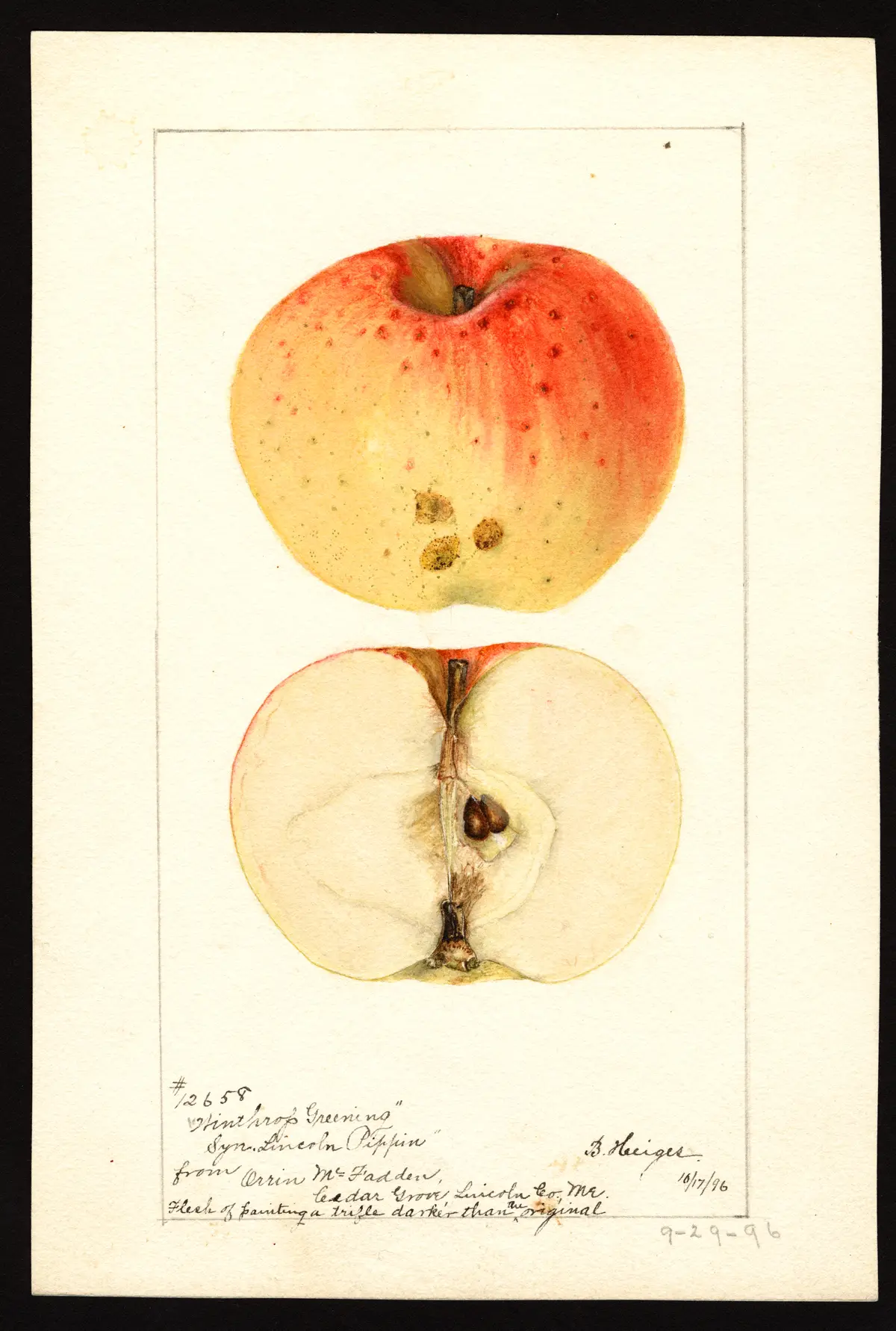
USDA Pomological Watercolor Collection
Origin/History
Originated in Winthrop, Maine, about the year 1800 (Beach; Downing; Elliott). Entered in the catalogue of the American Pomological Society in 1854 and dropped from that list in 1897 (Beach). Little known in New York (Beach). A valued sort in Maine (Thomas).
Tree
Vigorous, upright spreading (Downing). A shy bearer (Beach).
Fruit
Size and form: Large; oblate, remotely conical, slightly ribbed, nearly regular (Thomas); oblate, slightly ribbed (Downing). Of good size (Beach).
Stem: Stalk rather short (Downing); stem short (Thomas).
Cavity: Shallow (Thomas).
Calyx: Large, open (Downing).
Basin: Moderate (Thomas).
Skin: Sources give varying accounts. Downing describes the skin as greenish yellow, with nettings and patches of russet, thickly sprinkled with light and gray dots. Elliott describes it as golden yellow, with slight russet tinge of red in the sun. Beach describes it as yellow, tinged with red. Thomas describes it as yellow when ripe, with a little green, sometimes a faint red shade to the sun.
Flesh/flavor: White (Downing) or yellowish white (Thomas); tender, crisp, very juicy (Beach; Elliott); tender, juicy, rather rich subacid (Downing); sprightly, mild subacid (Beach); sprightly rich flavor (Elliott); sub-acid (Thomas). Quality: Good (Downing); good quality (Beach); very good (Thomas).
Core/seeds: Core small (Downing).
Season
September (Downing; Elliott); September to early winter (Beach); mid-autumn (Thomas).
Uses
Not described in source.
Subtypes/Variants
Not described in source.
Other
Not described in source.
Book Sources
Described in 4 period pomological works
Nursery Catalog Sources
Found in 1 catalog (1900)
- Central Experimental Farm , Dominion Department of Agriculture, Agassiz, British Columbia (under test; Bulletin No. 3, Second Series) — 1900 — listed as Lincoln
View original book sources (4)
— A.J. Downing, The Fruits and Fruit Trees of America (1900)Winthrop Greening.
Lincoln Pippin. Howe Apple.
Origin, Winthrop, Me. Tree vigorous, upright spreading.
Fruit large, oblate, slightly ribbed, greenish yellow, with nettings and patches of russet, thickly sprinkled with light and gray dots. Stalk rather short. Calyx large, open. Flesh white, tender, juicy, rather rich subacid. Good. Core small. September.
— S.A. Beach, The Apples of New York, Vol. 2 (1905)WINTHROP GREENING.
REFERENCES. 1. Hovey, Mag. Hort., 12:475. 1846. 2. Cole, 1849:104. 3. Am. Pom. Soc. Cat., 1854. 4. Mag. Hort., 21:63. 1855. 5. Downing, 1857:204. 6. Warder, 1867:737. 7. Thomas, 1875:209. 8. Downing, 1881:111 index, app. 9. Lyon, Mich. Hort. Soc. Rpt., 1890:300. 10. Burrill and McCluer, Ill. Sta. Bul., 45:347. 1896.
SYNONYMS. Howe Apple (2, 5). Kennebec Seedling (8). LINCOLN (1), LINCOLN PIPPIN (4). Lincoln Pippin (2, 5). WINTHROP GREENING (2, 3, 5, 6, 7, 8, 9, 10).
Fruit yellow, tinged with red, of good size and good quality; season September to early winter. The flesh is tender, crisp, very juicy, sprightly, mild subacid (2). The tree is a shy bearer.
Historical. Originated in Winthrop, Me., about the year 1800 (1, 2). It was entered in the catalogue of the American Pomological Society in 1854 (3) and dropped from that list in 1897. It is but little known in New York.
— F.R. Elliott, The Western Fruit Book (1865)Winthrop Greening. Lincoln Pippin. | Howe Apple. Origin, Winthrop, Maine. Fruit, large, golden yellow, with slight russet tinge of red in the sun ; flesh, tender, crisp, very juicy, with a sprightly rich flavor. September. (Cole.)
— John J. Thomas, The American Fruit Culturist (1903)Winthrop Greening. Large, oblate, remotely conical, slightly ribbed, nearly regular; skin yellow, when ripe, with a little green, sometimes a faint red shade to the sun; stem short, cavity shallow, basin moderate; flesh yellowish white, sub-acid, very good. Mid-autumn. A valued sort in Maine.