Stark
Apple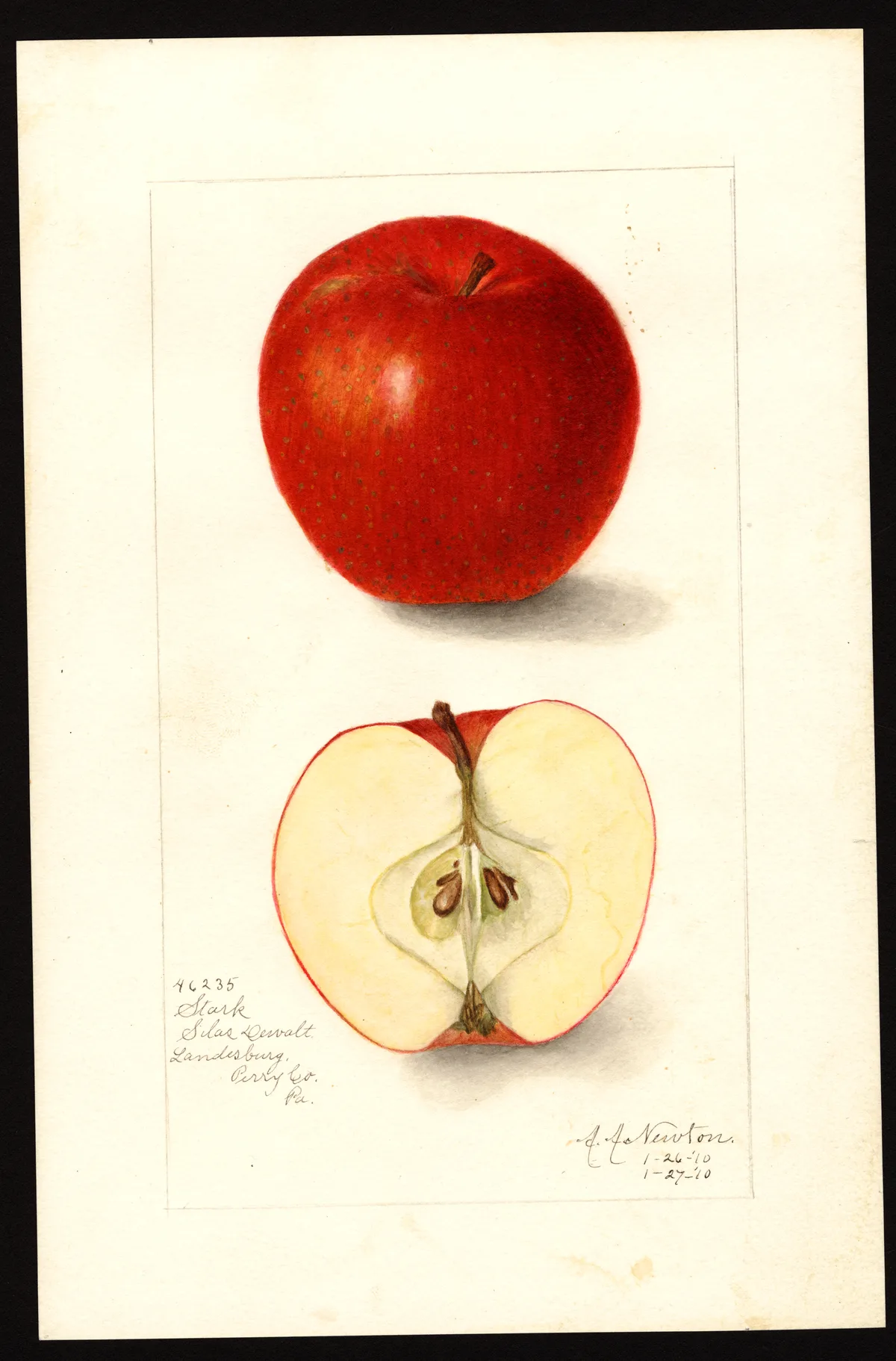
USDA Pomological Watercolor Collection
Stark
Origin / History
Origin unknown, but the variety probably originated in Ohio, where it was first brought to notice and was described first in 1867 as coming from that state. Beach notes that Stark is grown successfully over a wide range of territory and has received favorable notice in various regions from the Atlantic to the Pacific. In 1892 it was offered by nurserymen in all of the apple-growing sections of the country with the exception of the northern portion of the Mississippi valley and the Rocky Mountain region from Montana to Arizona and Texas. Thus far it has not been largely planted in New York but its cultivation in this state appears to be slowly increasing. Hedrick calls it one of the most cosmopolitan of all apples, thriving wherever apples are generally grown on this continent. Stark not only does well throughout the region where Baldwin succeeds but also has won recognition as a desirable commercial variety in certain districts in the North, South and West outside the range of profitable cultivation of Baldwin. At the Central Experimental Farm, Agassiz BC, trees were planted Spring 1890.
Tree
Tree vigorous, upright, spreading (Downing, Budd-Hansen); strong, straight, healthy in the nursery; vigorous and large or moderately large in the orchard, with long, strong branches (Beach). Hedrick describes the trees as vigorous, hardy, healthy, productive, and very accommodating as to soils, and notes Stark surpasses most of its orchard associates in all essential tree-characters. The Central Experimental Farm reports the tree a vigorous grower and a free bearer. Beach adds that it is thrifty, hardy, healthy, a reliable cropper and very productive.
Form upright spreading to roundish, rather dense (Beach); upright-spreading, dense, with long, strong branches (Hedrick). Twigs above medium length, nearly straight, slender to rather stout; internodes short to long. Young shoots dark brownish red (Downing). Bark reddish-brown tinged with olive-green, lightly streaked with gray scarf-skin; pubescent near tips. Lenticels quite numerous, conspicuous, small to large, roundish or oblong, slightly raised. Buds medium to large, plump, obtuse to acute, free, slightly pubescent.
Fruit
Size and Form
Large to medium, sometimes very large, quite uniform in size and shape (Beach); large (Downing, Budd-Hansen, Hedrick, Lowther); large, striped, coarse (Thomas); fruit large, oblong, tapering to the eye (Central Experimental Farm). Form roundish, inclining to conic, sometimes a little elongated, and sometimes slightly oblique (Downing); roundish, slightly conical, sometimes a little elongated and oblique (Budd-Hansen); roundish inclined to conic varying to slightly oblate or to roundish ovate, sides sometimes unequal (Beach); round-conic, oblate or round-ovate, sides sometimes unequal (Hedrick); roundish conical form (Lowther).
Stem and Cavity
Stalk short, rather stout, inserted in a medium cavity (Downing). Stem short to medium in length, moderately stout (Beach); stem short, stout (Hedrick). Cavity medium in size, acuminate or approaching acute, moderately deep, rather wide to moderately narrow, sometimes gently furrowed, occasionally lipped, sometimes russeted and with outspreading russet (Beach); acuminate, deep, wide, sometimes furrowed, occasionally lipped, sometimes russeted and with outspreading russet (Hedrick); cavity regular, obtuse, slightly russeted (Budd-Hansen).
Calyx and Basin
Calyx closed (Downing, Budd-Hansen); medium to rather large, closed or partly open (Beach); large, closed or partly open (Hedrick). Basin rather large, slightly corrugated (Downing); shallow, slightly wrinkled (Budd-Hansen); shallow and obtuse to medium in depth and somewhat abrupt, rather wide, slightly wrinkled (Beach); shallow, obtuse, wide, wrinkled (Hedrick).
Skin
Skin greenish yellow, shaded, splashed, and striped with light and dark red nearly over the whole surface, and thickly sprinkled with light and brown dots, a portion of them areole dots (Downing). Surface smooth, unctuous at maturity, yellowish green, mostly covered with light and dark red, shaded, striped, and splashed, overlaid with whitish; dots many, distinct, brown and whitish, some areolar (Budd-Hansen). Skin smooth or slightly roughened with russet dots, pale green becoming yellow more or less blushed and mottled with red and rather indistinctly striped with darker red; prevailing effect dull green and red, but in highly colored specimens fairly bright red (Beach); skin smooth or roughened with russet dots, pale yellow more or less blushed and mottled with red and indistinctly striped with darker red; prevailing effect dull green and red, in highly-colored specimens bright red (Hedrick). Skin greenish yellow, nearly covered with purple red and sprinkled with brown dots (Central Experimental Farm). Lowther describes the skin as yellow-red. Beach further notes Stark is often dull and not attractive sometimes having but very little red color yet under favorable conditions it is nearly covered with red and in the spring when the contrasting yellow tints are fully developed it becomes quite attractive. Hedrick adds the fruits are dull and unattractive in color. The fruit stands handling well because it is very firm and has a thick, tough skin (Beach); the flesh is firm and the skin thick and tough, qualities which make the crop desirable for distant shipment (Hedrick).
Flesh and Flavor
Flesh yellowish, a little coarse, moderately juicy, mild subacid (Downing, Budd-Hansen); flesh yellowish, crisp, a little coarse, moderately juicy, mildly sub-acid, quality good (Central Experimental Farm); flesh yellowish, firm, moderately fine to rather coarse, breaking, rather tender, juicy, sprightly, mild subacid, not high in flavor, fair to good, or nearly good, in quality (Beach); flesh yellow, firm, fine, breaking, tender, juicy, sprightly, mild subacid; fair to good (Hedrick); mild sub-acid, good (Thomas). Quality good (Downing, Budd-Hansen, Lowther, Central Experimental Farm). Beach notes it has a mild flavor and ranks only medium in quality but is well liked for baking and evaporating. Hedrick judges it not good enough in quality for a dessert fruit, though well liked for culinary purposes and prime favorites for drying.
Core and Seeds
Core small (Downing, Hedrick); core open, small, outline irregular, meeting; tube obtusely conical; stamens marginal or median (Budd-Hansen); calyx tube rather wide, truncate cone-shape with fleshy pistil point projecting into the base, or approaching funnel-form; stamens median or below; core medium to rather small, axile; cells uniform, symmetrical, closed or partly open; core lines meeting or slightly clasping; carpels thin, tender, flat, broadly roundish to obcordate, emarginate, mucronate, tufted; seeds few, long, acute, tufted (Beach); calyx-tube wide, truncate cone-shape with fleshy pistil point projecting into the base; stamens median; core small, axile; cells uniform, symmetrical, closed or partly open; core-lines meeting; carpels thin, tender, flat, broadly round to obcordate, emarginate, mucronate, tufted; seeds few, long, acute, tufted (Hedrick).
Season
January to May (Downing, Central Experimental Farm). Late winter (Budd-Hansen). Winter (Lowther). November to April (Hedrick). At Geneva its season in ordinary storage extends from January to June with May as the usual commercial limit (Beach). Valued as a long keeper (Downing, Thomas).
Uses
Family use (Lowther). Well liked for baking and evaporating (Beach); well liked for culinary purposes and prime favorites for drying (Hedrick). Valuable as a keeper (Thomas); valued as a long keeper and profitable market fruit (Downing). Regarded as a good variety for the commercial orchard by some New York fruit growers; often sells in the general market at remunerative prices and is regarded by some as a good apple for export trade; fruit is fair, smooth, uniform and keeps well (Beach). A commercial variety (Budd-Hansen). The thick, tough skin and firm flesh make it desirable for distant shipment (Hedrick, Beach).
Subtypes / Variants
Not described in source.
Other
Lowther reports distribution by reporting stations: Northern Division — no reporting stations; Central Division — 23 reporting stations (also reported in another division); Southern Division — 4 reporting stations (also reported in another division). Beach notes the accompanying illustration shows a highly colored Stark which was grown in Dutchess county.
Book Sources
Described in 6 period pomological works
Nursery Catalog Sources
Found in 33 catalogs (1884–1924) from Alabama, Arkansas, California, Illinois, Missouri, Oregon, Washington
- Felix Gillet , Barren Hill Nursery, Nevada City , California — 1884
- Missouri Nursery Co. , Louisiana , Missouri — 1891
- Milwaukie-Canby Nurseries , Canby, OR (and Milwaukie, OR) — 1893
- Oregon Wholesale Nurseries , Salem , Oregon — 1893
- Multnomah Nurseries , Russellville , Oregon — 1894
- The Vineland Nurseries (Kelsey & Co. , Proprietors), St. Joseph, Missouri (Office: 13th and Atchison Sts., 2 Blocks East of the Citizens St. Car Line) — 1894
- Woodburn Nurseries , Woodburn, Marion Co. , Oregon — 1894
- J.V. Cotta (Cotta Nursery) , Carroll County , Illinois — 1898
- Stark Bros. Nurseries & Orchards Co. , Louisiana , Missouri — 1898
- Alabama Nursery Co. , Huntsville , Alabama — 1900
- Central Experimental Farm , Dominion Department of Agriculture, Agassiz, British Columbia (under test; Bulletin No. 3, Second Series) — 1900
- The Dalles Nurseries , The Dalles , Oregon — 1901
- Washington Nursery Co. , Toppenish , Washington — 1901
- Benjamin Buckman (personal inventory) , Farmingdale , Illinois — 1901
- Mountain Grove Nurseries (Tippin & Moore , Proprietors; Geo. T. Tippin, J. W. Tippin, J. C. Moore), Mountain Grove , Missouri — 1901
- Yarbrough Bros. , Stephens , Arkansas — 1901
- Pacific Nursery Company (W. O. Hudson & A. D. Hudson) , Tangent , Oregon — 1903
- Russellville Nursery Co. , Russellville, OR (three miles east of Portland, one mile from Montavilla car line) — 1903
- Stark Bros. Nurseries & Orchards Co. , Louisiana , Missouri — 1906
- Russellville Nursery Co. , Montavilla Station, Portland, OR (three miles east of Portland, one mile from Montavilla car line) — 1907
- Carlton Nursery Co. , Carlton , Oregon — 1909
- Washington Nursery Company , Toppenish , Washington — 1909
- C.F. Lansing , Salem , Oregon — 1910
- Stark Bros. Nurseries & Orchards Co. , Louisiana , Missouri — 1910
- Stark Bros. Nurseries & Orchards Co. , Louisiana , Missouri — 1911
- Pacific Nursery Company , Portland , Oregon — 1912
- Stark Bros. Nurseries & Orchards Co. , Louisiana , Missouri — 1912
- Vineland Nurseries Company , Clarkston , Washington — 1912
- Washington Nursery Company , Toppenish , Washington — 1912
- Benjamin Buckman (personal inventory) , Farmingdale , Illinois — 1913
- Stark Bros. Nurseries & Orchards Co. , Louisiana , Missouri — 1918
- Christopher Nurseries / John Stewart & Sons , Christopher , Washington — 1920
- Fresno Nursery Co. , Fresno , California — 1924
View original book sources (7)
— A.J. Downing, The Fruits and Fruit Trees of America (1900)Stark. Origin unknown, grown in some parts of Ohio, and valued as a long keeper and profitable market fruit. Tree vigorous, upright, spreading. Young shoots dark brownish red. Fruit large, roundish, inclining to conic, sometimes a little elongated, and sometimes slightly oblique. Skin greenish yellow, shaded, splashed, and striped with light and dark red nearly over the whole surface, and thickly sprinkled with light and brown dots, a portion of them areole dots. Stalk short, rather stout, inserted in a medium cavity. Calyx closed. Basin rather large, slightly corrugated. Flesh yellowish, a little coarse, moderately juicy, mild subacid. Good. Core small. January to May.
— S.A. Beach, The Apples of New York, Vol. 1 (1905)STARK.
REFERENCES. 1. Warder, 1867:732. 2. Prairie Farmer, 1868. (cited by 25). 3. Downing, 1869:360. 4. Fitz, 1872:170. 5. Am. Pom. Soc. Cat., 1873. 6. Thomas, 1875:512. 7. Mo. Hort. Soc. Rpt., 1888:327. 8. Clark, Mo. Sta. Bul. 6:8. 1889. 9. Wickson, 1889:249. 10. Lyon, Mich. Hort. Soc. Rpt., 1890:298. 11. Bailey, An. Hort., 1892:250. 12. Can. Hort., 16:112. 1893. 13. Munson, Me. Sta. Rpt., 1893:133. 14. Stinson, Ark. Sta. Bul. 43:104. 1896. 15. Rural N. Y., 55:1. 1896. fig. 16. Can. Hort., 20:35. 1897. 17. Lazenby, Columbus Hort. Soc. Rpt., 1900:139. 18. Can. Hort., 23:126. 1900. 19. Dickens and Greene, Kan. Sta. Bul., 106:55. 1902. 20. Can. Hort., 25:303. 1902. figs. 21. Woolverton, Ont. Fr. Stas. An. Rpt., 9:2. 1902. figs. 22. Budd-Hansen, 1903:179. figs. 23. Powell and Fulton, U. S. B. P. I. Bul., 48:56. 1903. 24. Beach and Clark, N. Y. Sta. Bul., 248:144. 1904. 25. Ragan, U. S. B. P. I. Bul., 56:291. 1905.
SYNONYMS. Robinson (25). STARKE APPLE (4). Yeats (7, 25).
Stark is regarded as a good variety for the commercial orchard by some New York fruit growers particularly because the tree is thrifty, hardy, healthy, a reliable cropper and very productive and because the fruit is fair, smooth, uniform and keeps well. It is often dull and not attractive sometimes having but very little red color yet under favorable conditions it is nearly covered with red and in the spring when the contrasting yellow tints are fully developed it becomes quite attractive. The accompanying illustration shows a highly colored Stark which was grown in Dutchess county. At Geneva its season in ordinary storage extends from January to June with May as the usual commercial limit. The fruit stands handling well because it is very firm and has a thick, tough skin. It has a mild flavor and ranks only medium in quality but is well liked for baking and evaporating. It often sells in the general market at remunerative prices and is regarded by some as a good apple for export trade (20, 21). Stark not only does well throughout the region where Baldwin succeeds but also has won recognition as a desirable commercial variety in certain districts in the North, South and West outside the range of profitable cultivation of Baldwin.
Historical. Stark was first brought to notice in Ohio (3) and is said to have originated in that state (25). It is grown successfully over a wide range of territory and has received favorable notice in various regions from the Atlantic to the Pacific. In 1892 it was offered by nurserymen in all of the apple-growing sections of the country with the exception of the northern portion of the Mississippi valley and the Rocky Mountain region from Montana to Arizona and Texas (11). Thus far it has not been largely planted in New York but its cultivation in this state appears to be slowly increasing.
TREE.
Tree strong, straight, healthy in the nursery; vigorous and large or moderately large in the orchard, with long, strong branches. Form upright spreading to roundish, rather dense. Twigs above medium length, nearly straight, slender to rather stout; internodes short to long. Bark reddish-brown tinged with olive-green, lightly streaked with gray scarf-skin; pubescent near tips. Lenticels quite numerous, conspicuous, small to large, roundish or oblong, slightly raised. Buds medium to large, plump, obtuse to acute, free, slightly pubescent.
FRUIT.
Fruit large to medium, sometimes very large, quite uniform in size and shape. Form roundish inclined to conic varying to slightly oblate or to roundish ovate; sides sometimes unequal. Stem short to medium in length, moderately stout. Cavity medium in size, acuminate or approaching acute, moderately deep, rather wide to moderately narrow, sometimes gently furrowed, occasionally lipped, sometimes russeted and with outspreading russet. Calyx medium to rather large, closed or partly open. Basin shallow and obtuse to medium in depth and somewhat abrupt, rather wide, slightly wrinkled. Skin smooth or slightly roughened with russet dots, pale green becoming yellow more or less blushed and mottled with red and rather indistinctly striped with darker red. Prevailing effect dull green and red, but in highly colored specimens fairly bright red. Calyx tube rather wide, truncate cone-shape with fleshy pistil point projecting into the base, or approaching funnel-form. Stamens median or below. Core medium to rather small, axile; cells uniform, symmetrical, closed or partly open; core lines meeting or slightly clasping. Carpels thin, tender, flat, broadly roundish to obcordate, emarginate, mucronate, tufted. Seeds few, long, acute, tufted. Flesh yellowish, firm, moderately fine to rather coarse, breaking, rather tender, juicy, sprightly, mild subacid, not high in flavor, fair to good, or nearly good, in quality.
— Granville Lowther (ed.), Encyclopedia of Practical Horticulture (1914)Stark is a large apple of roundish conical form with yellow-red skin. Quality: good. Use: family. Season: winter. Northern Division: no reporting stations; Central Division: 23 reporting stations (also reported in another division); Southern Division: 4 reporting stations (also reported in another division).
— Central Experimental Farm, Central Experimental Farm, Agassiz BC — Catalogue of Fruit Trees under Test (Bulletin No. 3, 1900) (1900)Planted Spring 1890. Tree a vigorous grower and a free bearer. Fruit large, oblong, tapering to the eye. Skin greenish yellow, nearly covered with purple red and sprinkled with brown dots. Flesh yellowish, crisp, a little coarse, moderately juicy, mildly sub-acid, quality good. Season January to May.
— John J. Thomas, The American Fruit Culturist (1903)Stark. Large, striped, coarse; mild sub-acid, good. Valuable as a keeper. Ohio.
— J.L. Budd & N.E. Hansen, American Horticultural Manual, Part II: Systematic Pomology (1914)Stark.—Origin unknown, probably Ohio; tree vigorous, upright, spreading. A commercial variety.
Stark.
Fruit, large, roundish, slightly conical, sometimes a little elongated and oblique; surface smooth, unctuous at maturity, yellowish green, mostly covered with light and dark red, shaded, striped, and splashed, overlaid with whitish; dots many, distinct, brown and whitish, some areolar; cavity regular, obtuse, slightly russeted; basin shallow, slightly wrinkled; calyx closed. Core open, small, outline irregular, meeting; tube obtusely conical: stamens marginal or median; flesh yellowish, a little coarse, moderately juicy, mild subacid, good. Late winter.
— U.P. Hedrick, Cyclopedia of Hardy Fruits (1922)STARK.
Stark surpasses most of its orchard associates in all essential tree-characters—the trees being vigorous, hardy, healthy, productive, and very accommodating as to soils. The fruits are large, smooth, well-turned in shape, uniform, and keep well, but are dull and unattractive in color and not good enough in quality for a dessert fruit, though well liked for culinary purposes and prime favorites for drying. The flesh is firm and the skin thick and tough, qualities which make the crop desirable for distant shipment. Stark is one of the most cosmopolitan of all apples, thriving wherever apples are generally grown on this continent. The variety probably originated in Ohio, having been described first in 1867 as coming from that state.
Tree vigorous, upright-spreading, dense, with long, strong branches. Fruit large, sometimes very large, uniform in size and shape, round-conic, oblate or round-ovate, sides sometimes unequal; stem short, stout; cavity acuminate, deep, wide, sometimes furrowed, occasionally lipped, sometimes russeted and with outspreading russet; calyx large, closed or partly open; basin shallow, obtuse, wide, wrinkled; skin smooth or roughened with russet dots, pale yellow more or less blushed and mottled with red and indistinctly striped with darker red; prevailing effect dull green and red, in highly-colored specimens bright red; calyx-tube wide, truncate cone-shape with fleshy pistil point projecting into the base; stamens median; core small, axile; cells uniform, symmetrical, closed or partly open; core-lines meeting; carpels thin, tender, flat, broadly round to obcordate, emarginate, mucronate, tufted; seeds few, long, acute, tufted; flesh yellow, firm, fine, breaking, tender, juicy, sprightly, mild subacid; fair to good; November to April.