Lincoln Pippin
Apple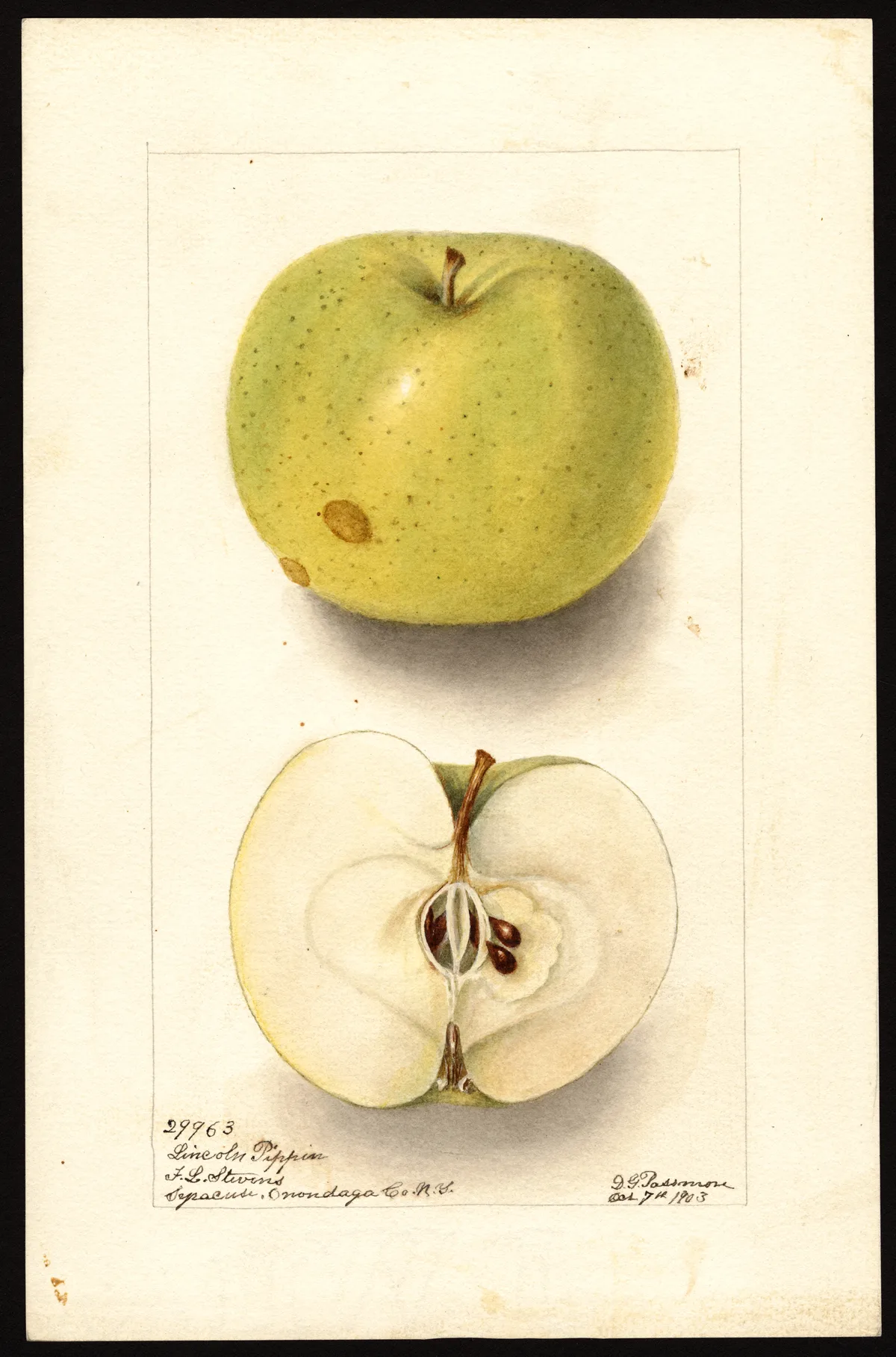
USDA Pomological Watercolor Collection
Lincoln Pippin
Origin and History
An old variety said to have been brought from Connecticut, many years since, to Syracuse, New York, by a Mr. Knapp, and lately brought into notice by the late Reuben Lincoln, whose name it bears. The original name has been lost.
Tree
A tall, vigorous grower, making a large, open, spreading head. An early and good bearer annually, but large crops on alternate years. Hardy, healthy, and long-lived. The fruit is of good appearance—large, fair, and uniform in size—making it valuable for market or family use.
Fruit
Size and Form: Medium to large; roundish oblate, slightly conical, slightly angular; sides sometimes a little unequal.
Skin: Pale greenish yellow, moderately sprinkled with grayish dots.
Stem: Short to long, slender.
Cavity: Large, deep.
Calyx: Small, closed.
Basin: Small or medium, slightly corrugated.
Flesh and Flavor: Half fine, pale whitish yellow, tender, juicy, subacid, slightly aromatic. Quality: very good.
Core: Rather large.
Season
October to December.
Uses
Valuable for market or family use.
Subtypes and Variants
Not described in source.
Other
Not described in source.
Book Sources
Described in 1 period pomological work
View original book sources (1)
— A.J. Downing, The Fruits and Fruit Trees of America (1900)Lincoln Pippin.
An old variety, said to have been brought from Connecticut, many years since, to Syracuse, N. Y., by a Mr. Knapp, and lately brought into notice by the late Reuben Lincoln, whose name it bears, the original name being lost. Tree a tall vigorous grower, making a large, open, spreading head; an early and good bearer annually, but large crops on alternate years; and being hardy, healthy, long-lived, and the fruit of good appearance, large, fair, and uniform in size, makes it valuable for market or family use.
Fruit medium to large, roundish oblate, slightly conical, slightly angular, sides sometimes a little unequal; skin pale greenish yellow, moderately sprinkled with grayish dots; stalk short to long, slender; cavity large, deep; calyx small, closed; basin small or medium, slightly corrugated; flesh half fine, pale whitish yellow, tender, juicy, subacid, slightly aromatic; very good; core rather large. October, December.