Summer Bellflower
Apple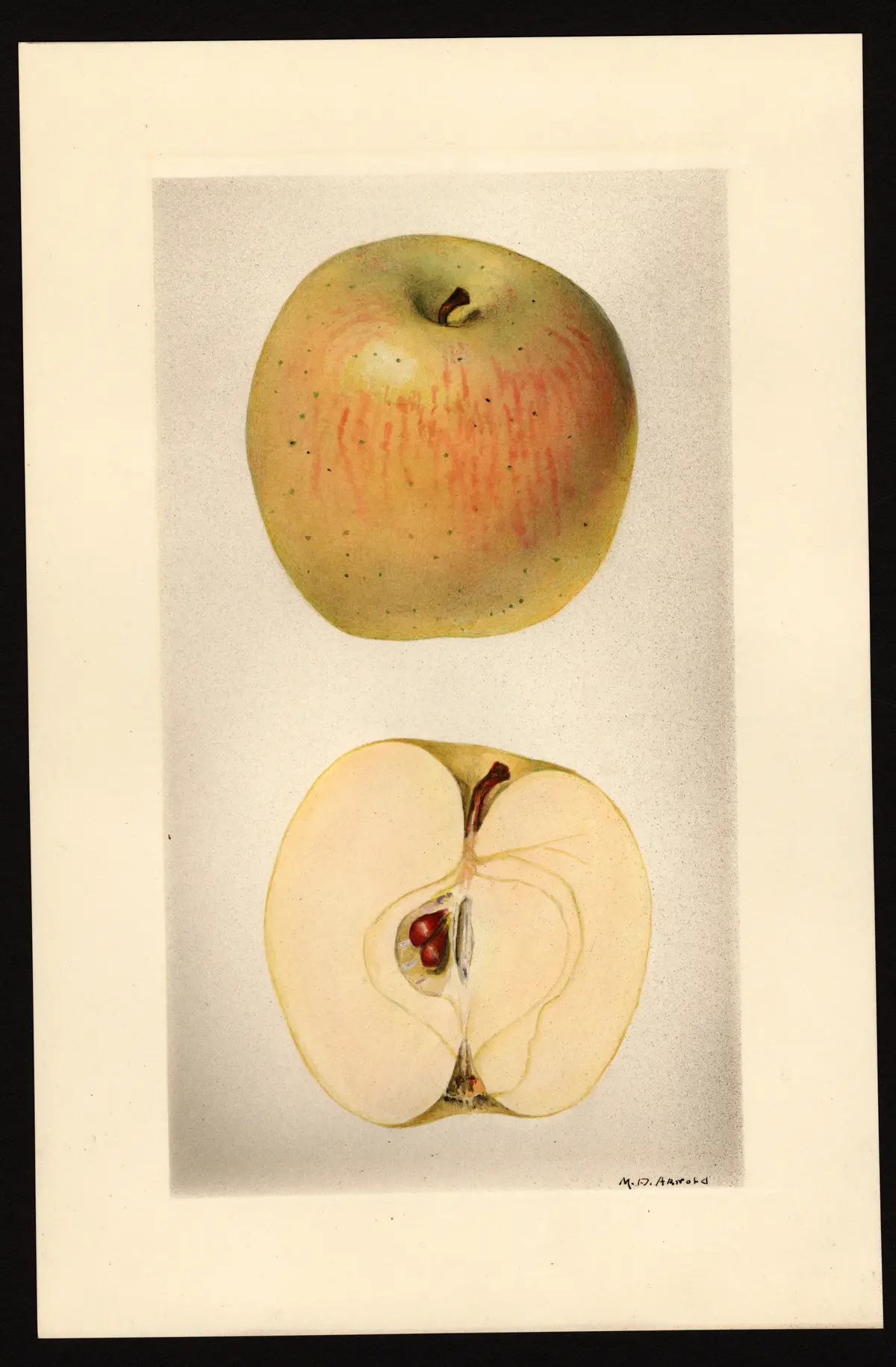
USDA Pomological Watercolor Collection
Origin & History
Originated on the farm of John R. Comstock, Washington, Dutchess County, New York, raised from seed of the Esopus Spitzenburg (Beach). Downing described it in 1848 as a new variety of promise (Beach). It was entered on the list of the American Pomological Society in 1875 as a variety of value for Nebraska, but was dropped from that list in 1897 (Beach). Beach noted that it was not considered a satisfactory variety for commercial planting and, so far as could be learned, was gradually becoming obsolete in New York by 1905.
Tree
Vigorous, upright, productive (Downing). Elliott describes a strong, upright growth with a spreading head, and an early, regular bearer. Beach characterizes the tree as erect, of medium size, a good grower, hardy and a good cropper. Young shoots clear reddish brown (Downing).
Fruit
Size: Medium or above (Downing). Elliott says above medium. Thomas says medium.
Form: Oval, inclining to conic (Downing). Elliott describes the fruit as roundish oblong, slightly conical, with two or three obscure ribs. Thomas describes it as ovate. Beach notes that it bears considerable resemblance in form and color to Yellow Bellflower.
Stem: An inch long (Downing). Elliott describes the stem as long, stout at base.
Cavity: Shallow (Downing, Elliott).
Calyx: Closed, with small reflexed segments (Downing, Elliott).
Basin: Slightly five-sided (Downing). Elliott says five-sided.
Skin: Clear yellow, with rarely a faint orange blush on the side of the sun (Downing). Elliott adds few greenish dots and a faint orange blush.
Flesh & Flavor: White, fine-grained, tender, excellent subacid (Downing). Elliott concurs: white, fine-grained, tender, subacid, rating it "best." Thomas describes the flesh as white, rich, subacid, very good. Beach says tender, subacid, good. Quality ratings differ: Downing rates it "Good," Elliott "best," Thomas "very good," and Beach "good."
Core & Seeds: Core medium, hollow; small seeds (Elliott).
Season
Middle of August to middle of September (Downing, Beach). Elliott gives August to September. Thomas gives August.
Uses
Not described in source.
Subtypes & Variants
Summer Bellflower of Pennsylvania: Described by Downing as quite distinct from the Comstock variety, very much resembling Yellow Bellflower in shape and color, but with a very wide and deep cavity and closed calyx. Flesh yellowish white, firm and fine texture, not very juicy, with a brisk, agreeable, pleasant subacid. Rated "Good." Last of August and first of September. Young shoots light reddish brown, downy. Elliott also describes this Pennsylvania variety and agrees on the wide and deep cavity, closed calyx, yellowish white flesh that is firm and fine in texture, not very juicy, with a brisk, agreeable, very pleasant flavor, rating it "decidedly the best of its season." Beach confirms that a distinct variety of Pennsylvania origin has also been known under the name Summer Bellflower.
Ohio Summer Bellflower: Elliott mentions a Summer Bellflower grown in Ohio, seen only once, which was an inferior fruit, distinct from the Comstock variety.
Book Sources
Described in 4 period pomological works
View original book sources (4)
— A.J. Downing, The Fruits and Fruit Trees of America (1900)Summer Bellflower.
Origin, farm of J. R. Comstock, Dutchess Co., N. Y. Tree vigorous, upright, productive. Young shoots clear reddish brown.
Fruit medium or above, oval, inclining to conic, clear yellow, with rarely a faint orange blush on the side of the sun. Stalk an inch long, in a shallow cavity. Calyx closed, with small reflexed segments, slightly five-sided basin. Flesh white, fine-grained, tender, excellent subacid. Good. Middle of August to middle of September.
Summer Bellflower of Pennsylvania
is quite distinct from the above, and very much resembles Yellow Bellflower in shape and color, but has a very wide and deep cavity, and closed calyx. Flesh yellowish white, firm and fine texture, not very juicy, with a brisk, agreeable, pleasant subacid. Good. Last of August and first of September. Young shoots light reddish brown, downy.
— S.A. Beach, The Apples of New York, Vol. 2 (1905)SUMMER BELLFLOWER.
REFERENCES. 1. Horticulturist, 3:168. 1848. fig. 2. Thomas, 1849:143. 3. Cole, 1849:104. 4. Waring, 1851:31. 5. Elliott, 1854:159. 6. Downing, 1857:196. 7. Warder, 1867:733. 8. Am. Pom. Soc. Cat., 1875:14.
SYNONYMS. SUMMER BELLEFLEUR (1, 8). Summer Belle-fleur (5). SUMMER BELLFLOWER (2, 3, 4, 5, 6, 7). Summer Bell-flower (1).
This fruit bears considerable resemblance in form and color to Yellow Bellflower. Flesh tender, subacid, good. It is in season from the middle of August to the middle of September. The tree is erect, of medium size, a good grower, hardy and a good cropper. It is not considered a satisfactory variety for commercial planting and so far as we can learn is gradually becoming obsolete in New York. Downing described it in 1848 as a new variety of promise and stated that it was raised by John R. Comstock of Washington, Dutchess county, N. Y., from seed of the Esopus Spitzenburg (1, 6). It was entered on the list of the American Pomological Society in 1875 as a variety of value for Nebraska (8). It was dropped from that list in 1897. A distinct variety of Pennsylvania origin has also been known under the name Summer Bellflower (6, 7).
— F.R. Elliott, The Western Fruit Book (1865)Summer Bellflower. Summer Belle-fleur. From Dutchess Co., N. Y. Tree, strong, upright growth, spreading head, early regular bearer. Fruit, above medium, roundish oblong, slightly conical, two or three obscure ribs : clear yellow, few greenish dots, faint orange blush : stem, long, stout at base ; cavity, shallow ; calyx, closed, small reflexed segments ; basin, five-sided ; core, medium, hollow ; small seeds ; flesh, white, fine-grained, tender, sub-acid ; " best." New. Aug. to Sept. (Hort.) There is a Summer Bellflower grown in Ohio, which we have only once seen, which is an inferior fruit, distinct from above. There is also a Summer Bellflower which is distinct from the above, and very much resembles Yellow Bellflower in shape and color, but has a very wide and deep cavity, and closed calyx. Flesh, yellowish white, firm and fine texture, not very juicy, with a brisk, agreeable, very pleasant flavor, and decidedly the best of its season. Last of August and first of September.
— John J. Thomas, The American Fruit Culturist (1903)Summer Bellflower. Medium, ovate, yellow; flesh white, rich, sub-acid, very good. August. Dutchess County, N. Y.