Flory
Apple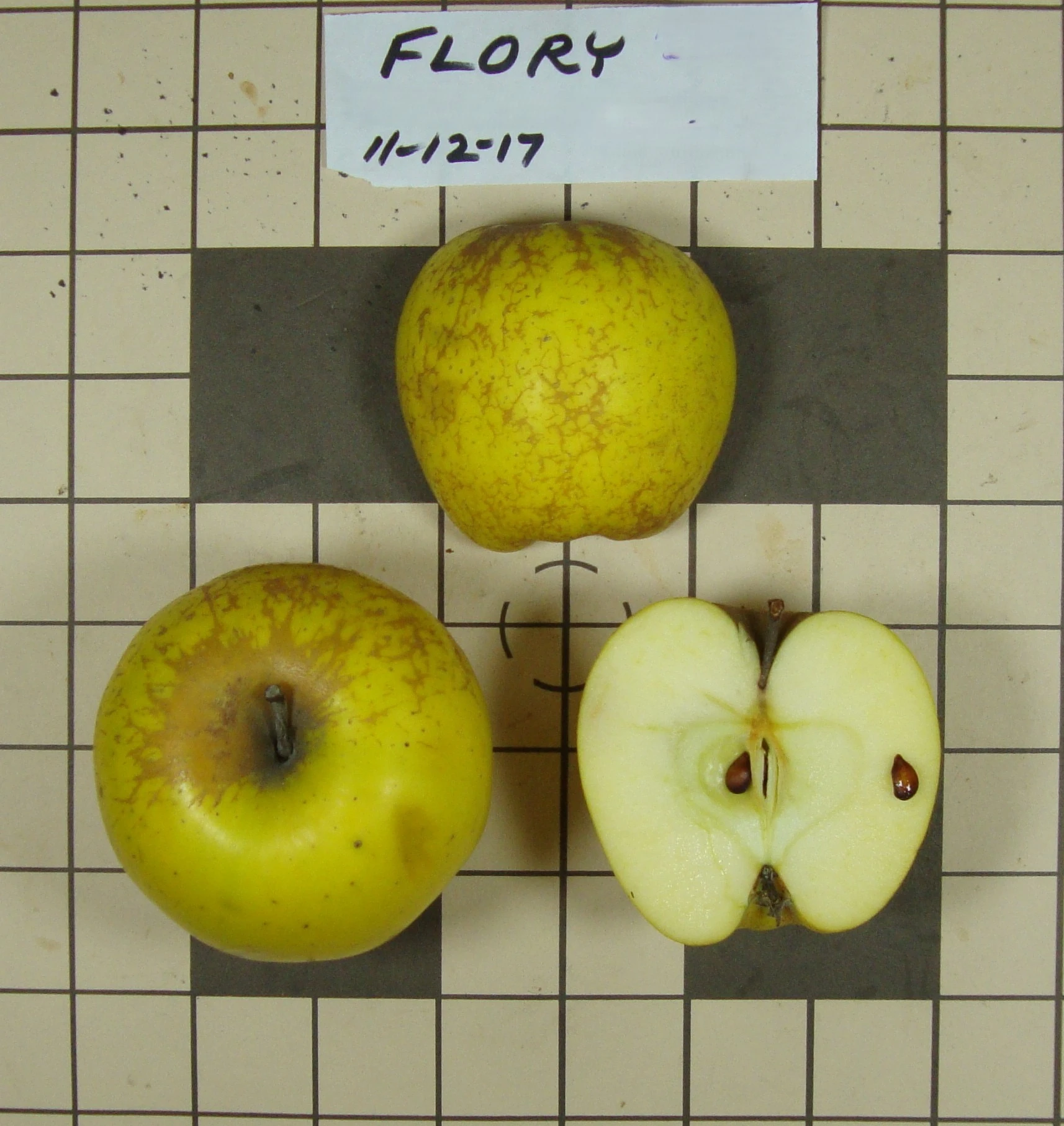
Flory
Origin / History
Originated in Montgomery County, Ohio, before 1872, when it was first described by Downing (Hedrick). Beach's references run from Downing (1872) through Bailey, An. Hort. (1892), Farrand, Michigan Station Bulletin 205 (1903), and Beach and Clark, New York Station Bulletin 248 (1904). Downing called it "a new variety, highly regarded in the vicinity of its origin." Beach calls it "an attractive deep yellow apple of good size and good quality," but does not recommend it for planting in New York. Hedrick places Flory in the type of Yellow Bellflower, "to which it is inferior in nearly all characters." He also states that it "is now grown only in the Middle West, usually under the name Flora Belle."
Tree
Vigorous or rather vigorous; form upright (Downing) to upright spreading. Twigs below medium to above, rather slender, irregularly curved, very slightly pubescent; internodes short to nearly long. Bark dull brownish red, mostly overlaid with thick scarf-skin. Lenticels very numerous, raised, not very conspicuous, medium, narrow, elongated. Buds medium, slightly acute, lightly attached or partly free from the bark (Beach). Downing calls it an abundant bearer. Beach says the tree "does not come into bearing very early and is but moderately productive." At the Central Experimental Farm, Agassiz, British Columbia, a tree planted in spring 1894 was recorded as a vigorous grower.
Fruit
Size: Medium to above medium.
Form: Roundish conic to ovate, often faintly ribbed, pretty symmetrical (Beach). The Agassiz station calls it oblong, slightly conical.
Stem: Medium in length, rather slender (Beach).
Cavity: Acuminate, variable in depth, rather narrow, pretty symmetrical, sometimes lipped (Beach).
Calyx: Closed or partly open; lobes rather narrow and acute. Calyx tube not large, conical to elongated funnel-form, sometimes meeting the core. Stamens median or below (Beach).
Basin: Medium in width, moderately deep to shallow, abrupt, somewhat furrowed (Beach).
Skin: Tough; beautiful rich clear yellow, becoming deeper yellow as the ripening season advances. Marked with small patches or spots of russet and roughened with capillary netted russet lines. Attractive.
Dots: Russet; minute and raised (Downing).
Flesh and flavor: Flesh yellowish (Downing, Beach) or white (Agassiz station). Tender (Downing, Agassiz station); firm, hard, moderately coarse (Beach). Moderately juicy (Downing) to juicy. Subacid, "agreeably subacid" (Beach). Quality good in every account, Beach calling it "good in flavor and quality."
Core and seeds: Core medium to very large, abaxile. Cells fairly symmetrical, partly open to wide open. Core lines meeting when the calyx tube is conical, clasping when it is funnel-form. Carpels long, ovate. Seeds very numerous, often irregular in form, small to rather large, rather wide, obtuse, dark brown (Beach).
Season
The recorded season runs from September into spring. Downing gives October and November, the season Beach cites for Southern Ohio, and the Agassiz station gives September and October. In Western New York the season extends to February, and often some portion of the fruit may be kept till spring (Beach, citing Beach and Clark).
Uses
Not described in source.
Subtypes / Variants
Not described in source.
Other
Not described in source.
Book Sources
Described in 3 period pomological works
Nursery Catalog Sources
Found in 6 catalogs (1891–1904) from Illinois, Missouri
- Missouri Nursery Co. , Louisiana , Missouri — 1891
- The Vineland Nurseries (Kelsey & Co. , Proprietors), St. Joseph, Missouri (Office: 13th and Atchison Sts., 2 Blocks East of the Citizens St. Car Line) — 1894
- J.V. Cotta (Cotta Nursery) , Carroll County , Illinois — 1898
- Central Experimental Farm , Dominion Department of Agriculture, Agassiz, British Columbia (under test; Bulletin No. 3, Second Series) — 1900 — listed as Flora Belle
- Benjamin Buckman (personal inventory) , Farmingdale , Illinois — 1901
- Phoenix Nursery Company (W. E. Rossney , President; Sidney Tuttle, Vice-President), Bloomington , Illinois — 1904 — listed as Flora Belle
View original book sources (4)
— A.J. Downing, The Fruits and Fruit Trees of America (1900)Flory.
Flory's Bellflower. Sheep Shire.
Origin, Montgomery Co., Ohio. A new variety, highly regarded in the vicinity of its origin. Tree upright grower, abundant bearer. Fruit medium, roundish conical, rich yellow, with small patches of russet and minute raised russet dots. Flesh yellowish, tender, moderately juicy, subacid. Good. October, November.
— S.A. Beach, The Apples of New York, Vol. 1 (1905)FLORY.
REFERENCES. 1. Downing, 1872:179. 2. Bailey, An. Hort., 1892:239. 3. Farrand, Mich. Sta. Bul., 205:42. 1903. 4. Beach and Clark, N. Y. Sta. Bul., 248:120. 1904.
SYNONYMS. FLORY BELLFLOWER (3). Flory's Bellflower (1). Sheep Shire (1).
An attractive deep yellow apple of good size and good quality. The tree does not come into bearing very early and is but moderately productive. It is not recommended for planting in New York.
Historical. Origin, Montgomery county, Ohio.
TREE.
Tree rather vigorous. Form upright spreading. Twigs below medium to above, rather slender, irregularly curved, very slightly pubescent; internodes short to nearly long. Bark dull brownish-red, mostly overlaid with thick scarf-skin. Lenticels very numerous, raised, not very conspicuous, medium, narrow, elongated. Buds medium, slightly acute, lightly attached or partly free from the bark.
FRUIT.
Fruit medium or above. Form ovate to roundish conic, often faintly ribbed, pretty symmetrical. Stem medium in length, rather slender. Cavity acuminate, variable in depth, rather narrow, pretty symmetrical, sometimes lipped. Basin medium in width, moderately deep to shallow, abrupt, somewhat furrowed. Calyx closed or partly open; lobes rather narrow and acute.
Skin tough, beautiful clear yellow, becoming deeper yellow as the ripening season advances, roughened with capillary netted russet lines and russet dots. Calyx tube not large, conical to elongated funnel-form, sometimes meeting the core. Stamens median or below. Core medium to very large, abaxile; cells fairly symmetrical, partly open to wide open; core lines meeting when the calyx tube is conical, clasping when it is funnel-form. Carpels long, ovate. Seeds very numerous, often irregular in form, small to rather large, rather wide, obtuse, dark brown. Flesh yellowish, firm, hard, moderately coarse, juicy, agreeably subacid, good in flavor and quality.
Season October and November in Southern Ohio (1); in Western New York it extends to February, and often some portion of the fruit may be kept till spring (4).
— U.P. Hedrick, Cyclopedia of Hardy Fruits (1922)FLORY. Flory Bellflower. Flora Belle. Flory is an apple of the type of Yellow Bellflower, to which it is inferior in nearly all characters. It originated in Montgomery County, Ohio, previous to 1872, when it was first described by Downing. It is now grown only in the Middle West, usually under the name Flora Belle. Tree vigorous, upright-spreading. Fruit medium to large, ovate to round-conic, often ribbed, symmetrical; stem slender; cavity acuminate, symmetrical, sometimes lipped; basin medium in width, deep, abrupt, somewhat furrowed; calyx closed or open; lobes narrow and acute; skin tough, clear yellow, becoming deeper yellow, roughened with capillary-netted russet lines and russet dots; calyx-tube conical, sometimes meeting the core; stamens median; core large, abaxile; cells symmetrical, partly open to wide open; core-lines meeting; carpels long, ovate; seeds numerous, often irregular in form, small to large, wide, obtuse, dark brown; flesh yellow, firm, hard, coarse, juicy, agreeably subacid; good in quality; October.
— Central Experimental Farm, Central Experimental Farm, Agassiz BC — Catalogue of Fruit Trees under Test (Bulletin No. 3, 1900) (1900)Planted Spring 1894. Tree a vigorous grower. Fruit above medium size, oblong, slightly conical. Skin a rich clear yellow, with small russet spots, and russet dots. Flesh white, tender, juicy, sub-acid, quality good. Season September and October.