Fall Wine
Apple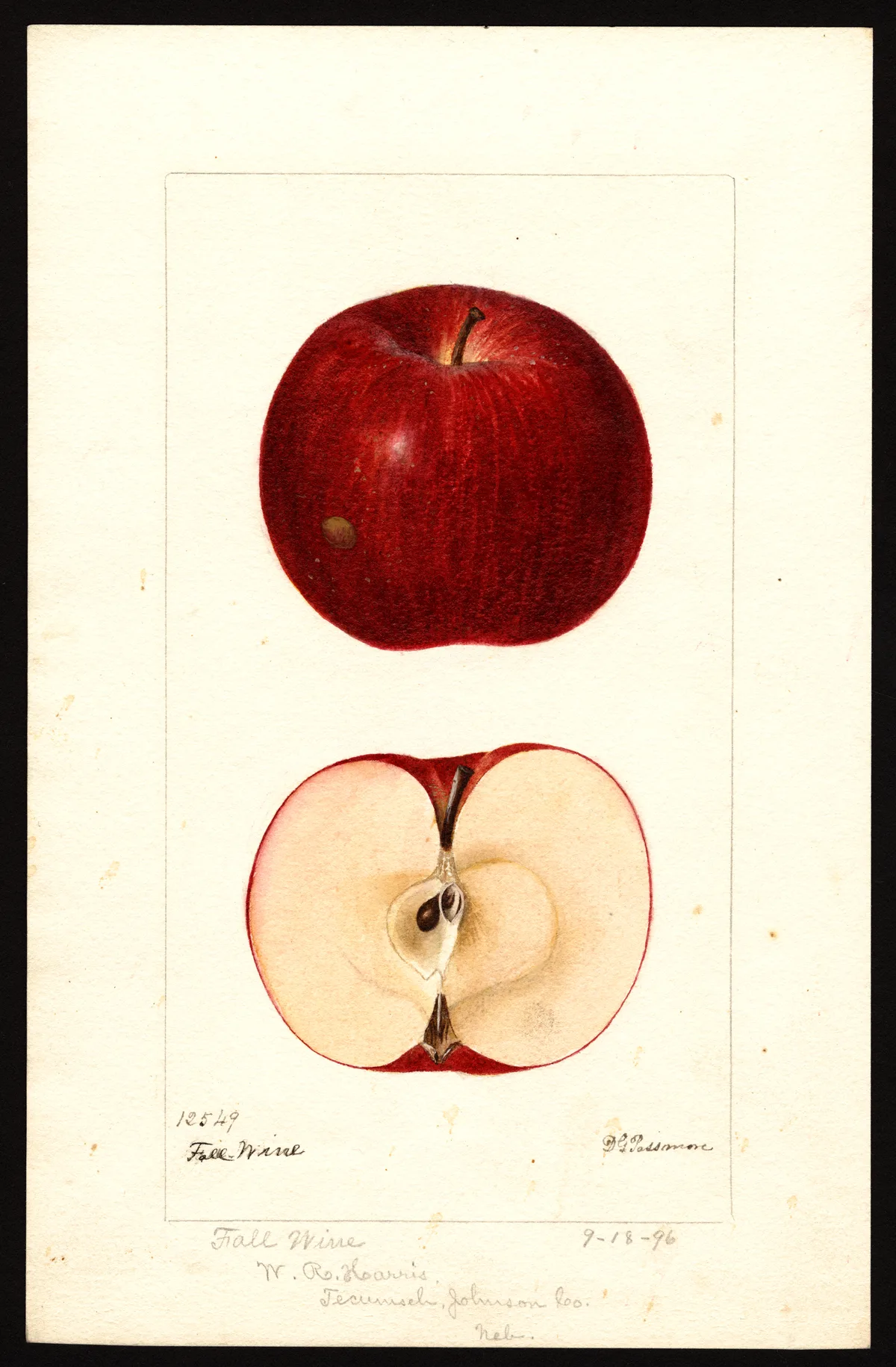
USDA Pomological Watercolor Collection
Fall Wine
Origin / History
American in origin, though its exact origin is unknown. Elliott (1865) records that it was introduced to the West from the garden of Judge Jonathan Buel of Albany, New York, about 1832; Beach (1905) and Hedrick (1922) repeat this Albany, New York, 1832 attribution. Downing supposes it is probably an old Eastern fruit originally called "Wine" or "Sweet Wine," but it is no longer much cultivated in the East on account of the fruit being defective there. Warder (1867) notes it was "brought" from the Eastern States and became a great favorite in the West as a table fruit, while remaining little grown in the East — Downing suggests this is because the fruit is defective there. Elliott observes that although it is evidently an old Eastern fruit, it now appears unknown there, except for Cole's short description and his notice of where it was grown. Elliott further notes that it was, in his time, much grown in Indiana and Illinois under the name "Wine," from which it is quite distinct. Beach warns that Fall Wine should not be confused with Twenty Ounce, which in some sections of New York is known as "Wine apple," and that it is also quite distinct from the true Wine, which is a large, showy apple that ripens in midautumn and often keeps well through the winter. Beach notes it had been a favorite variety in many parts of the Middle West but was not extensively cultivated in New York and was, by 1905, seldom or never planted in that state. Hedrick (1922) writes that "at one time noted for its excellent fruits, Fall Wine has practically passed into oblivion," and that except for the high quality of its product, the variety is but mediocre.
Tree
Of medium size (Warder, Beach, Hedrick), described by Elliott as of slender, slow growth, and by Budd-Hansen (1914) as of rather slender spreading growth. Warder calls it rather slender but healthy, spreading, and annually productive. Beach describes the tree as having rather drooping branches, moderately vigorous, healthy, moderately long-lived, yielding good to heavy crops biennially. Elliott specifies it is drooping when in bearing state, very healthy, producing moderately but annually. Downing calls the tree healthy but of rather slender growth, bearing moderate crops annually. Hedrick describes it as of medium size, vigorous, healthy, long-lived, productive biennially. Bearing habit is therefore reported variously as annual (Elliott, Warder, Budd-Hansen, Downing) and biennial (Beach, Hedrick). The Central Experimental Farm catalogue (Agassiz BC, 1900) — where trees were planted Spring 1894 — describes the tree as a vigorous grower and free bearer. Beach notes that the fruit is apt to drop to a considerable extent before it is fully mature.
Fruit
Size
Medium to large (Elliott, Thomas); medium (Warder); above medium (Downing, Budd-Hansen); medium or above (Beach); large (Hedrick, Central Experimental Farm); medium-sized (Lowther). Elliott specifies large, beautiful fruit on rich Western soils and fruit of medium size on soils of moderate quality, with his accompanying figure exhibiting examples from the two soils.
Form
Roundish, flattened (Elliott); oblate (Warder, Budd-Hansen); roundish-oblate (Thomas, Lowther); round-oblate, ribbed, sides often unequal (Hedrick); roundish oblate, somewhat ribbed, sides often unequal (Beach). The Central Experimental Farm describes the fruit as somewhat tapering to the eye. Warder notes the fruit is inclined to crack open if left on the tree till ripe.
Stem
Slender (Elliott, Thomas); long, slender (Warder, Budd-Hansen, Hedrick); rather long, slender (Downing); medium to rather long (Beach).
Cavity
Deep (Elliott); wide, regular, uniformly green (Warder); broad, deep, surrounded by clear waxen yellow (Downing); deep, wide, regular, uniformly green (Budd-Hansen); obtuse to somewhat acute, wide, shallow to moderately deep, sometimes lipped (Beach); obtuse, wide, deep, sometimes lipped (Hedrick).
Calyx
Half closed (Elliott); small, closed, with calyx reflexed (Warder); partially closed (Downing); small, half open, with segments divergent (Budd-Hansen); small to medium, closed or partly open, with lobes long, narrow, reflexed (Beach); small, closed or partly open, with lobes long, narrow, reflexed (Hedrick). Beach and Hedrick add that the calyx tube is long, narrow, funnel-form, and the stamens median.
Basin
Open, shallow (Elliott); abrupt, wide, regular or wavy (Warder); broad, deep, corrugated (Downing); wide, deep, abrupt, regular, slightly corrugated (Budd-Hansen); deep, wide or medium in width, rather abrupt, furrowed (Beach); deep, wide, abrupt, furrowed (Hedrick).
Skin / Color
Rich red marbled over clear yellow, with many spots or specks of brownish — sometimes faintly striped (Elliott). Surface very smooth, waxen-yellow, almost completely covered with bright, and often deep red, upon which it is indistinctly striped; dots minute (Warder). Striped and shaded with red on a light ground, with numerous russet dots (Downing). Rich red, faintly striped on a rich yellow skin (Thomas). Surface very smooth, clear, waxen yellow, almost wholly covered with bright and often deep red, obscurely striped sometimes with spots or specks of brownish red, very fair in new rich Western soils; dots minute, many, russet (Budd-Hansen). Bright red, attractive (Beach); skin clear yellow washed with red which on the exposed cheek deepens to a beautiful bright blush, indistinctly striped with carmine; dots yellowish-brown or russet (Beach). Yellow washed with red which on the exposed cheek deepens to a bright blush, indistinctly striped with carmine; dots yellowish-brown or russet (Hedrick). Red and yellow skin (Lowther). The Central Experimental Farm catalogue uniquely describes the skin as greenish yellow with red splashes.
Flesh / Flavor
Yellowish, crisp, tender, juicy, delicious, sub-acid, vinous (Elliott). Yellow, breaking, tender, fine-grained, juicy; flavor mild sub-acid and very aromatic; quality best, for table and market (Warder). Yellowish, juicy, tender, with a rich, aromatic, very mild, subacid flavor, almost sweet; very good to best (Downing). Yellow, crisp, tender, juicy, with a mild, rich, scarcely sub-acid flavor (Thomas). Yellow, tender, juicy, aromatic, rich, very mild subacid, almost sweet; very good to best (Budd-Hansen). Tinged with yellow, tender, juicy, aromatic, very mild subacid or almost sweet; very good for dessert but only fair for culinary use (Beach). Yellow, tender, juicy, aromatic, very mild subacid; fair to good (Hedrick). The Central Experimental Farm catalogue describes the flesh as yellowish, juicy, tender, mildly acid, aromatic, quality good. Lowther rates the quality as best. Beach notes the fruit is very tender, not a good shipper and not a desirable commercial variety; it is not much valued for culinary use but is generally esteemed wherever it is known on account of its excellent dessert qualities; he does not recommend it for commercial planting in New York. Budd-Hansen note that the fruit is too tender for distant market.
Core / Seeds
Core medium, regular, closed, meeting the eye; seeds numerous, angular or plump (Warder). Core closed, meeting; seeds many, angular or plump (Budd-Hansen). Core medium, axile; cells symmetrical, closed or slightly open; core lines clasping; carpels broadly roundish, tufted; seeds medium size, rather wide, acute (Beach). Core medium, axile; cells symmetrical, closed or open; core-lines clasping; carpels broadly roundish, tufted; seeds wide, acute (Hedrick).
Season
September to November (Elliott, Downing, Budd-Hansen); during September and October or later (Warder); mid-autumn till winter (Thomas); September to early winter (Beach); September to January (Beach, Hedrick); early autumn (Lowther); October (Central Experimental Farm, Agassiz BC). Beach notes Fall Wine succeeds best in the West and is often scabby in the East (a point also made by Thomas, who states it "succeeds best in the West — often scabby at the East").
Uses
Primarily a table / dessert fruit. Warder rates it quality best, for table and market. Beach calls it very good for dessert but only fair for culinary use, generally esteemed for its excellent dessert qualities, but not much valued for culinary use and not a desirable commercial variety due to its tenderness and poor shipping. Budd-Hansen note the fruit is too tender for distant market. Lowther gives the primary use as family.
Subtypes / Variants
Not described in source.
Other
Lowther reports the variety as a medium-sized fruit of roundish oblate form with red and yellow skin, quality best, primary use family, season of ripening early autumn. Reporting stations for Lowther: 4 in the Northern Division, 12 in the Central Division, and 2 in the Southern Division; all three division counts carry an asterisk, indicating the variety is reported as adapted to more than one division. Elliott observes that on rich Western soils the variety produces large, beautiful fruit, while on soils of moderate quality the fruit is of medium size. Warder adds that in virgin soil the fruit is remarkably fair and handsome. Downing notes that in rich Western soils the tree thrives admirably, producing fine fruit, yet in a few localities complaints are made of its being knurly. Budd-Hansen specifies the fruit is "very fair in new rich, Western soils."
Book Sources
Described in 8 period pomological works
- Warder, American Pomology: Apples (1867)
- Beach, The Apples of New York Vol. 2 (1905)
- Budd & Hansen, Systematic Pomology (1914)
- Downing, Fruits and Fruit Trees of America (1900) — listed as Sweet Wine
- Elliott, The Western Fruit Book (1865)
- Lowther (ed.), Encyclopedia of Practical Horticulture (1914)
- Hedrick, Cyclopedia of Hardy Fruits (1922)
- Thomas, The American Fruit Culturist (1903)
Nursery Catalog Sources
Found in 2 catalogs (1894–1900)
- The Vineland Nurseries (Kelsey & Co. , Proprietors), St. Joseph, Missouri (Office: 13th and Atchison Sts., 2 Blocks East of the Citizens St. Car Line) — 1894
- Central Experimental Farm , Dominion Department of Agriculture, Agassiz, British Columbia (under test; Bulletin No. 3, Second Series) — 1900
View original book sources (9)
— F.R. Elliott, The Western Fruit Book (1865)Fall Wine.
Sweet Wine, Wine, of Cole, Uncle Sam's Best. Ohio Wine, Sharpe's Spice,
American: its origin unknown; introduced West from the garden of Judge Buel, Albany, about 1832. Tree, of slender, slow growth; drooping when in bearing state; very healthy; producing moderately, but annually, large, beautiful fruit on the rich Western soils, and fruit of medium size on soils of moderate quality. Our figure exhibits from the two soils. It is now much grown in Indiana and Illinois, as "Wine," from which it is quite distinct.
Size, medium to large; form, roundish, flattened; color, rich red marbled over clear yellow, and with many spots or specks of brownish—sometimes it is faintly striped; stem, slender; cavity, deep; calyx, half closed; basin, open, shallow; flesh, yellowish, crisp, tender, juicy, delicious, sub-acid, vinous. September to November.
Although evidently an old Eastern fruit, it appears now unknown there, if we except the short description made of it by Cole, and his notice of where grown.
— John A. Warder, American Pomology: Apples (1867)Fall Wine.
Origin unknown. A great favorite in the West as a table fruit; little grown in the Eastern States, whence it was brought. Downing supposes this is because the fruit is there defective. In virgin soil it is remarkably fair and handsome.
Tree of medium size, rather slender, but healthy, spreading, and annually productive.
Fruit medium, oblate, handsome; inclined to crack open if left on the tree till ripe; Surface very smooth, waxen-yellow, almost completely covered with bright, and often deep red, upon which it is indistinctly striped; Dots minute.
Basin abrupt, wide, regular or wavy; eye small, closed; Calyx reflexed.
Cavity wide, regular, uniformly green; Stem long, slender.
Core medium, regular, closed, meeting the eye; Seeds numerous, angular or plump; flesh yellow, breaking, tender, fine-grained, juicy; flavor mild sub-acid, and very aromatic; Quality best, for table and market, during September and October or later
— A.J. Downing, The Fruits and Fruit Trees of America (1900)Sweet Wine. Ohio Wine. Fall Wine. Sharpe's Spice. Uncle Sam's best. Musk Spice. Hower or House.
Origin unknown, probably an old Eastern fruit called "Wine" or "Sweet Wine," but not now much cultivated on account of the fruit being defective. In the rich Western soils it thrives admirably, producing fine fruit, yet in a few localities they complain of its being knurly. Tree healthy, but of rather slender growth, bearing moderate crops annually.
Fall Wine. Fruit above medium. Stem rather long, slender, in a broad, deep cavity, surrounded by clear waxen yellow. Calyx partially closed in a broad, deep, corrugated basin. Skin striped and shaded with red, on a light ground, with numerous russet dots. Flesh yellowish, juicy, tender, with a rich, aromatic, very mild, subacid flavor, almost sweet. Very good to best. September, November.
— John J. Thomas, The American Fruit Culturist (1903)Fall Wine.* Medium to large, roundish-oblate; color a rich red, faintly striped on a rich yellow skin; stem slender; flesh yellow, crisp, tender, juicy, with a mild, rich, scarcely sub-acid flavor. Mid-autumn till winter. Fig. 382. Succeeds best in the West—often scabby at the East.
— S.A. Beach, The Apples of New York, Vol. 2 (1905)FALL WINE.
REFERENCES. 1. Mag. Hort., 14:114. 1848. 2. Cole, 1849:108. 3. Ib., 1849:109. 4. Elliott, 1854:77. 5. Horticulturist, 10:87. 1855. 6. Hooper, 1857:36. 7. Downing, 1857:78. 8. Am. Pom. Soc. Rpt., 1860:50, 240. 9. Warder, 1867:434. fig. 10. Downing, 1869:170. fig. 11. Fitz, 1872:153. 12. Thomas, 1875:200. 13. Barry, 1883:338. 14. Wickson, 1889:244. 15. Lyon, Mich. Hort. Soc. Rpt., 1890:290. 16. Bailey, An. Hort., 1892:239. 17. Budd-Hansen, 1903:81. fig.
SYNONYMS. FALL WINE (1, 3, 4, 5, 6, 7, 8, 9, 10, 11, 12, 13, 14, 15, 16, 17). House (10). Hower (10). Musk Spice (10). Ohio Wine (7, 10, 13). Sharpe's Spice (7, 10). Sweet Wine (7, 10). Uncle Sam's Best (7, 10). WINE (2). Wine of Cole (4).
Fruit medium or above, bright red, attractive; in season from September to early winter. The tree is of medium size with rather drooping branches, moderately vigorous, healthy, moderately long-lived and yields good to heavy crops biennially. The fruit is apt to drop to a considerable extent before it is fully mature. It is very tender, not a good shipper and not a desirable commercial variety. It is not much valued for culinary use but it is generally esteemed wherever it is known on account of its excellent dessert qualities. It is not recommended for commercial planting in New York.
Fall Wine should not be confused with Twenty Ounce which in some sections of New York is known under the name of Wine apple. It is also quite distinct from the true Wine which is a large, showy apple that ripens in midautumn and often keeps well through the winter.²
Historical. The origin of this variety is unknown. Elliott (4) says that it was introduced into the West from the garden of Judge Jonathan Buel, Albany, N. Y., about 1832. It has been a favorite variety in many parts of the Middle West but has not been extensively cultivated in New York and is now seldom or never planted in this state.
FRUIT. Fruit medium or above. Form roundish oblate, somewhat ribbed; sides often unequal. Stem medium to rather long. Cavity obtuse to somewhat acute, wide, shallow to moderately deep, sometimes lipped. Calyx small to medium, closed or partly open; lobes long, narrow, reflexed. Basin deep, wide or medium in width, rather abrupt, furrowed. Skin clear yellow washed with red which on the exposed cheek deepens to a beautiful bright blush, indistinctly striped with carmine. Dots yellowish-brown or russet. Calyx tube long, narrow, funnel-form. Stamens median. Core medium, axile; cells symmetrical, closed or slightly open; core lines clasping. Carpels broadly roundish, tufted. Seeds medium size, rather wide, acute. Flesh tinged with yellow, tender, juicy, aromatic, very mild subacid or almost sweet; very good for dessert but only fair for culinary use.
Season September to January.
¹ See description of Twenty Ounce, page 227. ² See description of Wine apple in Volume I of this Report, page 373.
— J.L. Budd & N.E. Hansen, American Horticultural Manual, Part II: Systematic Pomology (1914)Fall Wine.—Of American origin; tree of rather slender spreading growth, a moderate annual bearer. Fruit too tender for distant market.
Fruit above medium, oblate; surface very smooth, clear, waxen yellow, almost wholly covered with bright, and often deep red, obscurely striped sometimes with spots or specks, of brownish red, very fair in new rich, Western soils; dots minute, many, russet; cavity deep, wide, regular, uniformly green; stem long, slender; basin wide, deep, abrupt, regular, slightly corrugated; calyx small, half open; segments divergent. Core closed, meeting; seeds many, angular or plump; flesh yellow, tender, juicy, aromatic, rich very mild subacid, almost sweet, very good to best. September, November.
— Granville Lowther (ed.), Encyclopedia of Practical Horticulture (1914)Fall Wine is a medium-sized fruit of roundish oblate form with red and yellow skin. Quality is best. Primary use is family. Season of ripening is early autumn. Reporting stations: 4 in the Northern Division, 12 in the Central Division, and 2 in the Southern Division; all three division counts carry an asterisk, indicating the variety is reported as adapted to more than one division.
— U.P. Hedrick, Cyclopedia of Hardy Fruits (1922)FALL WINE.
Musk Spice. Ohio Wine. Sweet Wine. Wine.
At one time noted for its excellent fruits, Fall Wine has practically passed into oblivion. Except for the high quality of its product, the variety is but mediocre. Fall Wine is reported to have originated in Albany, New York, in 1832.
Tree of medium size, vigorous, healthy, long-lived, productive biennially. Fruit large, round-oblate, ribbed, sides often unequal; stem long; cavity obtuse, wide, deep, sometimes lipped; calyx small, closed or partly open; lobes long, narrow, reflexed; basin deep, wide, abrupt, furrowed; skin yellow washed with red which on the exposed cheek deepens to a bright blush, indistinctly striped with carmine; dots yellowish-brown or russet; calyx-tube long, narrow, funnel-form; stamens median; core medium, axile; cells symmetrical, closed or open; core-lines clasping; carpels broadly roundish, tufted; seeds wide, acute; flesh yellow, tender, juicy, aromatic, very mild subacid; fair to good; September to January.
— Central Experimental Farm, Central Experimental Farm, Agassiz BC — Catalogue of Fruit Trees under Test (Bulletin No. 3, 1900) (1900)Planted Spring 1894. Tree a vigorous grower and free bearer. Fruit large, somewhat tapering to the eye. Skin greenish yellow with red splashes. Flesh yellowish, juicy, tender, mildly acid, aromatic, quality good. Season October.