Ashmore
Apple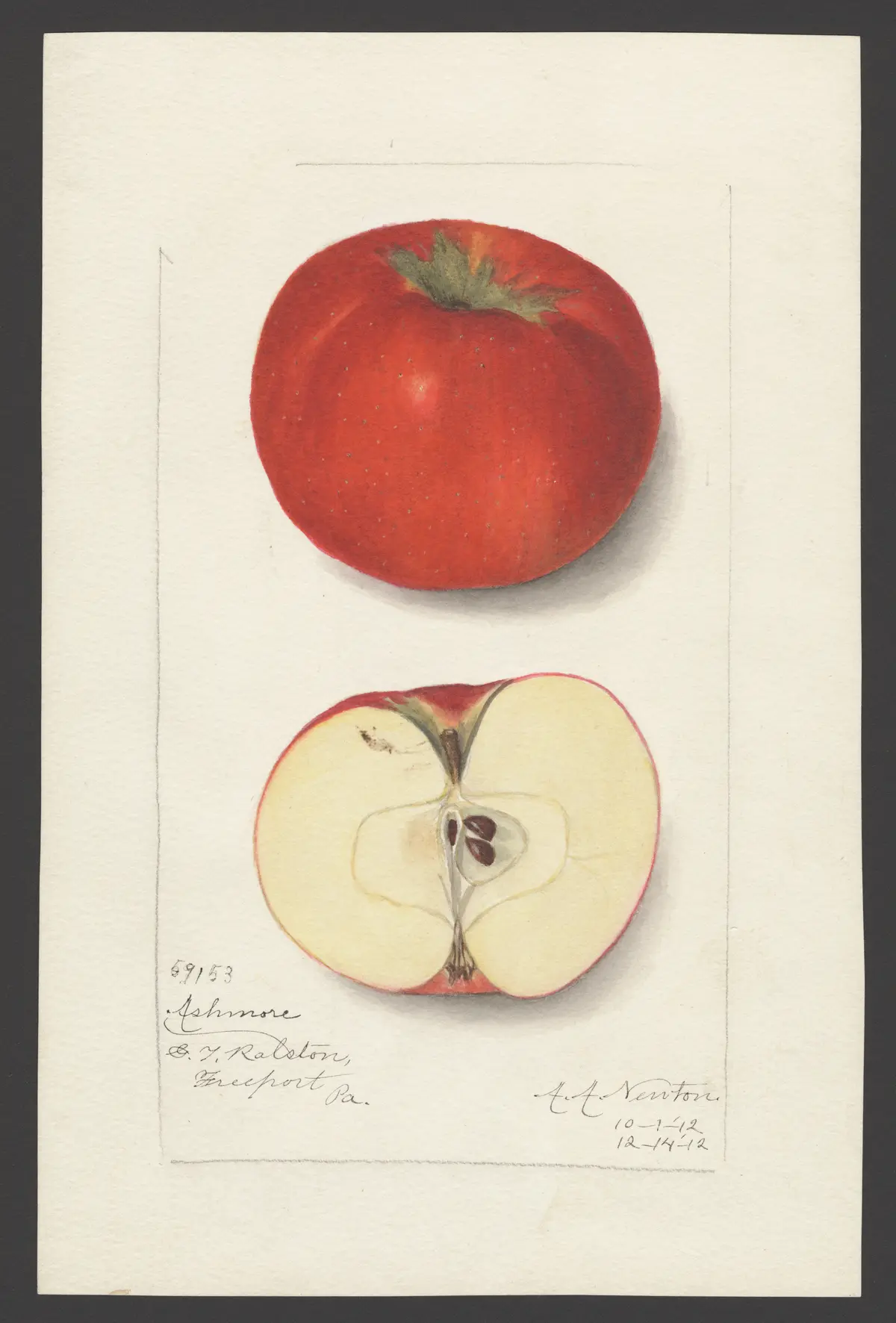
USDA Pomological Watercolor Collection
Ashmore
Origin/History
The origin of Ashmore is unknown. Warder describes it as American and notes that, though not commonly cultivated, it is considerably scattered, having come to him from several points in the West under different local names. Elliott characterizes it as "one of the most showy and desirable market sorts in the South-western States" and notes that the Black Vandervere, a third-rate fruit, is sometimes grown as this variety in error.
Tree
Vigorous, upright, with long parallel branches that become spreading (Warder); upright, spreading (Downing). Young shoots are rather slender (Warder) and dull reddish brown (Downing). Foliage is rich green. Warder notes that the variety has been propagated to some extent by suckers or sprouts.
Fruit
Size and Form: Warder describes the fruit as rather large, handsome, round, frequently flattened, regular, and rarely angular. Elliott calls it above medium, regular, roundish, slightly conical. Downing describes it as medium, roundish oblate, inclining to conical, generally regular.
Stem/Stalk and Cavity: Stem medium to short (Warder); short and slender (Elliott); medium (Downing). Cavity narrow, acute, regular or wavy (Warder); deep (Elliott); broad, deep, slightly russeted (Downing).
Calyx and Basin: Eye/calyx small, closed (all sources agree); segments reflexed (Warder) or erect (Downing). Basin medium, often wavy or even folded (Warder); deep, regular (Elliott); deep, open, slightly uneven (Downing).
Skin: Smooth, polished, very light waxen yellow, almost wholly covered with brilliant lively carmine, very rarely an indistinct stripe (Warder); bright clear red with few white dots (Elliott); glossy, smooth, whitish yellow washed or shaded with rich bright red, obscurely splashed, moderately sprinkled with light and gray dots (Downing). Dots are minute, gray, and indented (Warder).
Flesh and Flavor: Flesh yellowish-white (Warder) or white (Elliott, Downing), crisp, tender, very fine-grained, juicy. Flavor sub-acid, sprightly (Elliott), very agreeable, mild (Downing). Quality best, though not rich (Warder); very good (Downing).
Core and Seeds: Core indistinct, closed (Warder); large with hollow capsules (Elliott); small (Downing). Seeds plump.
Season
September and October (Warder, Elliott); October and November (Downing). May be kept into winter (Warder).
Uses
Table, kitchen, and market. One of the most showy and desirable market sorts in the South-western States (Elliott).
Subtypes/Variants
A Striped Ashmore is recognized, resembling Ashmore in every respect except in the distinct stripe. Warder supposes it to be a sport from Ashmore. Downing notes that the Striped Ashmore is claimed by some as a distinct variety, differing only in its coloring.
Other
Not described in source.
Book Sources
Described in 3 period pomological works
USDA Nomenclature (1905)
From W.H. Ragan, Nomenclature of the Apple, USDA Bulletin No. 56
"Striped Ashmore of Downing," probably distinct.
Nursery Catalog Sources
Found in 1 catalog (1913) from Illinois
- Benjamin Buckman (personal inventory) , Farmingdale , Illinois — 1913
View original book sources (4)
— John A. Warder, American Pomology: Apples (1867)Ashmore.
The origin of this fine dessert fruit is not known. Though not commonly cultivated, it is considerably scattered, and has come to me from several points in the West with different local names.
Tree vigorous, upright, with long parallel branches that become spreading. Shoots rather slender, foliage rich green.
Fruit rather large, handsome, round, frequently flattened, regular, rarely angular; Surface smooth, polished, very light waxen yellow, almost wholly covered with brilliant lively carmine, very rarely an indistinct stripe; Dots minute, gray, indented.
Basin medium, often wavy or even folded; Eye small, closed; Segments reflexed.
Cavity narrow, acute, regular or wavy; Stem medium to short.
Core indistinct, closed; Seeds plump; Flesh yellowish-white, crisp, tender, very fine-grained, juicy; Flavor sub-acid, very agreeable; Quality best, though not rich; Uses, table, kitchen and market; Season, September and October; May be kept into winter.
There is also a Striped Ashmore, resembling this in every respect, except in the distinct stripe. It is supposed to be a sport from the above. Both varieties have been propagated to some extent by suckers or sprouts.
— A.J. Downing, The Fruits and Fruit Trees of America (1900)Ashmore. Red Ashmore. Origin unknown. Tree vigorous, upright, spreading. Young shoots dull reddish brown. Fruit medium, form roundish oblate, inclining to conical, generally regular; color whitish yellow, washed or shaded with rich bright red, obscurely splashed, moderately sprinkled with light and gray dots. Skin glossy, smooth. Stalk medium; cavity broad, deep, slightly russeted. Calyx small, finely closed. Segments erect. Basin deep, open, slightly uneven. Flesh white, tender, juicy, mild, subacid. Core small. Very good. October, November. Striped Ashmore is claimed by some as a distinct variety, differing only in its coloring.
— F.R. Elliott, The Western Fruit Book (1865)ASHMORE.
Red Ashmore, (Fall Wine, erroneously. Striped Ashmore.
American. A desirable variety, deserving attention. Fruit, above medium, regular roundish, slightly conical, few white dots, bright clear red; short, slender stem; deep cavity; calyx, small, closed; deep, regular basin; core, large; capsules hollow; seeds, plump; flesh, white, crisp, tender, juicy, sub-acid, sprightly. September and October. The Black Vandervere, a third rate fruit, is sometimes grown as this variety. The true Ashmore is one of the most showy and desirable market sorts in the South-western States.
— John J. Thomas, The American Fruit Culturist (1903)Striped Ashmore. See Ashmore.