Greyhouse
Apple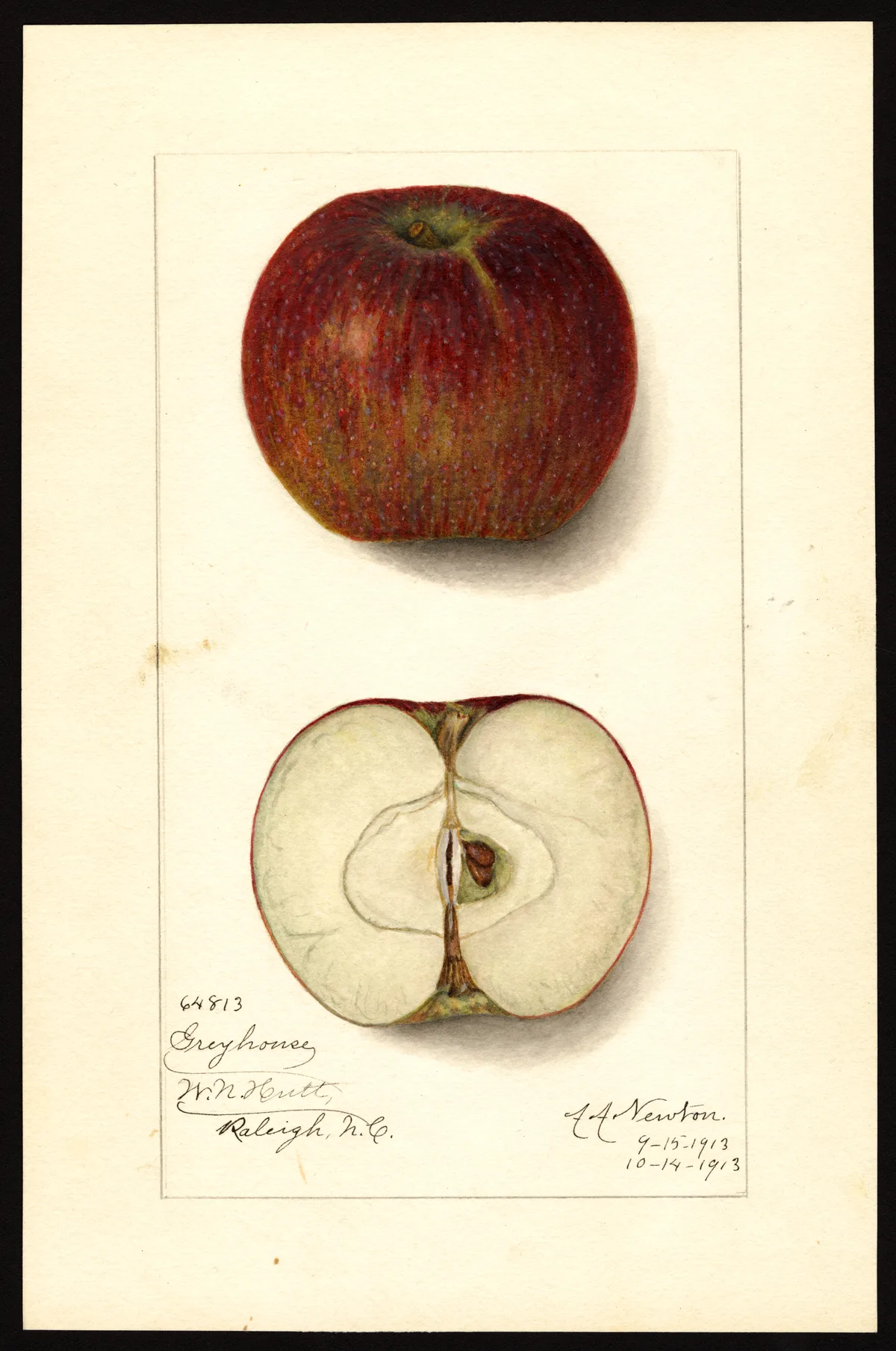
USDA Pomological Watercolor Collection
Greyhouse
Origin/History
Greyhouse probably originated either in New Jersey (Downing; Beach, citing Downing) or Pennsylvania (Beach, citing Warder). It has been long grown and highly valued for cider-making (Downing). The variety has been cultivated under various names in different parts of the country, and there has been much uncertainty with regard to its synonymy; it appears in print as early as Coxe (1817) and is recorded across subsequent pomological literature through the early twentieth century (Beach). The variety now known as May Seek-No-Farther, which was separately described by Elliott and Downing and considerably grown in some parts of the West, is considered identical with Greyhouse (Beach). As of 1905, Greyhouse was still offered by some nurserymen but was not generally cultivated (Beach).
Tree
Downing describes the tree as a strong, erect grower and productive. Beach, however, describes it as vigorous and spreading, and notes it is not a reliable bearer — a characterization supported by the description of Greyhouse under its synonym May Seek-No-Farther, where Downing likewise calls the tree spreading, hardy, and productive. The tree's growth habit is thus in conflict between sources: Downing's direct Greyhouse entry says erect; both Beach and Downing's May Seek-No-Farther entry say spreading.
Fruit
Size
Medium (Elliott; Downing; Beach).
Form
Oblate, nearly globular (Elliott; Downing). Downing, describing the same variety under the name May Seek-No-Farther, characterizes the fruit as oblate and oblique.
Stem
Not described in source.
Cavity
Not described in source.
Calyx
Not described in source.
Basin
Not described in source.
Skin
Thick (Elliott, describing May Seek-No-Further; Beach). In color, dull red with faint stripes (Elliott; Downing, Greyhouse entry). Downing's description under May Seek-No-Farther gives a fuller account: dull greenish, mostly overspread and shaded with obscure stripes and marblings of dull dingy red. Beach describes the color as dull, green and red. The green-and-red characterization from Downing's May Seek-No-Farther entry and from Beach is thus more nuanced than the simple "dull red" of the earlier Greyhouse entries; the green ground is likely underreported in the briefer descriptions.
Flesh and Flavor
Firm and dry (Elliott; Downing). Dry, coarse, and subacid; not suitable for dessert (Beach). Downing, under May Seek-No-Farther, calls the flesh firm, dry, and subacid, and rates it good. Elliott's May Seek-No-Further entry agrees on dry and coarse. Downing's direct Greyhouse entry rates the quality as poor. The variety is valued not for eating quality but solely as a long keeper (Downing; Beach; Downing under May Seek-No-Farther). Elliott's May Seek-No-Further entry notes it is "outwardly like Pryor's Red."
Core and Seeds
Not described in source.
Season
Winter (Elliott). Season February to May (Downing, under May Seek-No-Farther; Beach). A long keeper (Downing; Beach).
Uses
Cider: said to be fine for cider (Elliott); long grown and highly valued for cider-making (Downing). Long keeping: valued primarily as a long keeper rather than for dessert or fresh eating (Downing; Beach; Downing under May Seek-No-Farther). The variety was considerably grown in some parts of the West, valued for its productiveness and long keeping (Downing, under May Seek-No-Farther).
Subtypes/Variants
Not described in source.
Other
Not described in source.
Book Sources
Described in 3 period pomological works
USDA Nomenclature (1905)
From W.H. Ragan, Nomenclature of the Apple, USDA Bulletin No. 56
May Seek-no-further and Hoops are now considered as synonyms of Greyhouse.
View original book sources (3)
— F.R. Elliott, The Western Fruit Book (1865)Greyhouse. Medium, oblate, nearly globular, dull red, with faint stripes ; flesh, firm and dry ; said to be fine for cider. Winter.
[Additional entry in this volume: "May Seek No-Further", pp. 194–194]
May Seek No-Further. Pilliken, | May Apple, | Lop-sided Pearmain. Outwardly like Pryor's Red; flesh, dry, coarse; only valued as a keeper; skin, thick.
— A.J. Downing, The Fruits and Fruit Trees of America (1900)Greyhouse. Hoopes. Hopaoy. Origin, supposed New Jersey. Has been long grown and highly valued for cider-making. Tree strong, erect grower, and productive. Fruit medium, oblate, nearly globular, dull red, with faint stripes. Flesh firm and dry, poor in quality. A long keeper.
[Additional entry in this volume: "May Seek No-Further", pp. 295–295]
May Seek-no-Farther.
Lop-sided Pearmain. Pilliken. May, erroneously.
Origin unknown. Considerably grown in some parts of the West, and valued only because of its productiveness and long keeping.
Tree spreading, hardy, productive.
Fruit medium, oblate, oblique, dull greenish, mostly overspread and shaded with obscure stripes and marblings of dull dingy red. Flesh firm, dry, subacid. Good. February to May.
— S.A. Beach, The Apples of New York, Vol. 1 (1905)GREYHOUSE.
References. 1. Coxe, 1817:154. fig. 2. Elliott, 1854:174. 3. Downing, 1857:214. 4. Warder, 1867:720, 722. 5. Downing, 1872:204, 270. 6. Downing, Am. Pom. Soc. Rpt., 1875:68. 7. Downing, 1876:57 app. 8. Lyon, Mich. Hort. Soc. Rpt., 1890:294. 9. Bailey, An. Hort., 1892:241. 10. Burrill and McCluer, Ill. Sta. Bul., 45:323, 326. 1896. 11. Beach and Clark, N. Y. Sta. Bul., 248:131. 1904. 12. Ragan, U. S. B. P. I. Bul., 56:131. 1905.
Synonyms. Big Romanite (incorrectly 6, 7, 11, of some 12). Black Jack (6, 7, 12). Black Pennock (6, 7, 12). Black Vandervere (7, 12). Black Vandcverc (6). Filliken (6). German Spitzenberg (6, 7, 12). Grayhouse (12). Gray Romanite (6, 12). Hard Red (7, 12). Hoop (12). Hoopes (4, 9). Hoopes (5, 6, 7, 12). Hoopes' Pearmain (6, 7, 12). Hoops (10). Hoops (12). Hopsey (5, 6, 7, 12). Hopson (6, 7, 12). House (1). Keystone (6, 7, 12). Lopside (6, 7, 12). Lop-sided Pearmain (5, 12). Lopside Pearmain (6). May, erroneously (5, 6, 12). May Apple (2). May Seek-No-Farther (7, 11). May Seek-No-Further (2, 6). May Seek-No-Further (12). May Seek-No-Further (8). Pilliken (5, 12). Red Everlasting (6, 7, 12). Romanite (8, incorrectly 6 and 12).
Fruit medium in size, dull colored, green and red; skin thick; flesh dry, coarse, subacid; not suitable for dessert and valued only as a long keeper (1, 2, 5, 8). Season February to May (5, 11). Tree vigorous, spreading; not a reliable bearer.
Historical. Greyhouse probably originated either in New Jersey (5) or Pennsylvania (4). It has been grown under various names in different parts of the country and there has been much uncertainty with regard to its synonymy. May Seek-No-Farther and Hoops are now considered identical with Grayhouse (12). It is still offered by some nurserymen (9), but it is not now generally cultivated (11).