Spijon
Apple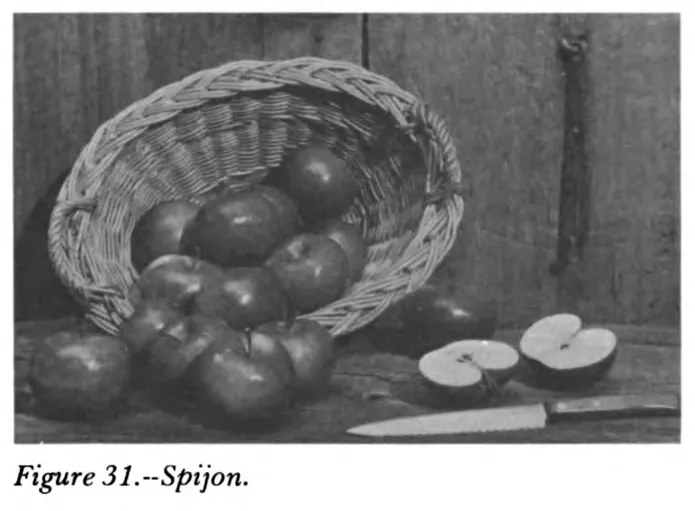
Spijon
Origin / History
Spijon originated from the cross Red Spy x Monroe, made in 1944 and recorded as breeding number 44408. The cross and its reciprocal were made four times, in 1944, 1950, 1952, and 1953. A total of 2092 seedlings were planted into first-test plantings. During the 16-year period from 1952 to 1967, 38 superior clones were selected and propagated from these populations. In 1969 most of the 38 had not yet been fully evaluated, and some of them may prove more superior than Spijon, which was the first to be introduced. No other cross in the apple breeding program at Geneva has produced such a large number of superior selections.
The original Spijon tree first fruited in 1953 and was then assigned the temporary number designation N.Y. 44408-5. After selection it was budded in the nursery onto EM VII and seedling rootstocks. The budded trees were planted into so-called second-test orchards, where they fruited for 10 years, from 1959 until the variety was named in 1968.
The name Spijon was chosen to indicate part of its parentage and grandparentage. "Spi" refers to its seed parent, Red Spy, and "jon" to Jonathan, which is one of its grandparents. Monroe, the pollen parent, has the parentage Jonathan x Rome. The introductory description of Spijon was published as a research circular (225).
Spijon was sold by the New York State Fruit Testing Association under its selection number, N.Y. 44408-5, for 2 years, 1966-67, and as Spijon in 1968. It has performed well in test orchards on commercial fruit farms and is especially suited to the processing industry.
Tree
Trees are upright and spreading, with terminals that are somewhat drooping because of heavy terminal bearing, as in Monroe. Trees are less vigorous than those of the seed parent, Red Spy, and their size is more easily controlled by pruning. Trees were budded onto EM VII and seedling rootstocks.
Trees are precocious, beginning to bear measurable crops about their fourth year in the orchard. They are productive, bearing crops equal to comparably aged McIntosh trees, and individual trees are annually productive, like the parent Monroe.
Spijon blossoms in midseason, averaging about half a day later than Delicious. It is diploid, and its pollen is viable, which makes it a good pollen donor for interplanting in blocks of other commercial cultivars that blossom in midseason. In test orchards on commercial fruit farms it has performed well.
Fruit
Size: Fruits are large, mostly more than 3 inches in diameter.
Form: Oblate, rather symmetrical, though the fruit halves are sometimes unequal in height, resulting in a slightly lopsided shape.
Stem: Usually long and thick, though sometimes intermediate in length. Stems often break off at their base inside the fruit cavity.
Cavity: Nearly obtuse, medium in depth, and rather broad. About half of the cavities are russeted and the other half smooth. Cavities are nearly symmetrical and somewhat furrowed.
Calyx: Conspicuously large, ranging from nearly closed to very open, even to the extent of exposing the calyx tube to full view. Calyx lobes are short, broad, and acuminate. The calyx tube is short, wide, and conical. Stamens are basal.
Basin: Medium in depth, though sometimes rather shallow; medium in width, obtuse, and only slightly furrowed.
Skin: Thick, tough, smooth, rather glossy but slightly dull. Nearly 100 per cent of the surface is a carmine blush with very little striping, giving an attractive over-all appearance with a slightly dull, muddy cast. The skin is susceptible to limb-rub marks, like that of the parent Red Spy.
Dots: Light brown russet, numerous, small, and conspicuous.
Flesh and flavor: Cream colored to light yellow when fully ripened in storage. Immediately after harvest the flesh may have a greenish tinge, with the strands of vascular bundles in the core line prominently green. The flesh is firm, medium grained, and tender, of medium juiciness, subacid, and somewhat sprightly, with fair to good eating quality. Upon exposure to air the flesh oxidizes and turns brown rather quickly. Fruits are not subject to bitter pit.
Core and seeds: Core medium sized to rather large and somewhat open. Carpels are roundish ovate. Seeds are numerous, large, wide, plump, and acuminate.
Season
The average harvest date at Geneva is October 17, 7 days later than Delicious. The average number of days from full bloom to harvest is 152, 7 more than Delicious. The fruits hang well on the tree after they have reached harvest maturity.
Spijon fruits have a long storage life of about 6 months when held at 31° F, and they have a good shelf life after storage.
Uses
Spijon has especially good processing qualities and is among the best cultivars for that purpose in controlled processing tests. In 6 years of processing tests it has rated excellent for applesauce and canned slices and good for frozen slices.
Because of its handsome color, Spijon could be easily sold on fresh markets. However, because it has only mediocre fresh eating quality, it might not be purchased a second time.
Subtypes / Variants
Thirty-eight superior clones were selected from the Red Spy x Monroe population between 1952 and 1967, and most had not been fully evaluated as of 1969. The original tree bore the temporary designation N.Y. 44408-5 before it was named.
Other
The fruit is illustrated in Figure 31 of the source, and fruit characteristics are summarized in Table 8.
Book Sources
Described in 1 period pomological work
View original book sources (1)
— Roger D. Way, Apple Cultivars Introduced by the New York State Agricultural Experiment Station, 1914–1968 (1971)Spijon
Origin. Spijon originated from the cross, Red Spy x Monroe, made in 1944. The breeding record number was 44408. This cross and its reciprocal were made four different times, 1944, 1950, 1952, and 1953. A total of 2092 seedlings were planted into first-test plantings, and during the 16-year period, 1952 to 1967, 38 superior clones were selected and propagated from these populations. In 1969, most of these 38 had not yet been fully evaluated. It is possible that some of them will prove to be even more superior than Spijon which was the first to be introduced. No other cross in the apple breeding program at Geneva has ever had such a large number of superior selections chosen from it.
The original Spijon tree first fruited in 1953 and at that time was assigned the temporary number designation, N.Y. 44408-5. After selection, it was budded in the nursery onto EM VII and seedling rootstocks. These budded trees were planted into so-called second-test orchards and fruited there for 10 years from 1959 until it was named in 1968 (Table 2).
The name Spijon was chosen to indicate a part of the parentage and grandparentage from which it originated. "Spi" refers to its seed parent, Red Spy, and "jon" to Jonathan which is one of its grandparents. Monroe, the pollen parent of Spijon, has the parentage, Jonathan x Rome. The introductory description of Spijon was published as a research circular (225).
Tree. Spijon tree characteristics are summarized in Table 5. Trees are less vigorous, and therefore their size is more easily controlled by pruning than trees of Spijon's parent, Red Spy. Like trees of Monroe, Spijon trees are upright and spreading with terminals which are somewhat drooping because of heavy terminal bearing. Trees are precocious, beginning to bear measurable crops about their fourth year in the orchard (Table 5). Trees are productive, bearing crops equal to comparably aged McIntosh trees (225). Individual trees are annually productive like the parent Monroe.
Pollination. Spijon blossoms in midseason, averaging about half a day later than Delicious (Table 6). It is diploid (Table 4), and the pollen is viable (Table 5), making it a good pollen donor to interplant in blocks of other commercial cultivars which blossom in midseason.
Fruit. Spijon fruits are illustrated in Figure 31, and fruit characteristics are summarized in Table 8. The fruits hang well on the tree after they have reached harvest maturity. The average harvest date at Geneva is October 17, 7 days later than Delicious (Table 7). The average number of days from full bloom to harvest is 152 days, 7 more than Delicious.
Fruits are large, mostly more than 3 inches in diameter. The shape is oblate, rather symmetrical, though fruit halves are sometimes unequal in height, resulting in a slightly lopsided shape. Stems are usually long and thick, though they are sometimes intermediate in length. Stems often break off at their base inside the fruit cavities. Fruit cavities are nearly obtuse, being medium in depth and rather broad. About half of the cavities are russeted and the other half, smooth. Cavities are nearly symmetrical and somewhat furrowed. The calyx is conspicuously large and ranges from nearly closed to very open, even to the extent of exposing the calyx tube to full view. The calyx lobes are short, broad, and acuminate. The basin is medium in depth, though it is sometimes rather shallow; it is medium in width, obtuse, and only slightly furrowed.
The fruit skin is thick, tough, smooth, rather glossy but slightly dull. Nearly 100 per cent of the fruit surface is a carmine blush with very little striping, giving it an over-all attractive appearance but with a slightly dull, muddy cast. The skin is susceptible to limb-rub marks like that of Spijon's parent, Red Spy. The dots are light brown russet, numerous, small, and conspicuous. The calyx tube is short, wide, and conical. Stamens are basal. The core is medium sized to rather large, and it is somewhat open. The carpels are roundish ovate. The seeds are numerous, large, wide, plump, and acuminate. The fruit flesh is cream colored to light yellow when fully ripened in storage. Immediately after harvest the flesh may have a greenish tinge, with the core line strands of vascular bundles being prominently green. The flesh is firm, medium grained, tender, of medium juiciness, subacid, somewhat sprightly, and of fair to good eating quality. Upon exposure to air, the flesh oxidizes and turns brown rather quickly. Fruits are not subject to bitter pit.
Spijon has especially good processing qualities. Controlled processing tests (Table 9) have shown it to be one of the best cultivars for that purpose. In 6 years' processing tests, it has rated excellent for applesauce and canned slices and good for frozen slices.
Spijon fruits have a long storage life of about 6 months when held at 31° F (Table 10). They also have a good shelf life after storage.
Commercial Usefulness. Trees of Spijon were sold by the New York State Fruit Testing Association under its selection number, N.Y. 44408-5, for 2 years, 1966-67, and as Spijon in 1968 (Table 2). In test orchards on commercial fruit farms, it has performed well. It is especially suitable for the processing industry. Because of its handsome color, it could be easily sold on fresh markets. However, because it has only mediocre fresh eating quality, it might not be purchased a second time.