Rome
Apple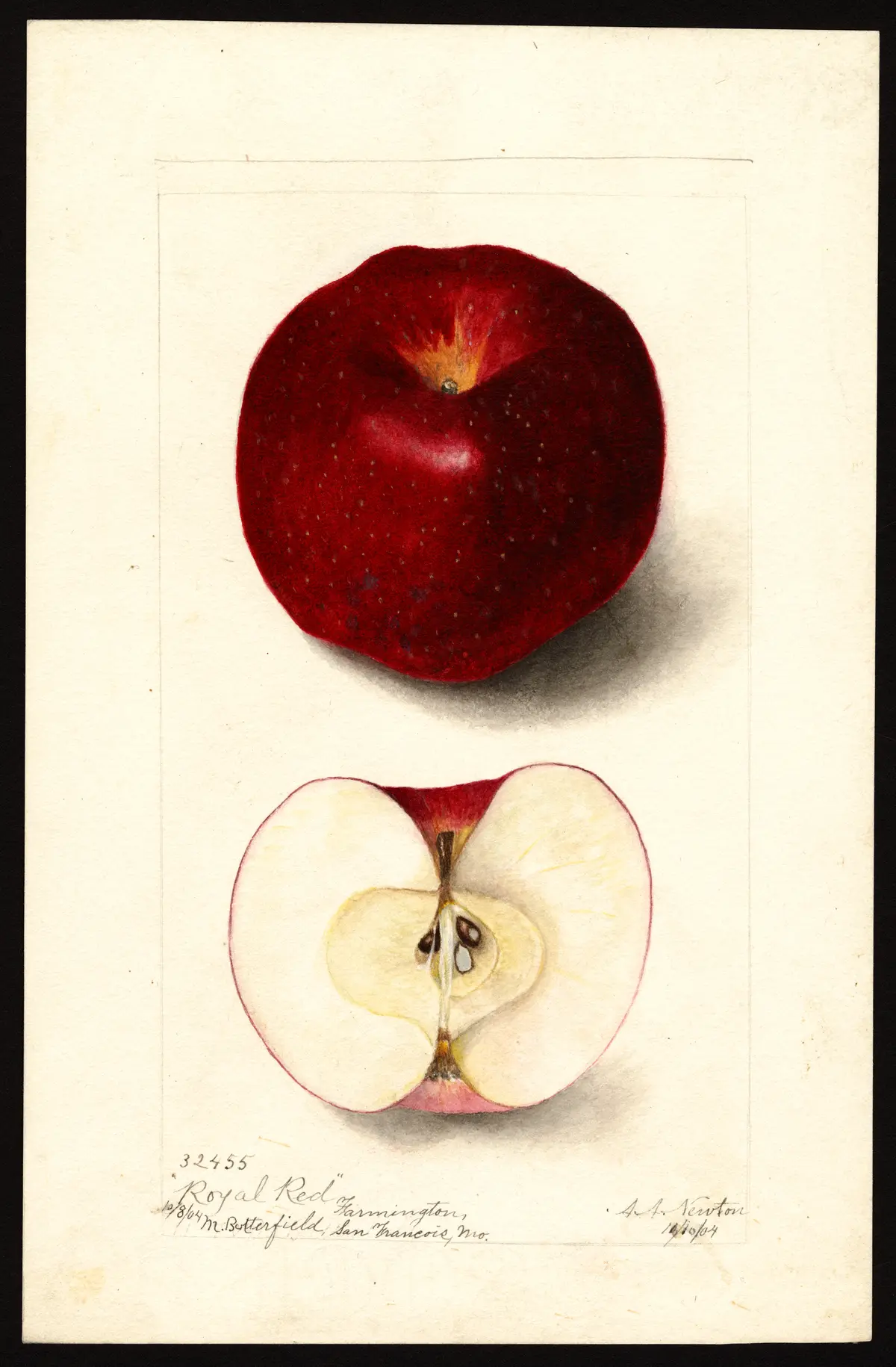
USDA Pomological Watercolor Collection
Rome
Origin/History
Rome originated in southern Ohio, raised by H. N. Gillett of Lawrence County. It was brought to the notice of the public at the Ohio Fruit Growers' Convention in 1848 as a new variety. Warder credits "that sterling pioneer pomologist, H. N. Gillett," and the variety was for a time circulated under the name "Gillett's Seedling." Beach reports that it is "holding its own as a profitable commercial variety" in southern Ohio and in certain other southern apple-growing districts. Stinson reported that in Missouri it is an uncertain bearer and not a safe variety to recommend for general planting, although some Missouri fruit growers recommend it for planting in some locations. Although occasionally old trees of this variety are found in New York, Rome was as yet but little known among New York fruit growers at the time of Beach's writing; within recent years it had been planted or grafted in commercial orchards to a limited extent and for the most part in an experimental way. Lowther (1914) reports it is coming to be widely distributed over the middle and western states, growing into favor in the Pacific Northwest as one of the most profitable varieties, and considered an early bearer, a good bearer, and perhaps the best baking apple in the markets. He notes it is better adapted to the middle section of the United States than to the northern or southern sections. Hedrick (1922) calls it a desirable commercial apple in all apple regions except northern ones, where in its early years at least it is precariously hardy, and notes it does best in southern latitudes or in the mild western climates, yet is grown to perfection in some parts of New York and Michigan. Bunyard (1920), writing from England, says the variety is under trial and so far seems promising, and if it crops sufficiently well and is resistant to canker it should be a valuable late market variety.
Tree
Warder calls the tree thrifty, hardy, round-headed, and very productive, with slender red shoots and healthy foliage; an early producer whose blossoms open late, often allowing it to escape late frost. Downing calls it a moderate grower that succeeds well at the Southwest, with young wood clear reddish brown, slightly downy or gray; a late bloomer. Budd-Hansen describes the tree as a moderate grower, round-headed, very productive, an early bearer, and a late bloomer.
Beach gives the most detailed account: not a very strong grower in the nursery, but in the orchard rather vigorous and attaining good medium size. Form at first upright but later roundish to somewhat spreading and drooping, with rather slender lateral branches. Twigs moderately stout, sometimes slender, moderately long; internodes short. Bark mottled brownish-red and green, rather bright. Lenticels medium to large, scattering, conspicuous, round to oblong, raised. Buds deeply set in bark, very short, broad, obtuse, appressed. Leaves rather long; foliage not particularly robust. Bunyard notes growth medium, at first upright, then slightly drooping, with long oval leaf.
Hedrick describes the tree as vigorous though only of medium size, coming into bearing early and loading with fruit annually; in high winds the apples persist on the long stems and flexible branches better than those of almost any other variety. He notes the trees are susceptible to blight and the scab fungus. Beach likewise notes the tree is apt to overbear, and in unfavorable locations as it advances in maturity there is often a considerable loss in undersized or poorly colored fruit; although it is a good grower there appears to be some advantage in top-grafting it upon some more vigorous stock, and when top-worked on bearing trees it usually produces some fruit within two or three years from the time of grafting or budding. Warder notes the fruit is said to be scabby on old trees. Beach adds that the fruit is supported by a long stem and usually hangs to the tree remarkably well even in high winds, but is somewhat subject to the attacks of scab and requires thorough and careful preventive treatment in order to protect it from injurious insects and diseases.
Fruit
Size
Large to very large. Warder: large to very large. Downing: large. Beach: medium to very large, usually averaging above medium, pretty uniform in size and shape. Lowther: in the Pacific Northwest much above medium. Thomas: large. Budd-Hansen: large. Bunyard: large, 3 by 2¼ inches, nearly round, even. Hedrick: medium to very large, uniform in size and shape.
Form
Warder: regular oblate, roundish-oblate, and sometimes rather conical. Downing: roundish, approaching conic. Beach: roundish to roundish conic or slightly oblong, regular or faintly ribbed, usually symmetrical but sometimes with sides unequal. Elliott: roundish. Thomas: roundish, very slightly conical. Budd-Hansen: roundish oblate, sometimes slightly conical. Bunyard: nearly round, even. Hedrick: round, round-conic, or oblong, regular or faintly ribbed, usually symmetrical but sometimes with sides unequal. Lowther: roundish conic or slightly oblong, regular or faintly ribbed, usually symmetrical with sides sometimes unequal.
Stem
Long and slender, often oblique. Warder: long, slender. Downing: stalk an inch long. Elliott: slender. Beach: characteristically long, slender, and often oblique. Budd-Hansen: medium. Bunyard: always long. Hedrick: characteristically long, slender, often oblique.
Cavity
Warder: wide, wavy, green. Downing: large, deep, surrounded by greenish russet. Elliott: open, regular. Beach: medium to rather large, characteristically obtuse and smooth, moderately shallow to rather deep, wide, sometimes compressed or lipped, often gently furrowed, green or red, never russeted. Budd-Hansen: wide, obtuse, wavy, lined with greenish russet. Bunyard: shallow russet. Hedrick: large, characteristically obtuse and smooth, shallow, wide, sometimes compressed or lipped, often gently furrowed, green or red, never russeted.
Calyx
Warder: eye quite small, closed. Downing: partially closed. Elliott: nearly closed, segments distinctly separate. Beach: rather small to medium, closed or somewhat open; lobes usually converging above but slightly separated toward the base. Budd-Hansen: closed; segments erect convergent. Bunyard: closed. Hedrick: small, closed or open; lobes converging above but separated toward the base.
Basin
Warder: wide, deep, regular. Downing: narrow, deep. Elliott: round, open, moderately deep. Beach: small to medium, shallow to moderately deep, narrow to medium in width, sometimes abrupt, usually a little furrowed or wrinkled. Budd-Hansen: abrupt, smooth, rather shallow. Bunyard: shallow, slightly ribbed. Hedrick: small, shallow, narrow, abrupt, usually furrowed or wrinkled.
Skin
Surface smooth. Warder: pale yellow, striped and mixed bright red; dots minute, indented. Downing: yellow, shaded and striped with bright red, and sprinkled with light dots. Elliott: rich light yellow, mostly overspread and striped with shades of clear, bright red. Beach: thick, tough, smooth, yellow or greenish, more or less mottled with bright red which in highly colored specimens deepens to almost solid red on the exposed cheek, striped with bright carmine; dots rather numerous, whitish or brown, small; prevailing effect red or red mingled with yellow. Thomas: mostly covered with bright red on pale yellow ground. Budd-Hansen: smooth, pale yellow, mostly covered with mixed bright red, striped and splashed, a beautiful fruit; dots distinct, many, russet, rather large. Bunyard: pale yellow, almost covered with bright red flush and some broad broken stripes showing through. Lowther: thick, tough, smooth, yellow or greenish, more or less mottled with bright red, sometimes with a general red color. Hedrick: thick, tough, smooth, yellow mottled with bright red which in highly-colored specimens deepens to solid red on the exposed cheek, striped with bright carmine; dots numerous, white or brown, small. Beach notes the fruit is thick-skinned and stands handling remarkably well.
Flesh and Flavor
Warder: yellow, breaking, coarse-grained; flavor sub-acid, not rich; quality scarcely good — valuable for market on account of its productiveness, size and beauty, as well as for its certain bearing. Downing: yellowish, tender, juicy, sprightly subacid; good. Elliott: yellow, crisp, mild, sub-acid. Beach: nearly white with slight tinge of yellow or green, firm, moderately fine-grained to a little coarse, rather crisp, juicy, slightly aromatic, agreeable mild subacid, commonly good but not high in quality. Thomas: tender, not fine-grained, juicy, of good quality. Budd-Hansen: yellow, coarse-grained, tender, juicy, sprightly subacid, good. Bunyard: palest yellow, crisp, juicy, a little sweet, not any marked flavour. Lowther: white, or nearly white with slight tinge of yellow, firm, moderately fine grained, rather crisp, juicy, slightly aromatic, agreeable mild subacid, commonly good but not high in quality. Hedrick: yellow, firm, fine-grained to coarse, crisp, juicy, aromatic, mild subacid; good. Beach notes that as compared with Baldwin it is not quite so good in quality either for dessert or for culinary uses.
Core and Seeds
Warder: core wide, regular, closed, meeting the eye; seeds numerous, long, pointed. Downing: core rather large. Elliott: core medium, somewhat hollow; seeds long ovate, large and full. Beach: calyx tube cone-shape or approaching short truncate funnel-form, often with fleshy pistil point projecting into the base; stamens marginal to median; core medium to large, abaxile; cells sometimes unsymmetrical, open; core lines meeting or slightly clasping; carpels roundish to ovate, narrowing both toward base and apex, sometimes obtusely emarginate, mucronate; seeds numerous, medium in size, plump, acute to somewhat obtuse, slightly tufted, light and dark brown. Budd-Hansen: core closed, meeting; cells obovate, entire; tube broad, funnel-shaped; stamens median; seeds long, plump, pointed. Hedrick: calyx-tube cone-shape, often with fleshy pistil point projecting into the base; stamens marginal; core medium to large, abaxile; cells sometimes unsymmetrical, open; core-lines meeting; carpels round, narrowing toward base and apex, sometimes obtusely emarginate, mucronate; seeds numerous, plump, acute, tufted, light and dark brown.
Season
Sources give somewhat differing winter ranges. Warder: December to February. Downing: October to December. Elliott: October to December. Thomas: ripens early in winter. Budd-Hansen: early winter. Beach: November to April or May. Lowther: November to April or May. Hedrick: November to May. Bunyard: keeps till May. Beach adds that it is thick-skinned, stands handling remarkably well, and is a good keeper; held in cold storage till May or later, going down gradually in storage, and if properly colored is not subject to scald.
Uses
A handsome market fruit. Warder calls it valuable for market on account of its productiveness, size and beauty, as well as for its certain bearing. Beach notes it has an established reputation in market and sells at good prices. Bunyard lists it as culinary or dessert. Lowther identifies it as perhaps the best baking apple in the markets. Beach notes that compared with Baldwin it is not quite so good in quality either for dessert or for culinary uses, but the tree comes into bearing at a much earlier age and under right conditions is more nearly an annual cropper.
Cultural Notes
Elliott reports that Rome requires, to perfect good fruit, a rich, warm, loamy soil; on poor land it is undersized, deficient in character, and inclined to overbear. Beach reports it appears to be better adapted to bottom lands and to fertile sandy or gravelly loams than to heavy clay soils, and that it develops proper size, color and quality more often when grown in Southeastern New York than in cooler and more elevated regions in the interior of the state; yet in some localities in Western New York on warm, fertile, well-drained soils it attains good size and good color and gives promise of being satisfactory in commercial orchards. Hedrick concurs that it requires rich soils, failing in which, the fruits are undersized and poorly colored.
Subtypes/Variants
Lowther references "Red Rome Beauty" as a related/derivative form (cross-referenced in his entry but not described there).
Other
Not described in source.
Book Sources
Described in 9 period pomological works
- Beach, The Apples of New York Vol. 1 (1905)
- Warder, American Pomology: Apples (1867) — listed as Rome Beauty
- Budd & Hansen, Systematic Pomology (1914) — listed as Rome Beauty
- Lowther (ed.), Encyclopedia of Practical Horticulture (1914) — listed as Rome Beauty
- Bunyard, A Handbook of Hardy Fruits (1920) — listed as ROME BEAUTY
- Downing, Fruits and Fruit Trees of America (1900) — listed as Rome Beauty
- Elliott, The Western Fruit Book (1865) — listed as Rome Beauty
- Hedrick, Cyclopedia of Hardy Fruits (1922) — listed as ROME BEAUTY
- Thomas, The American Fruit Culturist (1903) — listed as Rome Beauty
Nursery Catalog Sources
Found in 73 catalogs (1881–1932) from Alabama, Arkansas, California, Illinois, Kansas, Maryland, Massachusetts, Missouri, Nebraska, New Jersey, New York, Oregon, Pennsylvania, Washington
- Hutchison Nursery , James Hutchison, Oakland , California — 1881 — listed as Rome Beauty
- Felix Gillet , Barren Hill Nursery, Nevada City , California — 1884 — listed as Rome Beauty
- Huntsville Wholesale Nurseries (Jessie S. Moss , Proprietor; W.F. Heikes, Manager), Huntsville , Alabama — 1886 — listed as Rome Beauty
- Felix Gillet , Barren Hill Nursery, Nevada City , California — 1888 — listed as Rome Beauty
- California Nursery Co. , Niles , California — 1889 — listed as Rome Beauty
- Felix Gillet , Barren Hill Nursery, Nevada City , California — 1889 — listed as Rome Beauty
- Felix Gillet , Barren Hill Nursery, Nevada City , California — 1890 — listed as Rome Beauty
- William H. Moon Co. , Morrisville, Bucks County , Pennsylvania — 1890 — listed as Rome Beauty
- Felix Gillet , Barren Hill Nursery, Nevada City , California — 1891 — listed as Rome Beauty
- Puyallup & Yakima Nurseries , Puyallup, Washington (Lock Box 191) and North Yakima , Washington — 1892 — listed as Rome Beauty
- Milwaukie-Canby Nurseries , Canby, OR (and Milwaukie, OR) — 1893 — listed as Rome Beauty
- Rogers Nursery Co. , Moorestown , New Jersey — 1893 — listed as Rome Beauty
- Sherwood Hall Nursery Co. , Timothy Hopkins (Menlo Park Nurseries), San Francisco / Menlo Park , California — 1893 — listed as Rome Beauty
- Multnomah Nurseries , Russellville , Oregon — 1894 — listed as Rome Beauty
- Woodburn Nurseries , Woodburn, Marion Co. , Oregon — 1894 — listed as Rome Beauty
- The Vineland Nurseries (Kelsey & Co. , Proprietors), St. Joseph, Missouri (Office: 13th and Atchison Sts., 2 Blocks East of the Citizens St. Car Line) — 1894 — listed as Rome Beauty
- Felix Gillet , Barren Hill Nursery, Nevada City , California — 1895 — listed as Rome Beauty
- Stark Bros. Nurseries & Orchards Co. , Louisiana , Missouri — 1896 — listed as Rome Beauty
- The Lovett Company , Little Silver , New Jersey — 1896 — listed as Rome Beauty
- Felix Gillet , Barren Hill Nursery, Nevada City , California — 1897 — listed as Rome Beauty
- Reading Nursery , Jacob W. Manning, Proprietor, Reading , Massachusetts — 1898 — listed as Rome Beauty
- Stark Bros. Nurseries & Orchards Co. , Louisiana , Missouri — 1898 — listed as Rome Beauty
- Brown Brothers Co. , Continental Nurseries, Rochester, NY (also operated from Toronto, Canada) — 1899 — listed as Rome Beauty
- Alabama Nursery Co. , Huntsville , Alabama — 1900 — listed as Rome Beauty
- Central Experimental Farm , Dominion Department of Agriculture, Agassiz, British Columbia (under test; Bulletin No. 3, Second Series) — 1900 — listed as Rome Beauty
- Washington Nursery Co. , Toppenish , Washington — 1901 — listed as Rome Beauty
- Brown Brothers Co. , Continental Nurseries, Rochester, NY (also operated from Toronto, Canada) — 1901 — listed as Rome Beauty
- Mountain Grove Nurseries (Tippin & Moore , Proprietors; Geo. T. Tippin, J. W. Tippin, J. C. Moore), Mountain Grove , Missouri — 1901 — listed as Rome Beauty
- S.L. Watkins , Grizzly Flats, El Dorado County , California — 1901 — listed as Rome Beauty
- Yarbrough Bros. , Stephens , Arkansas — 1901 — listed as Rome Beauty
- Benjamin Buckman (personal inventory) , Farmingdale , Illinois — 1901 — listed as Rome Beauty
- Forestville Nurseries , T.J. True, Forestville , California — 1902 — listed as Rome Beauty
- Pacific Nursery Company (W. O. Hudson & A. D. Hudson) , Tangent , Oregon — 1903 — listed as Rome Beauty
- Russellville Nursery Co. , Russellville, OR (three miles east of Portland, one mile from Montavilla car line) — 1903 — listed as Rome Beauty
- Phoenix Nursery Company (W. E. Rossney , President; Sidney Tuttle, Vice-President), Bloomington , Illinois — 1904 — listed as Rome Beauty
- Stark Bros. Nurseries & Orchards Co. , Louisiana , Missouri — 1906 — listed as Rome Beauty
- J.B. Pilkington , Portland , Oregon — 1907 — listed as Rome Beauty
- Russellville Nursery Co. , Montavilla Station, Portland, OR (three miles east of Portland, one mile from Montavilla car line) — 1907 — listed as Rome Beauty
- Carlton Nursery Co. , Carlton , Oregon — 1909 — listed as Rome Beauty
- Milton Nursery Co. (A. Miller & Sons , Proprietors), Milton , Oregon — 1909 — listed as Rome Beauty
- Wm. J. Corse (successor to Robert Sinclair / Sinclair Nurseries) , Baltimore , Maryland — 1909 — listed as Rome Beauty
- Washington Nursery Company , Toppenish , Washington — 1909 — listed as Rome Beauty
- C.F. Lansing , Salem , Oregon — 1910 — listed as Rome Beauty
- Wapato Nursery , Wapato , Washington — 1910 — listed as Rome Beauty
- Cashmere Nurseries , Cashmere , Washington — 1910 — listed as Rome Beauty
- Milton Nursery Co./Montana Fruit Growers — 1910 — listed as Rome Beauty
- Quaker Nurseries (Patterson/Lansing) — 1910 — listed as Rome Beauty
- Stark Bros. Nurseries & Orchards Co. , Louisiana , Missouri — 1910 — listed as Rome Beauty
- Galbraith Nursery Co. (DeWitt Hansen , Pres.-Mgr.), Fairbury , Nebraska — 1911 — listed as Rome Beauty
- Stark Bros. Nurseries & Orchards Co. , Louisiana , Missouri — 1911 — listed as Rome Beauty
- Ballygreen Nurseries , Hanford , Washington — 1912 — listed as Rome Beauty
- Pacific Nursery Company , Portland , Oregon — 1912 — listed as Rome Beauty
- Stark Bros. Nurseries & Orchards Co. , Louisiana , Missouri — 1912 — listed as Rome Beauty
- Vineland Nurseries Company , Clarkston , Washington — 1912 — listed as Rome Beauty
- Washington Nursery Company , Toppenish , Washington — 1912 — listed as Rome Beauty
- J. B. Pilkington , Nurseryman, Portland, OR (nurseries near Newberg, forty miles from Portland) — 1913 — listed as Rome Beauty
- Samuel Fraser , Geneseo , New York — 1913 — listed as Rome Beauty
- Van Holderbeke Nursery Co. , Incorporated, Spokane, Washington (nurseries at Otis Orchards WA, Pasadena WA, Kennewick WA) — 1913 — listed as Rome Beauty
- Benjamin Buckman (personal inventory) , Farmingdale , Illinois — 1913 — listed as Rome Beauty
- Ornamental & Fruit Nursery Company , Wapato, County of Yakima , Washington — 1915 — listed as Rome Beauty
- Union Nurseries , J.B. Weaver & Sons, Union , Oregon — 1915 — listed as Rome Beauty
- Holsinger Bros. Nurseries (Holsinger Brothers Nursery) , Rosedale , Kansas — 1916 — listed as Rome Beauty
- Fancher Creek Nurseries , George C. Roeding, Fresno , California — 1918 — listed as Rome Beauty
- Stark Bros. Nurseries & Orchards Co. , Louisiana , Missouri — 1918 — listed as Rome Beauty
- Oregon Nursery Co. , Orenco , Oregon — 1920 — listed as Rome Beauty
- Christopher Nurseries / John Stewart & Sons , Christopher , Washington — 1920 — listed as Rome Beauty
- Benedict Nursery Co. , Portland , Oregon — 1921 — listed as Rome Beauty
- Fresno Nursery Co. , Fresno , California — 1924 — listed as Rome Beauty
- Columbia & Okanogan Nursery Co. , Wenatchee , Washington — 1925 — listed as Rome Beauty
- Hudson's Wholesale Nurseries , Tangent , Oregon — 1926 — listed as Rome Beauty
- Stark Bro's Nurseries , Louisiana , Missouri — 1932 — listed as Rome Beauty
- Rich & Sons Nursery , Hillsboro , Oregon — listed as Rome Beauty
- North-Western Nurseries , Walla Walla , Washington — listed as Rome Beauty
View original book sources (9)
— John A. Warder, American Pomology: Apples (1867)Rome Beauty. GILLETT'S SEEDLING.
This handsome market fruit was originated in Southern Ohio, by that sterling pioneer pomologist, H. N. Gillett, to whose contributions I acknowledge myself under many obligations.
Tree thrifty, hardy, round headed, very productive;
Fig. 111.—ROME BEAUTY.
shoots slender, red; Foliage healthy; Blossoms open late, and thus it often escapes a late frost; early productive.
Fruit large to very large, regular, handsome, fair, said to be scabby on old trees, regular oblate, roundish-oblate, and sometimes rather conical; Surface smooth, pale yellow, striped and mixed bright red; Dots minute, indented.
Basin wide, deep, regular; Eye quite small, closed. Cavity wide, wavy, green; Stem long, slender. Core wide, regular, closed, meeting the eye; Seeds numerous, long, pointed; Flesh yellow, breaking, coarse-grained; Flavor sub-acid, not rich; Quality scarcely good; valuable for market, on account of its productiveness, size and beauty, as well as for its certain bearing; Season December to February.
— A.J. Downing, The Fruits and Fruit Trees of America (1900)Rome Beauty.
Gillett's Seedling.
Origin, Southern Ohio. Tree a moderate grower, succeeds well at the Southwest. Young wood clear reddish brown, slightly downy or gray. A late bloomer.
Fruit large, roundish, approaching conic, yellow, shaded and striped with bright red, and sprinkled with light dots. Stalk an inch long, inserted in a large, deep cavity, surrounded by greenish russet. Calyx partially closed, set in a narrow, deep basin. Flesh yellowish, tender, juicy, sprightly subacid. Good. Core rather large. October to December.
— S.A. Beach, The Apples of New York, Vol. 1 (1905)ROME.
REFERENCES. 1. Ohio Convention of Fr. Gr. Rpt., 1848. (cited by 2). 2. Hodge, Horticulturist, 6:181. 1851. 3. Emmons, Nat. Hist. N. Y., 3:102. 1851. fig. 4. Elliott, 1854:106. fig. 5. Horticulturist, 9:193. 1854. 6. Mag. Hort., 20:241. 1854. 7. Ib., 22:130. 1856. 8. Wood, Horticulturist, 12:149. 1857. 9. Downing, 1857:102. fig. 10. Gregg, 1857:57. 11. Hooper, 1857:81. 12. Mag. Hort., 26:101. 1860. 13. Am. Pom. Soc. Cat., 1862. 14. Warder, 1867:458. fig. 15. Fitz, 1872:172, 175. 16. Leroy, 1873:124. fig. 17. Thomas, 1875:221. 18. Parry, 1883:341. 19. Wickson, 1889:248. 20. Lyon, Mich. Hort. Soc. Rpt., 1890:296. 21. Bailey, An. Hort., 1892:248. 22. Mathews, Ky. Sta. Bul., 50:32. 1894. 23. Beach, N. Y. Sta. An. Rpt., 14:254. 1895. 24. Rural N. Y., 55:1. 1896. 25. Ib., 56:244. 1897. 26. Massey, N. C. Sta. Bul., 149:317. 1898. 27. Beach, W. N. Y. Hort. Soc. Rpt., 1900:36. 28. Lazenby, Columbus Hort. Soc. Rpt., 1900:138. 29. Beach, W. N. Y. Hort. Soc. Rpt., 1901:76. 30. Van Deman, Rural N. Y., 60:209. 1901. 31. Coxe, Ib., 60:266. 1901. 32. Alwood, Va. Sta. Bul., 130:136. 1901. 33. Black, Rural N. Y., 61:185. 1902. 34. Stinson, Mo. Fr. Sta. Bul., 3:27. 1902. 35. Dickens and Greene, Kan. Sta. Bul., 106:55. 1902. 36. Budd-Hansen, 1903:167. fig. 37. Powell and Fulton, U. S. B. P. I. Bul., 48:54. 1903. 38. Bruner, N. C. Sta. Bul., 182:22. 1903. fig. 39. Beach and Clark, N. Y. Sta. Bul., 248:142. 1904.
SYNONYMS. BELLE DE ROME (16). Faust's Rome Beauty (23). Gillett's Seedling (4, 9, 14, 16). Phoenix, erroneously (29). Roman Beauty (4, 16). ROME BEAUTY (2, 3, 4, 5, 6, 7, 8, 9, 10, 11, 12, 13, 14, 15, 17, 18, 19, 20, 21, 23, 24, 25, 26, 30, 31, 32, 33, 34, 35). Rome Beauty (16, 27, 37, 39). ROME Beauty (36, 38).
When well grown this fruit is of good size, uniform, fair, smooth and handsomely colored. It is thick-skinned, stands handling remarkably well and is a good keeper. It is held in cold storage till May or later. It goes down gradually in storage and if properly colored is not subject to scald (39). It has an established reputation in market and sells at good prices. As compared with Baldwin it is not quite so good in quality either for dessert or for culinary uses but the tree comes into bearing at a much earlier age and under right conditions is more nearly an annual cropper. It is not as well adapted as Baldwin for general cultivation in New York state, the fruit often being less reliable and less satisfactory in size and color, the foliage less healthy and the tree less vigorous and not so large. Although it is an old variety it has not been sufficiently tested in New York to determine the range of its proper cultivation. Generally speaking it succeeds better farther south, as, for example, in some districts in New Jersey and along the Ohio river. It appears to be better adapted to bottom lands and to fertile sandy or gravelly loams than to heavy clay soils. Evidently it develops proper size, color and quality more often when grown in Southeastern New York than it does in cooler and more elevated regions in the interior of the state yet in some localities in Western New York on warm, fertile, well-drained soils it attains good size and good color and gives promise of being satisfactory in commercial orchards. The tree is apt to overbear and in unfavorable locations as it advances in maturity there is often a considerable loss in undersized or poorly colored fruit. Although it is a good grower there appears to be some advantage in top-grafting it upon some more vigorous stock. When top-worked on bearing trees it usually produces some fruit within two or three years from the time of grafting or budding. The fruit is supported by a long stem and usually hangs to the tree remarkably well even in high winds. It is somewhat subject to the attacks of the scab and requires thorough and careful preventive treatment in order to protect it from injurious insects and diseases.
Historical. Originated by H. N. Gillett in Lawrence county, Ohio. Brought to the notice of the Ohio Convention of fruit growers in 1848 as a new variety (1, 14). It is holding its own as a profitable commercial variety in that section of the country (31) and also in certain other southern apple-growing districts (30, 34, 38), but Stinson reports that in Missouri it is an uncertain bearer and not a safe variety to recommend for general planting although some Missouri fruit growers recommend it for planting in some locations (34). Although occasionally old trees of this variety are found in New York, Rome is as yet but little known among New York fruit growers. Within recent years it has been planted or grafted in commercial orchards to a limited extent and for the most part in an experimental way.
TREE.
Tree not a very strong grower in the nursery but in the orchard it is rather vigorous and attains good medium size. Form at first upright but later it is roundish to somewhat spreading and drooping, with rather slender lateral branches. Twigs moderately stout, sometimes slender, moderately long; internodes short. Bark mottled brownish-red and green, rather bright. Lenticels medium to large, scattering, conspicuous, round to oblong, raised. Buds deeply set in bark, very short, broad, obtuse, appressed. Leaves rather long; foliage not particularly robust.
FRUIT.
Fruit medium to very large, usually averaging above medium, pretty uniform in size and shape. Form roundish to roundish conic or slightly oblong, regular or faintly ribbed, usually symmetrical but sometimes with sides unequal. Stem characteristically long, slender, and often oblique. Cavity medium to rather large, characteristically obtuse and smooth, moderately shallow to rather deep, wide, sometimes compressed or lipped, often gently furrowed, green or red, never russeted. Calyx rather small to medium, closed or somewhat open; lobes usually converging above but slightly separated toward the base. Basin small to medium, shallow to moderately deep, narrow to medium in width, sometimes abrupt, usually a little furrowed or wrinkled. Skin thick, tough, smooth, yellow or greenish, more or less mottled with bright red which in highly colored specimens deepens to almost solid red on the exposed cheek, striped with bright carmine. Dots rather numerous, whitish or brown, small. Prevailing effect red or red mingled with yellow. Calyx tube cone-shape or approaching short truncate funnel-form, often with fleshy pistil point projecting into the base. Stamens marginal to median. Core medium to large, abaxile; cells sometimes unsymmetrical, open; core lines meeting or slightly clasping. Carpels roundish to ovate, narrowing both toward base and apex, sometimes obtusely emarginate, mucronate. Seeds numerous, medium in size, plump, acute to somewhat obtuse, slightly tufted, light and dark brown. Flesh nearly white with slight tinge of yellow or green, firm, moderately fine-grained to a little coarse, rather crisp, juicy, slightly aromatic, agreeable mild subacid, commonly good but not high in quality.
Season November to April or May.
— Granville Lowther (ed.), Encyclopedia of Practical Horticulture (1914)Rome Beauty
The Rome Beauty originated in Ohio, by H. N. Gillett of Lawrence county, and was first brought to the notice of the public in the Ohio Fruit Growers' Convention in 1848. It is coming to be widely distributed over the middle and western states, although Stinson says it is not well adapted to Missouri. It is growing into favor in the Pacific Northwest, as one of the most profitable varieties, being considered an early bearer, a good bearer, and perhaps the best baking apple in the markets. It is better adapted to the middle section of the United States than to the northern or southern sections.
Tree not a very vigorous grower as it appears in the nursery, but in the orchard it attains to greater vigor and good medium size. Form at first upright, but later it is roundish to somewhat spreading, and drooping with rather slender lateral branches.
Fruit medium to very large, usually averaging about medium. In the Pacific Northwest it is much above medium. Form roundish conic or slightly oblong, regular or faintly ribbed, usually symmetrical with sides sometimes unequal. Skin thick, tough, smooth, yellow or greenish, more or less mottled with bright red, sometimes with a general red color. See Red Rome Beauty.
Flesh white, or nearly white with slight tinge of yellow, firm, moderately fine grained, rather crisp, juicy, slightly aromatic, agreeable mild subacid, commonly good but not high in quality.
Season from November to April or May.
— F.R. Elliott, The Western Fruit Book (1865)Rome Beauty.
Roman Beauty, | Gillett's Seedling.
American. Native of Southern Ohio. Requires, to perfect good fruit, a rich, warm, loamy soil. On poor land, it is undersized, deficient in character, and inclined to overbear.
Fruit, large ; form, roundish ; color, rich light yellow, mostly overspread and striped with shades of clear, bright red ; stem, slender ; cavity, open, regular ; calyx, nearly closed, segments distinctly separate ; basin, round, open, moderately deep ; flesh, yellow, crisp, mild, sub-acid ; core, medium, somewhat hollow ; seeds, long ovate, large and full. October to December.
— John J. Thomas, The American Fruit Culturist (1903)Rome Beauty.* Large, roundish, very slightly conical; mostly covered with bright red on pale yellow ground; flesh tender, not fine-grained, juicy, of good quality. Ripens early in winter. The large size and beautiful appearance of this Ohio apple render it popular as an orchard variety. Fig. 441.
— J.L. Budd & N.E. Hansen, American Horticultural Manual, Part II: Systematic Pomology (1914)Rome Beauty.—Originated in southern Ohio by H. N. Gillett; tree moderate grower, round-headed, very productive, an early bearer, blooms late.
Fruit large, roundish oblate, sometimes slightly conical; surface smooth, pale yellow, mostly covered with mixed bright red, striped and splashed, a beautiful fruit; dots distinct, many, russet, rather large; cavity wide, obtuse, wavy, lined with greenish russet; stem medium; basin abrupt, smooth, rather shallow; calyx closed; segments erect convergent. Core closed, meeting; cells obovate, entire; tube broad, funnel-shaped; stamens median; seeds long, plump, pointed; flesh yellow, coarse-grained, tender, juicy, sprightly subacid, good. Early winter.
— E.A. Bunyard, A Handbook of Hardy Fruits (1920)ROME BEAUTY. New York, I. p. 290. (Belle de Rome, Roman Beauty, Rome.) Culinary or dessert, till May, large, 3 by 2¼, nearly round, even. Colour, pale yellow, almost covered with bright red flush and some broad broken stripes showing through. Flesh, palest yellow, crisp, juicy, a little sweet, not any marked flavour. Eye, closed, in a shallow, slightly ribbed basin. Stem, always long, in a shallow russet cavity. Growth, medium, at first upright, then slightly dropping. Leaf, long oval. Origin, raised by Mr. Gillett, in Lawrence, Ohio Co. Introduced in 1848. This American variety is under trial and so far seems promising, and if it crops sufficiently well and is resistent to canker it should be a valuable late market variety.
— U.P. Hedrick, Cyclopedia of Hardy Fruits (1922)ROME BEAUTY. Fig. 49. Rome.
Rome Beauty is a desirable commercial apple in all apple regions except northern ones, where in its early years at least, it is precariously hardy. The best characters are those of the tree. The trees, while of but medium size, are vigorous, come in bearing early, load with fruit annually, and in high winds the apples persist on the long stems and flexible branches better than those of almost any other variety. The trees are susceptible to blight and the scab-fungus—unfortunate faults. The apples are large, smooth, handsome, uniform in size and shape, thick-skinned, and, therefore, ship and keep well, but are of only mediocre quality. Generally speaking, Rome Beauty does best in southern latitudes or in the mild western climates, yet it is grown to perfection in some parts of New York and Michigan. It requires rich soils, failing in which, the fruits are undersized and poorly colored. Rome Beauty originated with H. N. Gillet, Lawrence County, Ohio, who brought it to the attention of fruitgrowers in 1848.
Tree vigorous, small, at first upright but later spreading and drooping, with slender, lateral branches. Leaves long. Fruit medium to very large, uniform in size and shape, round, round-conic, or oblong, regular or faintly ribbed, usually symmetrical but sometimes with sides unequal; stem characteristically long, slender, often oblique; cavity large, characteristically obtuse and smooth, shallow, wide, sometimes compressed or lipped, often gently furrowed, green or red, never russeted; calyx small, closed or open; lobes converging above but separated toward the base; basin small, shallow, narrow, abrupt, usually furrowed or wrinkled; skin thick, tough, smooth, yellow mottled with bright red which in highly-colored specimens deepens to solid red on the exposed cheek, striped with bright carmine; dots numerous, white or brown, small; calyx-tube cone-shape, often with fleshy pistil point projecting into the base; stamens marginal; core medium to large, abaxile; cells sometimes unsymmetrical, open; core-lines meeting; carpels round, narrowing toward base and apex, sometimes obtusely emarginate, mucronate; seeds numerous, plump, acute, tufted, light and dark brown; flesh yellow, firm, fine-grained to coarse, crisp, juicy, aromatic, mild subacid; good; November to May.