Winesap
Apple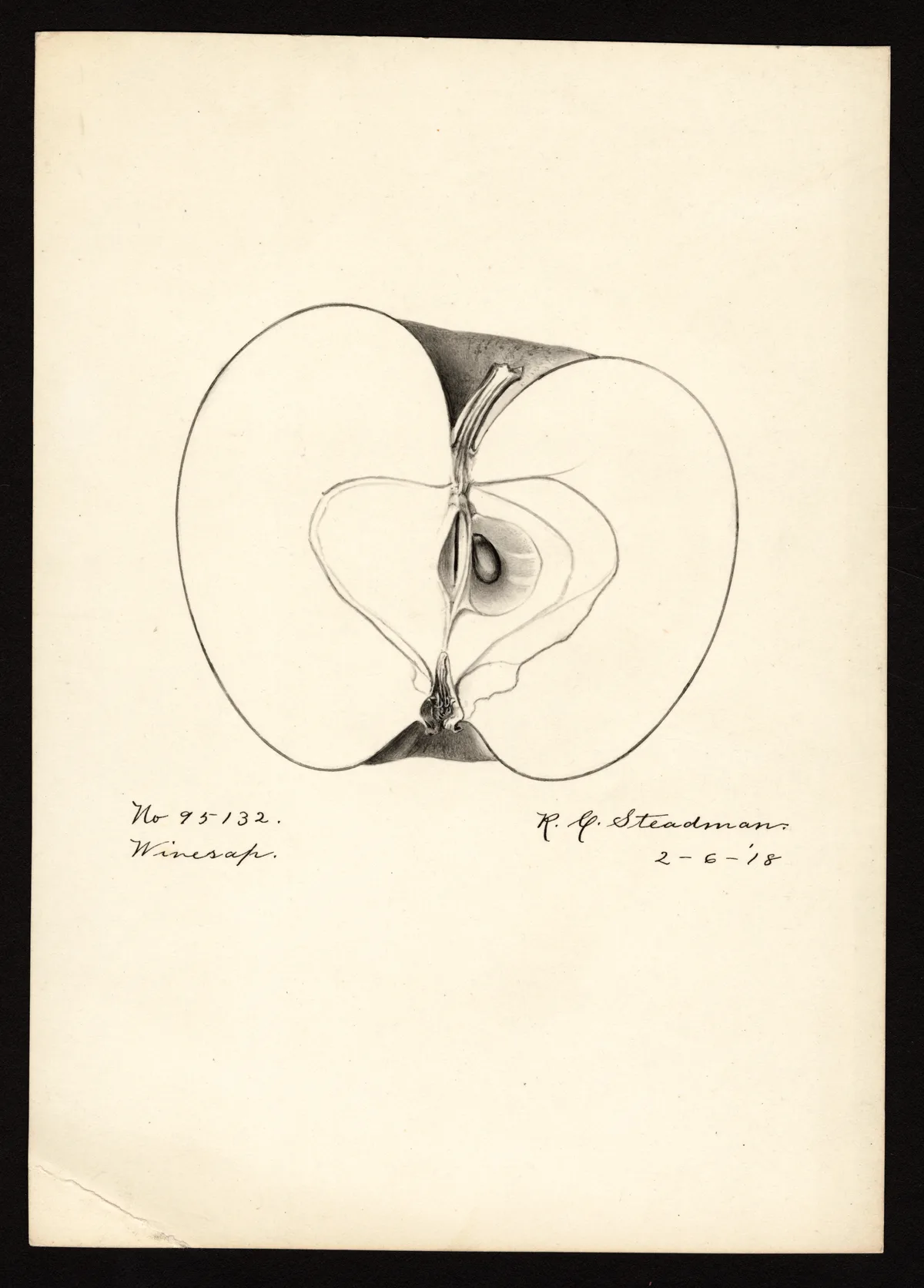
USDA Pomological Watercolor Collection
Winesap
Origin / History
Nothing definite is known of the origin of Winesap. Coxe (1817) speaks of it as "the most favored cider fruit in West Jersey," and from this many writers have inferred a New Jersey origin, though Beach notes that such statements seem hardly warranted by the evidence. Hedrick states the origin is unknown but that the variety "dates well back into the Colonial period." Elliott gives the probable origin as New Jersey and notes it was first described by Coxe; Hansen and Budd-Hansen likewise give the supposed origin as New Jersey, citing Coxe's 1817 description of it as one of the best cider and eating apples of his (western New Jersey) region.
Winesap is one of the oldest and most popular apples in America, known in all the principal apple-growing sections of the United States and Canada — from Virginia westward to the Pacific Coast — and is one of the leading apples for export. Beach notes that Bailey's Inventory of 1892 listed seventy-three nursery firms offering Winesap for sale, compared with sixty-four offering Baldwin, fifty-eight offering Northern Spy, and forty-eight offering Rhode Island Greening. Elliott calls it "one of the very best throughout the Southwest, and also in Oregon Territory." Thomas notes it is "widely cultivated at the West and Southwest." Lowther names the Piedmont region in Virginia and the Pacific Northwest as the regions where it reaches its best size and quality. Hansen reports that fine specimens have been grown along the Missouri River in the southeastern corner of South Dakota, but that the variety is not sufficiently hardy in the north. Stark Bros. (1910) describe it as "in great demand throughout western orchards for commerce" and "the best of all late varieties" in all climates including the southwest.
Winesap has produced many seedlings that partake more or less of the characters of the parent. The best known of these are Stayman Winesap, Paragon, Arkansas, and Arkansas Black (Beach, Lowther); Budd-Hansen additionally lists Gilbert and notes that these seedlings are larger in fruit and considered superior in vigor of tree, though their superiority to the parent for export has not been established.
Tree
Tree of medium size, vigorous though not a rank or particularly rank grower (Beach, Lowther, Hedrick); Warder calls it "vigorous, healthy, hardy"; Hansen and Budd-Hansen describe it as "moderately vigorous." Form roundish, spreading, rather straggling and open (Beach, Hedrick, Lowther); Warder describes the branches as "open, straggling"; Elliott calls the growth "irregular… not forming a handsome head"; Downing says it "grows rather irregularly, and does not form a handsome head"; Coxe notes the form is "irregular, the branches often grow downwards, and render it difficult to train in a handsome shape." Thomas calls the growth "rather irregular."
Twigs rather stout, rather short to above medium; internodes short (Beach). Shoots strong, dark reddish-brown (Warder). Young wood reddish brown, with smooth red buds (Downing). Bark very dark reddish-brown with thin gray scarf-skin, somewhat pubescent (Beach, Lowther, Hedrick). Lenticels especially clustered just below the nodes, conspicuous, round or elongated, variable in size but usually above medium (Beach). Buds large to medium, broad, usually rather obtuse but sometimes acute, free or nearly so (Beach).
Foliage thin (Beach, Lowther); Warder describes it as "curled, glaucous, sparse." Leaves usually not large, narrow (Beach); Lowther: "rather small and narrow"; Hedrick: "small, narrow."
Tree comes into bearing early and is a remarkably regular cropper / very productive and an early bearer (Beach, Warder, Hansen, Budd-Hansen, Lowther). Coxe states it "bears more uniformly than any fruitful kind with which I am acquainted." Elliott describes it as "hardy, an early and very productive bearer." Beach notes that in unfavorable situations the trees are apt to be short-lived, and in New York are less hardy than the leading commercial varieties of that region; Hedrick calls them "precariously hardy" and notes they "will grow only where the season is long."
Soil preference: does best on rather light, rich, deep, well-drained soils; does not succeed on heavy clays or in low, damp locations (Beach, Lowther, Hedrick). Coxe specifically states "the tree is well adapted to light soils," recounting that of 100 trees he planted on a sandy blowing knoll eight years earlier and well cultivated, "not one has died — every tree bears fine fair apples." Elliott observes the tree produces fair, fine fruit in all soils, "from poor sand to limestone clay — largest in the latter, and finest texture in the former — fine on dry prairies." Downing notes "the tree thrives well on sandy, light soils." Stark Bros. call it "well adapted to all soils" and a "great commercial tree… will grow strong, stocky-branched." Lowther notes that in sections where it tends to grow small, this may be obviated somewhat by fertilizing the soil or by heavily pruning the tree.
Fruit
Size
Size is generally given as medium (Coxe: "middling"; Elliott; Warder; Thomas; Hansen; Budd-Hansen; Beach). Hedrick gives medium to large. Beach notes that as grown in New York it averages even smaller than that grown farther south, seldom reaching good medium size; Lowther says "rather small but uniform in shape and size" and notes its tendency to grow small except in a few favored sections. Thomas observes that fruit "formerly always fair, of late years more imperfect." Beach notes the fruit is "pretty uniform in size and shape."
Form
Form usually conical, sometimes roundish, nearly truncate at base (Beach, Hedrick, Lowther). Coxe describes it as "round, lessening a little towards the crown." Elliott gives "ovate conical, flattened at base, sometimes roundish conical, occasionally angular and slightly ribbed." Warder: "conical, often obscurely angular, or slightly ribbed." Downing: "rather roundish oblong." Hansen and Budd-Hansen: "roundish conical, often obscurely angular and slightly ribbed." Thomas: "round-ovate, slightly conical, sometimes obscurely flattened." Beach: "nearly regular or obscurely ribbed, symmetrical." Hedrick adds that the rotund shape, usually somewhat truncate, is "always uniform and regular."
Stem / Stalk
Stem medium (Warder, Hansen, Budd-Hansen) to medium to short (Beach), rather slender (Beach, Hedrick). Elliott: "varying in length, slender." Downing: "nearly an inch long, slender." Thomas: "slender, three-fourths of an inch long."
Cavity
Beach: medium to rather small, acute to acuminate, narrow to rather broad, deep, symmetrical or somewhat furrowed, often more or less lipped, often russeted or with outspreading russet rays. Hedrick: small, acute, narrow, deep, symmetrical or furrowed, often lipped, often russeted or with outspreading russet rays. Warder: "wide, reddish brown." Hansen and Budd-Hansen: "wide, regular, acute, lined with reddish stellate russet, sometimes extending out a little over base." Elliott: "narrow, deep." Downing: "irregular." Thomas: "acute."
Calyx and Basin
Calyx small (Elliott, Downing, Thomas), nearly closed (Elliott) or closed (Warder, Hansen, Budd-Hansen, Beach, Hedrick); Beach and Hedrick describe it as medium to large, closed, with lobes long, narrow, acuminate. Hansen and Budd-Hansen: segments flat convergent. Warder: eye small, closed.
Basin narrow, shallow, plaited / furrowed (Warder, Hansen, Budd-Hansen, Elliott, Downing, Thomas — "finely plaited"). Elliott: "abrupt, furrowed." Beach: "rather small to medium, often oblique, shallow to rather deep and abrupt, narrow to moderately wide, distinctly furrowed, somewhat wrinkled." Hedrick: "small, often oblique, shallow, narrow, distinctly furrowed, wrinkled."
Skin
Skin smooth (Coxe, Downing, Hedrick), medium in thickness, tough, smooth, glossy (Beach, Lowther, Hedrick); Hansen and Budd-Hansen: "moderately thick, very tough; surface smooth."
Color: a dark red, with a small portion of yellow, and sometimes a few streaks (Coxe). Downing: "fine dark red, with a few streaks, and a little yellow ground, appearing on the shady side." Thomas: "a lively deep red." Beach: "bright deep red indistinctly striped and blotched with very dark purplish-red over a distinctly yellow ground color or green if not fully mature, overspread with faint bloom. Prevailing effect bright deep red." Hedrick: "bright red indistinctly striped and blotched with dark red over a yellow ground-color, overspread with faint bloom; prevailing effect deep red." Lowther: "bright deep red." Hansen and Budd-Hansen: "rich dark yellow, mostly covered with fine lively dark red, sometimes obscurely striped, often with russet net-veining, especially toward the base." Warder: "rather smooth, bright or dark red, mixed and obscurely striped on yellow, which is mostly covered, often veined russet." Elliott distinguishes by region: "grown North, a bright clear red, stained and striped with darker shades, and with spots of light yellow; grown South, the dark red becomes most prominent, while the patches of light yellow at base are more often seen; it is also more irregular or angular in form, and oft with russet about the stem." Stark Bros.: "a dark red color." Hedrick summarizes the appearance: "the smooth glossy texture and soft bloom, make this a very handsome fruit."
Dots: rather small, scattering, whitish (Beach), sometimes in conspicuous contrast with the deep red skin especially toward the cavity (Beach). Hedrick: small, scattering, white. Warder: few, minute, indented. Hansen and Budd-Hansen: few, minute, indented toward the apex, distinctly elongated toward the base.
Flesh and Flavor
Flesh tinged with yellow (Beach, Hedrick, Lowther) or yellow (Warder, Downing, Hansen, Budd-Hansen); Coxe: "rich, yellow"; Elliott: "yellowish"; Thomas: "yellowish." Veins sometimes red (Beach, Hedrick, Lowther). Texture: firm (Warder, Downing, Hansen, Budd-Hansen, Hedrick, Lowther) or very firm (Beach, Lowther); rather coarse (Beach, Lowther, Hedrick) — Hedrick describes "the coarse yellow flesh, with veins tinged with red," as distinctive — though Hansen and Budd-Hansen describe it as "fine-grained." Crisp (Downing, Hansen, Budd-Hansen, Thomas, Hedrick) or moderately crisp (Beach, Lowther). Very juicy (Beach, Lowther, Hedrick) or tolerably juicy (Coxe); Elliott: "juicy, tender."
Flavor: Coxe: "pleasant, and sweet." Elliott: "sub-acid, sprightly." Warder: "rich, acid to sub-acid." Downing: "rich, high flavor. Very good." Thomas: "rich sub-acid or rather acid flavor." Hansen, Budd-Hansen, Beach, Hedrick, Lowther: "sprightly subacid"; Hansen and Budd-Hansen add "rich" and rate it "very good." Beach: "sprightly subacid, good to very good." Hedrick: "the sprightly, subacid flavor" is distinctive (along with the coarse flesh); rates it "good to very good." Lowther: "good to very good."
Core and Seeds
Core medium (Warder, Elliott) — Beach: medium to small, abaxile with a hollow cylinder in the axis, narrowing toward the apex; Hedrick: small, abaxile with a hollow cylinder in the axis, narrowing toward the apex. Cells: pretty uniformly developed, symmetrical, open or slightly closed (Beach); uniformly developed, symmetrical, open or nearly closed (Hedrick); Warder describes the core as "regular, somewhat open"; Hansen and Budd-Hansen: "slightly open, clasping, turbinate; cells ovate, slit; tube funnel-shaped." Elliott: "capsule, hollow." Core-lines clasping (Beach, Hedrick). Calyx tube quite variable, conical or funnel-shape (Beach); Hedrick: variable, conical. Stamens marginal (Beach, Hansen, Budd-Hansen, Hedrick).
Carpels broadly roundish (Beach) / broadly round (Hedrick), much concave / concave, slightly emarginate if at all, mucronate (Beach, Hedrick).
Seeds: Warder: "large, rather light." Elliott: "short, ovate." Hansen and Budd-Hansen: "few, medium, short, plump, rather short, brown." Beach: "below medium to above, wide, plump, obtuse." Hedrick: "wide, plump, obtuse."
Season
Sources vary, reflecting differing climates and storage conditions:
- Coxe: apples hang late on the tree.
- Elliott: October to January, often keeps till March.
- Warder: January to March.
- Downing: November to May.
- Hansen: December to May.
- Thomas: keeps through winter.
- Beach: as grown at the New York Station, January to June with April as the ordinary commercial limit; when grown farther south its season extends to February in ordinary storage and to April in cold storage.
- Budd-Hansen: December to May.
- Hedrick: October to March.
Beach and Hedrick both note that the apples keep and ship well — "a good shipper and stands heat well before going into storage" — but that late in the season they often scald, particularly when not well colored or in cold storage. Coxe notes that the apples "hang late, and make good cider without housing; they will however repay all the expense of complete maturation in an airy loft, by the increased flavour of the liquor." Downing notes the apples "have the good quality of hanging late upon the trees without injury." Stark Bros. call it "the best of all late varieties."
Uses
One of the best cider fruits (Coxe, Downing): Coxe describes the cider as "vinous, clear, and strong; equal to any fruit liquor of our country for bottling." Also "a good Apple for the table" (Downing); a good eating apple (Coxe). Warder gives use as "market, kitchen, cider." Thomas: "One of the best apples for baking." Hansen and Budd-Hansen note it is "one of the leading apples for export." Beach and Lowther identify it as a well-known market / commercial apple, with the Piedmont region of Virginia, the Pacific Northwest, and certain other districts as the regions where it reaches good commercial size and quality.
Subtypes / Variants
Beach and Lowther name the best-known Winesap seedlings as Stayman Winesap, Paragon, Arkansas, and Arkansas Black; Budd-Hansen additionally lists Gilbert and notes these seedlings are larger in fruit and considered superior in vigor of tree, though their superiority to the parent for export has not yet been established. No description of distinct Winesap strains or sports is given by the sources.
Other
Beach notes that the popularity indicated by the 1892 Bailey Inventory (seventy-three nurseries offering Winesap, more than Baldwin, Northern Spy, or Rhode Island Greening) is "not an altogether true criterion of the number of trees sold." Hedrick credits Winesap's "adaptability to various soils and climates" as the chief asset of the variety, alongside its excellent qualities of fruit and tree. Stark Bros. summarize it as "a great commercial tree" — "planted by the thousands — profitable tree."
Book Sources
Described in 10 period pomological works
- Coxe, A View of the Cultivation of Fruit Trees (1817)
- Lowther (ed.), Encyclopedia of Practical Horticulture (1914)
- Warder, American Pomology: Apples (1867)
- Budd & Hansen, Systematic Pomology (1914)
- Downing, Fruits and Fruit Trees of America (1900)
- Elliott, The Western Fruit Book (1865)
- Hansen, A Study of Northwestern Apples (1902)
- Hedrick, Cyclopedia of Hardy Fruits (1922)
- Thomas, The American Fruit Culturist (1903)
- Beach, The Apples of New York Vol. 1 (1905)
Nursery Catalog Sources
Found in 76 catalogs (1864–1947) from Alabama, Arkansas, California, Illinois, Kansas, Maryland, Massachusetts, Missouri, Nebraska, New Jersey, New York, Oregon, Pennsylvania, Virginia, Washington
- St. Helena Nursery , Howell's Prairie, Marion County , Oregon — 1864
- Hutchison Nursery , James Hutchison, Oakland , California — 1881
- Huntsville Wholesale Nurseries (Jessie S. Moss , Proprietor; W.F. Heikes, Manager), Huntsville , Alabama — 1886
- California Nursery Co. , Niles , California — 1889
- William H. Moon Co. , Morrisville, Bucks County , Pennsylvania — 1890
- Puyallup & Yakima Nurseries , Puyallup, Washington (Lock Box 191) and North Yakima , Washington — 1892
- Milwaukie-Canby Nurseries , Canby, OR (and Milwaukie, OR) — 1893
- Oregon Wholesale Nurseries , Salem , Oregon — 1893
- Rogers Nursery Co. , Moorestown , New Jersey — 1893
- Sherwood Hall Nursery Co. , Timothy Hopkins (Menlo Park Nurseries), San Francisco / Menlo Park , California — 1893
- Multnomah Nurseries , Russellville , Oregon — 1894
- Woodburn Nurseries , Woodburn, Marion Co. , Oregon — 1894
- The Vineland Nurseries (Kelsey & Co. , Proprietors), St. Joseph, Missouri (Office: 13th and Atchison Sts., 2 Blocks East of the Citizens St. Car Line) — 1894
- The Lovett Company , Little Silver , New Jersey — 1896
- The Salem Nursery (John A. Francis , Proprietor), Salem , Virginia — 1897
- Arthur J. Collins & Sons , Moorestown , New Jersey — 1898
- Reading Nursery , Jacob W. Manning, Proprietor, Reading , Massachusetts — 1898
- Stark Bros. Nurseries & Orchards Co. , Louisiana , Missouri — 1898
- Brown Brothers Co. , Continental Nurseries, Rochester, NY (also operated from Toronto, Canada) — 1899
- Alabama Nursery Co. , Huntsville , Alabama — 1900
- Central Experimental Farm , Dominion Department of Agriculture, Agassiz, British Columbia (under test; Bulletin No. 3, Second Series) — 1900
- The Dalles Nurseries , The Dalles , Oregon — 1901
- Washington Nursery Co. , Toppenish , Washington — 1901
- Brown Brothers Co. , Continental Nurseries, Rochester, NY (also operated from Toronto, Canada) — 1901
- S.L. Watkins , Grizzly Flats, El Dorado County , California — 1901
- Yarbrough Bros. , Stephens , Arkansas — 1901
- Benjamin Buckman (personal inventory) , Farmingdale , Illinois — 1901
- Benjamin Buckman (personal inventory) , Farmingdale , Illinois — 1901 — listed as Royal Red
- Forestville Nurseries , T.J. True, Forestville , California — 1902
- Pacific Nursery Company (W. O. Hudson & A. D. Hudson) , Tangent , Oregon — 1903
- Russellville Nursery Co. , Russellville, OR (three miles east of Portland, one mile from Montavilla car line) — 1903
- OSU Bulletin 81 — 1904
- Henderson Luelling / Traveling Nursery (historical recall) , Oregon — 1904
- Phoenix Nursery Company (W. E. Rossney , President; Sidney Tuttle, Vice-President), Bloomington , Illinois — 1904
- Stark Bros. Nurseries & Orchards Co. , Louisiana , Missouri — 1906
- J.B. Pilkington , Portland , Oregon — 1907
- Russellville Nursery Co. , Montavilla Station, Portland, OR (three miles east of Portland, one mile from Montavilla car line) — 1907
- Carlton Nursery Co. , Carlton , Oregon — 1909
- Milton Nursery Co. (A. Miller & Sons , Proprietors), Milton , Oregon — 1909
- Wm. J. Corse (successor to Robert Sinclair / Sinclair Nurseries) , Baltimore , Maryland — 1909
- Washington Nursery Company , Toppenish , Washington — 1909
- C.F. Lansing , Salem , Oregon — 1910
- Wapato Nursery , Wapato , Washington — 1910
- Cashmere Nurseries , Cashmere , Washington — 1910
- Milton Nursery Co./Montana Fruit Growers — 1910
- Stark Bros. Nurseries & Orchards Co. , Louisiana , Missouri — 1910
- Island Nurseries & Fruit Farm , Vashon (Vashon Island) , Washington — 1911
- Stark Bros. Nurseries & Orchards Co. , Louisiana , Missouri — 1911
- Galbraith Nursery Co. (DeWitt Hansen , Pres.-Mgr.), Fairbury , Nebraska — 1911
- Ballygreen Nurseries , Hanford , Washington — 1912
- Pacific Nursery Company , Portland , Oregon — 1912
- Stark Bros. Nurseries & Orchards Co. , Louisiana , Missouri — 1912
- Vineland Nurseries Company , Clarkston , Washington — 1912
- Washington Nursery Company , Toppenish , Washington — 1912
- J. B. Pilkington , Nurseryman, Portland, OR (nurseries near Newberg, forty miles from Portland) — 1913
- Samuel Fraser , Geneseo , New York — 1913
- Van Holderbeke Nursery Co. , Incorporated, Spokane, Washington (nurseries at Otis Orchards WA, Pasadena WA, Kennewick WA) — 1913
- Benjamin Buckman (personal inventory) , Farmingdale , Illinois — 1913
- Island Nurseries & Fruit Farm , Vashon (Vashon Island) , Washington — 1914
- Island Nurseries & Fruit Farm , Vashon (Vashon Island) , Washington — 1915
- Ornamental & Fruit Nursery Company , Wapato, County of Yakima , Washington — 1915
- Holsinger Bros. Nurseries (Holsinger Brothers Nursery) , Rosedale , Kansas — 1916
- Island Nurseries & Fruit Farm , Vashon (Vashon Island) , Washington — 1916
- Manalapan Nurseries , Englishtown , New Jersey — 1916
- Island Nurseries & Fruit Farm , Vashon (Vashon Island) , Washington — 1917
- Fancher Creek Nurseries , George C. Roeding, Fresno , California — 1918
- Stark Bros. Nurseries & Orchards Co. , Louisiana , Missouri — 1918
- Oregon Nursery Co. , Orenco , Oregon — 1920
- Christopher Nurseries / John Stewart & Sons , Christopher , Washington — 1920
- Fresno Nursery Co. , Fresno , California — 1924
- Columbia & Okanogan Nursery Co. , Wenatchee , Washington — 1925
- Hudson's Wholesale Nurseries , Tangent , Oregon — 1926
- Stark Bro's Nurseries , Louisiana , Missouri — 1932
- Milton Nursery Co. , Milton-Freewater , Oregon — 1947
- Rich & Sons Nursery , Hillsboro , Oregon
- North-Western Nurseries , Walla Walla , Washington
View original book sources (11)
— William Coxe, A View of the Cultivation of Fruit Trees (1817)NO. 89. WINESAP.
This is one of our best cider fruits, and is much esteemed as a good eating apple: the size is middling, the form round, lessening a little towards the crown: the skin is smooth, the colour a dark red, with a small portion of yellow, and sometimes a few streaks—the flesh is rich, yellow, and tolerably juicy, pleasant, and sweet; the cider produced from it is vinous, clear, and strong; equal to any fruit liquor of our country for bottling. The apples hang late, and make good cider without housing; they will however repay all the expense of complete maturation in an airy loft, by the increased flavour of the liquor—the tree is well adapted to light soils: of 100 trees I planted on a sandy blowing knoll eight years ago, and well cultivated, not one has died—every tree bears fine fair apples; it is becoming the most favorite cider fruit in West Jersey. The form of the tree is irregular, the branches often grow downwards, and render it difficult to train in a handsome shape; it bears more uniformly than any fruitful kind with which I am acquainted.
— F.R. Elliott, The Western Fruit Book (1865)Wine Sap. Wine Sop. Probably originated in New Jersey. First described by Coxe. It is one of the very best throughout the Southwest, and also in Oregon Territory. The tree is hardy, an early and very productive bearer, irregular in its growth, not forming a handsome head, but producing fair, fine fruit in all soils, from poor sand to limestone clay — largest in the latter, and finest texture in the former — fine on dry prairies. Fruit, medium ; form, ovate conical, flattened at base, sometimes roundish conical, occasionally angular and slightly ribbed ; color, grown North, a bright clear red, stained and striped with darker shades, and with spots of light yellow ; grown South, the dark red becomes most prominent, while the patches of light yellow at base are more often seen ; it is also more irregular or angular in form, and oft with russet about the stem ; stem, varying in length, slender ; cavity, narrow, deep ; calyx, small, nearly closed ; basin, abrupt, furrowed ; flesh, yellowish, juicy, tender, sub-acid, sprightly ; core, medium ; capsule, hollow ; seeds, short, ovate. October to January often keeps till March.
— John A. Warder, American Pomology: Apples (1867)Winesap.—[Coxe.]
Tree vigorous, healthy, hardy, productive, early bearer; Branches open, straggling; Shoots strong, dark reddish-brown; Foliage curled, glaucous, sparse.
Fruit medium, conical, often obscurely angular, or slightly ribbed; Surface rather smooth, bright or dark red, mixed and obscurely striped on yellow, which is mostly covered, often veined russet; Dots few, minute, indented.
Basin narrow, shallow, plaited; Eye small, closed.
Cavity wide, reddish brown; Stem medium.
Core regular, somewhat open; Seeds large, rather light; Flesh firm, yellow; Flavor rich, acid to sub-acid; Use, market, kitchen, cider; Season, January to March.
— A.J. Downing, The Fruits and Fruit Trees of America (1900)WINESAP.
Wine Sop ? Potpie Apple.
This is not only a good Apple for the table, but it is also one of the very finest cider fruits, and its fruitfulness renders it a great favorite with orchardists. The tree grows rather irregularly, and does not form a handsome head, but it bears early, and the apples have the good quality of hanging late upon the trees without injury, while the tree thrives well on sandy, light soils. The tree is very hardy, and one of the most profitable orchard varieties wherever grown. Young wood reddish brown, with smooth red buds.
Winesap.
Fruit of medium size, rather roundish oblong. Skin smooth, of a fine dark red, with a few streaks, and a little yellow ground, appearing on the shady side. Stalk nearly an inch long, slender, set in an irregular cavity. Calyx small, placed in a regular basin, with fine plaits. Flesh yellow, firm, crisp, with a rich, high flavor. Very good. November to May.
— N.E. Hansen, A Study of Northwestern Apples (1902)Winesap—Supposed origin, New Jersey; described by Coxe, in 1817, as one of the best cider and eating apples of his region (western New Jersey); very popular in parts of the south and west. One of the leading apples for export.
Tree moderately vigorous, with rather open, straggling head; very productive and an early bearer—Fruit medium, roundish conical, often obscurely angular and slightly ribbed; skin moderately thick, very tough; surface smooth, rich dark yellow, mostly covered with fine lively dark red, sometimes obscurely striped, often with russet net-veining, especially toward the base; dots few, minute, indented toward the apex; distinctly elongated toward the base; cavity wide, regular, acute, lined with reddish stellate russet, sometimes extending out a little over base; stem medium; basin narrow, shallow, plaited; calyx closed, segments flat convergent. Core slightly open, clasping, turbinate; cells ovate, slit; tube funnel-shaped; stamens marginal; seeds few, medium, short, plump, rather short, brown; flesh yellow, firm, crisp, fine grained, rich; sprightly subacid, very good.
December to May.
Fine specimens have been grown along the Missouri river in the southeastern corner of the state, but the variety is not sufficiently hardy at the north.
— John J. Thomas, The American Fruit Culturist (1903)Winesap.* Size medium, round-ovate, slightly conical, sometimes obscurely flattened; color a lively deep red; stalk slender, three-fourths of an inch long; cavity acute; calyx small, in a finely plaited basin; flesh yellowish, firm, crisp, with a rich sub-acid or rather acid flavor. Keeps through winter. One of the best apples for baking. Growth rather irregular, fruit formerly always fair, of late years more imperfect. Widely cultivated at the West and Southwest. Fig. 438.
— S.A. Beach, The Apples of New York, Vol. 1 (1905)WINESAP
REFERENCES. 1. Coxe, 1817:153. fig. 2. (?)Thacher, 1822:140. 3. Buel, N. Y. Bd. Agr. Mem., 1826:476. 4. Wilson, 1828:136. 5. Cat. Hort. Soc. London, 1831:39. 6. Manning, Mag. Hort., 7:50. 1841. 7. Downing, 1845:143. 8. Kirtland, Horticulturist, 2:545. 1848. 9. Thomas, 1849:175. 10. Elliott, Horticulturist, 3:420. 1849. 11. Cole, 1849:130. 12. Phoenix, Horticulturist, 4:472. 1850. 13. Emmons, Nat. Hist. N. Y., 3:68. 1851. 14. Am. Pom. Soc. Cat., 1852. 15. Elliott, 1854:117. fig. 16. Hooper, 1857:97. 17. Gregg, 1857:60. 18. Mag. Hort., 30:162. 1864. 19. Warder, 1867:546. fig. 20. Downing, 1872:10, 12 index, app. 21. Fitz, 1872:143, 155, 172. fig. 22. Barry, 1883:357. 23. Rural N. Y., 47:749. 1888. 24. Wickson, 1889:246. 25. Lyon, Mich. Hort. Soc. Rpt., 1890:300. 26. Beach, N. Y. Sta. An. Rpt., 11:589, 596. 1892. 27. Bailey, An. Hort., 1892:252. 28. Clayton, Ala. Sta. Bul., 47:7. 1893. 29. Munson, Me. Sta. Rpt., 1893:134. 30. Stinson, Ark. Sta. An. Rpt., 7:46. 1894. 31. Mathews, Ky. Sta. Bul., 50:32. 1894. 32. Rural N. Y., 54:859. 1895. 33. Ib., 55:1, 51, 190, 250, 341. 1896. 34. Burrill and McCluer, Ill. Sta. Bul., 45:346. 1896. 35. Taylor, U. S. Pom. Bul., 7:357. 1898. 36. Massey, N. C. Sta. Bul., 149:318. 1898. 37. Van Deman, Rural N. Y., 59:224. Horticulturist, 4:471. 1850. Schroeder, Montreal Hort. Soc. Rpt., 1900. 38. Atwood, Va. Sta. Bul., 130:138. 1901. figs. 39. Munson, Me. Sta. Rpt., 1902:96. 40. Dickens and Greene, Kan. Sta. Bul., 106:56. 1902. 41. Hansen, S. D. Sta. Bul., 76:116. 1902. 42. Stinson, Mo. Fr. Sta. Bul., 3:26. 1902. 43. Budd-Hansen, 1903:206. fig. 44. Bruner, N. C. Sta. Bul., 182:27. 1903. figs. 45. Powell, U. S. Dept. Agr. Yr. Bk., 1903:232. col. pl. 46. Powell and Fulton, U. S. B. P. I. Bul., 48:61. 1903. 47. Beach and Clark, N. Y. Sta. Bul., 248:151. 1904.
SYNONYMS. Holland's Red Winter (20). Royal Red of Kentucky (20). Texan Red (20). WINE SAP (12, 13, 15, 17, 21, 27, 28, 31). Wine Sop (15, 17).
Winesap is one of the oldest and most popular apples in America. It is known in all the apple-growing sections from Virginia westward to the Pacific Coast. An indication of its popularity may be gained from the fact that according to Bailey's Inventory (27) there were, in 1892, seventy-three nursery firms offering Winesap for sale as compared with sixty-four firms offering Baldwin, fifty-eight offering Northern Spy and forty-eight offering Rhode Island Greening. It should be borne in mind however that the number of firms selling a variety is not an altogether true criterion of the number of trees sold. Like various other old varieties, Winesap has many seedlings which partake more or less of the characters of the parent. The best known of these are Arkansas, Arkansas Black, Paragon and Stayman Winesap.
The tree is a rather vigorous though not particularly rank grower, comes into bearing early and is a remarkably regular cropper. It does best on rather light, rich, deep soils and does not succeed on heavy clays or in low, damp locations. In unfavorable situations the trees are apt to be short-lived and in New York are less hardy than the leading commercial varieties of this region. Although Winesap is a well-known market apple, yet with the exception of the Piedmont region in Virginia and certain districts elsewhere it has not proved generally successful for the commercial orchard. In New York it seldom reaches good medium size. In more southern latitudes and under favorable conditions the fruit is well colored and of good quality, but excepting on young trees or on soils of more than average fertility it averages too small for a good market variety. When well grown it is of very good quality and attractive in appearance, being quite uniform in shape and size and of good dark red color. As grown at this Station it is in season from January to June with April as the ordinary commercial limit (47). When grown farther south its season extends to February in ordinary storage and to April in cold storage. It is a good shipper and stands heat well before going into storage, but late in the season it often scalds, particularly when not well colored.
Historical. Nothing definite is known of the origin of Winesap. Coxe speaks of it as being "the most favored cider fruit in West Jersey." From this fact many writers have referred to West Jersey as the region of its origin or probable origin but such statements seem hardly warranted by the evidence.
TREE.
Tree medium size, vigorous. Form roundish spreading, rather straggling and open. Twigs rather stout, rather short to above medium; internodes short. Bark very dark reddish-brown with thin gray scarf-skin, somewhat pubescent. Lenticels especially clustered just below the nodes, conspicuous, round or elongated, variable in size but usually above medium. Buds large to medium, broad, usually rather obtuse but sometimes acute, free or nearly so. Foliage thin; leaves usually not large, narrow.
FRUIT.
Fruit as grown in New York averages even smaller than that which is grown farther south. It is pretty uniform in size and shape. Form usually conical, sometimes roundish, nearly truncate at base, nearly regular or obscurely ribbed, symmetrical. Stem medium to short, rather slender. Cavity medium to rather small, acute to acuminate, narrow to rather broad, deep, symmetrical or somewhat furrowed, often more or less lipped, often russeted or with outspreading russet rays. Calyx medium to large, closed; lobes long, narrow, acuminate. Basin rather small to medium, often oblique, shallow to rather deep and abrupt, narrow to moderately wide, distinctly furrowed, somewhat wrinkled. Skin medium in thickness, tough, smooth, glossy, bright deep red indistinctly striped and blotched with very dark purplish-red over a distinctly yellow ground color or green if not fully mature, overspread with faint bloom. Dots rather small, scattering, whitish, sometimes in conspicuous contrast with the deep red skin especially toward the cavity. Prevailing effect bright deep red. Calyx tube quite variable, conical or funnel-shape. Stamens marginal. Core medium to small, abaxile with a hollow cylinder in the axis, narrowing toward the apex; cells pretty uniformly developed, symmetrical, open or slightly closed; core lines clasping. Carpels broadly roundish, much concave, slightly emarginate if at all, mucronate. Seeds below medium to above, wide, plump, obtuse. Flesh tinged with yellow, veins sometimes red, very firm, rather coarse, moderately crisp, very juicy, sprightly subacid, good to very good.
— J.L. Budd & N.E. Hansen, American Horticultural Manual, Part II: Systematic Pomology (1914)Winesap. — Supposed origin, New Jersey; described by Coxe in 1817 as one of the best cider and eating apples of his region (western New Jersey), very popular in parts of the South and West. One of the leading apples for export. Some of its known or supposed seedlings, such as Stayman, Gilbert, Paragon, and Arkansas, are larger in fruit and are considered superior in vigor of tree. For export their superiority to the parent has not yet been established. Tree moderately vigorous, with rather open, straggling head; very productive and an early bearer.
Fruit medium, roundish conical, often obscurely angular and slightly ribbed; skin moderately thick, very tough; surface smooth, rich dark yellow, mostly covered with fine lively dark red, sometimes obscurely striped, often with russet net-veining, especially toward the base; dots few, minute, indented toward the apex, distinctly elongated toward base; cavity wide, regular, acute, lined with reddish stellate russet, sometimes extending out a little over base; stem medium; basin narrow, shallow, plaited; calyx closed; segments flat convergent. Core slightly open, clasping, turbinate; cells ovate, slit; tube funnel-shaped; stamens marginal; seeds few, medium, short, plump, rather short, brown; flesh yellow, firm, crisp, fine-grained, rich, sprightly subacid, very good. December to May.
— Granville Lowther (ed.), Encyclopedia of Practical Horticulture (1914)Winesap
The Winesap is one of the oldest and one of the most popular apples in America. It is known in all the principal apple growing sections in the United States and Canada. The Winesap has evolved many seedlings which partake more or less of
King David. Masted Photo.
the characters of the parent. Among them are the Stayman Winesap, the Paragon, Arkansas and Arkansas Black.
The tree is rather vigorous, though not a rank grower, comes into bearing early and is a remarkably regular cropper. It does best on rather light, rich, deep soils and does not succeed well on heavy clays or in damp locations. The difficulty with the Winesap is its tendency to grow small. However, there are a few sections in the United States where it reaches a good size, and it is one of the best commercial apples. Notably among them are the Piedmont region in Virginia, and the Pacific Northwest. In sections where it tends to grow small this may be obviated somewhat by fertilizing the soil, or by heavily pruning the tree.
Form roundish, spreading, rather straggling and open. Bark very dark reddish brown with thin gray scarf skin, somewhat pubescent. Foliage thin, leaves rather small and narrow.
Fruit rather small but uniform in shape and size. Form roundish conical, nearly truncate at the base. Skin medium in thickness, tough, smooth, glossy, bright deep red. Flesh tinged with yellow, veins somewhat red, very firm, rather coarse, moderately crisp, very juicy, sprightly subacid, good to very good.
Historical. Nothing definite is known of the origin of the Winesap. Coxe speaks of it as being the most favored cider fruit in New Jersey. From this it has been inferred by some that it originated in that state but this is not proven.
— U.P. Hedrick, Cyclopedia of Hardy Fruits (1922)WINESAP. Fig. 62. Holland's Red Winter. Royal Red. Texan Red. Wine Sop.
Winesap is one of the most widely distributed and best known American apples. Though it has its local attachments, it may be found thriving on both the Atlantic and Pacific seaboards and in most of the apple regions that lie between. No doubt its adaptability to various soils and climates is the chief asset of the variety, but it has excellent qualities of fruit and tree besides. The prevailing color of the apple is bright deep red, striped and blotched with dark purple, the ground color being golden yellow, which, with the smooth glossy texture and soft bloom, make this a very handsome fruit. The rotund shape, usually somewhat truncate, and always uniform and regular, adds to the attractiveness of the apples. The coarse yellow flesh, with veins tinged with red, is distinctive, as is, also, the sprightly, subacid flavor. The apples keep and ship well, though they often scald in cold storage. The trees are vigorous, come in bearing early, and on light, rich, deep, well-drained soils are remarkably productive and regular bearers; they are precariously hardy and will grow only where the season is long. As a commercial fruit, Winesap finds its best environment in parts of Virginia and in the northern states of the Pacific Coast. The origin of the variety is unknown, but it dates well back into the Colonial period.
Tree of medium size, vigorous, round-spreading, straggling and open. Leaves small, narrow. Fruit medium to large, uniform in size and shape, usually conical, sometimes round, truncate at base, regular or obscurely ribbed, symmetrical; stem short, slender; cavity small, acute, narrow, deep, symmetrical or furrowed, often lipped, often russeted or with outspreading russet rays; calyx large, closed; lobes long, narrow, acuminate; basin small, often oblique, shallow, narrow, distinctly furrowed, wrinkled; skin tough, smooth, glossy, bright red indistinctly striped and blotched with dark red over a yellow ground-color, overspread with faint bloom; dots small, scattering, white; prevailing effect deep red; calyx-tube variable, conical; stamens marginal; core small, abaxile with a hollow cylinder in the axis, narrowing toward the apex; cells uniformly developed, symmetrical, open or nearly closed; core-lines clasping; carpels broadly round, concave, slightly emarginate if at all, mucronate; seeds wide, plump, obtuse; flesh yellow, veins sometimes red, firm, coarse, crisp, juicy, sprightly subacid; good to very good; October to March.
— Stark Bros. Nurseries & Orchards Co., Stark Bros. Year Book (1910) (1910)In great demand throughout western orchards for commerce. A dark red color, a very hardy and the best of all late varieties. In all climates, including the southwest. A great commercial tree. Planted by the thousands—profitable tree; will grow strong stocky—branched well adapted to all soils. N C S