Paragon
Apple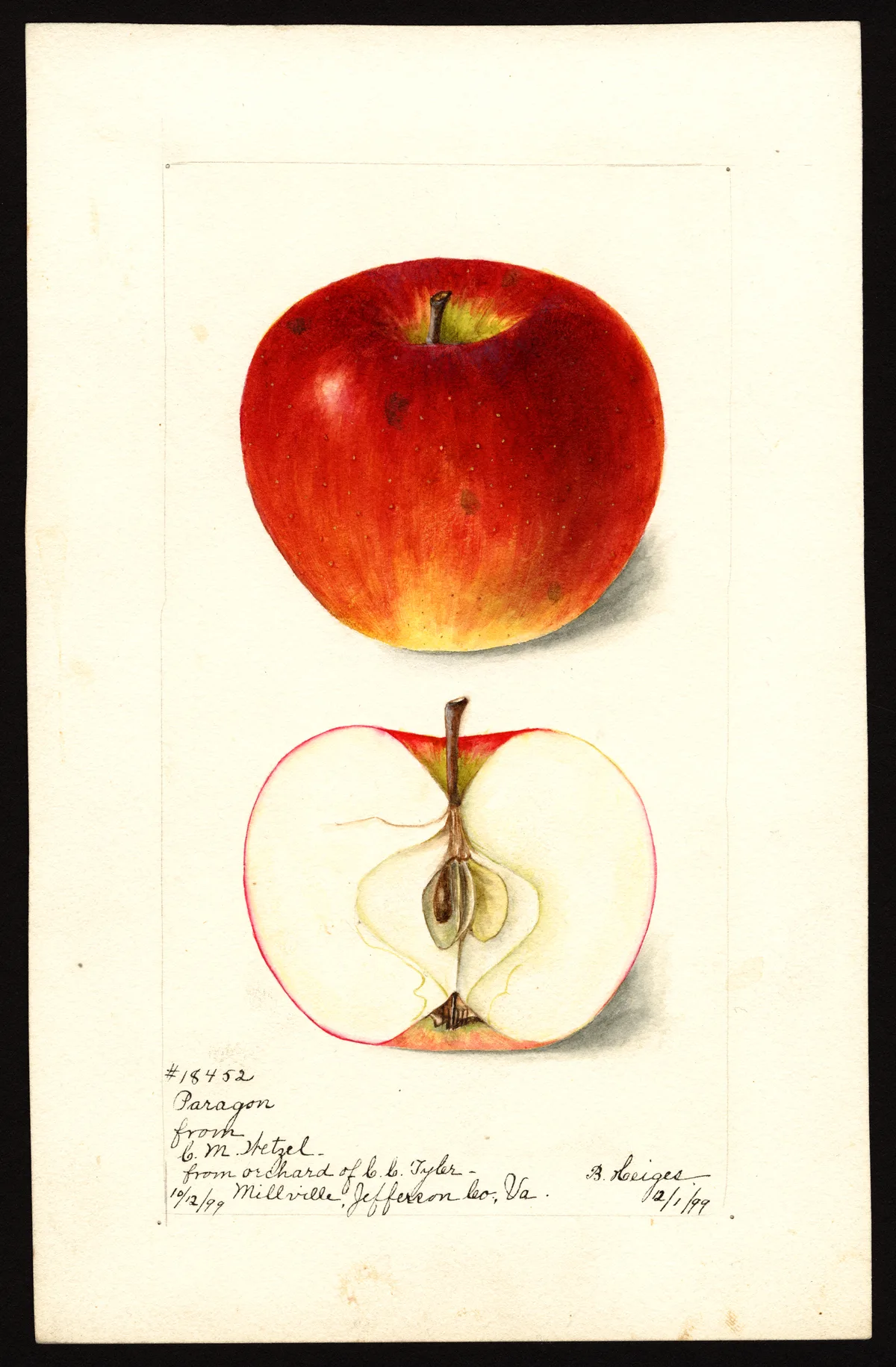
USDA Pomological Watercolor Collection
Paragon
Origin / History
Paragon originated on the farm of Major Rankin Toole near Fayetteville, Lincoln County, Tennessee, probably from a seed planted about 1830 (Beach; Hedrick). Budd-Hansen places the origin "nearly seventy years ago" relative to 1914, in the orchard of Major Rankin Toole, Lincoln Co., Tenn. Elliott alternatively gives the origin as Canton, Illinois, and lists it under "Downing's Paragon" — this conflicts with the Tennessee origin given by the later authorities.
The early history of the tree is not very clear (Beach). Grafts from the original tree were taken in 1870 by Mr. Twitty, a local nurseryman, and later introduced to the public (Beach); Budd-Hansen likewise dates first propagation to about 1870. Dr. W. L. Moores of Cyruston, Tennessee, wrote in December 1895 that he had named both Paragon and Gilbert and introduced them to public notice about eight years earlier, that both original trees were still standing and bore fruit in 1895, and that "The Paragon has obtained wonderful popularity, yet I believe it is an inferior apple to Gilbert, its twin-brother" (Budd-Hansen).
Paragon was badly confused for a while with an Arkansas seedling now properly known by the name of Arkansas but then passing under the name of Mammoth Black Twig; some believed Arkansas was identical with Paragon. Extensive discussion and the testimony of many persons established that these are two distinct although similar seedlings, of Arkansas and Tennessee origin respectively (Beach; Budd-Hansen). Many have thought that Paragon may be a seedling of Winesap crossed by Limbertwig, as it possesses some of the characteristics of both varieties (Beach); Dr. Moores likewise judged both Paragon and Gilbert to be "apparently a cross of Black Twig (Winesap) and Limbertwig, and are so much alike in appearance as to require an expert to distinguish them" (Budd-Hansen). Hedrick states Paragon is probably a seedling of Winesap, which it greatly resembles in tree and fruit, and that it is not easily distinguished from Arkansas, also thought to be an offspring of Winesap.
Paragon is a southern variety of the Winesap type. In the apple-growing regions of the South where it has been tested it has proven to be an excellent variety in many respects, but it is not generally regarded by the orchardists of that region as being especially promising for commercial orchards. The fruit evidently does not develop to as high a degree of perfection in New York as it does in more southern latitudes (Beach). It is now extensively raised in various parts of the South, and is a profitable late winter market variety (Budd-Hansen). The variety thrives only in regions where Winesap grows well, and is for most purposes inferior to the older sort (Hedrick).
Tree
Sources differ on vigor: Beach calls the tree moderately vigorous; Budd-Hansen calls it very vigorous; Hedrick calls it vigorous. Form roundish to spreading, inclined to droop, rather dense (Beach); round-spreading, inclined to droop, dense (Hedrick); spreading, rather an open head (Budd-Hansen). Branches short, stout, twisted (Beach, Hedrick). Not an early bearer (Budd-Hansen); Elliott calls it a good regular bearer.
Twigs medium to rather long, nearly straight, stout to rather slender; internodes short to medium. Bark very dark reddish-brown, mottled with thin scarf-skin, pubescent. Lenticels scattering, medium in size, roundish to oval, raised. Buds large, prominent, broad, plump, acute to somewhat obtuse, curved, free, generally pubescent. Leaves medium in size, broad (Beach); leaves broad (Hedrick).
Fruit
Size and form
Fruit above medium (Elliott); medium or above, pretty uniform in size and shape (Beach); medium or large, uniform in size and shape (Hedrick); large (Budd-Hansen). Form round ovate, flattened at ends (Elliott); roundish or sometimes oblate, slightly conic, rounding toward stem and calyx, sides often a little unequal (Beach); round or sometimes oblate, slightly conic, rounding toward stem and calyx, sides often unequal (Hedrick); roundish conical (Budd-Hansen).
Stem and cavity
Stem short, slender (Elliott); short, slender (Budd-Hansen); medium in length and thickness (Beach, Hedrick).
Cavity deep (Elliott); nearly obtuse to acute, medium in width and moderately shallow to sometimes rather wide and deep, usually symmetrical, often furrowed or compressed, occasionally lipped, usually russet and with outspreading russet rays (Beach); obtuse, shallow to wide and deep, symmetrical, often furrowed or compressed, occasionally lipped, russet and with outspreading russet rays (Hedrick); large, regular, deep, flaring, russet (Budd-Hansen).
Calyx and basin
Calyx half open (Elliott); rather small, closed (Beach); small, closed (Hedrick); small, nearly closed; segments small, converging, or slightly reflexed (Budd-Hansen).
Basin deep, slightly ribbed (Elliott); rather shallow and obtuse, varying occasionally to abrupt and medium in width and depth, often furrowed and wrinkled (Beach); shallow, obtuse, often furrowed and wrinkled (Hedrick); medium in size and depth, abrupt, furrowed (Budd-Hansen).
Skin
Pale yellow with faint blush (Elliott). Thick, tough; surface smooth, yellow, washed with red, having a few indistinct stripes (Budd-Hansen). Tough, smooth, grass-green or yellowish, largely covered with rather dull, deep red and indistinctly striped with darker red (Beach); tough, smooth, yellow, covered with dull red and indistinctly striped with darker red (Hedrick). Prevailing effect dark red (Beach, Hedrick). Dots gray or whitish, small, sometimes rather conspicuous (Beach); gray or white, small, sometimes conspicuous (Hedrick); medium, yellow (Budd-Hansen).
Flesh and flavor
Yellow, crisp, brisk, juicy, slightly sweet; nearly "best" (Elliott). Greenish or tinged with yellow, firm, a little coarse, rather tender, juicy, mild subacid, somewhat aromatic, good to very good (Beach). Yellow, firm, coarse, tender, juicy, mild subacid, aromatic; good to very good (Hedrick). Yellow, moderately fine-grained, breaking, juicy, subacid, very good (Budd-Hansen).
Core and seeds
Core medium; capsules open; seeds ovate pointed (Elliott). Core rather small; cells partly open; core lines clasping. Carpels much concave, roundish varying to nearly cordate, slightly emarginate. Seeds rather large, long, acute, dark; often some are abortive (Beach). Core small; cells partly open; core-lines clasping; carpels concave, round varying to cordate, emarginate; seeds large, long, acute, dark, often abortive (Hedrick). Core medium, conical, clasping, partially open; seeds numerous, medium, plump, brown (Budd-Hansen).
Calyx tube and stamens
Calyx tube rather small, varying from conical to funnel-form. Stamens median to slightly marginal (Beach). Calyx-tube small, conical; stamens median (Hedrick).
Season
September to November (Elliott); January to May (Beach, Hedrick); Winter (Budd-Hansen) — described as a late winter market variety in the South (Budd-Hansen).
Uses
A profitable late winter market variety in the South (Budd-Hansen). Excellent variety in many respects in southern apple-growing regions, though not regarded by orchardists as especially promising for commercial orchards; sufficient merit to make it worthy of testing to a limited extent in New York, though not probable that it will prove successful as a commercial variety there (Beach). Thrives only in regions where Winesap grows well, and is for most purposes inferior to the older sort (Hedrick).
Subtypes / Variants
Not described in source.
Other
Beach cites the variety as figured in American Gardening 17 (1896) and Budd-Hansen 1903. Budd-Hansen notes the illustration in their description is "outlined from Tenn. Exp. Sta. Bul., Vol. IX., No. 1, May, 1896." Cross-reference is made to the Gilbert apple, described as Paragon's "twin-brother," likewise originating in the same Tennessee neighborhood and judged by Dr. Moores to be the superior of the two (Budd-Hansen).
Book Sources
Described in 4 period pomological works
USDA Nomenclature (1905)
From W.H. Ragan, Nomenclature of the Apple, USDA Bulletin No. 56
Doubtful if distinct from Arkansas.
Named prior to preceding. Doubtless extinct.
Nursery Catalog Sources
Found in 41 catalogs (1886–1932) from Alabama, Arkansas, Illinois, Indiana, Kansas, Missouri, Nebraska, Oregon, Virginia, Washington
- Huntsville Wholesale Nurseries (Jessie S. Moss , Proprietor; W.F. Heikes, Manager), Huntsville , Alabama — 1886
- Missouri Nursery Co. , Louisiana , Missouri — 1891
- Puyallup & Yakima Nurseries , Puyallup, Washington (Lock Box 191) and North Yakima , Washington — 1892
- Oregon Wholesale Nurseries , Salem , Oregon — 1893
- Knox Nurseries (H.M. Simpson Co. , Proprietors), Vincennes , Indiana — 1894
- The Vineland Nurseries (Kelsey & Co. , Proprietors), St. Joseph, Missouri (Office: 13th and Atchison Sts., 2 Blocks East of the Citizens St. Car Line) — 1894
- Woodburn Nurseries , Woodburn, Marion Co. , Oregon — 1894
- Stark Bros. Nurseries & Orchards Co. , Louisiana , Missouri — 1896
- The Salem Nursery (John A. Francis , Proprietor), Salem , Virginia — 1897
- J.V. Cotta (Cotta Nursery) , Carroll County , Illinois — 1898
- Alabama Nursery Co. , Huntsville , Alabama — 1900
- Central Experimental Farm , Dominion Department of Agriculture, Agassiz, British Columbia (under test; Bulletin No. 3, Second Series) — 1900
- The Dalles Nurseries , The Dalles , Oregon — 1901
- Washington Nursery Co. , Toppenish , Washington — 1901
- Mountain Grove Nurseries (Tippin & Moore , Proprietors; Geo. T. Tippin, J. W. Tippin, J. C. Moore), Mountain Grove , Missouri — 1901
- Benjamin Buckman (personal inventory) , Farmingdale , Illinois — 1901
- Yarbrough Bros. , Stephens , Arkansas — 1901
- Russellville Nursery Co. , Russellville, OR (three miles east of Portland, one mile from Montavilla car line) — 1903
- Pacific Nursery Company (W. O. Hudson & A. D. Hudson) , Tangent , Oregon — 1903
- Phoenix Nursery Company (W. E. Rossney , President; Sidney Tuttle, Vice-President), Bloomington , Illinois — 1904
- Stark Bros. Nurseries & Orchards Co. , Louisiana , Missouri — 1906
- Russellville Nursery Co. , Montavilla Station, Portland, OR (three miles east of Portland, one mile from Montavilla car line) — 1907
- Carlton Nursery Co. , Carlton , Oregon — 1909
- Milton Nursery Co. (A. Miller & Sons , Proprietors), Milton , Oregon — 1909
- Washington Nursery Company , Toppenish , Washington — 1909
- Stark Bros. Nurseries & Orchards Co. , Louisiana , Missouri — 1910
- Galbraith Nursery Co. (DeWitt Hansen , Pres.-Mgr.), Fairbury , Nebraska — 1911
- Stark Bros. Nurseries & Orchards Co. , Louisiana , Missouri — 1911
- Stark Bros. Nurseries & Orchards Co. , Louisiana , Missouri — 1912
- Vineland Nurseries Company , Clarkston , Washington — 1912
- Pacific Nursery Company , Portland , Oregon — 1912
- Washington Nursery Company , Toppenish , Washington — 1912
- Benjamin Buckman (personal inventory) , Farmingdale , Illinois — 1913
- Union Nurseries , J.B. Weaver & Sons, Union , Oregon — 1915
- Holsinger Bros. Nurseries (Holsinger Brothers Nursery) , Rosedale , Kansas — 1916
- Stark Bros. Nurseries & Orchards Co. , Louisiana , Missouri — 1918
- Oregon Nursery Co. , Orenco , Oregon — 1920
- Benedict Nursery Co. , Portland , Oregon — 1921
- Columbia & Okanogan Nursery Co. , Wenatchee , Washington — 1925
- Stark Bro's Nurseries , Louisiana , Missouri — 1932
- North-Western Nurseries , Walla Walla , Washington
View original book sources (4)
— F.R. Elliott, The Western Fruit Book (1865)Paragon. Downing's Paragon. Origin, Canton, Ill. Fruit, above medium, round ovate, flattened at ends; pale yellow, faint blush; stem, short, slender; cavity, deep; calyx, half open; basin, deep, slightly ribbed; core, medium; capsules, open; seeds, ovate pointed; flesh, yellow, crisp, brisk, juicy, slightly sweet; nearly "best." September to November. Good regular bearer.
— S.A. Beach, The Apples of New York, Vol. 1 (1905)PARAGON.
REFERENCES. 1. Van Deman, Am. Pom. Soc. Rpt., 1891:123, 159. 2. Bailey, An. Hort., 1892:246. 3. Heiges, U. S. Pom. R'pt., 1895:30. 4. Babcock, Am. Pom. Soc. Rpt., 1895:190. 5. Amer. Gard., 16:419. 1895. 6. Ib., 17:12, 28, 33, 42, 65, 97, 146, 152, 194, 210, 306. 1896. fig. 7. Van Deman, Rural N. Y., 55:243. 1896. 8. Watts, Tenn. Sta. Bul., 1:24. 1896. fig. 9. Powell, Del. Sta. Bul., 38:19. 1898. 10. Stinson, Ark. Sta. Bul., 49:7. 1898. 11. Bruner, N. C. Sta. Bul., 182:21. 1903. 12. Thomas, 1903:712. 13. Budd-Hansen, 1903:144. fig. 14. Powell and Fulton, U. S. B. P. I. Bul., 48:52. 1903. 15. Beach and Clark, N. Y. Sta. Bul., 248:137. 1904. SYNONYMS. Black Twig (8, 14), but erroneously. Mammoth Black Twig (8, 13, 15), but erroneously. Twitty's Paragon (8).
This is a southern variety of the Winesap type. In the apple-growing regions of the South where it has been tested it has proven to be an excellent variety in many respects, but it is not generally regarded by the orchardists of that region as being especially promising for commercial orchards. The fruit evidently does not develop to as high a degree of perfection in New York as it does in more southern latitudes. It is not probable that it will prove successful as a commercial variety here, though it has sufficient merit to make it worthy of testing to a limited extent.
Historical. The Paragon originated on the farm of Major Rankin Toole near Fayetteville, Lincoln county, Tennessee (3, 6, 7, 8). The early history of the tree is not very clear but it probably came from a seed planted about 1830. Grafts from the original tree were taken in 1870 by Mr. Twitty, a local nurseryman, and later introduced to the public. It was badly confused for a while with an Arkansas seedling now properly known by the name of Arkansas but then passing under the name of Mammoth Black Twig. Some believed that the Arkansas was identical with Paragon. An extensive discussion and the testimony of many persons has since brought out the fact that these are two distinct although similar seedlings of Arkansas and Tennessee origin respectively. Many have thought that Paragon may be a seedling of the Winesap crossed by Limbertwig as it possesses some of the characteristics of both of these varieties.
TREE.
Tree moderately vigorous with rather short, stout, twisted branches. Form roundish to spreading, inclined to droop, rather dense. Twigs medium to rather long, nearly straight, stout to rather slender; internodes short to medium. Bark very dark reddish-brown, mottled with thin scarf-skin, pubescent. Lenticels scattering, medium in size, roundish to oval, raised. Buds large, prominent, broad, plump, acute to somewhat obtuse, curved, free, generally pubescent. Leaves medium in size, broad.
FRUIT.
Fruit medium or above, pretty uniform in size and shape. Form roundish or sometimes oblate, slightly conic, rounding toward stem and calyx; sides often a little unequal. Stem medium in length and thickness. Cavity nearly obtuse to acute, medium in width and moderately shallow to sometimes rather wide and deep, usually symmetrical, often furrowed or compressed, occasionally lipped, usually russet and with outspreading russet rays. Calyx rather small, closed. Basin rather shallow and obtuse varying occasionally to abrupt and medium in width and depth, often furrowed and wrinkled. Skin tough, smooth, grass-green or yellowish, largely covered with rather dull, deep red and indistinctly striped with darker red. Dots gray or whitish, small, sometimes rather conspicuous. Prevailing effect dark red. Calyx tube rather small, varying from conical to funnel-form. Stamens median to slightly marginal. Core rather small; cells partly open; core lines clasping. Carpels much concave, roundish varying to nearly cordate, slightly emarginate. Seeds rather large, long, acute, dark; often some are abortive. Flesh greenish or tinged with yellow, firm, a little coarse, rather tender, juicy, mild subacid, somewhat aromatic, good to very good. Season January to May.
— J.L. Budd & N.E. Hansen, American Horticultural Manual, Part II: Systematic Pomology (1914)Paragon (Mammoth Black Twig). — Originated in the orchard of Major Rankin Toole, Lincoln Co., Tenn., nearly seventy years ago, and first propagated about 1870. This variety and Arkansaw were mixed for a time in nurseries under the names Paragon and Mammoth Black Twig; the trees are very similar in fruit and habit of growth, but are now considered quite distinct. Both appear to be seedlings of Winesap. (See Gilbert apple description.) The Paragon is now extensively raised in various parts of the South, and is a profitable late winter market variety; tree very vigorous, spreading, rather an open head, not an early bearer. (The cut is outlined from Tenn. Exp. Sta. Bui., Vol. IX., No. 1, May, 1896.) Dr. W. L. Moores, Cyruston, Tenn., in 1895, upon request sent both Gilbert and Paragon to the U. S. Dept. of Agriculture and wrote:
"Both originated in this neighborhood; both original trees are standing (December, 1895), and bore fruit this season. I named both apples and introduced them to public notice about eight years ago. The Paragon has obtained wonderful popularity, yet I believe it is an inferior apple to Gilbert, its twin-brother. Both apples are apparently a cross of Black Twig (Winesap) and Limbertwig, and are so much alike in appearance as to require an expert to distinguish them."
Fruit large, roundish conical; skin thick, tough; surface smooth, yellow, washed with red, having a few indistinct stripes; dots medium, yellow; cavity large, regular, deep, flaring, russet; stem short, slender; basin medium in size and depth, abrupt, furrowed; calyx small, nearly closed; segments small, converging, or slightly reflexed. Core medium, conical, clasping, partially open; seeds numerous, medium, plump, brown; flesh yellow, moderately fine-grained, breaking, juicy, subacid, very good. Winter.
— U.P. Hedrick, Cyclopedia of Hardy Fruits (1922)PARAGON. Fig. 42. Paragon is probably a seedling of Winesap, which it greatly resembles in tree and fruit. It is not easily distinguished, either, from Arkansas, which is also thought to be an offspring of Winesap. The variety thrives only in regions where Winesap grows well, and is for most purposes inferior to the older sort. Paragon originated on the farm of Major Rankin Toole, Fayetteville, Tennessee, from a seed planted about 1830. Tree vigorous, round-spreading, inclined to droop, dense, with short, stout, twisted branches. Leaves broad. Fruit medium or large, uniform in size and shape, round or sometimes oblate, slightly conic, rounding toward stem and calyx, sides often unequal; stem medium in length and thickness; cavity obtuse, shallow to wide and deep, symmetrical, often furrowed or compressed, occasionally lipped, russet and with outspreading russet rays; calyx small, closed; basin shallow, obtuse, often furrowed and wrinkled; skin tough, smooth, yellow, covered with dull red and indistinctly striped with darker red; dots gray or white, small, sometimes conspicuous; prevailing effect dark red; calyx-tube small, conical; stamens median; core small; cells partly open; core-lines clasping; carpels concave, round varying to cordate, emarginate; seeds large, long, acute, dark, often abortive; flesh yellow, firm, coarse, tender, juicy, mild subacid, aromatic; good to very good; January to May.