Limbertwig
Apple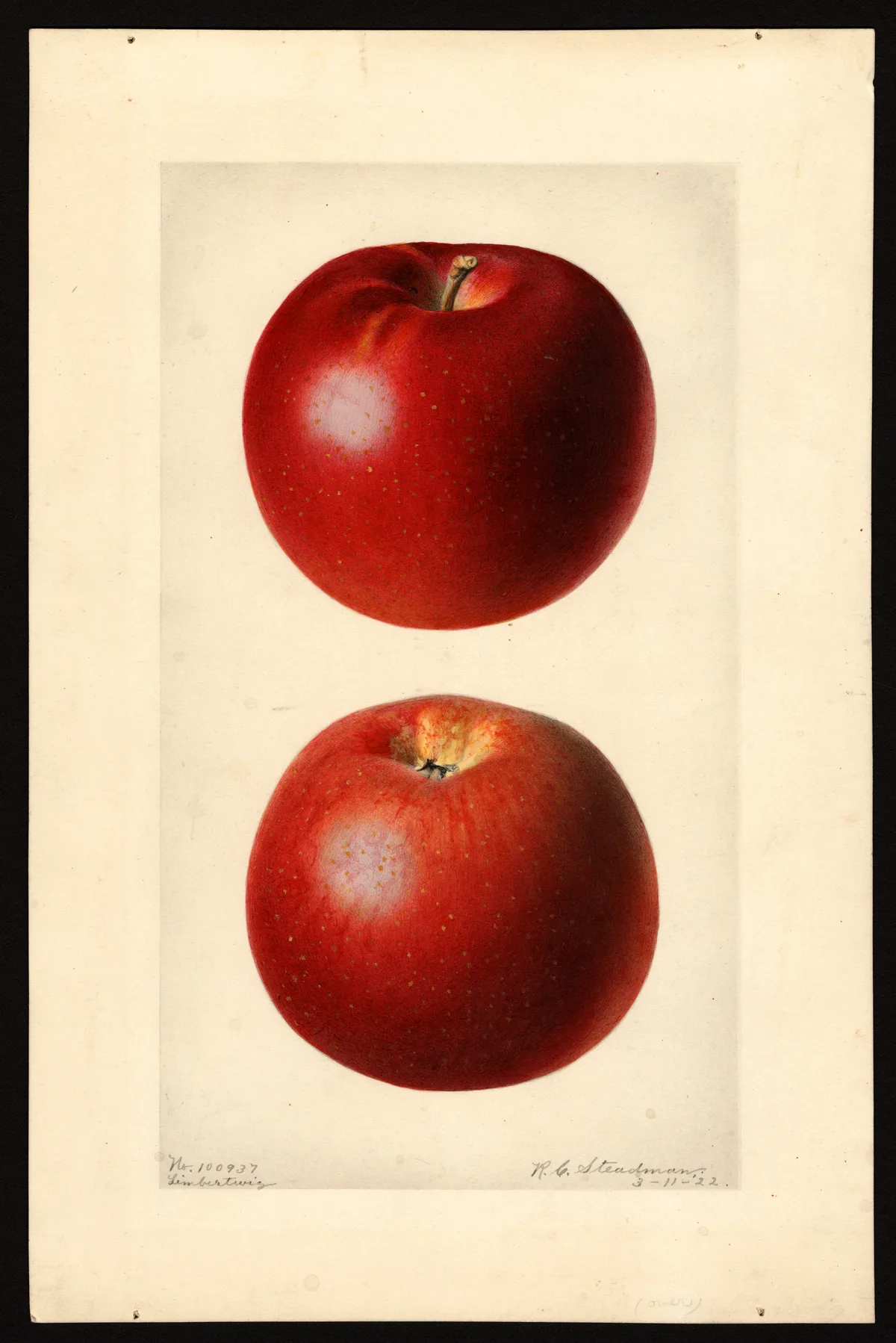
USDA Pomological Watercolor Collection
Limbertwig
Origin / History
Origin is supposed to be North Carolina (Downing, Budd-Hansen). Hedrick states the origin is not known, with the earliest notice being that of Kenrick in 1832. Much cultivated in the South and West as a long-keeping winter variety; a favorite with southern immigrants and found most abundant in regions occupied by them, though carried pretty far to the north (Warder). Elliott notes it as a valuable fruit in Southern Ohio, Kentucky, and Indiana. Thomas attributes the variety's name to the tree being "ill shapen, with pendent branches."
Beach observes that several different apples are known locally under the name Limbertwig. Willow Twig is sometimes incorrectly called Limbertwig (a confusion also noted by Warder, who states that "the Willow Twig is often so named"); Thomas explicitly distinguishes Limbertwig from Willow Twig. An apple grown in Northern New York, probably of local origin, is there known under the name Limbertwig — it is of the Blue Pearmain class and resembles Bethel in form and color, but the flesh is coarser and has more acidity; it is a good keeper. In some portions of Western New York the Twenty Ounce is called Limbertwig. Warder notes that the synonym "James River" given by Downing is not met with among the people as applied to this apple. Hedrick observes that "Limbertwig" is a rather common appellation for varieties of apples having willowy twigs, with possibly a dozen varieties so called in different parts of America, but that the name belongs properly to a variety producing a medium-sized, deep-red, late-keeping apple rather popular in southern latitudes.
Beach distinguishes two principal forms in the literature: a small or red Limbertwig and a large or green Limbertwig. The small or red form appears to be practically unknown among New York fruit growers except in some localities in the southeastern portions of the state; the large or green form, so far as Beach knows, is not grown in New York. (See Subtypes / Variants below.)
Tree
Hardy, thrifty, vigorous, exceedingly/very productive (Warder, Downing, Budd-Hansen, Hedrick, Beach). Habit roundish, spreading, somewhat drooping (Downing, Budd-Hansen). Shoots/laterals slender, becoming drooping with the heavy crops (Warder, Budd-Hansen, Beach, Hedrick). Fruit hangs well to the tree despite high winds (Beach, Hedrick). Thomas describes the tree as "ill shapen, with pendent branches."
Fruit
Size
Reports vary. Medium to small (Warder); rather small to medium (Budd-Hansen); medium or above (Downing); large (Elliott); large, roundish (Thomas); medium (Hedrick, Lowther). Beach, describing the small/red form: above medium to below; uniform in size and shape. Beach notes that the large or green form is much larger than the red, but does not keep as well.
Form
Roundish conic, regular (Warder); roundish oblate, inclining to conic (Downing); roundish oblate, somewhat conical, regular (Budd-Hansen); roundish, tapering a little to the eye (Elliott); large, roundish, slightly conical (Thomas); roundish (oblate) (Lowther); round to oblate-conic, symmetrical and regular (Hedrick); roundish to slightly oblate conic, ribbed but slightly if at all, symmetrical and regular (Beach, red form).
Stem / Stalk
Medium in length and thickness, usually not exserted (Beach, Hedrick); medium, curved (Warder); medium (Budd-Hansen); of medium length (Downing); long, slender (Elliott, Thomas).
Cavity
Deep, acute, brown (Warder); broad, deep, surrounded by thin, green russet (Downing); broad, deep, acute, green and russet (Budd-Hansen); open, funnel shape, russeted (Elliott); acuminate, deep, rather broad to moderately narrow, sometimes partly russeted, smooth or gently furrowed (Beach, red form); acuminate, deep, broad, sometimes russeted, smooth or gently furrowed (Hedrick). For the large or green form, Beach gives: large, acute or approaching acuminate, wide, deep, somewhat furrowed.
Calyx / Eye
Small, open (Warder); closed, set in a small, uneven basin (Downing); small, half open (Budd-Hansen); rather small (Elliott, Thomas); small to medium, closed or partly open; lobes short, broad, flat or sometimes recurved (Beach, red form); small, closed or partly open; lobes short, broad, sometimes recurved (Hedrick).
Calyx tube cone-shape to elongated funnel-form (Beach, red form); cone-shape to somewhat funnel-form (Beach, green form); cone-shape (Hedrick). Stamens median or above (Beach, red form); median (Beach, green form; Hedrick).
Basin
Medium, regular (Warder); small, uneven (Downing); small, shallow, uneven (Budd-Hansen); irregular, round (Elliott); small, moderately narrow, varying from shallow and obtuse to moderately deep and somewhat abrupt, often a little furrowed (Beach, red form); small, narrow, shallow and obtuse or deep and abrupt, often furrowed (Hedrick).
Skin
Surface rather smooth, mixed dull purplish red, on green, stripes scarcely to be traced (Warder); greenish yellow, shaded and striped with dull crimson, and sprinkled with light dots (Downing); surface yellowish green covered with dull red, with obscure darker stripes (Budd-Hansen); light yellow, striped and splashed with red in sun, rough russet specks, and occasional patch of russet (Elliott); striped and splashed with red on yellow (Thomas); yellow-red (Lowther); slightly roughened with numerous and rather conspicuous russet dots, yellow largely covered with red, deepening in the sun to dark purplish-red, sparingly and obscurely striped with dull carmine, sometimes marked with broken irregular russet veins; prevailing effect attractive dark red (Beach, red form); roughened with numerous conspicuous russet dots, yellow covered with red, deepening in the sun to dark red, obscurely striped with dull carmine, sometimes marked with broken russet veins; prevailing effect dark red (Hedrick).
Dots
Numerous, large, irregular, brown (Warder); light dots (Downing); many, large, light brown, irregular (Budd-Hansen); rough russet specks, and occasional patch of russet (Elliott); numerous and rather conspicuous russet dots (Beach, red form; Hedrick). For the large or green form, Beach gives: coarse, conspicuous, usually areolar with russet point. The green form is also marked over the base with whitish scarf-skin and sometimes with a few irregular patches or streaks of russet.
Flesh / Flavor
Greenish-yellow, firm; flavor sub-acid, rich, aromatic; quality very good (Warder). Whitish, not very tender, juicy, with a brisk, subacid flavor; good (Downing). Greenish yellow, very firm, juicy, brisk, rich, aromatic subacid, good (Budd-Hansen). Whitish, tender, sub-acid; "very good" (Elliott). Yellowish, very compact, not high flavored (Thomas). Yellowish, hard, moderately fine, not very crisp, juicy, aromatic, subacid, good (Beach, red form). Yellow, firm, fine, juicy, aromatic, subacid; good (Hedrick). For the large or green form, Beach notes: subacid, coarser and more juicy than the [red form] and much inferior in flavor and quality.
Sources thus largely agree on a subacid, aromatic, firm flesh of good quality, but disagree on flesh color (greenish-yellow / whitish / yellow) and tenderness (Downing: "not very tender"; Elliott: "tender"; Beach/Warder/Hedrick: firm/hard; Thomas: "very compact").
Core / Seeds
Core rather large, regular, turbinate, closed, clasping (Warder); core closed (Budd-Hansen); core large, hollow (Elliott); core sessile, abaxile or nearly so, rather small to medium; cells not uniformly developed, pretty symmetrical, closed or slightly open; core lines clasping; carpels concave, elliptical, deeply emarginate, much tufted (Beach, red form); core sessile, abaxile, small; cells not uniformly developed, symmetrical, closed or open; core-lines clasping; carpels concave, elliptical, deeply emarginate, much tufted (Hedrick). For the large or green form, Beach gives: core medium to rather large, axile; cells symmetrical, closed; core lines meeting or somewhat clasping; carpels smooth or nearly so, elliptical to broadly obcordate, deeply emarginate.
Seeds: numerous, small, plump, long (Warder, Budd-Hansen); plump, pyriform (Elliott); numerous, elongated, medium to small, plump, obtuse to acute, much tufted, clinging to the carpels (Beach, red form); numerous, elongated, small, plump, obtuse, much tufted, clinging to the carpels (Hedrick). For the large or green form, Beach gives: rather large to medium, rather wide, obtuse, smooth or nearly so, free.
Season
March and April (Warder); January, April (Downing); late winter and spring (Budd-Hansen); keeps to May (Elliott); winter (Lowther); January to March or April, in cold storage February to May or later (Beach, red form); fruit keeps from April until May; January to April (Hedrick). Well adapted for storage, ships well, keeps late (Beach, red form). The large or green form does not keep as well as the red (Beach). Keeps very well, but wilts if exposed to the air — preserved very well in the ground (Warder).
Uses
Table and kitchen (Warder); market (Lowther). Cultivated in the South and West for its keeping properties (Thomas).
Subtypes / Variants
Beach treats two forms separately:
Limbertwig (small or red). Fruit attractive in appearance, of good deep red color, pretty uniform in size, well adapted for storage, ships well and keeps late, but the quality is only fair to good. Tree thrifty and an excellent cropper; fruit hangs well to the tree despite high winds; laterals slender, becoming drooping with heavy crops. (Full physical description integrated above.)
Limbertwig (large or green). Fruit much larger than the red form but does not keep as well. Decidedly less attractive, being dull green partly overspread with dull brownish-red, marked over the base with whitish scarf-skin and sometimes with a few irregular patches or streaks of russet. Dots coarse, conspicuous, usually areolar with russet point. Cavity large, acute or approaching acuminate, wide, deep, somewhat furrowed. Calyx tube cone-shape to somewhat funnel-form. Stamens median. Core medium to rather large, axile; cells symmetrical, closed; core lines meeting or somewhat clasping. Carpels smooth or nearly so, elliptical to broadly obcordate, deeply emarginate. Seeds rather large to medium, rather wide, obtuse, smooth or nearly so, free. Flesh subacid, coarser and more juicy than the red, and much inferior in flavor and quality.
Beach notes that authors describing this apple sometimes clearly mean the red form (Emmons, Downing 1857, Warder, Lyon, Budd-Hansen), sometimes the green form (Thomas, Elliott), occasionally both (Phoenix, Hooper, W. Sta. Bul.), but most often it is not clear which is meant. Elliott himself refers the reader to "Willow Twig, &c." for "varieties of this."
Other
Lowther's tabular entry: Northern Division reports 3 (also reported in another division). Beach's record of regional confusion (above) is geographically significant for identification: an apple bearing the name "Limbertwig" in Northern New York will likely be a Blue Pearmain-class fruit resembling Bethel, not the southern red Limbertwig; and in parts of Western New York, "Limbertwig" may denote Twenty Ounce. Warder also notes that Willow Twig is often locally called Limbertwig.
Book Sources
Described in 8 period pomological works
- Warder, American Pomology: Apples (1867)
- Beach, The Apples of New York Vol. 1 (1905)
- Hedrick, Cyclopedia of Hardy Fruits (1922)
- Budd & Hansen, Systematic Pomology (1914)
- Thomas, The American Fruit Culturist (1903)
- Downing, Fruits and Fruit Trees of America (1900) — listed as Limber Twig
- Elliott, The Western Fruit Book (1865) — listed as Limber Twig
- Lowther (ed.), Encyclopedia of Practical Horticulture (1914) — listed as Limber Twig
Nursery Catalog Sources
Found in 12 catalogs (1886–1913) from Alabama, Arkansas, California, Illinois, Missouri, Oregon, Virginia, Washington
- Fancher Creek Nursery , Fresno , California — 1886
- Huntsville Wholesale Nurseries (Jessie S. Moss , Proprietor; W.F. Heikes, Manager), Huntsville , Alabama — 1886
- Woodburn Nurseries , Woodburn, Marion Co. , Oregon — 1894
- The Salem Nursery (John A. Francis , Proprietor), Salem , Virginia — 1897
- Alabama Nursery Co. , Huntsville , Alabama — 1900
- Central Experimental Farm , Dominion Department of Agriculture, Agassiz, British Columbia (under test; Bulletin No. 3, Second Series) — 1900 — listed as Red Limbertwig
- Mountain Grove Nurseries (Tippin & Moore , Proprietors; Geo. T. Tippin, J. W. Tippin, J. C. Moore), Mountain Grove , Missouri — 1901
- Yarbrough Bros. , Stephens , Arkansas — 1901
- Benjamin Buckman (personal inventory) , Farmingdale , Illinois — 1901
- Phoenix Nursery Company (W. E. Rossney , President; Sidney Tuttle, Vice-President), Bloomington , Illinois — 1904
- Vineland Nurseries Company , Clarkston , Washington — 1912
- Benjamin Buckman (personal inventory) , Farmingdale , Illinois — 1913
View original book sources (8)
— John A. Warder, American Pomology: Apples (1867)Limbertwig.
This well known southern apple is much cultivated in many parts of the West as a long keeping winter variety. It is a favorite with the southern immigrants, and found most abundant in regions occupied by them, but it has been carried pretty far to the north. The synonym James River, as given by Downing, is not met with among the people as applied to this apple, but the Willow Twig is often so named.
Tree thrifty, exceedingly productive; Shoots slender and drooping with the heavy crops.
Fruit medium to small, roundish conic, regular; Surface rather smooth, mixed dull purplish red, on green, stripes scarcely to be traced; Dots numerous, large, irregular, brown.
Basin medium, regular; Eye small, open.
Cavity deep, acute, brown; Stem medium, curved.
Core rather large, regular, turbinate, closed, clasping; Seeds numerous, small, plump, long; Flesh greenish-yellow, firm; Flavor sub-acid, rich, aromatic; Quality very good; Use, table and kitchen; Season, March and April. Keeps very well, but wilts if exposed to the air—preserved very well in the ground.
— A.J. Downing, The Fruits and Fruit Trees of America (1900)Limber Twig.
James River. Red Limber Twig ?
An Apple much cultivated South and West. Origin, supposed North Carolina. Tree hardy and productive, roundish, spreading, somewhat drooping.
Fruit medium or above, roundish oblate, inclining to conic, greenish yellow, shaded and striped with dull crimson, and sprinkled with light dots. Stalk of medium length, inserted in a broad, deep cavity, surrounded by thin, green russet. Calyx closed, set in a small, uneven basin. Flesh whitish, not very tender, juicy, with a brisk, subacid flavor. Good. January, April.
— S.A. Beach, The Apples of New York, Vol. 1 (1905)LIMBERTWIG.
REFERENCES. 1. Kenrick, 1832:59. 2. Thomas, 1849:168. 3. Phoenix, Horticulturist, 4:471. 1850. 4. Emmons, Nat. Hist. N. Y., 3:67. 1851. 5. Elliott, 1854:143. 6. Robey, Horticulturist, 11:89. 1856. 7. Downing, 1857:164. 8. Hooper, 1857:54. 9. Am. Pom. Soc. Cat., 1860. 10. Warder, 1867:516. fig. 11. Fitz, 1872:143, 149. 12. Leroy, 1873:420. fig. 13. Barry, 1883:348. 14. Lyon, Mich. Hort. Soc. Rpt., 1890:294. 15. Wickson, 1891:248. 16. Bailey, An. Hort., 1892:243. 17. Clayton, Ala. Sta. Bul., 47:7. 1893. 18. Stinson, Ark. Sta. An. Rpt., 7:47. 1894. 19. W. Sta. Bul., 45:329. 1896. 20. Rural N. Y., 62:822. 1903. fig. 21. Budd-Hansen, 1903:115. 22. Bruner, N. C. Sta. Bul., 182:25. 1903. figs. 23. Farrand, Mich. Sta. Bul., 205:45. 1903. 24. Powell and Fulton, U. S. B. P. I. Bul., 48:47. 1903. 25. Beach and Clark, N. Y. Sta. Bul., 248:129. 1904.
SYNONYMS. James River (2, 5, 7). LAMBERTWIG (12). LIMBER TWIG (1, 2, 4, 5, 7, 8, 9, 13, 14, 15, 16, 23). Red Limbertwig (22).
There are several different apples which are known locally under the name Limbertwig. Willow Twig is sometimes incorrectly called Limbertwig, as has been noted by some writers (5, 14). There is an apple grown in Northern New York, probably of local origin, which is there known under the name of Limbertwig. This fruit is of the Blue Pearmain class and resembles Bethel in form and color but the flesh is coarser and has more acidity. It is a good keeper. In some portions of Western New York the Twenty Ounce is called Limbertwig.
The variety described below as the small or red Limbertwig appears to be practically unknown among New York fruit growers except in some localities in the southeastern portions of the state. That described as the large or green Limbertwig, so far as we know, is not grown in New York.
In some of the references above cited the writers appear to have clearly in mind the red Limbertwig (4, 7, 10, 14, 21); in other cases they evidently describe the green Limbertwig (2, 5); occasionally both are mentioned (3, 8, 19), but in most instances it is not clear which variety is referred to.
LIMBERTWIG (Small or red).
Fruit attractive in appearance, of good deep red color, pretty uniform in size, well adapted for storage, ships well and keeps late, but the quality is only fair to good. The tree is thrifty and an excellent cropper and the fruit hangs well to the tree despite high winds (8, 10, 20); laterals slender becoming drooping with heavy crops.
FRUIT.
Fruit above medium to below; uniform in size and shape. Form roundish to slightly oblate conic, ribbed but slightly if at all, symmetrical and regular. Stem medium in length and thickness, usually not exserted. Cavity acuminate, deep, rather broad to moderately narrow, sometimes partly russeted, smooth or gently furrowed. Calyx small to medium, closed or partly open; lobes short, broad, flat or sometimes recurved. Basin small, moderately narrow, varying from shallow and obtuse to moderately deep and somewhat abrupt, often a little furrowed.
Skin slightly roughened with numerous and rather conspicuous russet dots, yellow largely covered with red, deepening in the sun to dark purplish-red, sparingly and obscurely striped with dull carmine, sometimes marked with broken irregular russet veins. Prevailing effect attractive dark red.
Calyx tube cone-shape to elongated funnel-form. Stamens median or above.
Core sessile, abaxile or nearly so, rather small to medium; cells not uniformly developed, pretty symmetrical, closed or slightly open; core lines clasping. Carpels concave, elliptical, deeply emarginate, much tufted. Seeds numerous, elongated, medium to small, plump, obtuse to acute, much tufted, clinging to the carpels.
Flesh yellowish, hard, moderately fine, not very crisp, juicy, aromatic, subacid, good.
Season January to March or April; in cold storage February to May or later.
LIMBERTWIG (Large or green).
As compared with the variety last described the fruit of the large or green Limbertwig is much the larger but it does not keep as well. It is decidedly less attractive being dull green partly overspread with dull brownish-red, marked over the base with whitish scarf-skin and sometimes with a few irregular patches or streaks of russet. Dots coarse, conspicuous, usually areolar with russet point.
Cavity large, acute or approaching acuminate, wide, deep, somewhat furrowed. Calyx tube cone-shape to somewhat funnel-form. Stamens median. Core medium to rather large, axile; cells symmetrical, closed; core lines meeting or somewhat clasping. Carpels smooth or nearly so, elliptical to broadly obcordate, deeply emarginate. Seeds rather large to medium, rather wide, obtuse, smooth or nearly so, free. Flesh subacid, coarser and more juicy than the other and much inferior in flavor and quality.
— Granville Lowther (ed.), Encyclopedia of Practical Horticulture (1914)Limber Twig: size medium; form roundish (oblate); color yellow-red; quality good; use market; season winter; Northern Division reports 3 (also reported in another division).
— F.R. Elliott, The Western Fruit Book (1865)Limber Twig. James River. A valuable fruit in Southern Ohio, Kentucky, and Indiana. Tree, hardy, productive. Fruit, large, roundish, tapering a little to the eye ; light yellow, striped and splashed with red in sun, rough russet specks, and occasional patch of russet ; stem, long, slender ; cavity, open, funnel shape, russeted ; calyx, rather small ; basin, irregular, round ; core, large, hollow ; seeds, plump, pyriform ; flesh, whitish, tender, sub-acid ; "very good." Keeps to May. For varieties of this, see Willow Twig, &c.
— John J. Thomas, The American Fruit Culturist (1903)Limbertwig.* (James River.) Large, roundish, slightly conical; striped and splashed with red on yellow; stalk long, slender, calyx rather small; flesh yellowish, very compact, not high flavored, but cultivated in the South and West for its keeping properties. The tree is ill shapen, with pendent branches, whence its name. Distinct from the Willow Twig. North Carolina.
— J.L. Budd & N.E. Hansen, American Horticultural Manual, Part II: Systematic Pomology (1914)Limbertwig. — Supposed origin, North Carolina; tree thrifty, very productive, roundish, spreading, the slender shoots drooping with the heavy crop.
Fruit rather small to medium, roundish oblate, somewhat conical, regular; surface yellowish green covered with dull red, with obscure darker stripes; dots many, large, light brown, irregular; cavity broad, deep, acute, green and russet; stem medium; basin small, shallow, uneven; calyx small, half open. Core closed; seeds many, small, plump, long; flesh greenish yellow, very firm, juicy, brisk, rich, aromatic subacid, good. Late winter and spring.
— U.P. Hedrick, Cyclopedia of Hardy Fruits (1922)LIMBERTWIG. James River. Limbertwig is a rather common appellation for varieties of apples having willowy twigs. Possibly a dozen varieties have been so called in different parts of America, but the name belongs properly to a variety producing a medium-sized, deep-red, late-keeping apple rather popular in southern latitudes. The tree is vigorous and productive, its slender branches usually bending in season with a heavy crop. The fruit keeps from April until May. The origin of Limbertwig is not known; the earliest notice is that of Kenrick in 1832. Tree thrifty, productive, fruit hanging well to the tree; laterals slender becoming drooping with heavy crops. Fruit medium, uniform in size and shape, round to oblate-conic, symmetrical and regular; stem medium in length and thickness, usually not exserted; cavity acuminate, deep, broad, sometimes russeted, smooth or gently furrowed; calyx small, closed or partly open; lobes short, broad, sometimes recurved; basin small, narrow, shallow and obtuse or deep and abrupt, often furrowed; skin roughened with numerous conspicuous russet dots, yellow covered with red, deepening in the sun to dark red, obscurely striped with dull carmine, sometimes marked with broken russet veins; prevailing effect dark red; calyx-tube cone-shape; stamens median; core sessile, abaxile, small; cells not uniformly developed, symmetrical, closed or open; core-lines clasping; carpels concave, elliptical, deeply emarginate, much tufted; seeds numerous, elongated, small, plump, obtuse, much tufted, clinging to the carpels; flesh yellow, firm, fine, juicy, aromatic, subacid; good; January to April.