Willow
Apple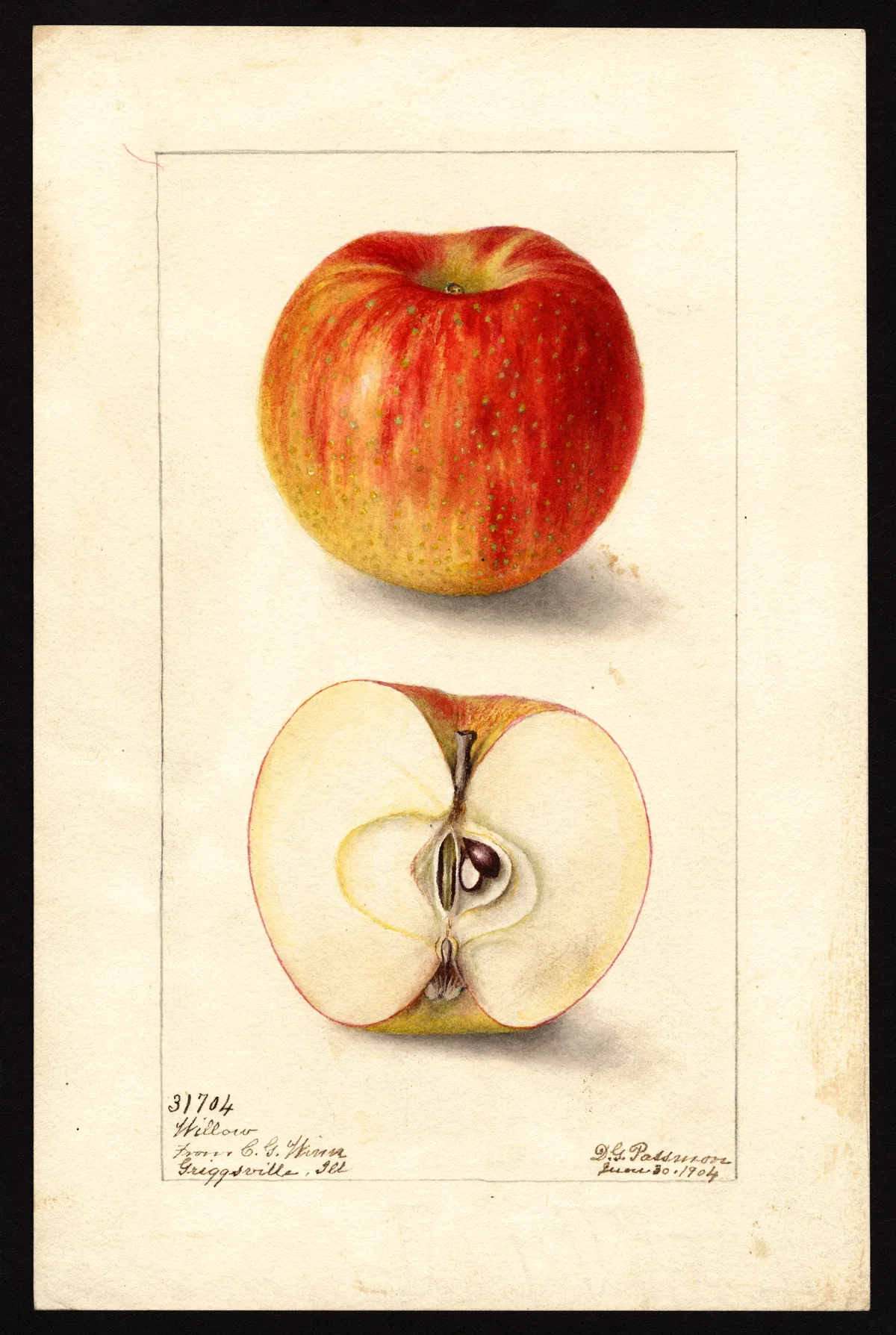
USDA Pomological Watercolor Collection
Willow
Origin / History
The origin of Willow is uncertain and has long been a matter of conflicting report. Elliott (1865) states that the variety came from New Jersey. Warder (1867) refers to it as a Virginia fruit, though without giving the authority for the statement. Downing (1900) calls it "of unknown origin." Budd-Hansen (1914) records the "supposed origin" as Virginia. Beach (1905) notes that the first written pomological notice of the variety places it in the state of Ohio about the middle of the 19th century, and that it was said to have been brought there from New Jersey, but he regards these statements as lacking definiteness. Hedrick (1922) suggests that the origin is not known, but that it is "probably an old sort brought to new life in Ohio about 1848."
From Ohio its cultivation gradually spread throughout the Middle West. The fruit was found particularly desirable for shipping to New Orleans and other southern markets, and was valued for southern exportation. Up to about twenty years before Beach wrote (i.e., into the 1880s), Willow was esteemed very highly as a commercial variety in the apple-growing portions of Illinois, Missouri, Arkansas and Kansas; but during the last two decades of the 19th century it fell very much into disfavor on account of its susceptibility to scab, blight, and bitter rot, and many cultivators went so far as to cut the trees out altogether on account of the menace from the spread of these diseases to other varieties. So far as Beach had learned, it was quite free from disease when grown in New York. It has been cultivated in New York in a limited way only, and the planting of it did not appear to be increasing very much at the time of Beach's writing. Thomas (1903) notes it was cultivated as a market apple in Southern Ohio. Hedrick (1922) emphasizes that the variety is of value only in the South, though the tree is comparatively hardy, and that it is chiefly grown in the Central Mississippi Valley.
Tree
Tree habit is distinctive and immediately recognizable: Hedrick (1922) writes that "once seen, the tree of this variety can always be recognized by its slender drooping twigs." Warder (1867) describes the tree as very vigorous, healthy, productive, branching, twiggy, and thorny while young. Downing (1900) and Budd-Hansen (1914) both note that the tree is a poor grower in the nursery, but makes a good spreading, somewhat drooping orchard tree — quite hardy and very productive. The Central Experimental Farm catalogue (1900) similarly calls it "a vigorous but slender grower." Beach (1905) confirms that the tree makes a poor growth in the nursery but under favorable conditions becomes large and vigorous in the orchard, and is a strong grower and a rather early and regular bearer. Hedrick (1922) describes it as large, vigorous, upright-spreading with terminals drooping, with strong, vigorous, healthy growth, early bearing, and productiveness; the crop requires a long and warm season for full development. Budd-Hansen note it "blights in some localities" but is profitable for market in parts of the West.
Form: upright spreading with terminals drooping on bearing trees (Beach).
Shoots / twigs: Young shoots slender; Warder describes them as olive brown; Downing as reddish brown and downy. Beach: twigs short to medium, very slender, straight, limber; internodes long. Budd-Hansen: slender drooping shoots.
Bark: clear yellowish-green or light reddish with no noticeable scarf-skin; quite pubescent (Beach).
Lenticels: scattering, small, generally elongated, raised (Beach).
Buds: Downing calls them inconspicuous. Beach: small to medium, projecting a little, moderately obtuse, rather pubescent, adhering to the bark.
Foliage: Stark Bros. (1910) note "heavier foliage than Ben Davis."
Fruit
Size
Generally large to medium. Elliott: above medium to large. Warder: not specified by adjective but described as globular. Downing: medium size. Thomas (1903): large. Beach: large to medium. Budd-Hansen: large. Hedrick: large. Central Experimental Farm: above medium size. Stark Bros.: fair size. Lowther (1914): medium. Beach notes that when well grown the fruit is quite uniform in size and shape, large and nearly symmetrical.
Form
Elliott: roundish. Warder: globular, truncated, looking oblong from its cylindrical sides. Downing: roundish, slightly conic, somewhat oblate. Thomas: roundish, slightly conical, obtuse, very regular. Beach: usually roundish inclined to conic, varying sometimes to roundish oblate, regular or faintly ribbed, symmetrical. Budd-Hansen: roundish, regular, flattened at ends, somewhat cylindrical. Hedrick: round-conic, sometimes round-oblate, regular or faintly ribbed, symmetrical. Central Experimental Farm: roundish, conical.
Stem / Stalk
Elliott: generally short, slender. Warder: long, slender, inclined. Downing: rather short and slender. Thomas: short. Beach: short. Budd-Hansen: medium to rather long, slender. Hedrick: short. Sources thus conflict on stem length: most period authorities (Elliott, Downing, Thomas, Beach, Hedrick) describe it as short, while Warder describes it as long and inclined and Budd-Hansen as medium to rather long; all agree it is slender.
Cavity
Elliott: roundish acuminate. Warder: wide or acute, regular. Downing: narrow, sometimes partially closed, with a lip. Beach: acute, deep, wide, often irregular or compressed, sometimes lipped, usually smooth green or red with pale dots but sometimes thinly russeted. Budd-Hansen: narrow, acute, sometimes lipped. Hedrick: acute, deep, wide, often irregular or compressed, sometimes lipped, smooth, green or red, with pale dots sometimes thinly russeted.
Calyx / Eye
Elliott: calyx and basin, medium. Warder: eye medium, closed. Downing: calyx partially closed. Beach: calyx small, closed. Budd-Hansen: calyx closed or half open. Hedrick: calyx small, closed.
Basin
Elliott: medium. Warder: wide, abrupt, plaited. Downing: somewhat corrugated, abrupt. Thomas: very wide and deep, rim obtuse. Beach: medium size or above, moderately wide to wide, irregular or compressed, rather deep, often abrupt, sometimes ridged, wrinkled. Budd-Hansen: wide, deep, abrupt, with obtuse rim, somewhat corrugated. Hedrick: wide, irregular or compressed, deep, often abrupt, sometimes ridged, wrinkled.
Skin / Surface
Elliott: dull yellow, striped, splashed, or mottled with light and dark red. Warder: surface smooth, dull greenish-yellow, marbled and striped dull red. Downing: light yellow, shaded and marbled with dull red, and sprinkled with numerous russet dots. Thomas: greenish yellow, striped and mottled faintly with dull red. Beach: skin smooth, pale yellowish-green or dull green mottled and blushed with red and irregularly striped and splashed with deeper red. Budd-Hansen: surface smooth, somewhat polished, dull light greenish yellow, obscurely marbled, striped and mottled with dull red. Hedrick: skin smooth, pale yellow or dull green, mottled and blushed with red and irregularly striped and splashed with deeper red. Central Experimental Farm: skin greenish yellow, shaded with dark red and sprinkled with grayish dots. Lowther: color yellow-red.
Prevailing color: Beach: fairly good red but usually rather dull. Hedrick: dull red. Beach further notes that when well grown the prevailing color, though somewhat dull, is a pretty good red with contrasting green showing through the stripes; Hedrick says dull red as the prevailing color is "not at all striking in appearance." Stark Bros. (1910) value it "with deeper color and heavier foliage than Ben Davis."
Dots
Warder: dots minute, gray. Downing: numerous russet dots. Beach: dots numerous, rather large, russet-gray or yellowish. Budd-Hansen: dots many, minute, gray and russet. Hedrick: dots numerous, large, russet-gray or yellow. Central Experimental Farm: grayish dots. Sources differ on dot size — Warder and Budd-Hansen call them minute, while Beach and Hedrick describe them as numerous and rather large.
Calyx tube / Stamens
Beach: calyx tube rather long, narrow, funnel-shape. Stamens marginal to median. Hedrick: calyx-tube long, narrow, funnel-shape; stamens marginal.
Core / Carpels
Elliott: core rather small. Warder: core medium, round, regular, closed, meeting, not clasping the eye. Beach: core medium or above, axile; cells not uniformly developed, symmetrical, closed or partly open; core lines clasping. Carpels thin, tender, rather flat, broadly roundish narrowing toward the base. Budd-Hansen: core medium, closed, meeting. Hedrick: core small; cells not uniformly developed, but usually symmetrical, closed or open; core-lines clasping; carpels thin, flat, broadly round, narrowing toward the base. Sources thus give the core variously as small (Elliott, Hedrick), medium (Warder, Budd-Hansen), or medium or above (Beach). Warder specifically notes the core does not clasp the eye, while Beach and Hedrick describe the core lines as clasping.
Seeds
Elliott: oblong pyriform. Warder: numerous, plump, brown. Beach: medium to large, flat, wide, plump, rather blunt. Budd-Hansen: many, plump. Hedrick: large, flat, wide, plump, blunt.
Flesh
Elliott: yellowish, rather dry, breaking, mild sub-acid. Warder: greenish-yellow, breaking, juicy; flavor acid. Downing: yellowish green, not very tender, pleasant subacid. Thomas: flavor sub-acid, or rather acid, not rich. Beach: yellowish or greenish, very firm, coarse, crisp, moderately tender, juicy, sprightly, slightly aromatic, fair to good. Budd-Hansen: yellowish green, firm, juicy, pleasant subacid, good only. Hedrick: yellow, firm, coarse, crisp, tender, juicy, sprightly, aromatic; fair to good. Central Experimental Farm: greenish yellow, of a mild pleasant acid character, quality good. Hedrick further notes the flesh being coarse and the flavor but fairly good.
Quality: Elliott: not quite "very good." Warder: only good, but valuable for market and culinary uses. Downing: Good. Thomas: not rich. Beach: fair to good. Budd-Hansen: good only. Hedrick: fair to good. Lowther: quality "C." Central Experimental Farm: good. Beach observes that like many other southern winter apples its quality is not the best; it is less attractive than Ben Davis, both in size and in color, but after coming into season it does not become mealy and deteriorate in quality as soon as Ben Davis does in the regions where it is most popular; the fruit is not as attractive as that of the Baldwin, neither is it as good in quality, but it is valuable because it keeps late.
Season
December to May (Elliott). December to April (Warder). January to May (Beach, Hedrick). Late winter and spring (Budd-Hansen). Winter (Lowther). January and February (Central Experimental Farm). Valuable for late keeping (Downing). A long keeper (Thomas). Hedrick: the character by virtue of which Willow Twig has gained eminence in the Central Mississippi Valley, where it is chiefly grown, is length of season, as few apples keep longer.
Uses
Esteemed for orcharding on rich bottom lands or prairies, being a good bearer, great keeper, and valuable for Southern exportation (Elliott). Valuable for market and culinary uses; excellent for shipping South (Warder). A profitable market apple for rich prairie and bottom lands in the West (Downing). Cultivated as a market apple in Southern Ohio (Thomas). Profitable for market in parts of the West (Budd-Hansen). Both kitchen and market (Lowther). Excellent for the prairies of the Northwest; Minnesota for superior, more profitable, and of the best (Stark Bros.). Particularly desirable for shipping to New Orleans and other southern markets (Beach). Beach notes it is not recommended for general planting in New York state.
Subtypes / Variants
Not described in source.
Other
Reporting-station distribution (Lowther, 1914): Northern Division — 3 reporting stations (also reported in another division); Central Division — 16 reporting stations (also reported in another division); Southern Division — 1 reporting station (also reported in another division).
Planting record (Central Experimental Farm, 1900): Planted Spring 1892 at the Agassiz BC station.
Disease susceptibility: Beach notes susceptibility to scab, blight, and bitter rot in the apple-growing portions of Illinois, Missouri, Arkansas and Kansas, leading many cultivators to cut the trees out on account of the menace from the spread of these diseases to other varieties; he adds that so far as he had learned it has been quite free from disease when grown in New York. Budd-Hansen note it "blights in some localities."
Comparative observations: Beach compares the variety to Ben Davis (less attractive in size and color, but holds up longer in storage without becoming mealy) and to Baldwin (less attractive and not as good in quality, but valuable for late keeping). Stark Bros. value it "with deeper color and heavier foliage than Ben Davis."
Book Sources
Described in 8 period pomological works
- Beach, The Apples of New York Vol. 1 (1905)
- Warder, American Pomology: Apples (1867)
- Budd & Hansen, Systematic Pomology (1914) — listed as Willow Twig
- Elliott, The Western Fruit Book (1865) — listed as Willow Twig
- Downing, Fruits and Fruit Trees of America (1900) — listed as Willow Twig
- Lowther (ed.), Encyclopedia of Practical Horticulture (1914) — listed as Willow Twig
- Hedrick, Cyclopedia of Hardy Fruits (1922) — listed as WILLOW TWIG
- Thomas, The American Fruit Culturist (1903) — listed as Willow Twig
Nursery Catalog Sources
Found in 24 catalogs (1890–1932) from Alabama, Illinois, Maryland, Massachusetts, Missouri, New Jersey, Oregon, Pennsylvania, Washington
- William H. Moon Co. , Morrisville, Bucks County , Pennsylvania — 1890 — listed as Willow Twig
- Rogers Nursery Co. , Moorestown , New Jersey — 1893 — listed as Willow Twig
- The Vineland Nurseries (Kelsey & Co. , Proprietors), St. Joseph, Missouri (Office: 13th and Atchison Sts., 2 Blocks East of the Citizens St. Car Line) — 1894 — listed as Willow Twig
- Woodburn Nurseries , Woodburn, Marion Co. , Oregon — 1894 — listed as Willow Twig
- The Lovett Company , Little Silver , New Jersey — 1896 — listed as Willow Twig
- Reading Nursery , Jacob W. Manning, Proprietor, Reading , Massachusetts — 1898 — listed as Willow Twig
- Brown Brothers Co. , Continental Nurseries, Rochester, NY (also operated from Toronto, Canada) — 1899 — listed as Willow Twig
- Alabama Nursery Co. , Huntsville , Alabama — 1900 — listed as Willow Twig
- Central Experimental Farm , Dominion Department of Agriculture, Agassiz, British Columbia (under test; Bulletin No. 3, Second Series) — 1900 — listed as Willow Twig
- Washington Nursery Co. , Toppenish , Washington — 1901 — listed as Willow Twig
- Brown Brothers Co. , Continental Nurseries, Rochester, NY (also operated from Toronto, Canada) — 1901 — listed as Willow Twig
- Benjamin Buckman (personal inventory) , Farmingdale , Illinois — 1901
- Phoenix Nursery Company (W. E. Rossney , President; Sidney Tuttle, Vice-President), Bloomington , Illinois — 1904 — listed as Willow Twig
- Stark Bros. Nurseries & Orchards Co. , Louisiana , Missouri — 1906 — listed as Willow Twig
- Carlton Nursery Co. , Carlton , Oregon — 1909 — listed as Willow Twig
- Wm. J. Corse (successor to Robert Sinclair / Sinclair Nurseries) , Baltimore , Maryland — 1909 — listed as Willow Twig
- Washington Nursery Company , Toppenish , Washington — 1909 — listed as Willow Twig
- Stark Bros. Nurseries & Orchards Co. , Louisiana , Missouri — 1910 — listed as Willow Twig
- Stark Bros. Nurseries & Orchards Co. , Louisiana , Missouri — 1911 — listed as Willow Twig
- Stark Bros. Nurseries & Orchards Co. , Louisiana , Missouri — 1912 — listed as Willow Twig
- Vineland Nurseries Company , Clarkston , Washington — 1912 — listed as Willow Twig
- Washington Nursery Company , Toppenish , Washington — 1912 — listed as Willow Twig
- Benjamin Buckman (personal inventory) , Farmingdale , Illinois — 1913
- Stark Bro's Nurseries , Louisiana , Missouri — 1932 — listed as Willow Twig
View original book sources (10)
— F.R. Elliott, The Western Fruit Book (1865)Willow Twig. Willow, | Willow Leaf? Under these names we have examined specimens, and although there is a slight difference, we are inclined to think it only from varied location and soil. The variety came from New Jersey. It is esteemed for orcharding on rich bottom lands or prairies, being a good bearer, great keeper, and valuable for Southern exportation. Fruit, above medium to large, roundish ; dull yellow, striped, splashed, or mottled with light and dark red ; calyx and basin, medium ; stem, generally short, slender ; cavity, roundish acuminate ; core, rather small ; seeds, oblong pyriform ; flesh, yellowish, rather dry, breaking, mild sub-acid ; not quite "very good." December to May.
— John A. Warder, American Pomology: Apples (1867)Willow.
WILLOW TWIG — JAMES RIVER, ETC.
This Virginia fruit has obtained a wide spread notoriety as a valuable market apple throughout the West.
Tree very vigorous, healthy, productive, branching, twiggy, thorny while young; Shoots slender, olive brown.
Fig. 236.— WILLOW.
Fruit globular, truncated, looking oblong from its cylindrical sides; Surface smooth, dull greenish-yellow, marbled and striped dull red; Dots minute, gray.
Basin wide, abrupt, plaited; Eye medium, closed.
Cavity wide or acute, regular; Stem long, slender, inclined.
Core medium, round, regular, closed, meeting, not clasping the eye; Seeds numerous, plump, brown; Flesh greenish-yellow, breaking, juicy; Flavor acid; Quality only good, but valuable for market and culinary uses; Season, December to April. Excellent for shipping South.
— A.J. Downing, The Fruits and Fruit Trees of America (1900)Willow Twig.
Willow. James River.
Of unknown origin. The tree is a poor grower in the nursery, but makes a good spreading, somewhat drooping, orchard tree, quite hardy, and very productive, and although of only good quality, its keeping qualities, productiveness, and hardihood make it a profitable market Apple for rich prairie and bottom lands in the West. Young shoots slender, reddish brown, downy. Buds inconspicuous.
Fruit medium size, roundish, slightly conic, somewhat oblate, light yellow, shaded and marbled with dull red, and sprinkled with numerous russet dots. Stalk rather short and slender. Cavity narrow, sometimes partially closed, with a lip. Calyx partially closed, in a somewhat corrugated abrupt basin. Flesh yellowish green, not very tender, pleasant subacid. Good. Valuable for late keeping.
— John J. Thomas, The American Fruit Culturist (1903)Willow Twig.* Large, roundish, slightly conical, obtuse, very regular; greenish yellow, striped and mottled faintly with dull red; stalk short; basin very wide and deep, rim obtuse; flavor sub-acid, or rather acid, not rich. A long keeper. Shoots slender. Cultivated as a market apple in Southern Ohio. Fig. 447.
— S.A. Beach, The Apples of New York, Vol. 1 (1905)WILLOW.
References. 1. Mag. Hort., 14:113. 1848. 2. Thomas, 1849:175. 3. Emmons, Nat. Hist. N. Y., 3:77. 1851. fig. 4. Elliott, 1854:164. fig. 5. Horticulturist, 10:87. 1855. 6. Downing, 1857:204. 7. Hooper, 1857:96. 8. Am. Pom. Soc. Cat., 1860. 9. Mag. Hort., 27:99. 1861. 10. Warder, 1867:619. fig. 11. Barry, 1883:357. 12. Lyon, Mich. Hort. Soc. Rpt., 1890:300. 13. Taylor, Me. Pom. Soc. Rpt., 1892:57. 14. Bailey, An. Hort., 1892:252. 15. Hoskins, Rural N. Y., 53:310. 1894. 16. Burrill and McCluer, Ill. Sta. Bul., 45:346. 1896. 17. Richman, Utah Sta. Bul., 45:17. 1896. 18. Stinson, Mo. Fr. Sta. Bul., 3:27. 1902. 19. Budd-Hansen, 1903:205. fig. 20. Powell and Fulton, U. S. B. P. I. Bul., 48:61. 1903.
Synonyms. James River (9, 10, 12). Willow Leaf (4). Willow Twig (2, 5, 6, 7, 8, 9, 11, 12, 14, 15, 17, 18). Willow Twig (19). Willow Twig (1, 3, 4, 10, 16, 20).
Willow is a southern or semi-southern variety. It has been cultivated chiefly in the central portion of the Mississippi valley. Like many other southern winter apples its quality is not the best, but it is a good, long keeper. The tree is a strong grower and a rather early and regular bearer. Willow is less attractive than Ben Davis, both in size and in color, but after coming into season it does not become mealy and deteriorate in quality as soon as Ben Davis does in the regions where it is most popular. Willow has proved to be quite hardy in the North, but it requires a rather long and favorable season for the proper development of its fruit. The fruit is not as attractive as that of the Baldwin, neither is it as good in quality, but it is valuable because it keeps late. When well grown it is, on the whole, rather attractive, being quite uniform in size and shape, large and nearly symmetrical. The prevailing color, though somewhat dull, is a pretty good red with contrasting green showing through the stripes. It is not recommended for general planting in New York state.
Historical. The origin of Willow is uncertain. The first that written pomology knows of this variety is that it was being grown in the state of Ohio about the middle of the last century. It was said to have been brought there from New Jersey (1, 4), but these statements are hardly convincing because they lack definiteness. Warder refers to it as a Virginia fruit but the authority for the statement is not given. Its cultivation gradually spread from Ohio throughout the Middle West. The fruit was found particularly desirable for shipping to New Orleans and other southern markets. Up to about twenty years ago, Willow was esteemed very highly as a commercial variety in the apple-growing portions of Illinois, Missouri, Arkansas and Kansas, but during the last two decades it has fallen very much into disfavor on account of its susceptibility to scab, blight, and bitter rot and many cultivators have gone so far as to cut the trees out altogether on account of the menace from the spread of these diseases to other varieties. So far as we have learned it has been quite free from disease when grown in this state. It has been cultivated in New York in a limited way only and the planting of it does not appear to be increasing very much.
Tree.
Tree makes a poor growth in the nursery but under favorable conditions it becomes large and vigorous in the orchard. Form upright spreading with terminals drooping on bearing trees. Twigs short to medium, very slender, straight, limber; internodes long. Bark clear yellowish-green or light reddish with no noticeable scarf-skin; quite pubescent. Lenticels scattering, small, generally elongated, raised. Buds small to medium, projecting a little, moderately obtuse, rather pubescent, adhering to the bark.
Fruit.
Fruit large to medium. Form usually roundish inclined to conic, varying sometimes to roundish oblate, regular or faintly ribbed, symmetrical. Stem short. Cavity acute, deep, wide, often irregular or compressed, sometimes lipped, usually smooth green or red with pale dots but sometimes thinly russeted. Calyx small, closed. Basin medium size or above, moderately wide to wide, irregular or compressed, rather deep, often abrupt, sometimes ridged, wrinkled.
Skin smooth, pale yellowish-green or dull green mottled and blushed with red and irregularly striped and splashed with deeper red. Dots numerous, rather large, russet-gray or yellowish. Prevailing color fairly good red but usually rather dull.
Calyx tube rather long, narrow, funnel-shape. Stamens marginal to median. Core medium or above, axile; cells not uniformly developed, symmetrical, closed or partly open; core lines clasping. Carpels thin, tender, rather flat, broadly roundish narrowing toward the base. Seeds medium to large, flat, wide, plump, rather blunt.
Flesh yellowish or greenish, very firm, coarse, crisp, moderately tender, juicy, sprightly, slightly aromatic, fair to good.
Season January to May.
— J.L. Budd & N.E. Hansen, American Horticultural Manual, Part II: Systematic Pomology (1914)Willow Twig. — Supposed origin, Virginia; tree a poor grower in nursery, in orchard vigorous, spreading, with slender drooping shoots, productive; blights in some localities; profitable for market in parts of the West. Fruit large, roundish, regular, flattened at ends, somewhat cylindrical; surface smooth, somewhat polished, dull light greenish yellow, obscurely marbled, striped and mottled with dull red; dots many, minute, gray and russet; cavity narrow, acute, sometimes lipped; stem medium to rather long, slender; basin wide, deep, abrupt, with obtuse rim, somewhat corrugated; calyx closed or half open. Core medium, closed, meeting; seeds many, plump; flesh yellowish green, firm, juicy, pleasant subacid, good only. Late winter and spring.
— Granville Lowther (ed.), Encyclopedia of Practical Horticulture (1914)Willow Twig (32). Size: medium. Form: "re". Color: yellow-red. Quality: "C". Use: both kitchen and market. Season: winter. Northern Division: 3 reporting stations (also reported in another division). Central Division: 16 reporting stations (also reported in another division). Southern Division: 1 reporting station (also reported in another division).
— U.P. Hedrick, Cyclopedia of Hardy Fruits (1922)WILLOW TWIG. Willow Leaf. Willow. Once seen, the tree of this variety can always be recognized by its slender drooping twigs. The tree is further characterized by strong, vigorous, healthy growth, early bearing, and productiveness. Despite the fact that the variety is of value only in the South, the tree is comparatively hardy. The crop requires a long and warm season for full development. The apples are large, symmetrical, shapely, with dull red as the prevailing color—not at all striking in appearance. Nor would the quality of the apples attract attention, the flesh being coarse and the flavor but fairly good. The character by virtue of which Willow Twig has gained eminence in the Central Mississippi Valley, where it is chiefly grown, is length of season, as few apples keep longer. The origin of the variety is not known, but probably it is an old sort brought to new life in Ohio about 1848. Tree large, vigorous, upright-spreading with terminals drooping. Fruit large, round-conic, sometimes round-oblate, regular or faintly ribbed, symmetrical; stem short; cavity acute, deep, wide, often irregular or compressed, sometimes lipped, smooth, green or red, with pale dots sometimes thinly russeted; calyx small, closed; basin wide, irregular or compressed, deep, often abrupt, sometimes ridged, wrinkled; skin smooth, pale yellow or dull green, mottled and blushed with red and irregularly striped and splashed with deeper red; dots numerous, large, russet-gray or yellow; prevailing color dull red; calyx-tube long, narrow, funnel-shape; stamens marginal; core small; cells not uniformly developed, but usually symmetrical, closed or open; core-lines clasping; carpels thin, flat, broadly round, narrowing toward the base; seeds large, flat, wide, plump, blunt; flesh yellow, firm, coarse, crisp, tender, juicy, sprightly, aromatic; fair to good; January to May.
— Central Experimental Farm, Central Experimental Farm, Agassiz BC — Catalogue of Fruit Trees under Test (Bulletin No. 3, 1900) (1900)Planted Spring 1892. Tree a vigorous but slender grower. Fruit above medium size, roundish, conical. Skin greenish yellow, shaded with dark red and sprinkled with grayish dots. Flesh greenish yellow, of a mild pleasant acid character, quality good. Season January and February.
— Stark Bros. Nurseries & Orchards Co., Stark Bros. Year Book (1910) (1910)Fair size, especially valued with deeper color and heavier foliage than Ben Davis. Regular bearer. Excellent for the prairies of the Northwest. Minnesota for superior, more profitable, and of the best. N.C.S.