Bethel
Apple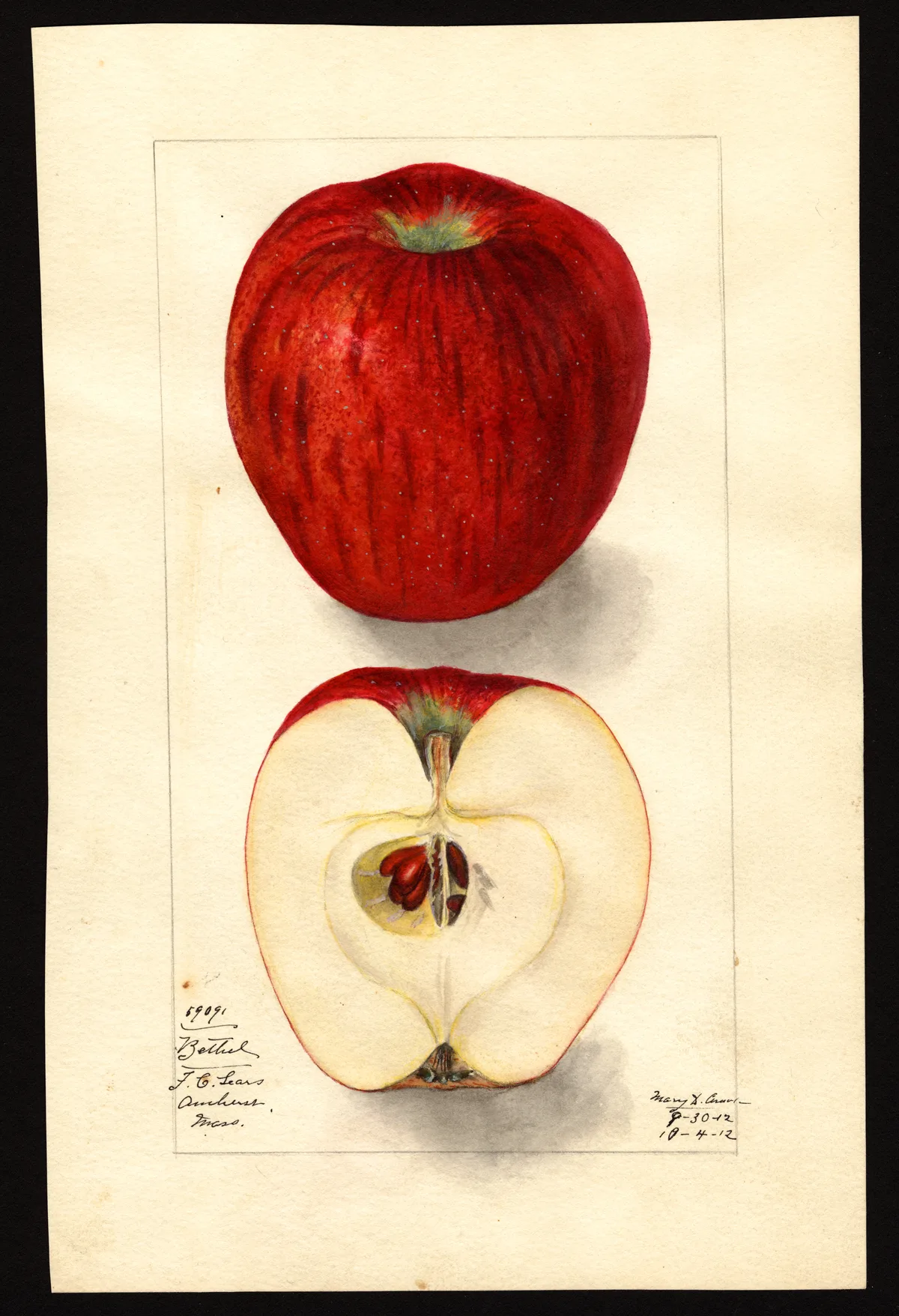
USDA Pomological Watercolor Collection
Bethel
Origin/History
Bethel originated at Bethel, Vermont, at some time previous to 1886. During the twenty-five years following its first notice (Hoskins, 1886), it became scattered throughout Northern New York, Northern New England, and portions of Canada. Its culture remains largely confined to the New England states.
Bethel falls at once, through its fruit and tree characters, into the well-known Blue Pearmain group of apples. It is probably worth planting only in regions where Baldwin is injured by cold. It has proved very hardy in Northern New York and is recommended for home use and local markets in that section and in the more elevated regions of the state. In such localities some prefer to grow it on warm soil or sod, to favor the development of better color. It is healthy, long-lived, locally profitable, and a reliable cropper.
Bethel is sometimes confused with an apple grown in Northern New York under the name Stone. The two varieties, as described and received by Beach, are certainly distinct, though both belong to the Blue Pearmain group.
Tree
Beach describes the tree as medium to rather large, moderately vigorous or vigorous; Hedrick gives it as large and vigorous. Form round and spreading. The tree shows a rather weak development of roots in the nursery but in the orchard becomes moderately vigorous and generally quite productive. It is healthy, hardy, and long-lived, usually comes into bearing rather young, and bears annually.
Budd describes the tree simply as a strong grower.
Twigs: Spreading, below medium in length, usually curved, somewhat slender; internodes medium.
Bark: Brownish-red, exceptionally mingled with olive-green, blotched with gray; sparingly pubescent.
Lenticels: Not very conspicuous, moderately abundant, rather small, roundish.
Buds: Rather small, obtuse, appressed, pubescent.
Fruit
Size
Large, uniform in size.
Form
Beach: roundish, slightly conic, somewhat angular or irregularly elliptical. Hedrick: round-conic, angular or irregularly elliptical. Budd gives the form as roundish oblate, slightly irregular and angular — differing from Beach and Hedrick, which indicate a conic tendency rather than an oblate one.
Stem
Beach and Hedrick: short, slender. Budd: medium, slender. Hedrick notes that the stem of Bethel is characteristically curved to one side — a distinguishing identification feature.
Cavity
Beach: acute to acuminate, deep, rather broad, rather symmetrical, with red russet often outspreading broadly. Hedrick: acuminate, deep, broad, symmetrical, with red-russet often outspreading. Budd: usually deep, medium width, slightly russeted — giving a narrower width than Beach and Hedrick, and less pronounced russet.
Calyx
Pubescent; Beach: medium to rather large, partly open or closed, lobes rather narrow and acute. Hedrick: large, open or closed. Budd: half open.
Basin
Beach: rather shallow to moderately deep, moderately wide, slightly furrowed and wrinkled. Hedrick: shallow, wide, furrowed and wrinkled. Budd: shallow, narrow, nearly smooth — differing from both Beach and Hedrick on width (narrow vs. wide) and surface character (nearly smooth vs. furrowed and wrinkled).
Skin
Thick, tough, smooth. Base color: Beach and Hedrick describe it as good deep yellow / yellow; Budd gives greenish yellow. All sources agree the surface is heavily overlaid: Beach describes it as washed and mottled with red and striped with purplish carmine, becoming very dark red in highly colored specimens. Hedrick: washed and mottled with red and striped with carmine, dark red in highly colored specimens (omitting "purplish"). Budd: heavily splashed and shaded with carmine, with considerable bloom — bloom not mentioned by the other sources. Sometimes the fruit has a rather dull appearance, but may attain a bright and attractive, though dark red, color.
Dots
Beach and Hedrick: numerous, conspicuous, russet or light, many small and many (Beach) / some (Hedrick) large and areolar. Budd: many, greenish yellow and russet, distinct — adding greenish yellow as a dot color not noted by the others. Prevailing effect somewhat striped.
Calyx Tube
Very large, wide, somewhat (Beach) / fully (Hedrick) funnel-shaped with a short cylinder.
Stamens
Beach: median to basal. Hedrick: median.
Core
Beach: large, somewhat abaxile, open or sometimes closed; core lines somewhat clasping. Hedrick: large, abaxile, open or closed; core-lines clasping. Budd gives the core as medium — differing from Beach and Hedrick, who call it large.
Carpels: Broad, roundish ovate (Beach) / round-ovate (Hedrick), emarginate, tufted.
Seeds: Large, rather wide (Beach) / wide (Hedrick), long, acute to acuminate, tufted, medium brown (Beach) / brown (Hedrick).
Flesh/Flavor
Beach: yellowish, firm, coarse, crisp, moderately tender, moderately juicy, mild subacid, fair to good. Hedrick: yellow, firm, coarse, crisp, tender, juicy, mild subacid; fair to good — omitting "moderately" from the tenderness and juiciness qualifications. Budd: greenish white with traces of pink, firm, juicy, mild subacid, good — differing from Beach and Hedrick in color (greenish white with pink traces rather than yellowish or yellow).
Season
November to midwinter or possibly March (Beach); November to late winter (Budd); November to March (Hedrick).
Uses
Baking, dessert, and local market (Beach). The fruit will not bear rough handling and is suitable for local markets rather than for shipping long distances. Hedrick confirms it keeps well but does not ship well.
Other
There is apt to be considerable loss from dropping of the fruit before harvest — Beach notes the fruit is prone to preharvest drop; Hedrick similarly states that the trees often lose the crop before picking time.
Book Sources
Described in 3 period pomological works
Nursery Catalog Sources
Found in 4 catalogs (1892–1913) from Illinois, Washington
- Puyallup & Yakima Nurseries , Puyallup, Washington (Lock Box 191) and North Yakima , Washington — 1892
- Central Experimental Farm , Dominion Department of Agriculture, Agassiz, British Columbia (under test; Bulletin No. 3, Second Series) — 1900
- Benjamin Buckman (personal inventory) , Farmingdale , Illinois — 1901
- Benjamin Buckman (personal inventory) , Farmingdale , Illinois — 1913
View original book sources (3)
— S.A. Beach, The Apples of New York, Vol. 1 (1905)REFERENCES. 1. Hoskins, U. S. Agr. Rpt., 1886:274. 2. Hoskins, Rural N. Y., 47:249, 1888. figs. 3. Bailey, An. Hort., 1892:235. 4. An. Pom. Soc. Cat., 1899:15. 5. Waugh, Vt. Sta. An. Rept., 14:288. 1901. 6. Munson, Me. Sta. Bul., 82:83. 1902. 7. Budd-Hansen, 1903:48.
This shows its kinship to the Blue Pearmain in the quality, texture, form, conspicuous dots and color of its fruit. Sometimes it has a rather dull appearance, but it may attain a bright and attractive, though dark red, color. The quality is fairly good. It will not bear rough handling, and is suitable rather for local markets than for shipping long distances. The tree shows a rather weak development of roots in the nursery, but in the orchard becomes moderately vigorous and generally quite productive. It has proved very hardy in Northern New York, and is recommended for planting for home use and local markets in that section and in the more elevated regions of the state, where varieties of the grade of hardiness of Baldwin are apt to show winter injury. In such localities some prefer to grow it on warm soil or sod, to favor the development of better color. It is locally profitable. It is healthy, long-lived and a reliable cropper, usually comes into bearing rather young and bears annually. There is apt to be considerable loss from dropping of the fruit.
Some have thought that it is identical with an apple grown in Northern New York under the name Stone. The two varieties, as we have received them, are certainly distinct, but both belong to the Blue Pearmain group.
Historical. It originated in Bethel, Vermont (1). During the last twenty-five years it has become scattered throughout Northern New York, Northern New England and portions of Canada.
TREE. Tree medium to rather large, moderately vigorous or vigorous. Form round, spreading. Twigs spreading, below medium in length, usually curved, somewhat slender; internodes medium. Bark brownish-red, exceptionally mingled with olive-green, blotched with gray; sparingly pubescent. Lenticels not very conspicuous, moderately abundant, rather small, roundish. Buds rather small, obtuse, appressed, pubescent.
FRUIT. Fruit large. Form roundish, slightly conic, somewhat angular or irregularly elliptical. Stem short, rather slender. Cavity acute to acuminate, deep, rather broad, rather symmetrical, with red russet often outspreading. Calyx pubescent, medium to rather large, partly open or closed; lobes rather narrow, acute. Basin rather shallow to moderately deep, moderately wide, slightly furrowed and wrinkled. Skin thick, tough, smooth; good deep yellow, washed and mottled with red and striped with purplish carmine, becoming very dark red in highly colored specimens. Dots numerous, conspicuous, russet or light, many small, many large and areolar. Prevailing effect somewhat striped. Calyx tube very large, wide, somewhat funnel-shaped with a short cylinder. Stamens median to basal. Core large, somewhat abaxile, open or sometimes closed; core lines somewhat clasping. Carpels broad, roundish ovate, emarginate, tufted. Seeds large, rather wide, long, acute to acuminate, tufted, medium brown. Flesh yellowish, firm, coarse, crisp, moderately tender, moderately juicy, mild subacid, fair to good. Season November to midwinter or possibly March.
Uses. Baking, dessert and local market.
— J.L. Budd & N.E. Hansen, American Horticultural Manual, Part II: Systematic Pomology (1914)Bethel.—Origin, Bethel, Vermont; tree a strong grower.
Fruit large, roundish oblate, slightly irregular and angular, surface greenish yellow, heavily splashed and shaded with carmine with considerable bloom; dots many, greenish yellow and russet, distinct; cavity usually deep, medium width, slightly russeted; stem medium, slender; basin shallow, narrow, nearly smooth; calyx half open.
Core medium; flesh greenish white, with traces of pink, firm, juicy, mild subacid, good. November to late winter.
— U.P. Hedrick, Cyclopedia of Hardy Fruits (1922)BETHEL. Fig. 10.
Bethel falls at once through its fruit and tree characters into the well-known Blue Pearmain group of apples. It is probably worth planting only in regions where Baldwin is injured by cold. The apples are bright dark red, uniform in size, fair in quality, and keep well, but do not ship well. The trees are vigorous, healthy, hardy, longlived, fruitful, bear young and annually, but often lose the crop before picking time. The stem of Bethel is characteristically curved to one side. Culture of the variety is largely confined to the New England states. Bethel is often confused with Stone, but the two, as the descriptions show, are quite distinct. The variety originated at Bethel, Vermont, some time previous to 1886.
Tree large, vigorous, round, spreading. Fruit large, round-conic, angular or irregularly elliptical; stem short, slender; cavity acuminate, deep, broad, symmetrical, with red-russet often outspreading; calyx pubescent, large, open or closed; basin shallow, wide, furrowed and wrinkled; skin thick, tough, smooth, yellow, washed and mottled with red and striped with carmine, dark red in highly colored specimens; dots numerous, conspicuous, russet or light, many small and some large and areolar; calyx-tube very large, wide, funnel-shaped with a short cylinder; stamens median; core large, abaxile, open or closed; core-lines clasping; carpels broad, round-ovate, emarginate, tufted; seeds large, wide, long, acute to acuminate, tufted, brown; flesh yellow, firm, coarse, crisp, tender, juicy, mild subacid; fair to good; November to March.