Arkansas
Apple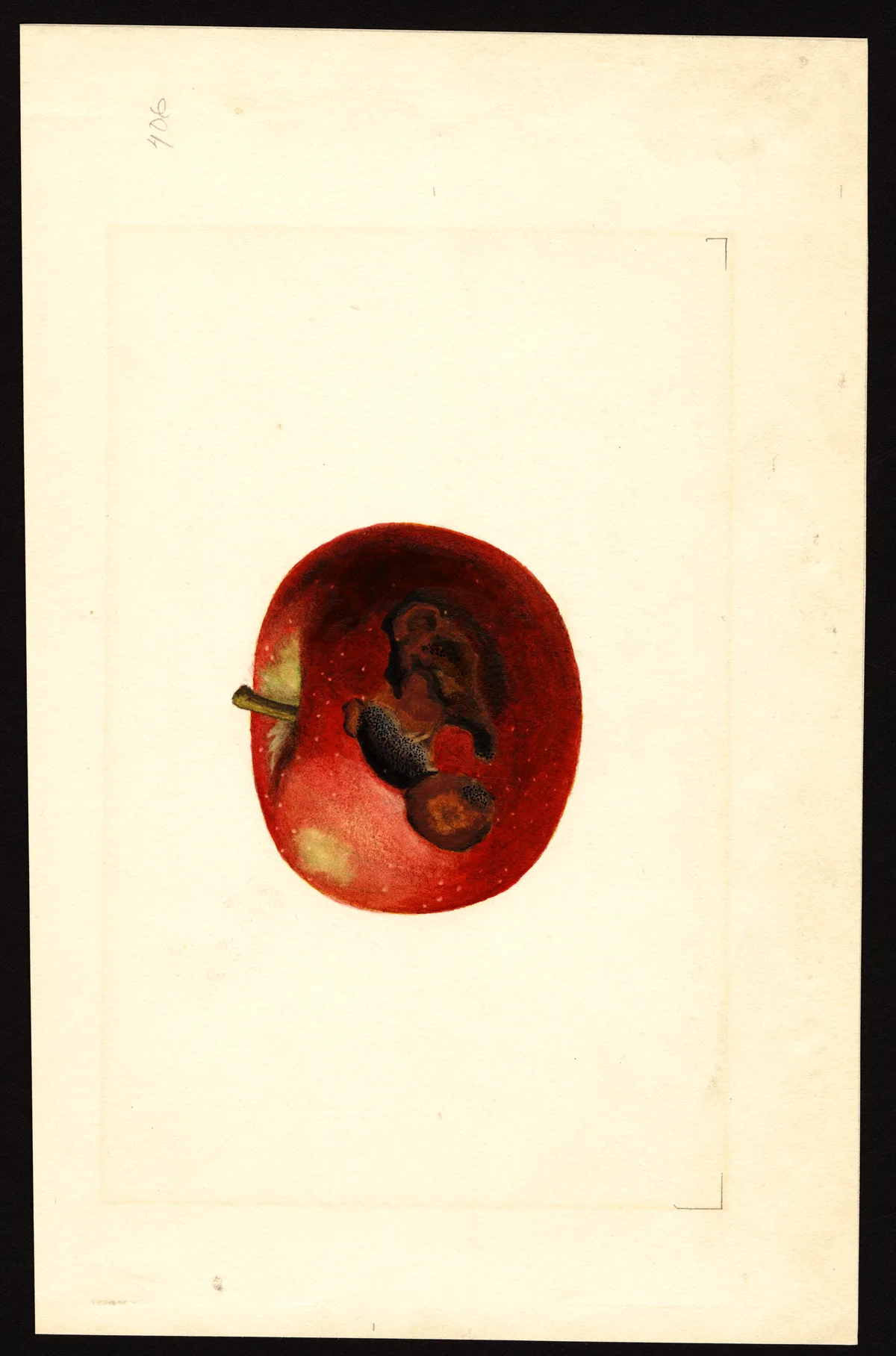
USDA Pomological Watercolor Collection
Arkansas
Origin/History
Arkansas was grown from seed planted circa 1833 near Rhea Mills, Arkansas, where the original tree still stood at the time of Beach's writing (1905). The variety bears marked resemblance to the Winesap, of which it is said to be a seedling. Nurserymen began propagating it commercially around 1868, and in succeeding years it became widely disseminated throughout Arkansas and surrounding states. The variety was occasionally called Arkansaw or Mammoth Black Twig in the trade. It was frequently confused with the Paragon, a Tennessee-origin apple which it much resembles, leading to mixed stock in nurseries and orchards during the nineteenth century; by the time of Beach's writing, it was conceded that Paragon and Arkansas are two distinct varieties, though Arkansas Black — a decidedly distinct variety in both tree and fruit — has sometimes been erroneously listed as identical to Arkansas, apparently due to similarity of names rather than botanical resemblance.
Tree
Tree rather large and vigorous, with large, crooked, stout branches forming an upright-spreading, rather open form. Twigs medium to long, sometimes drooping, somewhat curved and thick, with short internodes. Bark very dark brownish-red with dull olive-green, thickly mottled with thin gray scarf-skin, somewhat pubescent toward the tips; with age becomes nearly black. Lenticels scattering and rather conspicuous, mostly roundish, medium or sometimes small, often slightly raised. Buds somewhat pubescent; at the tip and base of the twig they are appressed and often obtuse, but on intermediate portions they stand out prominently, large, broad, plump, acute, and free. Foliage rather dense; leaves medium to large, often broad. The mature young twigs of Arkansas much resemble those of Paragon but are somewhat darker and stockier, whereas mature Paragon twigs have comparatively more reddish-brown tinge.
Fruit
Large to medium, pretty uniform in size. Form roundish inclined to conic, sometimes slightly oblate, broadly ribbed, pretty uniform in shape. Stem long to almost short, rather stout. Cavity acute, rather wide, medium in depth, green, often much russeted, sometimes indistinctly furrowed. Calyx small to medium, usually closed. Basin rather abrupt, rather wide, moderately deep, broadly furrowed or wavy. Skin nearly smooth, dull green, often becoming good deep yellow, largely overspread with dull deep red, obscurely striped with darker red. Dots generally small, russet, and inconspicuous; sometimes medium and whitish. Calyx tube medium, conical, sometimes funnel-form. Stamens median to nearly basal. Core usually axile, usually closed; core lines slightly clasping. Carpels broadly ovate, deeply emarginate, tufted; not always well developed. Seeds few and variable, not always well developed; if plump they are long, rather narrow, acute, and tufted. Flesh tinged with yellow, very firm, moderately fine-grained, rather tender, moderately juicy, subacid, crisp, and of good quality.
Season
December to May.
Uses and Performance
A late-keeping winter apple of good red color and good quality. Arkansas keeps later than the Baldwin but is inferior to that variety in productiveness and also in the color and quality of its fruit. During the last quarter century (1880–1905), Arkansas was planted quite extensively in the South and Southwest, but even as grown in these regions, the variety has not been satisfactory in commercial orchards because it is a shy bearer. It is not a desirable variety for growing in New York State because it is not sufficiently productive and the northern seasons are not always favorable to the proper development of its fruit.
Book Sources
Described in 1 period pomological work
Nursery Catalog Sources
Found in 38 catalogs (1886–1932) from Alabama, Arkansas, Illinois, Indiana, Kansas, Missouri, Nebraska, Oregon, Virginia, Washington
- Huntsville Wholesale Nurseries (Jessie S. Moss , Proprietor; W.F. Heikes, Manager), Huntsville , Alabama — 1886
- Missouri Nursery Co. , Louisiana , Missouri — 1891
- Puyallup & Yakima Nurseries , Puyallup, Washington (Lock Box 191) and North Yakima , Washington — 1892
- Oregon Wholesale Nurseries , Salem , Oregon — 1893
- Knox Nurseries (H.M. Simpson Co. , Proprietors), Vincennes , Indiana — 1894
- The Vineland Nurseries (Kelsey & Co. , Proprietors), St. Joseph, Missouri (Office: 13th and Atchison Sts., 2 Blocks East of the Citizens St. Car Line) — 1894
- Woodburn Nurseries , Woodburn, Marion Co. , Oregon — 1894
- Stark Bros. Nurseries & Orchards Co. , Louisiana , Missouri — 1896
- The Salem Nursery (John A. Francis , Proprietor), Salem , Virginia — 1897
- J.V. Cotta (Cotta Nursery) , Carroll County , Illinois — 1898
- Alabama Nursery Co. , Huntsville , Alabama — 1900
- The Dalles Nurseries , The Dalles , Oregon — 1901
- Washington Nursery Co. , Toppenish , Washington — 1901
- Mountain Grove Nurseries (Tippin & Moore , Proprietors; Geo. T. Tippin, J. W. Tippin, J. C. Moore), Mountain Grove , Missouri — 1901
- Benjamin Buckman (personal inventory) , Farmingdale , Illinois — 1901
- Yarbrough Bros. , Stephens , Arkansas — 1901
- Russellville Nursery Co. , Russellville, OR (three miles east of Portland, one mile from Montavilla car line) — 1903
- Pacific Nursery Company (W. O. Hudson & A. D. Hudson) , Tangent , Oregon — 1903
- Phoenix Nursery Company (W. E. Rossney , President; Sidney Tuttle, Vice-President), Bloomington , Illinois — 1904
- Russellville Nursery Co. , Montavilla Station, Portland, OR (three miles east of Portland, one mile from Montavilla car line) — 1907
- Carlton Nursery Co. , Carlton , Oregon — 1909
- Milton Nursery Co. (A. Miller & Sons , Proprietors), Milton , Oregon — 1909
- Washington Nursery Company , Toppenish , Washington — 1909
- Stark Bros. Nurseries & Orchards Co. , Louisiana , Missouri — 1910
- Galbraith Nursery Co. (DeWitt Hansen , Pres.-Mgr.), Fairbury , Nebraska — 1911
- Stark Bros. Nurseries & Orchards Co. , Louisiana , Missouri — 1911
- Stark Bros. Nurseries & Orchards Co. , Louisiana , Missouri — 1912
- Vineland Nurseries Company , Clarkston , Washington — 1912
- Pacific Nursery Company , Portland , Oregon — 1912
- Washington Nursery Company , Toppenish , Washington — 1912
- Union Nurseries , J.B. Weaver & Sons, Union , Oregon — 1915
- Holsinger Bros. Nurseries (Holsinger Brothers Nursery) , Rosedale , Kansas — 1916
- Stark Bros. Nurseries & Orchards Co. , Louisiana , Missouri — 1918
- Oregon Nursery Co. , Orenco , Oregon — 1920
- Benedict Nursery Co. , Portland , Oregon — 1921
- Columbia & Okanogan Nursery Co. , Wenatchee , Washington — 1925
- Stark Bro's Nurseries , Louisiana , Missouri — 1932
- North-Western Nurseries , Walla Walla , Washington
View original book sources (1)
— S.A. Beach, The Apples of New York, Vol. 1 (1905)ARKANSAS.
REFERENCES. 1. Van Deman, Am. Pom. Soc. Rpt., 1891:123. 2. Babcock, Amer. Gard., 1891:118. 3. Bailey, An. Hort., 1892:234, 244. 4. Babcock, Am. Pom. Soc. Rpt., 1895:190. 5. Amer. Gard., 1895:419. 6. Stinson, Ark. Sta. Bul., 43:103. 1896. 7. Amer. Gard., 1896:29, 65, 146, 152, 210, 306. 8. Watts, Tenn. Sta. Bul., 9:24. 1896. fig. 9. U. S. Pom. Bul., 6:9. 1897. 10. Stinson, Ark. Sta. Bul., 49:5, 7. 1898. figs. of trees and fruit. 11. Powell, Del. Sta. Bul., 38:19. 1898. fig. 12. Stinson, Ark. Sta. Bul., 60:124. 1899. 13. N. C. Bd. of Agr. Apple Bul., 1900:9. 14. Alwood, Va. Sta. Bul., 130:127. 1901. 15. Stinson, Mo. State Fruit Sta. Bul., 3:26. 1902. 16. Budd-Hansen, 1903:39. fig. 17. Thomas, 1903:322, 690, 708.
SYNONYMS. ARKANSAW (4, 10, 12). Arkansaw (16). MAMMOTH BLACK TWIG (6). Mammoth Black Twig (9, 10, 11, 12, 14, 15, 16). PARAGON (erroneously) (1). ARKANSAS BLACK and Arkansas Black Twig (17) but erroneously.
The Arkansas is a late keeping winter apple, rather large, of good red color, and good quality. It is not a desirable variety for growing in New York state because it is not sufficiently productive and because in this northern latitude the seasons are not always favorable to the proper development of its fruit. It keeps later than the Baldwin but it is inferior to that variety in productiveness and also in the color and quality of its fruit.
During the last quarter century Arkansas has been quite extensively planted in the South and Southwest, but even as grown in these regions, the variety has not been satisfactory in commercial orchards because it is a shy bearer.
Arkansas and Paragon resemble each other so closely that at one time many regarded these two varieties as identical, and, in consequence, the stock of the two kinds became badly mixed in nurseries and orchards. Arkansas Black is decidedly distinct from Arkansas both in tree and fruit. Sometimes these two varieties have been erroneously listed as identical (17). This mistake doubtless arose because of the similarity of the two names, rather than from any marked resemblance between the varieties.
Historical. Arkansas was grown from seed (4, 10) planted about 1833 near Rhea Mills, Arkansas, where the original tree still stands. It bears a marked resemblance to the Winesap of which it is said to be a seedling (4). Nurserymen began to propagate it about 1868. In succeeding years it became pretty generally disseminated in Arkansas and surrounding states. As previously stated, this variety has been confused with the Paragon, an apple of Tennessee origin which it much resembles. It is now conceded that Paragon and Arkansas are two distinct varieties (4, 7, 8, 9, 10).
TREE. Tree rather large, vigorous; branches large, crooked, stout. Form upright spreading, rather open. Twigs medium to long, sometimes drooping, somewhat curved, thick; internodes short. Bark very dark brownish-red with some dull olive-green, thickly mottled with thin gray scarf-skin; somewhat pubescent toward the tips. Eventually it becomes almost black. Lenticels scattering, rather conspicuous, mostly roundish, medium or sometimes small, often slightly raised. Buds somewhat pubescent; towards the tip and base of the twig they are appressed and often obtuse, but on the intermediate portion they stand out prominently and are large, broad, plump, acute, free. Foliage rather dense; leaves medium to large, often broad. The mature young twigs of Arkansas much resemble those of Paragon but they are somewhat darker and stockier. The mature Paragon twigs have comparatively more of a reddish-brown tinge.
FRUIT. Fruit large to medium, pretty uniform in size. Form roundish inclined to conic, sometimes slightly oblate, broadly ribbed, pretty uniform in shape. Stem long to almost short, rather stout. Cavity acute, rather wide, medium in depth, green, often much russeted, sometimes indistinctly furrowed. Calyx small to medium, usually closed. Basin rather abrupt, rather wide, moderately deep, broadly furrowed or wavy. Skin nearly smooth, dull green, often becoming good deep yellow, largely overspread with a dull deep red, obscurely striped with darker red. Dots generally small, russet, inconspicuous; sometimes medium and whitish. Calyx tube medium, conical, sometimes funnel-form. Stamens median to nearly basal. Core usually axile, usually closed; core lines slightly clasping. Carpels broadly ovate, deeply emarginate, tufted; not always well developed. Seeds few and variable, not always well developed; if plump they are long, rather narrow, acute, tufted. Flesh tinged with yellow, very firm, moderately fine-grained, rather tender, moderately juicy, subacid, crisp, good.
Season December to May.