Kinnaird
Apple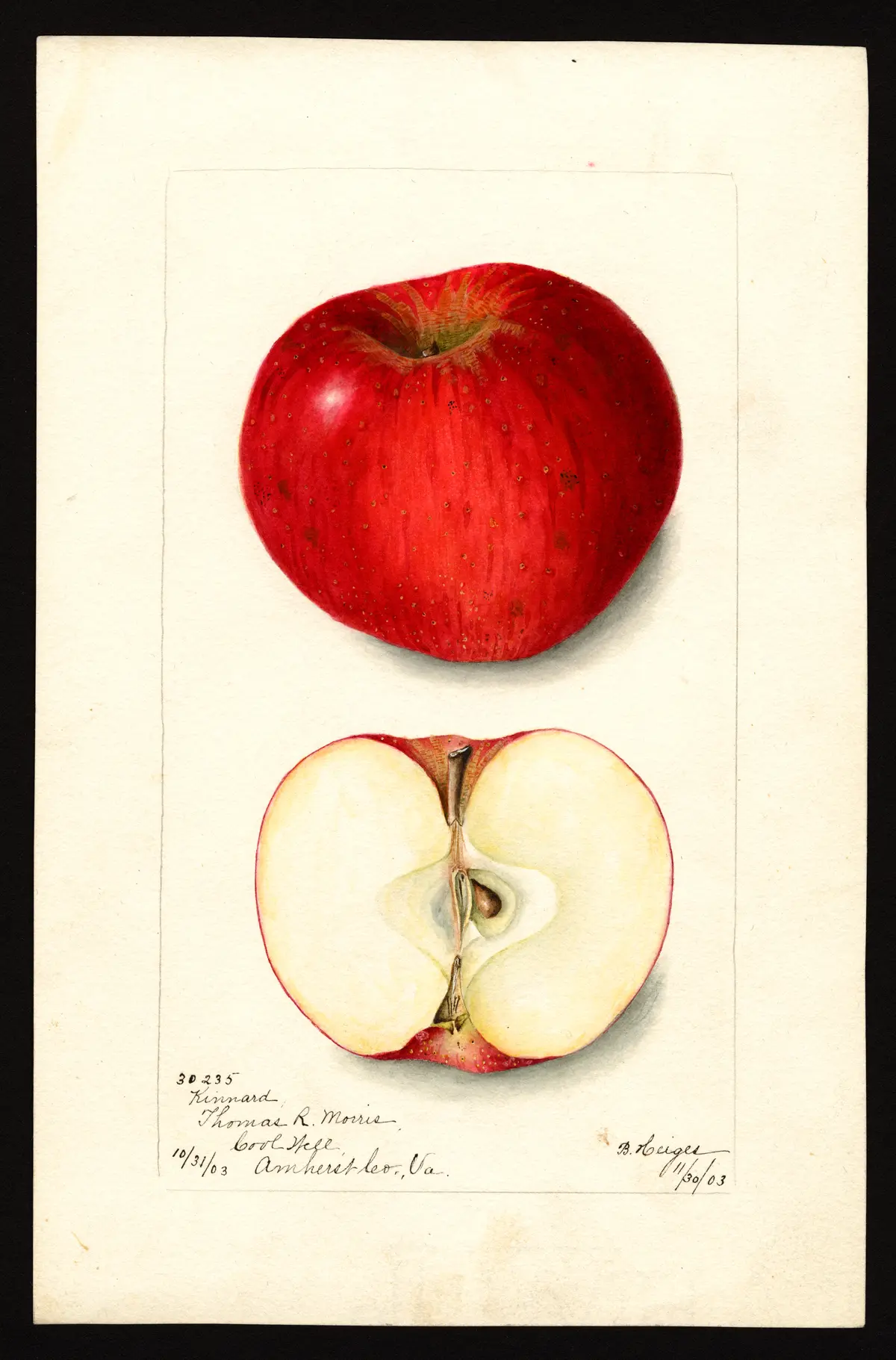
USDA Pomological Watercolor Collection
Kinnaird
Origin / History
Kinnaird originated on the farm of the late Michael Kinnaird (Budd-Hansen spells the surname "Kinnard") of Franklin, Williamson County, Tennessee. Beach notes the variety is highly esteemed in some sections of Tennessee and in other portions of the Middle West, but so far as tested in New York it does not appear to be adapted to regions as far north as that — it is practically unknown there. Hedrick states the variety is now grown only in its native and neighboring states. Beach's references trace the variety in print from Downing 1872 forward, and it was listed in the American Pomological Society Catalogue of 1875.
Tree
A thrifty, vigorous grower, not very upright or regular, similar in habit to Winesap (Downing); Beach calls it medium in size and a moderately vigorous grower, with form rather spreading or roundish, irregular, and not dense. Hedrick agrees: medium in size, vigorous, spreading, irregular. An early and annual bearer, producing heavier crops in alternate years (Downing, Budd-Hansen); Beach describes it as coming into bearing rather young and yielding moderate crops biennially. Thomas adds that the tree is hardy and bears young. The fruit hangs well to the tree but is not very uniform in grade, and does not produce as large a percentage of marketable fruit as either Baldwin or Rhode Island Greening (Beach).
Branchlets rather slender (Beach, Hedrick). Twigs medium to rather long, moderately slender, often irregularly crooked. Bark brownish-red or in some portions olive-green, somewhat pubescent; scarf-skin thin, not conspicuous. Lenticels rather numerous, irregular in size, not often large, usually very small, dull, elongated. Buds considerably sunk in the bark, rather broad, obtuse, appressed, quite pubescent (Beach).
Fruit
Size
Medium (Downing, Thomas, Budd-Hansen, Lowther); medium to large (Beach, Hedrick). When well grown it is of good size (Beach). Beach considers it similar to Winesap in size, as does Hedrick.
Form
Oblate, inclining to conic, flat at the base, slightly angular or obscurely ribbed, nearly regular, sides sometimes unequal (Downing, Budd-Hansen, Beach, Hedrick); Thomas and Lowther simply say oblate.
Stem / Stalk
Short, small, sometimes by a lip (Downing, Budd-Hansen); Beach and Hedrick describe the stem as not exserted, short, and rather thick (Beach) or thick (Hedrick).
Cavity
Wide, deep, russeted (Downing, Budd-Hansen); very wide, deep, acute, sometimes russeted (Beach, Hedrick).
Calyx
Closed (Downing, Budd-Hansen); small, closed or partly open (Beach, Hedrick).
Basin
Large, deep, furrowed (Downing, Budd-Hansen); moderately wide, deep, abrupt, gently furrowed, often somewhat oblique (Beach); wide, deep, abrupt, gently furrowed, often oblique (Hedrick).
Skin
Yellow, almost covered with dark rich red (Downing, Budd-Hansen); many small light dots near the crown, and larger and fewer dots near the base (Downing); dots near the basin many, small, light, and near the base larger and fewer (Budd-Hansen). Beach describes the skin as moderately thick, tough, smooth, yellow, mottled and blushed with red, in the sun becoming a lively deep red shading to purplish-red; dots numerous, small, whitish, becoming somewhat elongated towards the cavity; prevailing effect good dark red. Hedrick agrees: skin thick, tough, smooth, yellow, mottled and blushed with red, in the sun deep red; dots numerous, small, white, elongated towards the cavity; prevailing effect dark red. Lowther summarizes the color as striped or splashed (red). Beach characterizes the variety overall as a dark red winter apple of the Winesap class, attractive in appearance.
Calyx tube / Stamens
Tube obtusely conical (Budd-Hansen); calyx tube conical and moderately short, varying to almost cylindrical and deep, sometimes extending to the core (Beach); conical, short to cylindrical and deep, sometimes extending to the core (Hedrick). Stamens nearly marginal (Beach); marginal (Hedrick).
Flesh / Flavor
Yellowish (Downing, Budd-Hansen) or yellow (Hedrick), or tinged with yellow (Beach); half fine (Downing, Budd-Hansen), or moderately fine or a little coarse (Beach), or fine or a little coarse (Hedrick); crisp, tender, juicy (Downing, Budd-Hansen, Thomas); mild, rich subacid, slightly aromatic (Downing, Budd-Hansen); agreeably subacid, somewhat aromatic (Beach); agreeably subacid, aromatic (Hedrick). Quality very good (Downing, Budd-Hansen); good to very good (Beach, Hedrick); good (Lowther).
Core / Seeds
Core small (Downing, Budd-Hansen, Beach, Hedrick), axile; cells symmetrical, closed; core lines clasping; carpels obcordate, emarginate, noticeably concave, tufted; seeds rather short, wide, plump (Beach, Hedrick).
Season
January (Downing, Budd-Hansen); winter (Lowther); November to March (Hedrick); in season about with Baldwin (Beach).
Uses
Both kitchen and market (Lowther). Beach treats it as a market apple of the Winesap class, though noting it does not produce as large a percentage of marketable fruit as Baldwin or Rhode Island Greening.
Subtypes / Variants
Not described in source.
Other
Not described in source.
Book Sources
Described in 6 period pomological works
- Beach, The Apples of New York Vol. 1 (1905)
- Budd & Hansen, Systematic Pomology (1914) — listed as Kinnard
- Lowther (ed.), Encyclopedia of Practical Horticulture (1914)
- Hedrick, Cyclopedia of Hardy Fruits (1922)
- Downing, Fruits and Fruit Trees of America (1900) — listed as Kinnaird's Choice
- Thomas, The American Fruit Culturist (1903) — listed as Kinnard
Nursery Catalog Sources
Found in 14 catalogs (1891–1918) from Illinois, Missouri, Washington
- Missouri Nursery Co. , Louisiana , Missouri — 1891 — listed as Kinnaird Choice
- Stark Bros. Nurseries & Orchards Co. , Louisiana , Missouri — 1896 — listed as Kinnaird Choice
- J.V. Cotta (Cotta Nursery) , Carroll County , Illinois — 1898 — listed as Kinnaird Choice
- Stark Bros. Nurseries & Orchards Co. , Louisiana , Missouri — 1898 — listed as Kinnaird Choice
- Central Experimental Farm , Dominion Department of Agriculture, Agassiz, British Columbia (under test; Bulletin No. 3, Second Series) — 1900 — listed as Kinnaird's Choice
- Benjamin Buckman (personal inventory) , Farmingdale , Illinois — 1901 — listed as Kinnaird Choice
- Benjamin Buckman (personal inventory) , Farmingdale , Illinois — 1901
- Stark Bros. Nurseries & Orchards Co. , Louisiana , Missouri — 1906 — listed as Kinnaird Choice
- Stark Bros. Nurseries & Orchards Co. , Louisiana , Missouri — 1910 — listed as Kinnaird Choice
- Stark Bros. Nurseries & Orchards Co. , Louisiana , Missouri — 1911 — listed as Kinnaird Choice
- Stark Bros. Nurseries & Orchards Co. , Louisiana , Missouri — 1912 — listed as Kinnaird Choice
- Vineland Nurseries Company , Clarkston , Washington — 1912 — listed as Kinnaird Choice
- Benjamin Buckman (personal inventory) , Farmingdale , Illinois — 1913
- Stark Bros. Nurseries & Orchards Co. , Louisiana , Missouri — 1918 — listed as Kinnaird Choice
View original book sources (6)
— A.J. Downing, The Fruits and Fruit Trees of America (1900)Kinnaird's Choice.
Originated on the farm of the late Michael Kinnaird, of Franklin, Tenn. Tree a thrifty, vigorous grower, not very upright or regular, similar to Winesap; an early and annual bearer, producing heavier crops alternate years.
Fruit medium, oblate, inclining to conic, slightly angular, or obscurely ribbed, sides sometimes unequal; skin yellow, almost covered with dark rich red, many small light dots near the crown, and larger ones and less number near the base; stalk short, small, sometimes by a lip; cavity wide, deep, russeted; calyx closed; basin large, deep, furrowed; flesh yellowish, half fine, crisp, tender, juicy, mild, rich subacid, slightly aromatic; very good; core small. January.
— John J. Thomas, The American Fruit Culturist (1903)Kinnard. (Kinnard's Choice.) Medium, oblate; yellow, covered with dark red; flesh tender and juicy. Tree vigorous, hardy. Bears young. Tennessee.
[Additional entry in this volume: "Kinnaird", pp. 366–366]
Kinnard. (Kinnard's Choice.) Medium, oblate; yellow, covered with dark red; flesh tender and juicy. Tree vigorous, hardy. Bears young. Tennessee.
— S.A. Beach, The Apples of New York, Vol. 1 (1905)KINNAIRD.
REFERENCES. 1. Downing, 1872:18 app. fig. 2. Am. Pom. Soc. Cat., 1875. 3. Bailey, An. Hort., 1892:242. 4. Watts, Tenn. Sta. Bul., 1:15. 1896. fig. 5. Wright, Am. Gard., 17:33. 1896. 6. Thomas, 1897:291. 7. Ragan, U. S. Pom. Bul., 8:18. 1899. 8. Kan. Sta. Bul., 106:53. 1902. 9. Budd-Hansen, 1903:110. fig. 10. Farrand, Mich. Sta. Bul., 205:45. 1903. 11. Bruner, N. C. Sta. Bul., 182:25. 1903.
SYNONYMS. KINNAIRD'S CHOICE (1, 8). Kinnaird's Choice (4, 6). KINNAIRDS FAVORITE (2). KINNARD (7, 9). Kinnard's Choice (9).
This is a dark red winter apple of the Winesap class. When well grown it is of good size, very good quality and attractive in appearance. The tree comes into bearing rather young and yields moderate crops biennially. The fruit hangs well to the tree but is not very uniform in grade and does not produce as large a percentage of marketable fruit as either Baldwin or Rhode Island Greening. It is in season about with Baldwin. It is a variety of Tennessee origin which is highly esteemed in some sections of that state and in other portions of the Middle West (4). So far as tested in New York it does not appear to be adapted to regions as far north as this.
Historical. Origin Franklin, Williamson county, Tennessee. It is practically unknown in New York.
TREE.
Tree medium in size, a moderately vigorous grower; branchlets rather slender. Form rather spreading or roundish, irregular, not dense. Twigs medium to rather long, moderately slender, often irregularly crooked. Bark brownish-red or some portions olive-green, somewhat pubescent; scarf-skin thin, not conspicuous. Lenticels rather numerous, irregular in size, not often large, usually very small, dull, elongated. Buds considerably sunk in the bark, rather broad, obtuse, appressed, quite pubescent.
FRUIT.
Fruit medium to large. Form oblate inclined to conic, flat at the base, rather obscurely ribbed, nearly regular, sides sometimes unequal. Stem not exserted, short, rather thick. Cavity very wide, deep, acute, sometimes russeted. Calyx small, closed or partly open. Basin moderately wide, deep, abrupt, gently furrowed, often somewhat oblique.
Skin moderately thick, tough, smooth, yellow, mottled and blushed with red, in the sun becoming a lively deep red shading to purplish-red. Dots numerous, small, whitish, becoming somewhat elongated towards the cavity. Prevailing effect good dark red.
Calyx tube conical and moderately short varying to almost cylindrical and deep, sometimes extending to the core. Stamens nearly marginal.
Core small, axile; cells symmetrical, closed; core lines clasping. Carpels obcordate, emarginate, noticeably concave, tufted. Seeds rather short, wide, plump.
Flesh tinged with yellow, crisp, moderately fine or a little coarse, agreeably subacid, somewhat aromatic, good to very good.
— J.L. Budd & N.E. Hansen, American Horticultural Manual, Part II: Systematic Pomology (1914)Kinnard (Kinnard's Choice). — Originated on farm of the late Michael Kinnard, of Franklin, Tenn.; tree vigorous, not very upright, an early and annual bearer, producing heavier crop alternate years. Fruit medium, oblate, inclining to conic, slightly angular, or obscurely ribbed, sides sometimes unequal; surface yellow, almost covered with dark rich red; dots near basin many, small, light, near base larger and fewer; cavity wide, deep, russeted; stem short, small, sometimes by a lip; basin large, deep, furrowed; calyx closed. Core small; tube obtusely conical; flesh yellowish, half fine, crisp, tender, juicy, mild rich subacid, slightly aromatic, very good. January.
— Granville Lowther (ed.), Encyclopedia of Practical Horticulture (1914)Kinnaird. Size: medium. Form: oblate. Color: striped or splashed (red). Quality: good. Use: both kitchen and market. Season: winter.
— U.P. Hedrick, Cyclopedia of Hardy Fruits (1922)KINNAIRD. Kinnaird's Choice. Kinnaird's Favorite. Kinnaird is an attractive, dark-red apple similar to Winesap in size, quality, color, and season. The variety originated at Franklin, Williamson County, Tennessee, and is now grown only in its native and neighboring states.
Tree medium in size, vigorous, spreading, irregular; branchlets slender. Fruit medium to large, oblate to conic, flat at the base, obscurely ribbed, sides sometimes unequal; stem not exserted, short, thick; cavity very wide, deep, acute, sometimes russeted; calyx small, closed or partly open; basin wide, deep, abrupt, gently furrowed, often oblique; skin thick, tough, smooth, yellow, mottled and blushed with red, in the sun deep red; dots numerous, small, white, elongated towards the cavity; prevailing effect dark red; calyx-tube conical, short to cylindrical and deep, sometimes extending to the core; stamens marginal; core small, axile; cells symmetrical, closed; core-lines clasping; carpels obcordate, emarginate, concave, tufted; seeds short, wide, plump; flesh yellow, crisp, fine or a little coarse, agreeably subacid, aromatic; good to very good; season, November to March.