Monroe
Apple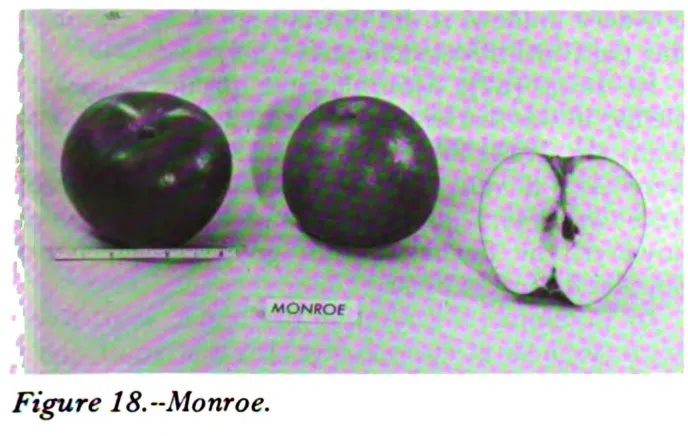
Monroe
Origin / History
Originated at the New York State Agricultural Experiment Station, Geneva, from a cross of Jonathan and Rome Beauty made in 1910 (breeding record number 11882, seedling number Station 1546). Selected in 1921 from a population of 18 seedlings. Observed on second test for an unusually long period, 28 years. Named for Monroe County, New York, and introduced in 1949. Zielinski says it was released primarily for its outstanding processing qualities. This Monroe is not the same cultivar as the Monroe described by Ragan.
In 1950, a year after introduction, Howe described Monroe as a promising late-keeping cultivar. It was briefly described in the Register of New Fruit and Nut Varieties and in the American Nurseryman, was described by Way, and was illustrated in Figure 18 and by Klein.
Trees were sold by the New York State Fruit Testing Association for 19 years, 1950-68, and by 12 commercial nurseries in 1960-68. Stations tested it in Minnesota and Nova Scotia in 1954. A 1963 survey listed tests in Connecticut, Illinois, Indiana, Kansas, Maine, Michigan, Minnesota, Missouri, New Jersey, New York, Ohio, Oregon, Pennsylvania, Vermont, Washington, and Wyoming. In 1968 it was under test in Arkansas, Colorado, Kansas, Minnesota, Michigan, New York, North Carolina, Pennsylvania, and Vermont.
Way calls Monroe one of the Geneva introductions that has found greatest favor with American fruit growers, and says many commercial apple growers have stated that it is a good commercial cultivar. In 1961, 12 years after introduction, it was already assuming commercial importance. In 1959 thousands of trees had been planted in western New York. In 1962 it was being planted more extensively there than any other Station cultivar, making up 7 per cent of the 440,000 nonbearing apple trees under 8 years of age. It ranked 14th among the 20 most important apple cultivars in New York in 1966, and was still being planted to some extent in 1965. Zielinski says it has been planted heavily in New York since 1949. New York recommended it for planting in 1956, and in 1967 it was one of 12 cultivars recommended for the State. It has been recommended for trial plantings in New Jersey, to replace Baldwin in Connecticut, for trial in Ohio orchards, and later for all areas in Ohio. Way concludes that Monroe is recommended for planting as a dual-purpose cultivar and especially as a processing cultivar.
In Massachusetts in 1959 it was described as a late winter cooking apple, fairly attractive with good color, but not a promising cultivar there because the tree is very susceptible to powdery mildew. In Iowa it was of excellent commercial value. In Vermont it performed well. In England, tested at the National Fruit Trials to determine its commercial potential, it was very susceptible to mildew, a poor cropper, and "had nothing to commend it."
Tree
Mature trees medium sized, vigorous, spreading, dense, round-topped, somewhat drooping if heavily cropped. Trees form good shapes without much training. Trunks stocky; trunk bark brown with a reddish tinge, with scarfskin. Branchlets thick, short, glabrous. Leaves numerous, medium sized, wide, medium in length, oval, taper-pointed, thick, rugose, dark green, crenate, susceptible to mildew. Petiole long, slender, pubescent. Flower petals often narrow and poorly developed, but fruits set well in spite of this. Blossoms late, more than a day after Delicious. Diploid; pollen viable.
Monroe is one of the most annually productive cultivars known, and the only one of 700 cultivars at Geneva that bore crops every year without fail for 40 years. Way (1979) calls it generally annually productive, though some problems of fruit set have been met in commercial orchards with solid blocks of Monroe without pollenizers. The few cases of poor yields may also have been partly due to excessive susceptibility of the blossoms to fire blight. In Iowa the trees were very productive, annual bearing, and gave heavy yields. In Vermont they began to bear at an early age.
Hardiness: after the 1966 severe freeze in British Columbia, fruit spurs of Monroe were moderately tender, while those of McIntosh were very hardy and those of Delicious tender.
Trees are more susceptible than most varieties to both fire blight and powdery mildew. Mildew is readily controlled by adding sulphur, 1 to 2 pounds per 100 gallons, to the organic fungicide used for scab control, continued until terminal growth ceases. Control is particularly necessary on young nonbearing trees. Monroe should not be planted in rows adjacent to Golden Delicious, because sulphur sprays for Monroe mildew russet Golden Delicious fruits. In a German study Monroe was very severely attacked by mildew, while Lodi was resistant. Massachusetts workers described the principal identifying characteristics of 1-year-old nursery trees to aid trueness-to-name determination in the nursery row.
Fruit
Size: Medium to large, up to 3 inches in diameter; average between 2¾ and 3 inches. Zielinski gives large, 2¾ to 3¼ inches, and uniform. In Iowa medium sized to large; in Vermont of good size.
Form: Round-ovate to conic, round conic, very symmetrical. Zielinski likens it to a large Jonathan or a moderately well-colored Baldwin in length of stem and shape.
Stem: Short and thick, often fleshy.
Cavity: Acute, medium in depth and width, symmetrical, usually slightly lipped, russeted on about 70 per cent of the fruits.
Calyx: Medium sized, usually somewhat open, especially on fruits from young trees; mostly closed on fruits from older trees. Lobes medium in length, broad, acute. Calyx tube short (9 mm), narrow (7 mm), funnel-shaped. Stamens median, on the sides of the tube.
Basin: Rather shallow, rather narrow, obtuse, furrowed, rather symmetrical.
Skin: Medium in thickness to thick, tough, smooth, somewhat dull, often greasy on overmature fruits; not subject to bruising. Color an attractive medium red, usually 100 per cent red, with a slight tendency to be somewhat russeted. Way (1979) calls it a Jonathan type with 100 per cent attractive red color; in Vermont a deep Jonathan-type red. Zielinski describes under Oregon conditions a solid, light, pinkish-red blush, not too attractive and duller than that of Baldwin; in Oregon trials it has not developed the attractive, deep, solid-red color needed for the best type of winter apple.
Dots: Numerous, small, gray, obscure.
Flesh and flavor: Yellowish cream colored, yellowish white to light yellow with some light green; firm, crisp, fine to medium grained, moderately tender to tender, only slightly juicy; subacid. Eating quality good to "excellent" (Zielinski); in Iowa the flavor was "not good enough for a popular dessert cultivar", and in Massachusetts the fruit was of "only fair quality". Fruits do not develop bitter pit or Jonathan spot.
Core and seeds: Core rather small (2 cm wide), closed. Carpels somewhat cordate. Seeds numerous, large, long, plump, acuminate, not tufted.
Season
Ripens at Geneva on an average date of October 14, 4 days after Delicious; 148 days from full bloom to harvest, 3 more than Delicious. In Oregon it is picked 7 to 10 days before Rome Beauty and after Baldwin; in Iowa it was harvested with Jonathan. Fruits hang on the tree 2 or 3 weeks after ripening. Growers therefore harvest other, dropping cultivars first, and much of the crop is picked overripe; in this Monroe is like Cortland, discrediting itself by its own virtue.
A good keeper, called late-keeping and a late winter apple. Storage life at 31°F is approximately 150 days; Zielinski says it keeps well until March. In Vermont fruits kept well but occasionally scalded; Way (1979) says that in some years they are subject to soft scald in storage.
Uses
Chiefly a processing apple, and good enough in eating quality to be sold on the fresh market; a dual-purpose type. Zielinski reports the originators' view that it is notable for processing quality as well as dessert use. Home economists have recommended it for both culinary and dessert uses. One New York sales outlet had repeat calls for it as a fresh fruit apple.
For processing it is about as good as Baldwin. The light yellow flesh is the desirable color, flesh texture rates near the top, and the average fruit size of 2¾ to 3 inches is the most desirable range according to a survey of New York canners. The very symmetrical shape lets machines peel it easily. In tests of 35 cultivars it ranked fourth among those scoring above average in most processing factors. In a study of 34 cultivars before and after freeze processing, it rated superior to the excellent freezing cultivars Baldwin, R.I. Greening, and Northern Spy. Over several years of testing it rated good for applesauce and very good for canned and frozen slices. Way (1979) calls it excellent for processing into sauce, though in Vineland studies Monroe applesauce was variable in quality and color.
Especially suited for mechanical harvesting. Fruits bruise considerably less than those of most mechanically harvested varieties, and grower experience rates it one of the most suitable cultivars. Both hand-picked and machine-harvested fruits made Grade A canned sauce and canned slices, which machine-harvested Rhode Island Greening did not.
Subtypes / Variants
Not described in source.
Other
In inheritance studies Monroe tended to transmit oblate shape, red color, and high quality to its progeny. Red Spy × Monroe produced a high proportion of progeny with very acid fruits. Monroe is heterozygous for a lethal gene. Spijon is a seedling of Monroe.
Book Sources
Described in 3 period pomological works
View original book sources (3)
— Quentin B. Zielinski, Apple Varieties for Oregon (1964)Monroe†
The Monroe originated at the New York Experiment Station and was named and introduced in 1949. It is a cross of Jonathan and Rome Beauty and was released primarily for its outstanding processing qualities. Fruit is large — 2¾ to 3¼ inches — uniform, round-ovate to conic symmetrical, and does not bruise easily. The skin is thick, tough, not subject to bruising, with a solid, light, pinkish-red blush that is not too attractive under Oregon conditions. In appearance, Monroe somewhat resembles a large Jonathan or a moderately well-colored Baldwin in length of stem and shape. The red color of Monroe is duller than that of Baldwin under Oregon conditions. Flesh is firm, fine, crisp, moderately tender, yellowish white to light yellow with some light green, and of excellent quality. Monroe is picked 7 to 10 days before Rome Beauty, and after Baldwin. According to the originators, Monroe is notable for its processing quality as well as for dessert use. In test trials in Oregon, Monroe has not developed the attractive, deep, solid-red color needed for the best type of winter apple. It keeps well in storage until March. Monroe has been planted heavily in New York since 1949.
— Roger D. Way, Apple Cultivars Introduced by the New York State Agricultural Experiment Station, 1914–1968 (1971)Monroe
Origin. Monroe originated from a cross between Jonathan and Rome Beauty which was made in 1910. The breeding record number was 11882, and the seedling number was Station 1546. Monroe was selected in 1921 from a population of 18 seedlings. It was observed on second test for an unusually long period, 28 years. It was introduced in 1949 (Table 2). It was named for Monroe County, New York.
In 1950, a year after introduction, Howe (104) described Monroe as a promising late-keeping cultivar. It was briefly described in the Register of New Fruit and Nut Varieties (31). It has also been described by Way (216, 217) and in the American Nurseryman (5).
This Monroe is not the same cultivar as the Monroe described by Ragan (181).
Winter Hardiness. Following the 1966 severe freeze in British Columbia (143), fruit spurs of Monroe were moderately tender, while those of McIntosh were very hardy, and Delicious spurs were tender.
Tree. The tree characteristics of Monroe are summarized in Table 5. Ten tree characteristics have been listed by Way (217, 221).
In Massachusetts (232), the principal identifying characteristics of 1-year-old nursery trees of Monroe were described to aid in determining the trueness-to-name of new cultivars in the nursery row.
Mature Monroe trees are medium sized, vigorous, spreading, dense, round-topped, and if heavily cropped, they are somewhat drooping. Trees form good shapes without much training (104). Monroe is one of the most annually productive cultivars known (Table 5). It is the only cultivar of 700 cultivars at Geneva which bore crops every year without fail for 40 years.
Monroe tree trunks are stocky. The trunk bark is brown, with a reddish tinge and scarfskin. The branchlets are thick, short, and glabrous. The leaves are numerous, medium sized, wide, medium in length, oval, taper-pointed, thick, rugose, dark green, crenate, and susceptible to mildew. The petiole is long, slender, and pubescent. The flower petals are often narrow and poorly developed, but fruits will set well in spite of this.
Pollination. Monroe blossoms late, more than a day after Delicious (Table 6). It is diploid (Table 4). The pollen is viable.
Fruit. Monroe fruits are illustrated in Figure 18. They were also illustrated by Klein (122). Ten fruit characteristics of Monroe have been listed by Way (217, 221). Its fruit characteristics are summarized in Table 8.
The average ripening date for Monroe at Geneva is October 14, 4 days after Delicious (Table 7). The average number of days from full bloom to harvest is 148, 3 more than Delicious. Monroe fruits will hang on the tree for 2 or 3 weeks after they ripen. This encourages growers to first harvest other cultivars which drop their fruits. Consequently, Monroe fruits are left hanging until all others are harvested. Much of the Monroe crop is harvested in an overripe condition. In this sense, Monroe is like Cortland; it discredits itself by its own virtue (see Cortland).
Monroe fruits are medium sized to large, up to 3 inches in diameter. They are round conic and very symmetrical. The stems are short and thick, often fleshy. The cavity is acute, medium in depth and width, symmetrical, usually slightly lipped, and russeted on about 70 per cent of the fruits. The calyx is medium sized and usually somewhat open, especially on fruits from young trees; the calyx is mostly closed on fruits from older trees. The calyx lobes are medium in length, broad, and acute. The basin is rather shallow, rather narrow, obtuse, furrowed, and rather symmetrical. The skin is medium in thickness, tough, smooth, often greasy on overmature fruits, and somewhat dull. The color is an attractive medium red, with a slight tendency to be somewhat russeted. Fruits are usually 100 per cent red. The dots are numerous, small, gray, and obscure. The calyx tube is short (9 mm), narrow (7 mm), and funnel-shaped. Stamens are in a median location on the sides of the calyx tube. The core is rather small (2 cm wide) and closed. The carpels are somewhat cordate. The seeds are numerous, large, long, plump, acuminate, and not tufted. The flesh of Monroe fruits is yellowish cream colored, firm, crisp, medium grained, tender, only slightly juicy, subacid, and good in eating quality. It is chiefly suited as a processing apple (Table 9), but is also good enough in eating quality to be sold on the fresh market; it is a dual-purpose type. The fruits do not develop bitter pit or Jonathan spot. Its approximate storage life at 31°F is 150 days (Table 10). It is a good keeper.
Powdery Mildew. Monroe leaves are subject to powdery mildew (123). This can be controlled by adding sulphur, at 1 to 2 pounds per 100 gallons, to the organic fungicide used for scab control. Sulphur should be used until the cessation of terminal growth (126). It is particularly necessary to control mildew on young nonbearing trees (124). Monroe and Golden Delicious trees should not be planted in adjacent rows in the orchard because sulphur sprays to control mildew on Monroe will cause russeting of Golden Delicious fruits. In a German study of the susceptibility of apple cultivars to powdery mildew (190), Monroe was found to be very severely attacked, while Lodi was resistant. Monroe was tested at the National Fruit Trials in England (180) to determine its commercial potential there. It was very susceptible to mildew and consequently, it was a poor cropper and "had nothing to commend it."
Breeding Behavior. In inheritance studies (121), Monroe tended to transmit to its progeny oblate shape, red color, and high quality. Red Spy x Monroe produced a high proportion of progeny with very acid fruits. Other breeding studies (133) showed that Monroe is heterozygous for a lethal gene. Spijon is a seedling of Monroe (see Spijon).
Mechanical Harvesting. Monroe is especially suited for mechanical harvesting. Research (127) in comparing the processing qualities of machine-harvested vs. hand-harvested fruits showed that Monroe fruits, compared with other cultivars, had a low level of bruising when it was mechanically harvested. Grower experience (140) has shown that Monroe is one of the most suitable cultivars for mechanical harvesting. Other studies (139) showed that both hand-picked and machine-harvested Monroe apples produced Grade A canned sauce and canned slices, but Rhode Island Greening, the major processing cultivar in New York, when machine harvested, did not produce Grade A products.
Processing. Monroe is chiefly a processing type (213). It is about as good as Baldwin for processing (Table 9). The flesh color is light yellow, which is the desirable color for processing, and it rates near the top for flesh texture. The fruit size averages between 2¾ and 3 inches, which is the most desirable range for processing, according to a survey of New York canners (115). The very symmetrical shape of the fruits make them easily peeled by machines. In tests comparing the processing qualities of fruits of 35 apple cultivars (137), Monroe ranked fourth among cultivars scoring above average in most processing quality factors. In another study (8), 34 cultivars were judged on the basis of 17 characteristics before and after freeze processing; Monroe rated superior to three excellent freezing cultivars, Baldwin, R.I. Greening, and Northern Spy. Table 9 shows that during several years of testing, Monroe rated good for applesauce and very good for canned and frozen slices. However, in Vineland studies (11), Monroe applesauce was variable in quality and color.
Commercial Usefulness. Trees of Monroe were sold by the New York State Fruit Testing Association for 19 years, 1950-68 (Table 2). In the 1960-68 period, it was sold by 12 commercial nurseries (Table 3).
In 1954 (186), Monroe was tested at experiment stations in Minnesota and Nova Scotia. In 1963, a survey of apple clones in the United States (79) showed that it was tested at stations in Connecticut, Illinois, Indiana, Kansas, Maine, Michigan, Minnesota, Missouri, New Jersey, New York, Ohio, Oregon, Pennsylvania, Vermont, Washington, and Wyoming. In 1968 (184), it was tested at stations in Arkansas, Colorado, Kansas, Minnesota, Michigan, New York, North Carolina, Pennsylvania, and Vermont.
Monroe is one of the Geneva introductions which has found greatest favor with American fruit growers (241). Many commercial apple growers have made statements (122) that it is a good commercial cultivar. In 1961 (130), 12 years after its introduction, it was already assuming commercial importance. In addition to its good processing, it is also a good fresh market cultivar (125). In New York in 1956 (10), Monroe was recommended for planting, and in 1967 (176), it was one of the 12 cultivars recommended for the State. Home economists have recommended it both for culinary and dessert uses (66).
In 1959, 10 years after introduction, thousands of Monroe trees had been planted in western New York (123). In 1962, it was being planted more extensively in western New York than any other Station cultivar. In that year, there were 440,000 nonbearing apple trees under 8 years of age in western New York, and 7 per cent of these were Monroe (63). Figure 41 shows that Monroe ranked 14th among the 20 most important apple cultivars in New York in 1966, and Table 1 shows that it was still being planted to some extent in 1965. One particular apple sales outlet in New York had repeat calls for Monroe as a fresh fruit apple; it has good eating quality.
In Massachusetts (227), Monroe was described in 1959 as a late winter cooking apple of only fair quality. It was a fairly attractive apple with good color, but because the tree was very susceptible to powdery mildew, it did not appear to be a promising cultivar for Massachusetts (230).
In Iowa (62), Monroe trees produced heavy yields; it was harvested at the same time as Jonathan; the fruits were medium sized to large and were red; it was of excellent commercial value; trees were very productive and annual bearing; however, the flavor was not good enough for a popular dessert cultivar.
In Vermont (55), Monroe performed well; trees began to bear at an early age; fruits were of good size, a deep Jonathan-type red; and they kept well in storage, though they occasionally scalded.
Monroe has been recommended for trial plantings in New Jersey (49), to replace Baldwin in Connecticut (203), for trial in Ohio orchards (75), and later, for all areas in Ohio (76).
In summary: Monroe is recommended for planting as a dual-purpose cultivar and especially as a processing cultivar.
— Roger D. Way, Apple Varieties Grown in New York State (1979)
- Monroe is a Jonathan type with 100 per cent attractive red color and is excellent for processing into sauce. It is generally annually productive, although some problems of fruit set have been encountered in commercial orchards having solid blocks of Monroe without pollenizers. The few cases of poor Monroe yields may also have been partially due to the excessive susceptibility of the blossoms to fire blight. Monroe trees are more susceptible than most varieties to both fire blight and mildew. Mildew is readily controlled by including sulphur in the spray schedule up to the time of terminal growth cessation. Tests have shown Monroe to be especially suited for mechanical harvesting because its fruits bruise considerably less than those of most varieties which are mechanically harvested. In some years, Monroe fruits are subject to soft scald in storage.