Wellington
Apple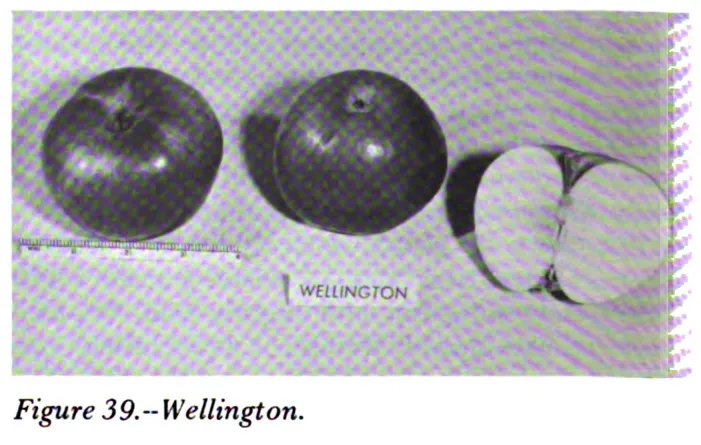
Wellington
[NOTE: Source text may be incorrect — the Agassiz catalogue entries (trees planted 1890) and the Bunyard catalog entry (1914) describe winter-keeping apples bearing the name Wellington that predate the New York Station cultivar of 1955 and cannot be the same variety. The two Agassiz entries also disagree with each other. Their details are kept apart under Other.]
Origin / History
Wellington was raised at the New York State Agricultural Experiment Station from the cross Cortland x Crimson Beauty, made in 1924. Its breeding record number was 2458 and its seedling number Station 4747. The original seedling was selected from a population of 22 seedlings. It first fruited in 1937, was budded in the nursery in 1939, and was orchard planted in the fall of 1941. These second-test trees bore their first crops in 1947, after 5 years in the orchard. They bore consistently for 9 years through 1955 without missing a crop, though in some years the crop was light, Way says probably because of poor pollinating weather.
The variety was named on February 18, 1955, in honor of Professor Richard Wellington, who for many years was in charge of the fruit breeding work at the Station. It was officially released that year. The introductory description appeared in Farm Research and in Fruit Varieties and Horticultural Digest. Brief descriptions followed by Klein and Way, by Brooks, in the Register of New Fruit and Nut Varieties, and in the American Fruit Grower. Way states that this Wellington is not the Wellington described by Hogg, which in 1954 was still grown commercially in England. Nor is it the Wellington described by Ragan.
Wellington was introduced in the hope that it would meet the need for an early commercial sauce apple. The New York State Fruit Testing Association sold trees for 15 years, 1954–68, and 12 commercial nurseries sold it in the 1960–68 period. Way takes this as evidence that it is a useful commercial cultivar. In 1963 it was being tested at experiment stations in Connecticut, Illinois, Maine, Michigan, Minnesota, New Jersey, New York, Ohio, Oregon, Vermont, Washington, and Wisconsin. In 1968 it was under test in Arkansas, New York, North Carolina, Pennsylvania, and Vermont.
Wellington was among the apples recommended for planting in New York State in 1956. By 1962 it had not been planted to any great extent: of 701,000 nonbearing apple trees under 8 years of age in the State, only 1 per cent were Wellington. Its performance in Massachusetts was described as questionable in 1956, yet it was recommended for trial plantings there in 1961. Way judged that it did not appear to have much potential in that State, because of its failure to set full crops at Amherst. New Jersey listed it in 1957 among cultivars recommended for limited trial plantings. Zielinski in 1964 called it a promising new variety for Oregon, on limited tests in Station orchards. In Iowa it was rated of excellent commercial value, though the market demand was limited. Way's summary recommends Wellington for planting for the mid-August fresh market and says small plantings can be very profitable for the early market.
Tree
Large, vigorous, upright, tall, rather dense, round-topped, and moderately productive. In Iowa the tree was somewhat spreading, with heavy wood, and fairly productive. One-year-old nursery trees are short but unusually thick stemmed. In Massachusetts the principal identifying characters of 1-year nursery trees were described to aid in determining trueness-to-name in the nursery row. Trunks stocky; trunk bark smooth, similar to Cortland. Mature trees bear numerous bumps on the sides of the main branches, 3 inches in diameter and 1 inch thick, containing root initials.
Leaves susceptible to spray injury, resulting in necrotic spots 1/8 to 3/8 inch in diameter. In Massachusetts the foliage was found very tender and susceptible to spray injury. Way states it is not known which spray chemical is toxic. In Iowa 10 to 50 per cent of branches contracted fire blight.
Blooms very early in the spring, nearly 3 days earlier than Delicious. A good pollinator for early-blooming cultivars such as Melba and McIntosh. Diploid. Petals very large. Pollen viable, effecting good fruit sets in controlled crosses. Trees sometimes set poorly in orchards having only a few other cultivars, because Wellington blooms very early and other early-blooming cultivars may not be present to pollinate it.
An annual cropper. In Iowa the trees bore medium-sized crops, and young trees were productive. At Amherst, Massachusetts, it never set a full crop up to 1964, though other cultivars in the same block set full crops and some overset.
Fruit
Size: Large, with 10 per cent of fruits more than 3 inches in diameter. In Iowa the fruits were medium-sized to large, and large for their season. In Georgia they were of good size for so early an apple.
Form: Round-oblate, somewhat irregular in cross section.
Stem: Rather short, medium in thickness.
Cavity: Obtuse, deep, broad, very slightly furrowed, with scaly russet in it.
Calyx: Open, medium-sized. Lobes long, broad, acute. Calyx tube long, wide, funnel-shaped. Stamens median.
Basin: Medium in depth and width, abrupt, slightly furrowed, almost symmetrical.
Skin: Thin, medium in toughness, smooth, slightly glossy, covered with heavy bloom. About 90 per cent red, striped on the lighter areas and solid blush on fully colored areas. A large, handsome, attractively red-striped or red-streaked apple. In Iowa the fruits were red but "fair in color."
Dots: Few, rather conspicuous. Small and red on light-colored areas; large and russeted on the side exposed to the sun.
Flesh and flavor: Flesh nearly white with a greenish tinge, even after the fruit has ripened. Semifirm, coarse, crisp, tender, juicy, slightly acid, sprightly. In Iowa firmer than most summer cultivars; in Georgia firm but tending to be coarse. Exposed flesh darkens rapidly. Quality fair to fair-plus: Way rates eating quality "somewhat better than fair," and Zielinski gives "fair to good." Georgia reports "fair eating quality."
Core and seeds: Core small, closed. Carpels round. Seeds medium-sized, wide, plump, obtuse.
Season
Ripens in mid-August. The average ripening date at Geneva is August 16, 8 weeks before Delicious, with an average of 93 days from full bloom to harvest, 52 fewer than Delicious. It ripens only a day or two later than Crimson Beauty (Zielinski). In Iowa it was harvested 9 weeks before Jonathan.
Unlike most early apples, it ripens its fruit all at one time and can be picked in a single harvest. Zielinski thought this probably an undesirable trait in a home orchard tree. The fruits drop readily once ripe. Storage life rather short, averaging about 30 days at 31° F.
Uses
Chiefly a cooking apple. Way calls it most useful for cooking purposes, and Zielinski calls it a good general-purpose variety. It was excellent for culinary use in Iowa and a good cooker in Georgia. Way calls it only a fair dessert cultivar, its dessert quality acceptable though not so good as that of Melba. According to the originators, as reported by Zielinski, it makes a satisfactory sauce. Way reports the sauce rated excellent for consistency and good for grain, flavor, and processor's yield.
As a processor it can be harvested in one picking because it ripens evenly. The rapid darkening of exposed flesh requires rapid processing, and Way says it "cannot be classed as a good processor," not particularly good as an early commercial processing type. He adds that although processing factories have wanted an early-ripening processing apple, Wellington, ripening in mid-August, is too early and is not the promising processor they have sought.
Subtypes / Variants
Not described in source.
Other
The following descriptions under the name Wellington do not fit the New York Station cultivar.
The Central Experimental Farm, Agassiz, British Columbia, recorded two entries from trees planted in spring 1890. The first: tree a strong and upright grower, but a shy bearer. Fruit of medium size, roundish, oblate, conical. Skin golden yellow, shaded and splashed with bright red. Flesh yellowish, crisp, juicy, tender, mildly subacid, quality "very good." Season December and January.
The second: tree a vigorous grower and productive. Fruit of medium size or above medium, roundish. Skin yellow, with a pale blush, sprinkled with brown dots. Flesh yellow, crisp, juicy, briskly acid, quality "good." Season January to March.
George Bunyard & Co. (1914) lists a culinary Wellington, season November to January, with the code "(H, B.T., P.)". Fruit medium-sized, of a greenish shade, with firm flesh. A good keeper, hardly subject to canker, and "one of the most valuable culinary sorts for market."
Book Sources
Described in 2 period pomological works
Nursery Catalog Sources
Found in 9 catalogs (1845–1917) from England, Illinois, Massachusetts
- Winship's Nursery (Brighton Nurseries , operated by the Winship family), Brighton (Boston) , Massachusetts — 1845
- Kelway & Son , Langport, Somerset , England — 1897
- George Bunyard & Co. , Royal Nurseries, Maidstone, Kent , England — 1900
- Central Experimental Farm , Dominion Department of Agriculture, Agassiz, British Columbia (under test; Bulletin No. 3, Second Series) — 1900
- Benjamin Buckman (personal inventory) , Farmingdale , Illinois — 1901
- Thomas Rivers & Son , Sawbridgeworth, Hertfordshire , England — 1913
- Benjamin Buckman (personal inventory) , Farmingdale , Illinois — 1913
- George Bunyard & Co. , Royal Nurseries, Maidstone, Kent , England — 1914
- George Bunyard & Co. , Royal Nurseries, Maidstone, Kent , England — 1917
View original book sources (4)
— Quentin B. Zielinski, Apple Varieties for Oregon (1964)Wellington†
This is a new variety officially released in 1955 by the New York Experiment Station. Limited tests in Station orchards indicate that it is promising in Oregon. The fruit is a large, handsome, red-streaked apple, ripening only a day or two later than Crimson Beauty. Unlike most early apples, Wellington matures its fruit all at one time. This would probably be an undesirable trait for a home orchard tree. It is an annual cropper of fair to good quality and a good general purpose variety. According to the originators, it makes a satisfactory sauce.
† Promising new variety.
— Roger D. Way, Apple Cultivars Introduced by the New York State Agricultural Experiment Station, 1914–1968 (1971)Wellington
Origin. Wellington originated from the cross, Cortland x Crimson Beauty, made in 1924. The breeding record number was 2458, and the seedling number was Station 4747. The original seedling was selected from a population of 22 seedlings. On first fruiting in 1937, it was budded in the nursery in 1939, and trees were orchard planted in the fall of 1941. These second-test trees bore their first crops in 1947, after they were in the orchard for 5 years. They bore consistently for 9 years through 1955, not missing a crop, though in some years the crop was light, probably due to poor pollinating weather. Wellington was named on February 18, 1955 (Table 2). The name was chosen in honor of Professor Richard Wellington, who for many years was in charge of the fruit breeding work at this Station (117).
The introductory description of Wellington was published in Farm Research (116) and in Fruit Varieties and Horticultural Digest (117). It was also briefly described by Klein and Way (130), by Brooks (29), in the Register of New Fruit and Nut Varieties (32), and in the American Fruit Grower (9).
This Wellington is not the same cultivar as the Wellington described by Hogg (99) which, in 1954, was still grown commercially in England (205). Likewise, it is not the same cultivar described by Ragan (181).
Tree. The tree characteristics of Wellington are summarized in Table 5; 10 tree characteristics have been listed by Way (221).
One-year-old Wellington trees in the nursery are short but unusually thick stemmed. In Massachusetts, the principal identifying characters of 1-year nursery trees of Wellington were described to aid in determining the trueness-to-name of new cultivars in the nursery row (232).
Older Wellington trees in the orchard are large, vigorous, upright, tall, rather dense, round-topped, and moderately productive (Table 5). Tree trunks are stocky. The trunk bark is smooth, similar to Cortland. Numerous bumps 3 inches in diameter and 1 inch thick containing root initials are borne on the sides of main branches of mature Wellington trees. The leaves are susceptible to spray injury, resulting in necrotic spots 1/8 to 3/8 inch in diameter. In Massachusetts, Wellington foliage was found to be very tender and susceptible to spray injury (230). It is not known which spray chemical is toxic.
Wellington blooms very early in the spring (98), nearly 3 days earlier than Delicious (Table 6). It is a good pollinator for early blooming cultivars such as Melba and McIntosh (117). It is diploid (Table 4). The petals are very large (147). Wellington pollen has effected good fruit sets in controlled crosses, which demonstrates that the pollen is viable. Trees sometimes set poorly in orchards having only a few other cultivars. This is because Wellington blooms very early, and there may not be other early blooming cultivars present to pollinate it.
Fruit. The fruits of Wellington are illustrated in Figure 39. The fruit characteristics are summarized in Table 8. Ten fruit characteristics have been listed by Way (221).
The average ripening date for Wellington at Geneva is August 16, 8 weeks before Delicious (Table 7). The average number of days from full bloom to harvest is 93, 52 fewer than Delicious. Unlike most early ripening cultivars, Wellington ripens its fruits all at one time, and they can be picked in a single harvest. The fruits drop readily after they become ripe.
Wellington fruits are large. Ten per cent of them are more than 3 inches in diameter. They are round-oblate and somewhat irregular in cross section. The stem is rather short and medium in thickness. The cavity is obtuse, deep, broad, very slightly furrowed, and with scaly russet in it. The calyx is open and medium sized. The calyx lobes are long, broad, and acute. The basin is medium in depth and width, abrupt, slightly furrowed, and almost symmetrical.
The skin is thin, medium in toughness, smooth, slightly glossy, and covered with heavy bloom. The skin color is 90 per cent red, striped on the lighter areas, and solid blush on fully colored areas. The dots are few, rather conspicuous, small and red on light-colored areas, and large and russeted on the side exposed to the sun. The calyx tube is long, wide, and funnel-shaped. The stamens are median. The core is small and closed. The carpels are round. The seeds are medium sized, wide, plump, and obtuse.
The flesh is nearly white, with a greenish tinge, even after the fruit has ripened. The flesh is semifirm, coarse, crisp, tender, juicy, slightly acid, and sprightly. The eating quality is somewhat better than fair. Wellington is most useful for cooking purposes and only a fair dessert cultivar. However, it is not particularly good as an early commercial processing type (Table 9). The storage life of Wellington fruits is rather short, averaging about 30 days at 31° F (Table 10).
Commercial Usefulness. Prior to 1968, trees of Wellington were sold by the New York State Fruit Testing Association for 15 years, 1954-68 (Table 2). In the 1960-68 period, Wellington trees were sold by 12 commercial nurseries (Table 3). This is evidence that it is a useful commercial cultivar.
In 1963, a survey of apple clones in the United States (79) showed that Wellington was being tested at experiment stations in Connecticut, Illinois, Maine, Michigan, Minnesota, New Jersey, New York, Ohio, Oregon, Vermont, Washington, and Wisconsin. In 1968, it was tested at experiment stations in Arkansas, New York, North Carolina, Pennsylvania, and Vermont (184).
Wellington was introduced in the hope that it would meet the need for an early commercial sauce cultivar. It is large, annually productive, and attractively red striped. As a processor, it can be harvested with one picking because it ripens evenly. The dessert quality is acceptable, though not so good as that of Melba. The sauce is rated excellent for consistency and good for grain, flavor, and processor's yield. However, the exposed flesh has a rapid rate of darkening, requiring rapid processing (127). It cannot be classed as a good processor (Table 9). Although commercial processing factories have wanted an early ripening processing cultivar, Wellington which ripens in mid-August is too early and is not the promising processor they have sought.
In 1956, Wellington was one of the apple cultivars recommended for planting in New York State (10). However, by 1962, it had not been planted to any great extent. In that year, there were 701,000 nonbearing apple trees under 8 years of age in the State, and only 1 per cent were Wellington (63).
In 1961, Wellington was recommended for trial plantings in Massachusetts (12), although its performance in that State had been described as questionable in 1956 (146). It did not appear to have much potential, because up to 1964, it never set a full crop in a test planting at Amherst, although other cultivars in the same block set full crops and some had overset (229).
In 1957, Wellington was on the list of cultivars recommended for limited trial plantings in New Jersey (49). Similarly, in 1964, it was described as a promising new cultivar for Oregon orchards (246).
In Iowa (62), Wellington trees bore medium sized crops. Ten to 50 per cent of Wellington branches contracted fire blight. The fruits were medium sized to large and were red. It was harvested 9 weeks before Jonathan. It was of excellent commercial value. Young trees were productive. Fruits were large for their season, fair in color, and excellent for culinary use. They were firmer than most summer cultivars. The tree was somewhat spreading, had heavy wood, and was fairly productive. The market demand was limited.
In Georgia (244), Wellington was red striped, had fair eating quality, good size for so early an apple, was firm, a good cooker, but it tended to be coarse.
In summary: Wellington is recommended for planting for the mid-August fresh market. Small plantings can be very profitable for the early market.
— Central Experimental Farm, Central Experimental Farm, Agassiz BC — Catalogue of Fruit Trees under Test (Bulletin No. 3, 1900) (1900)Planted Spring 1890. Tree a strong and upright grower, but a shy bearer. Fruit of medium size, roundish, oblate, conical. Skin golden yellow, shaded and splashed with bright red. Flesh yellowish, crisp, juicy, tender, mildly sub-acid, quality very good. Season December and January.
Planted Spring 1890. Tree a vigorous grower and productive. Fruit of medium size or above medium, roundish. Skin yellow, with a pale blush, and sprinkled with brown dots. Flesh yellow, crisp, juicy, briskly acid, quality good. Season January to March.
— George Bunyard & Co., George Bunyard Catalog of Fruit Trees (1914) (1914)Culinary; Nov.-Jan. Medium-sized; of a greenish shade; firm flesh; good keeper; hardly subject to canker. One of the most valuable culinary sorts for market. (H, B.T., P.)