King David
Apple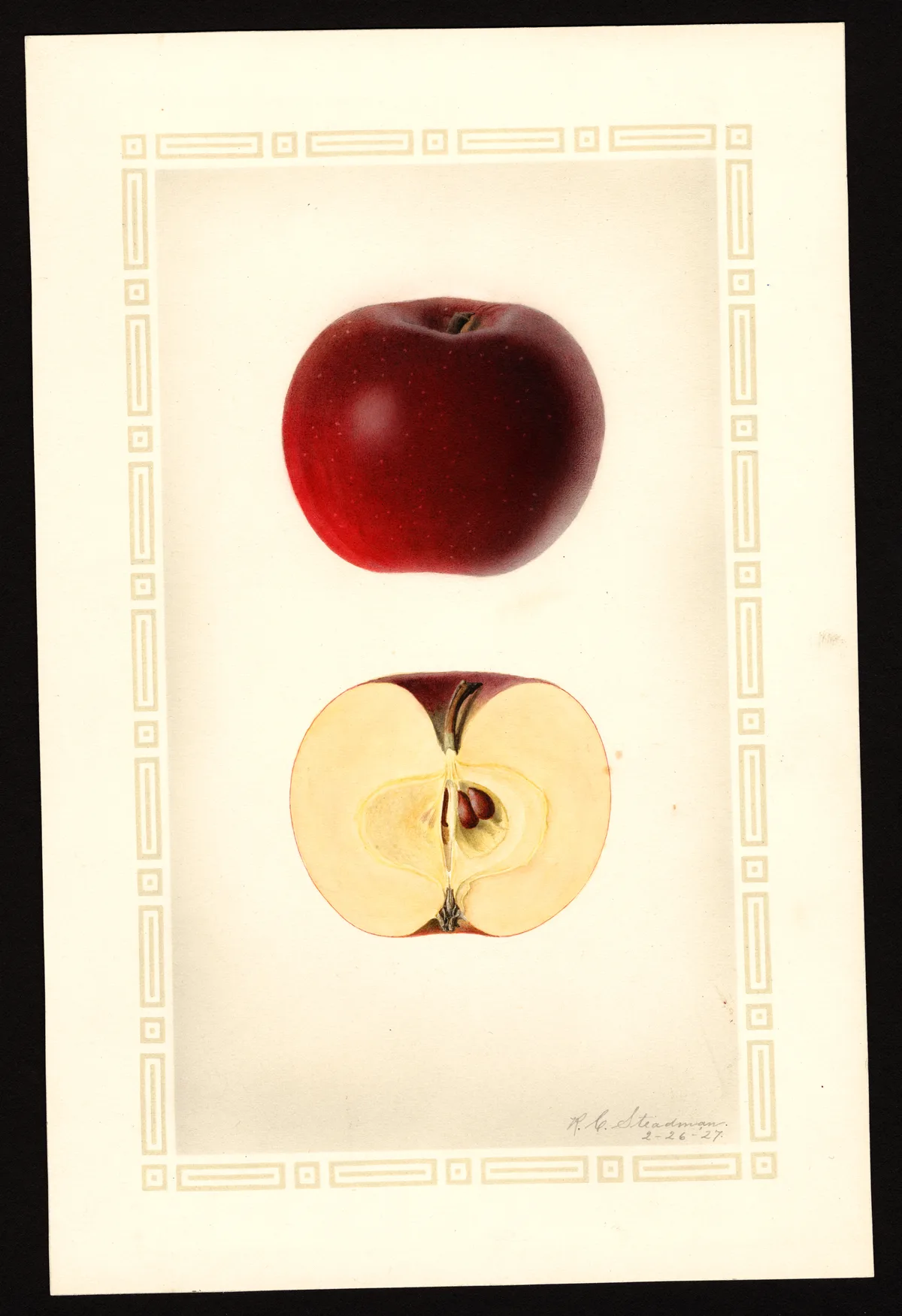
USDA Pomological Watercolor Collection
King David
Origin / History
Found growing in a fence-row in Washington County, Arkansas, in 1893, and introduced by Stark Brothers, Louisiana, Missouri, in 1902 (Hedrick). Hedrick calls it a cross between Jonathan and Arkansas Black, resembling both parents in one or more characters; Stark Bros. say "probably a cross between Jonathan and Arkansas Black," originating in Washington County, Arkansas. Stark Bros. paid $1,000 for the original tree.
Col. W. G. Vincenheller, Director of the Arkansas Experiment Station and, in Stark Bros.' words, "one of the foremost horticulturists in the country," had watched the variety for a number of years and predicted that it would take the place of Jonathan as soon as orchardists began to realize its value. Col. G. B. Brackett, United States Pomologist, felt sure Stark Bros. had found a valuable acquisition to the list of unusually valuable varieties, and wrote them: "The more I learn of King David the better I am satisfied that it is one of the coming apples"; later he called it his ideal apple. At the National Apple Growers' Congress at Council Bluffs, Iowa, in 1908, it was more admired and received more favorable comment than any apple on display, with the exception of Delicious.
Stark Bros. call it "one of the most beautiful apples grown," unsurpassed in beauty by any apple, and say that wherever placed on market it has created a sensation, that wherever it fruits it is the wonder of the neighborhood, that wherever exhibited it is the object of favorable comment and admiration, and that its wondrous beauty will command attention on any market. They call King David and Delicious "the two great market quality kings," and say its unparalleled excellence will make it a favorite with every one who tastes it. They predict that it will shortly be the favorite fancy fruit-stand apple, commanding prices heretofore unheard of, and that within a few years it will take the place of Jonathan with the commercial planter. Hedrick calls the fruit as beautiful as any in the orchard.
Tree
Vigorous, healthy, hardy, productive; equal to either Jonathan or Arkansas Black in hardiness, productiveness, vigor, and health (Hedrick). Branches long, moderately stout (Hedrick). Stark Bros. call the tree hardy and strong, a vigorous grower, and a remarkably young and heavy bearer, often bearing the second year after planting; this makes it an unsurpassed filler as well as a model permanent orchard tree.
Fruit
Size: Medium, about the size of Jonathan, and uniform in size (Hedrick); medium to large, of better size than Jonathan (Stark Bros.).
Form: Round to round-oblate to oblate-conic, slightly ribbed; rotundity of shape (Hedrick). Stark Bros. say it resembles Jonathan in shape.
Stem: Medium in length, slender.
Cavity: Moderately deep and broad, usually russeted.
Calyx: Small, closed; calyx-tube long, narrow, funnel-shaped.
Basin: Medium in depth, somewhat abrupt, furrowed.
Skin: Thin, tender, smooth. Ground color pale greenish yellow, almost entirely overspread with a very attractive deep, dark red, changing to scarlet; deep, rich red with distinct markings of very dark red, a blending of the colors of Jonathan and Arkansas Black (Stark Bros.). Even better colored than Jonathan (Hedrick). The color deepens while the fruit hangs on the tree. Deep, solid red color, rotundity, and uniformity in size give the fruit an almost perfect appearance (Hedrick).
Dots: Not described in source.
Flesh and flavor: Distinctly yellow, firm, fine, crisp, tender to moderately tender, juicy; brisk subacid, spicy and aromatic. Quality good to very good (Hedrick); "best" (Lowther). Stark Bros. say it surpasses Jonathan, Grimes, and Spitzenburg in quality.
Core and seeds: Core rather large, open, abaxile, with clasping core-lines. Chief fault a tendency to decay at the core, especially when over-ripe (Hedrick).
Season
Early autumn (Lowther); November to February (Hedrick). The apples hang long on the tree. For late keeping, pick as soon as overspread with red and before the seeds are well ripened (Hedrick). Stark Bros. say it keeps remarkably well, coming out of storage April 1st in perfect condition.
Uses
Both kitchen and market (Lowther). Brackett, quoted by Stark Bros., calls it just the right size for dessert, fancy stand and hotel trade. Stark Bros. recommend it as a fancy fruit-stand apple and as a commercial sort, and urge planters everywhere to plant it and Delicious, so that the product of the orchard sells far in advance of that from sorts of indifferent quality.
Subtypes / Variants
Not described in source.
Other
Not described in source.
Book Sources
Described in 2 period pomological works
Nursery Catalog Sources
Found in 11 catalogs (1906–1932) from Illinois, Missouri, Oregon, Washington
- Stark Bros. Nurseries & Orchards Co. , Louisiana , Missouri — 1906
- C.F. Lansing , Salem , Oregon — 1910
- Stark Bros. Nurseries & Orchards Co. , Louisiana , Missouri — 1910
- Stark Bros. Nurseries & Orchards Co. , Louisiana , Missouri — 1911
- Washington Nursery Company , Toppenish , Washington — 1912
- Stark Bros. Nurseries & Orchards Co. , Louisiana , Missouri — 1912
- Van Holderbeke Nursery Co. , Incorporated, Spokane, Washington (nurseries at Otis Orchards WA, Pasadena WA, Kennewick WA) — 1913
- Benjamin Buckman (personal inventory) , Farmingdale , Illinois — 1913
- Stark Bros. Nurseries & Orchards Co. , Louisiana , Missouri — 1918 — listed as Stark King David
- Columbia & Okanogan Nursery Co. , Wenatchee , Washington — 1925
- Stark Bro's Nurseries , Louisiana , Missouri — 1932
View original book sources (3)
— Granville Lowther (ed.), Encyclopedia of Practical Horticulture (1914)King David. Size: medium. Form: round. Color: red. Quality: best. Use: both kitchen and market. Season: early autumn.
— U.P. Hedrick, Cyclopedia of Hardy Fruits (1922)KING DAVID. Fig. 30. This apple is a cross between Jonathan and Arkansas Black, resembling both parents in one or more characters. The trees are equal to either in hardiness, productiveness, vigor, and health. The apples are about the size of those of Jonathan and even better colored, as beautiful as any in the orchard; for added to the deep, solid, red color are rotundity in shape and uniformity in size; these three qualities give the fruits an almost perfect appearance. The apples hang long on the tree, all the while deepening in color, but for late keeping should be picked as soon as overspread with red and before the seeds are well ripened. The flesh is firm, fine, crisp, tender, spicy, and juicy. The chief fault of the fruit is a tendency to decay at the core, especially when over-ripe. King David was found growing in a fence-row in Washington County, Arkansas, in 1893, and was introduced by Stark Brothers, Louisiana, Missouri, in 1902. Tree vigorous, healthy, hardy, productive; branches long, moderately stout. Fruit of medium size, round-oblate to oblate-conic, slightly ribbed; stem medium in length, slender; cavity moderately deep and broad, usually russeted; calyx small, closed; basin medium in depth, somewhat abrupt, furrowed; skin thin, tender, smooth; color pale greenish-yellow, almost entirely overspread with a very attractive deep, dark red, changing to scarlet; core rather large, open, abaxile, with clasping core-lines; calyx-tube long, narrow, funnel-shaped; flesh distinctly yellow, firm, crisp, moderately tender, juicy, brisk subacid, spicy and aromatic; quality good to very good; November to February.
— Stark Bros. Nurseries & Orchards Co., Stark Bros. Year Book (1910) (1910)Probably a cross between Jonathan and Arkansas Black, originating in Washington County, Arkansas. One of the most beautiful apples grown, medium to large, resembling Jonathan in shape, though of better size. Color a deep, rich red with distinct markings of very dark red—a blending of the colors of Jonathan and Arkansas Black. In beauty, it is unsurpassed by any apple, and wherever placed on market has created a sensation. In quality it surpasses Jonathan, Grimes, and Spitzenburg, while the tree is hardy and strong, a vigorous grower, and a remarkably young and heavy bearer, often bearing the second year after planting. This characteristic makes it an unsurpassed filler, besides being a model permanent orchard tree. It will shortly be the favorite fancy fruit-stand apple and will command prices heretofore unheard of, as its wondrous beauty will command attention on any market, and its unparalleled excellence will make it a favorite with every one who tastes it. Keeps remarkably well, coming out of storage April 1st in perfect condition. Everything considered, we believe that within a few years King David will take the place of Jonathan with the commercial planter.
When we undertook the introduction of this great apple (we paid $1,000 for the original tree), Col. W. G. Vincenheller, Director of the Arkansas Experiment Station, and one of the foremost horticulturists in the country, who had watched the variety for a number of years, predicted that it would take the place of Jonathan as soon as orchardists began to realize its value. Col. G. B. Brackett, United States Pomologist, also felt sure we had found a valuable acquisition to the list of unusually valuable varieties, and in a recent letter to us says: "The more I learn of King David the better I am satisfied that it is one of the coming apples." Later, Col. Brackett said that King David was his ideal apple, just the right size for dessert, fancy stand and hotel trade. Wherever it fruits it is the wonder of the neighborhood, wherever exhibited it is the object of favorable comment and admiration. At the meeting of the National Apple Growers' Congress at Council Bluffs, Iowa, in 1908, it was more admired and received more favorable comment than any apple on display, with the exception of Delicious. King David and Delicious are the two great market quality kings. We urge planters everywhere to plant them, for the excellence of their fruit will make the product of your orchard sell far in advance of that of the man who plants sorts of indifferent quality. NNCS
Probably a cross between Jonathan and Arkansas Black, originating in Washington County, Arkansas. One of the most beautiful apples grown, medium to large, resembling Jonathan in shape, though of better size. Color a deep, rich red with distinct markings of very dark red—a blending of the colors of Jonathan and Arkansas Black. In beauty, it is unsurpassed by any apple, and wherever placed on market has created a sensation. In quality it surpasses Jonathan, Grimes, and Spitzenburg, while the tree is hardy and strong, a vigorous grower, and a remarkably young and heavy bearer, often bearing the second year after planting. This characteristic makes it an unsurpassed filler, besides being a model permanent orchard tree. It will shortly be the favorite fancy fruit-stand apple and will command prices heretofore unheard of, as its wondrous beauty will command attention on any market, and its unparalleled excellence will make it a favorite with every one who tastes it. Keeps remarkably well, coming out of storage April 1st in perfect condition. Everything considered, we believe that within a few years King David will take the place of Jonathan with the commercial planter.
When we undertook the introduction of this great apple (we paid $1,000 for the original tree), Col. W. G. Vincenheller, Director of the Arkansas Experiment Station, and one of the foremost horticulturists in the country, who had watched the variety for a number of years, predicted that it would take the place of Jonathan as soon as orchardists began to realize its value. Col. G. B. Brackett, United States Pomologist, also felt sure we had found a valuable acquisition to the list of unusually valuable varieties, and in a recent letter to us says: "The more I learn of King David the better I am satisfied that it is one of the coming apples." Later, Col. Brackett said that King David was his ideal apple, just the right size for dessert, fancy stand and hotel trade. Wherever it fruits it is the wonder of the neighborhood, wherever exhibited it is the object of favorable comment and admiration. At the meeting of the National Apple Growers' Congress at Council Bluffs, Iowa, in 1908, it was more admired and received more favorable comment than any apple on display, with the exception of Delicious. King David and Delicious are the two great market quality kings. We urge planters everywhere to plant them, for the excellence of their fruit will make the product of your orchard sell far in advance of that of the man who plants sorts of indifferent quality. NNCS