Chenango Strawberry
Apple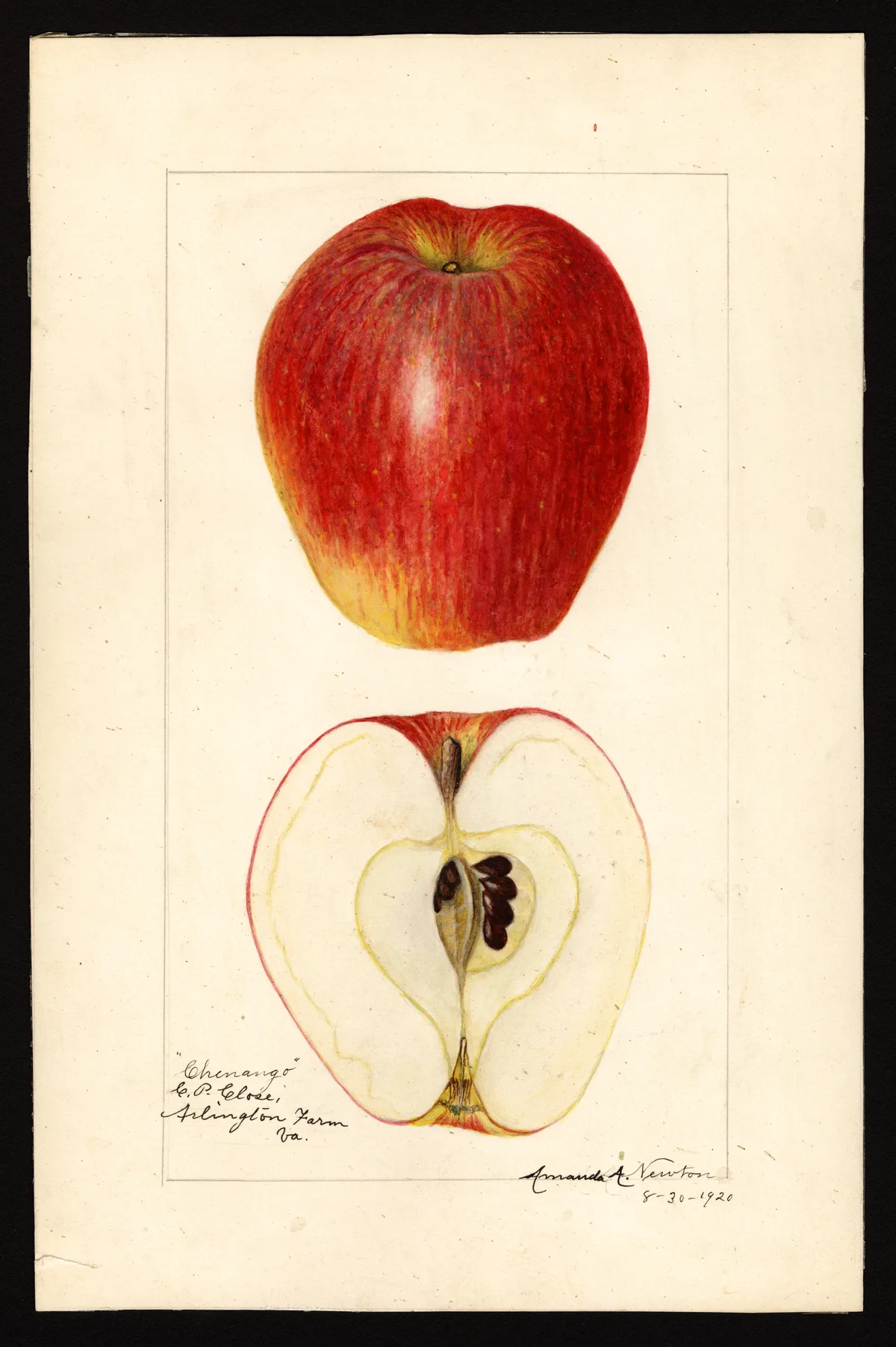
USDA Pomological Watercolor Collection
Chenango Strawberry
Origin / History
Accounts of origin differ. Downing, Hansen, and Budd-Hansen place the origin in the town of Lebanon, Madison County, New York. Thomas attributes it to Chenango County, New York. Beach records both traditions: some accounts give Lebanon, Madison County, while others say it was early brought into Chenango county by settlers from Connecticut. Warder states only that it is a native of New York. Hedrick writes that the history is not known with certainty but that it probably originated in Madison or Chenango County, New York; he notes it was first described in 1854. Beach notes it had certainly been known in cultivation for more than fifty years as of his writing (1905), and that it was still propagated by nurserymen though the demand for the stock was quite limited. Hedrick adds that its merits quickly brought it into culture in the apple regions of the whole country, and that it grew in the orchard of nearly every amateur apple-grower. Warder records that to avoid confusion with other "Strawberry" apples, it had been suggested that the local name Frank be adopted.
Tree
Tree of medium size, vigorous, with short, stout, curved branches (Beach, Hedrick). Form upright-spreading to roundish, rather dense (Beach); Hedrick gives upright-spreading, dense; Downing and Hansen describe it simply as vigorous, spreading; Thomas as upright, vigorous; Budd-Hansen as vigorous, spreading. The Central Experimental Farm catalog (Agassiz BC, 1900, planted Spring 1890) records it as a vigorous grower and a good bearer.
Twigs long to medium, curved, moderately slender; internodes medium (Beach). Young wood light reddish brown and downy (Downing); Thomas describes the shoots as light colored. Bark olive-green tinged with dull brown, lightly streaked with scarf-skin; pubescent (Beach). Lenticels scattering, small, round, not raised (Beach). Buds deeply set in bark, small, flat, obtuse, appressed, slightly pubescent (Beach).
Bearing habits: an early and regular bearer, hardy, healthy, and pretty long-lived; under favorable conditions an annual bearer, alternating rather light with heavy crops (Beach). Hedrick echoes this: early and regular bearers, hardy, healthy, long-lived, fruitful, and usually annual in bearing. Hansen notes it is "not sufficiently hardy at the north."
Fruit
Size: Medium to large (Warder, Hansen, Budd-Hansen, Beach, Hedrick); medium (Downing, Central Experimental Farm); rather large (Thomas); medium (Lowther). Beach adds that under unfavorable conditions it may be small and poorly colored.
Form: Sources broadly agree on an oblong, conic, somewhat ribbed form, with variations in descriptors. Warder: oblong, tapering, irregular. Downing: oblong conic or oblong truncated conic, indistinctly ribbed. Hansen and Budd-Hansen: oblong conic, regular, truncated, obscurely ribbed. Thomas: oblong-conic, angular. Beach: elongated ovate or oblong conic, slightly ribbed. Hedrick: elongated-ovate or oblong-conic, ribbed. Central Experimental Farm: oblong, conical, slightly ribbed. Lowther gives the form as oblate-conical (a notable departure from the other sources, which describe an elongated form).
Stem / Stalk: Stem medium (Warder); stalk rather short, small (Downing); stem very short, small (Hansen, Budd-Hansen); stem short to medium, moderately thick (Beach); stem short, thick (Hedrick).
Cavity: Acuminate (Warder, Hedrick); acute, somewhat uneven (Downing); regular, acute, narrow, somewhat uneven (Hansen, Budd-Hansen); narrow and deep (Thomas); acute to acuminate, deep, narrow, often somewhat furrowed and compressed, usually not russeted (Beach); acuminate, deep, narrow, often furrowed and compressed (Hedrick).
Calyx / Eye: Eye medium, closed (Warder). Calyx closed, or partially open; segments erect (Downing). Calyx closed or half open; segments erect convergent (Hansen, Budd-Hansen). Calyx medium to large, partly open or closed; lobes often separated at the base, long, broad, obtuse (Beach). Calyx large, partly open or closed; lobes often separated at the base, long, broad, obtuse (Hedrick).
Basin: Folded and plaited, abrupt (Warder); rather large, abrupt, slightly corrugated (Downing); narrow, shallow, nearly or quite smooth (Hansen, Budd-Hansen); narrow (Thomas); usually small, medium to rather shallow, narrow to moderately wide, obtuse to somewhat abrupt, furrowed, sometimes wrinkled (Beach); small, shallow, narrow, obtuse, furrowed, sometimes wrinkled (Hedrick). Sources differ chiefly on size — Downing describes it as rather large while Beach, Hedrick, Hansen, and Budd-Hansen describe it as small, narrow, and shallow.
Skin / Surface: Surface smooth, beautifully striped on waxen yellow (Warder). Color whitish, shaded, splashed and mottled with light and dark crimson over most of the surface, light dots (Downing). Surface yellowish white, mostly covered with rosy crimson stripes, mixed on sunny side, and in part thinly overlaid with whitish net-veining (Hansen, Budd-Hansen). Striped and splashed with light crimson on whitish yellow ground (Thomas). Skin rather tough, smooth, glossy, yellowish-white, often almost entirely overspread and mottled with attractive pinkish-red, conspicuously striped and splashed with bright carmine (Beach). Skin tough, smooth, glossy, yellowish-white, overspread and mottled with pinkish-red, conspicuously striped and splashed with carmine (Hedrick). Central Experimental Farm: skin white, shaded and splashed with dark crimson over most of the surface. Lowther summarizes color as green-red. Beach calls the appearance "beautiful."
Dots: Light dots (Downing); distinct, white, few, minute (Hansen, Budd-Hansen); few, small, inconspicuous, light colored, often submerged (Beach); few, inconspicuous, light-colored, often submerged (Hedrick).
Flesh / Flavor: Flesh tender, juicy; flavor sub-acid, aromatic; quality very good (Warder). Flesh white, tender, juicy, peculiar mild, subacid; very good (Downing). Flesh white, tender, juicy, mild, pleasant subacid, very good (Hansen, Budd-Hansen). Flesh white, very tender, with a pleasant, mild, sub-acid flavor (Thomas). Flesh white, moderately firm, tender, juicy, mild subacid, very aromatic, good to very good (Beach). Flesh white, firm, tender, juicy, mild subacid, very aromatic; good to very good (Hedrick). Central Experimental Farm: flesh white, tender, juicy, spicy, quality good. Lowther: quality very good. Hedrick offers a particularly enthusiastic appraisal: "In its season, Chenango is the apple of apples in taste, smell, and appearance… no apple can give more pleasure to those who grow fruit for quality."
Core / Seeds / Calyx tube / Stamens / Carpels: Core rather large (Downing). Core rather large, half open; cells elliptical, entire; tube funnel-shaped; stamens basal; seeds flat, pointed (Hansen, Budd-Hansen). Calyx tube long, funnel-shape or nearly so; stamens median; core rather large, abaxile; cells often unsymmetrical, wide open or closed; core lines clasping; carpels broadly ovate to oval, smooth; seeds small, moderately wide, plump, obtuse, not tufted (Beach). Calyx-tube long, funnel-shape; stamens median; core large, abaxile; cells often unsymmetrical, wide, open or closed; corelines clasping; carpels broadly ovate, smooth; seeds small, wide, plump, obtuse (Hedrick). The sources disagree on stamen position (Hansen/Budd-Hansen say basal; Beach/Hedrick say median) and on seed shape (Hansen/Budd-Hansen describe seeds as flat and pointed; Beach and Hedrick as small, wide/moderately wide, plump, and obtuse).
Season
Autumn (Warder); September and October (Downing, Hansen, Budd-Hansen, Thomas); latter part of August and through September (Beach, Hedrick); early autumn (Lowther); August (Central Experimental Farm, Agassiz BC). Beach explains the long ripening window: "The fruit begins to mature in September and ripens continuously during a period of several weeks. For this reason it should have more than one picking in order to secure the crop in the best condition." Hedrick concurs: the fruits begin to mature in September and continue to ripen for several weeks, lasting, in storage at least, until November.
Storage
The latest ripening fruit may be kept in ordinary storage till November, but after that the color fades and it deteriorates much in quality, even though it may remain apparently sound (Beach). The fruit does not ship well because its flesh is too tender (Beach); Hedrick likewise calls it "too delicate to send to market."
Uses
Use, dessert (Warder); much esteemed as a table fruit wherever grown (Downing); a great favorite for dessert wherever grown (Hansen, Budd-Hansen); an excellent dessert or market variety (Thomas); excellent dessert quality and good also for culinary uses (Beach); both kitchen and market (Lowther). Beach notes that some find it a profitable variety to grow for local or special markets, but that other varieties of its season are more desirable than Chenango for general commercial planting; it is recommended as an excellent variety for the home orchard. Hedrick endorses it for the quality grower: "no apple can give more pleasure to those who grow fruit for quality… it now grows in the orchard of nearly every amateur apple-grower."
Subtypes / Variants
Not described in source.
Other
Lowther's report from the Encyclopedia of Practical Horticulture records the variety as reported by 6 stations in the Northern Division, 10 stations in the Central Division, and 2 stations in the Southern Division, with an asterisk on each division count indicating the variety is reported as adapted to more than one of the three divisions. Beach catalogs an extensive bibliography of 22 references spanning 1854 to 1904, indicating wide notice in the period horticultural literature. The Central Experimental Farm trial at Agassiz, BC, planted Spring 1890, recorded the tree as a vigorous grower and a good bearer under that climate.
Book Sources
Described in 8 period pomological works
- Beach, The Apples of New York Vol. 2 (1905) — listed as Chenango
- Budd & Hansen, Systematic Pomology (1914) — listed as Chenango
- Downing, Fruits and Fruit Trees of America (1900)
- Thomas, The American Fruit Culturist (1903)
- Warder, American Pomology: Apples (1867) — listed as Frank or Chenango
- Lowther (ed.), Encyclopedia of Practical Horticulture (1914) — listed as Chenango (S'berry)
- Hansen, A Study of Northwestern Apples (1902) — listed as Chenango
- Hedrick, Cyclopedia of Hardy Fruits (1922) — listed as CHENANGO
Nursery Catalog Sources
Found in 31 catalogs (1884–1924) from Alabama, California, Illinois, Maryland, Massachusetts, Missouri, New Jersey, Oregon, Pennsylvania, Washington
- Felix Gillet , Barren Hill Nursery, Nevada City , California — 1884
- Huntsville Wholesale Nurseries (Jessie S. Moss , Proprietor; W.F. Heikes, Manager), Huntsville , Alabama — 1886
- Felix Gillet , Barren Hill Nursery, Nevada City , California — 1888
- Felix Gillet , Barren Hill Nursery, Nevada City , California — 1889
- Felix Gillet , Barren Hill Nursery, Nevada City , California — 1890
- William H. Moon Co. , Morrisville, Bucks County , Pennsylvania — 1890 — listed as Sherwood's Favorite
- Felix Gillet , Barren Hill Nursery, Nevada City , California — 1891
- Milwaukie-Canby Nurseries , Canby, OR (and Milwaukie, OR) — 1893
- Rogers Nursery Co. , Moorestown , New Jersey — 1893
- Rogers Nursery Co. , Moorestown , New Jersey — 1893 — listed as Sherwood's Favorite
- The Vineland Nurseries (Kelsey & Co. , Proprietors), St. Joseph, Missouri (Office: 13th and Atchison Sts., 2 Blocks East of the Citizens St. Car Line) — 1894
- Felix Gillet , Barren Hill Nursery, Nevada City , California — 1895
- Felix Gillet , Barren Hill Nursery, Nevada City , California — 1897
- Reading Nursery , Jacob W. Manning, Proprietor, Reading , Massachusetts — 1898 — listed as Sherwood's Favorite
- Brown Brothers Co. , Continental Nurseries, Rochester, NY (also operated from Toronto, Canada) — 1899
- Brown Brothers Co. , Continental Nurseries, Rochester, NY (also operated from Toronto, Canada) — 1899 — listed as Sherwood's Favorite
- Central Experimental Farm , Dominion Department of Agriculture, Agassiz, British Columbia (under test; Bulletin No. 3, Second Series) — 1900 — listed as Chenango
- Benjamin Buckman (personal inventory) , Farmingdale , Illinois — 1901 — listed as Chenango
- Brown Brothers Co. , Continental Nurseries, Rochester, NY (also operated from Toronto, Canada) — 1901 — listed as Sherwood's Favorite
- Phoenix Nursery Company (W. E. Rossney , President; Sidney Tuttle, Vice-President), Bloomington , Illinois — 1904
- Wm. J. Corse (successor to Robert Sinclair / Sinclair Nurseries) , Baltimore , Maryland — 1909 — listed as Sherwood's Favorite
- Island Nurseries & Fruit Farm , Vashon (Vashon Island) , Washington — 1910
- Island Nurseries & Fruit Farm , Vashon (Vashon Island) , Washington — 1911
- Ballygreen Nurseries , Hanford , Washington — 1912
- Vineland Nurseries Company , Clarkston , Washington — 1912
- Benjamin Buckman (personal inventory) , Farmingdale , Illinois — 1913 — listed as Chenango
- Island Nurseries & Fruit Farm , Vashon (Vashon Island) , Washington — 1914
- Union Nurseries , J.B. Weaver & Sons, Union , Oregon — 1915 — listed as Sherwood's Favorite
- Stark Bros. Nurseries & Orchards Co. , Louisiana , Missouri — 1918
- Benedict Nursery Co. , Portland , Oregon — 1921 — listed as Sherwood's Favorite
- Fresno Nursery Co. , Fresno , California — 1924 — listed as Chenango
View original book sources (9)
— John A. Warder, American Pomology: Apples (1867)Frank or Chenango. CHENANGO STRAWBERRY.
This beautiful apple has been called also the Lord Strawberry. So, to avoid confusion, perhaps, it were better to adopt its local name Frank. It is a native of New York.
Fruit medium to large oblong, tapering, irregular; Surface smooth, beautifully striped on waxen yellow. Basin folded and plaited, abrupt; Eye medium, closed. Cavity acuminate; Stem medium. Flesh tender, juicy; Flavor sub-acid, aromatic; Quality very good; Use, dessert; Season, autumn.
— A.J. Downing, The Fruits and Fruit Trees of America (1900)Chenango Strawberry.
Frank. Sherwood's Favorite. Jackson Apple. Buckley. Strawberry. Smyrna.
Originated in the town of Lebanon, Madison Co., N. Y. It is an apple pleasant to the taste and much esteemed as a table fruit wherever grown. Tree is vigorous, spreading. Young wood light reddish brown, downy.
Fruit medium, oblong conic or oblong truncated conic, indistinctly ribbed. Color whitish, shaded, splashed and mottled with light and dark crimson over most of the surface, light dots. Stalk rather short, email. Cavity acute, somewhat uneven. Calyx closed, or partially open. Segments erect. Basin rather large, abrupt, slightly corrugated. Flesh white, tender, juicy, peculiar mild, subacid. Core rather large. Very good. September and October.
— N.E. Hansen, A Study of Northwestern Apples (1902)Chenango (Chenango Strawberry, Sherwood's Favorite)—Origin, Lebanon, New York. Tree vigorous, spreading, fruit a great favorite for dessert wherever grown—Fruit medium to large, oblong conic, regular, truncated, obscurely ribbed; surface yellowish white, mostly covered with rosy crimson stripes, mixed on sunny side, and in part thinly overlaid with whitish net-veining; dots distinct, white, few, minute; cavity regular, acute, narrow, somewhat uneven; stem very short; small; basin narrow, shallow, nearly or quite smooth; calyx closed or half open, segments erect convergent. Core rather large, half open; cells elliptical, entire; tube funnel-shaped; stamens basal; seeds flat, pointed; flesh white, tender, juicy, mild, pleasant subacid, very good. September, October. Not sufficiently hardy at the north.
— John J. Thomas, The American Fruit Culturist (1903)Chenango Strawberry.* (Frank, Buckley, Jackson, Sherwood's Favorite, Strawberry.) Rather large, oblong-conic, angular; striped and splashed with light crimson on whitish yellow ground; cavity narrow and deep; basin narrow; flesh white, very tender, with a pleasant, mild, sub-acid flavor. September, October. Growth upright, vigorous, shoots light colored. Origin, Chenango County, N. Y. An excellent dessert or market variety.
— S.A. Beach, The Apples of New York, Vol. 2 (1905)CHENANGO.
REFERENCES. 1. Horticulturist, 9:475. 1854. 2. Am. Pom. Soc. Cat., 1869. 3. Downing, 1869:124. fig. 4. Thomas, 1875:199. 5. Ia. Hort. Soc. Rpt., 1879:472. 6. Montreal Hort. Soc. Rpt., 1879:24. 7. Barry, 1883:337. 8. Wickson, 1889:244. 9. Lyon, Mich. Hort. Soc. Rpt., 1890:290. 10. Bailey, An. Hort., 1892:236. 11. Ib., 1892:249. 12. Munson, Me. Sta. Rpt., 1893:132. 13. Burrill and McCluer, Ill. Sta. Bul., 45:317. 1896. 14. Waugh, Vt. Sta. An. Rpt., 14:291. 1901. 15. Atwood, Va. Sta. Bul., 130:120. 1901. 16. W. N. Y. Hort. Soc. Rpt., 1901:76. 17. Hansen, S. D. Sta. Bul., 76:39. 1902. 18. Can. Hort., 26:345. 1903. figs. 19. Budd-Hansen, 1903:62. 20. Farrand, Mich. Sta. Bul., 205:44. 1903. 21. Bruner, N. C. Sta. Bul., 182:20. 1903. 22. Beach and Clark, N. Y. Sta. Bul., 248:115. 1904.
SYNONYMS. Buckley (3, 4). CHENANGO (2, 9, 10, 14, 16, 17, 18, 19, 20, 21, 22). CHENANGO STRAWBERRY (1, 3, 4, 5, 6, 7, 8, 13, 15). Chenango Strawberry (10, 11, 14, 17, 18, 19, 22). CHENANGO Strawberry (12). Frank (3, 4). Jackson (3, 4). SHERWOOD'S FAVORITE (11). Sherwood's Favorite (3, 4, 6, 7, 12, 14, 17, 18, 19, 22). Smyrna (3). Strawberry (1, 3, 4).
Fruit beautiful in appearance, yellowish-white striped with red, of excellent dessert quality and good also for culinary uses. The tree is an early and regular bearer, hardy, healthy, and pretty long-lived. Under favorable conditions it is an annual bearer, alternating rather light with heavy crops. The fruit begins to mature in September and ripens continuously during a period of several weeks. For this reason it should have more than one picking in order to secure the crop in the best condition. The latest ripening fruit may be kept in ordinary storage till November, but after that the color fades and it deteriorates much in quality, even though it may remain apparently sound (22). The fruit does not ship well because its flesh is too tender. Some find it a profitable variety to grow for local or special markets, but other varieties of its season are more desirable than Chenango for general commercial planting. It is recommended as an excellent variety for the home orchard.
Historical. Chenango, according to some accounts, originated in Lebanon, Madison county, N. Y.; others say that it was early brought into Chenango county by settlers from Connecticut. It has certainly been known in cultivation for more than fifty years (3). It is still propagated by nurserymen but the demand for the stock is quite limited.
TREE.
Tree medium size, vigorous with short, stout, curved branches. Form upright spreading to roundish, rather dense. Twigs long to medium, curved, moderately slender; internodes medium. Bark olive-green tinged with dull brown, lightly streaked with scarf-skin; pubescent. Lenticels scattering, small, round, not raised. Buds deeply set in bark, small, flat, obtuse, appressed, slightly pubescent.
FRUIT.
Fruit above medium to large, but under unfavorable conditions it may be small and poorly colored. Form elongated ovate or oblong conic, slightly ribbed. Stem short to medium, moderately thick. Cavity acute to acuminate, deep, narrow, often somewhat furrowed and compressed, usually not russeted. Calyx medium to large, partly open or closed; lobes often separated at the base, long, broad, obtuse. Basin usually small, medium to rather shallow, narrow to moderately wide, obtuse to somewhat abrupt, furrowed, sometimes wrinkled.
Skin rather tough, smooth, glossy, yellowish-white, often almost entirely overspread and mottled with attractive pinkish-red, conspicuously striped and splashed with bright carmine. Dots few, small, inconspicuous, light colored, often submerged.
Calyx tube long, funnel-shape or nearly so. Stamens median.
Core rather large, abaxile; cells often unsymmetrical, wide open or closed; core lines clasping. Carpels broadly ovate to oval, smooth. Seeds small, moderately wide, plump, obtuse, not tufted.
Flesh white, moderately firm, tender, juicy, mild subacid, very aromatic, good to very good.
Season latter part of August and through September.
— J.L. Budd & N.E. Hansen, American Horticultural Manual, Part II: Systematic Pomology (1914)Chenango (Chenango Strawberry, Sherwood's Favorite).—Origin, Lebanon, New York. Tree vigorous, spreading; fruit a great favorite for dessert wherever grown.
Fruit medium to large, oblong conic, regular, truncated, obscurely ribbed; surface yellowish white, mostly covered with rosy crimson stripes, mixed on sunny side and in part thinly overlaid with whitish net-veining; dots distinct, white, few, minute; cavity regular, acute, narrow, somewhat uneven; stem very short, small; basin narrow, shallow, nearly or quite smooth; calyx closed or half open; segments erect convergent. Core rather large, half open; cells elliptical, entire; tube funnel-shaped; stamens basal; seeds flat, pointed; flesh white, tender, juicy, mild, pleasant subacid, very good. September, October.
— Granville Lowther (ed.), Encyclopedia of Practical Horticulture (1914)Chenango (S'berry): size medium; form oblate-conical; color green-red; quality very good; use both kitchen and market; season early autumn; reported by 6 stations in the Northern Division, 10 stations in the Central Division, and 2 stations in the Southern Division; the asterisk on each division count indicates the variety is reported as adapted to more than one of the three divisions.
— U.P. Hedrick, Cyclopedia of Hardy Fruits (1922)CHENANGO. Fig. 14. Chenango Strawberry. In its season, Chenango is the apple of apples in taste, smell, and appearance. The fruits begin to mature in September and continue to ripen for several weeks, lasting, in storage at least, until November. Chenango is too delicate to send to market, but no apple can give more pleasure to those who grow fruit for quality. The trees are early and regular bearers, hardy, healthy, long-lived, fruitful, and usually annual in bearing. Unfortunately, the history of this delicious apple is not known, but it probably originated in Madison or Chenango County, New York. It was first described in 1854. Its merits quickly brought it into culture in the apple regions of the whole country, and it now grows in the orchard of nearly every amateur apple-grower.
Tree of medium size, vigorous, upright-spreading, dense, with short, stout, curved branches. Fruit medium to large, elongated-ovate or oblong-conic, ribbed; stem short, thick; cavity acuminate, deep, narrow, often furrowed and compressed; calyx large, partly open or closed; lobes often separated at the base, long, broad, obtuse; basin small, shallow, narrow, obtuse, furrowed, sometimes wrinkled; skin tough, smooth, glossy, yellowish-white, overspread and mottled with pinkish-red, conspicuously striped and splashed with carmine; dots few, inconspicuous, light-colored, often submerged; calyx-tube long, funnel-shape; stamens median; core large, abaxile; cells often unsymmetrical, wide, open or closed; corelines clasping; carpels broadly ovate, smooth; seeds small, wide, plump, obtuse; flesh white, firm, tender, juicy, mild subacid, very aromatic; good to very good; latter part of August and through September.
— Central Experimental Farm, Central Experimental Farm, Agassiz BC — Catalogue of Fruit Trees under Test (Bulletin No. 3, 1900) (1900)Planted Spring 1890. Tree a vigorous grower and a good bearer. Fruit of medium size, oblong, conical, slightly ribbed. Skin white, shaded and splashed with dark crimson over most of the surface. Flesh white, tender, juicy, spicy, quality good. Season August.