Rock Pippin Of Eastern New York
Apple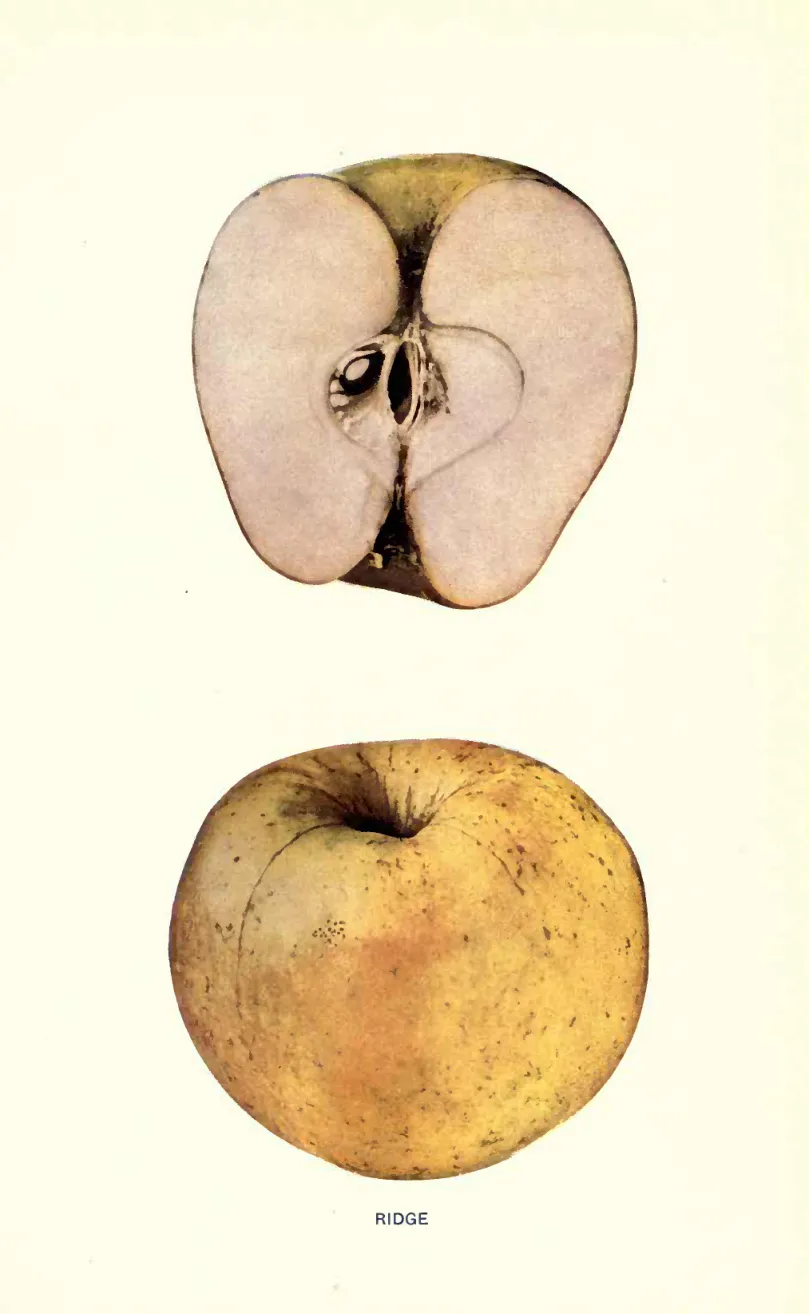
ROCK PIPPIN OF EASTERN NEW YORK
Origin and History
A variety grown in Eastern New York, particularly Dutchess county, of uncertain pedigree and previously unidentified. G. B. Brackett, U.S. Pomologist, confirmed it is not the Lansingburg (despite Downing's synonymy), nor is it the Rock of New Hampshire, Rock of Pennsylvania, or Rock Pippin of Ohio. It somewhat resembles the Tewksbury but is distinct from that variety; also bears some resemblance to Yellow Newtown but is smoother and has a redder cheek. In some regions known as Winter Blush, though available descriptions of Winter Maiden Blush or Winter Blush do not appear to refer to this variety.
Fruit of the same variety has been sent from Pullman, Washington, under the name Rock. According to W. H. Hart of Poughkeepsie, Rock Pippin is found in many orchards throughout Dutchess county, though not in large blocks. It is considered a good variety for profit as it keeps very late and is a good export apple to succeed the Newtown at the end of the season. It does not average as large as Baldwin and grades less No. 1 fruit than that variety. In some seasons it is inclined to scab.
Tree
Large and very vigorous, upright growth habit with long, erect, stout, yellowish-brown twigs. Hardy, very healthy, long-lived, reliable cropper. Does not come into bearing very young but, if kept free from scab, yields good to heavy crops biennially. Fruit hangs to the tree exceptionally well.
Fruit
Size and Form: Below medium to above, uniform in size and shape. Form roundish oblate to roundish, not inclined to conic, regular or nearly so; sides sometimes unequal.
Stem: Short to medium, moderately thick, pubescent.
Cavity: Small to above medium, acute to somewhat acuminate or sometimes approaching obtuse, moderately deep to deep, narrow to moderately broad, furrowed obscurely if at all, usually somewhat russeted.
Calyx: Medium to small, closed; lobes convergent to connivent.
Basin: Scarcely depressed and very obtuse or varying to moderately deep and abrupt, wide, slightly furrowed and wrinkled.
Skin: Moderately thick, tough, smooth or slightly roughened with russet dots, rather glossy. Ground color green or light yellow thinly washed with pinkish-red, often deepening to a distinct bright blush, streaked and mottled with pale scarf-skin toward the cavity. Dots numerous, mostly irregular, submerged and whitish around the basin, sometimes areolar with fine russet point; the russet dots are larger, more irregular, and scattering toward the cavity. Prevailing effect pale yellow.
Calyx Tube: Small, conical to funnel-form.
Stamens: Median to basal.
Core: Medium to small, axile; cells closed; core lines clasping.
Carpels: Thin, broadly roundish to somewhat obcordate, emarginate, somewhat tufted.
Seeds: Rather dark brown, medium to large, rather wide, acute to obtuse, sometimes tufted, compactly filling the cells.
Flesh and Flavor: Whitish or slightly tinged with yellow, very firm, rather hard, a little coarse, somewhat crisp, rather tender, aromatic, juicy, sprightly subacid. Good but not high in flavor.
Season and Storage
Commercial season in ordinary storage extends to April; in cold storage to June or July.
Uses
Grown as a profitable commercial variety, valued as a good export apple to succeed the Newtown at the end of the season.
Other
Tree does not average as large as Baldwin and produces a lower percentage of No. 1 grade fruit. Inclined to scab in some seasons.
Book Sources
Described in 1 period pomological work
View original book sources (1)
— S.A. Beach, The Apples of New York, Vol. 1 (1905)ROCK PIPPIN OF EASTERN NEW YORK.
A variety is grown under this name in Eastern New York, particularly in Dutchess county, which we have been unable to identify as any other named variety. G. B. Brackett, U. S. Pomologist, writes us that it certainly is not Lansingburg of which Rock is given by Downing¹ as a synonym and adds that he is unable to identify it. It is neither the Rock of New Hampshire,² the Rock of Pennsylvania² nor the Rock Pippin of Ohio.²⁻³ It somewhat resembles Tewksbury but is distinct from that variety. It also bears some resemblance to Yellow Newtown but is smoother and has a redder cheek. It is known to some under the name Winter Blush.⁴ All of the descriptions of Winter Maiden Blush or Winter Blush which we have been able to find are brief and unsatisfactory. So far as we can determine none of them refer to variety under discussion. Fruit of what appears to be the same variety
¹Downing, 1881:12 index app. ²Downing, 1869:338. ³Warder, 1867:691. ⁴Letter, C. H. Deuell, Bangall, N. Y., 1904.
as this Rock Pippin has been sent us from Pullman, Washington, under the name Rock. W. H. Hart of Poughkeepsie informs us that Rock Pippin is found in many orchards in Dutchess county but in no large blocks. He considers it a good variety to grow for profit because it keeps very late and is a good export apple to succeed the Newtown at the end of the season. In some seasons it is inclined to scab. It does not average as large as Baldwin and grades less No. 1 fruit than that variety. Its commercial season in ordinary storage extends to April and in cold storage to June or July. Mr. Hart reports that the tree is large, very vigorous, upright, with long, erect, stout, yellowish-brown twigs. It is hardy, very healthy, long-lived, a reliable cropper and, if kept free from scab, yields good to heavy crops biennially. The tree does not come into bearing very young. The fruit hangs to the tree exceptionally well.
FRUIT.
Fruit below medium to above, uniform in size and shape. Form roundish oblate to roundish, not inclined to conic, regular or nearly so; sides sometimes unequal. Stem short to medium, moderately thick, pubescent. Cavity small to above medium, acute to somewhat acuminate or sometimes approaching obtuse, moderately deep to deep, narrow to moderately broad, furrowed obscurely if at all, usually somewhat russeted. Calyx medium to small, closed; lobes convergent to connivent. Basin scarcely depressed and very obtuse or varying to moderately deep and abrupt, wide, slightly furrowed and wrinkled. Skin moderately thick, tough, smooth or slightly roughened with russet dots, rather glossy, green or light yellow thinly washed with pinkish-red often deepening to a distinct bright blush, streaked and mottled with pale scarf-skin toward the cavity. Dots numerous, mostly irregular, submerged and whitish around the basin, sometimes areolar with fine russet point; the russet ones are larger, more irregular and scattering toward the cavity. Prevailing effect pale yellow. Calyx tube small, conical to funnel-form. Stamens median to basal. Core medium to small, axile; cells closed; core lines clasping. Carpels thin, broadly roundish to somewhat obcordate, emarginate, somewhat tufted. Seeds rather dark brown, medium to large, rather wide, acute to obtuse, sometimes tufted, compactly filling the cells. Flesh whitish or slightly tinged with yellow, very firm, rather hard, a little coarse, somewhat crisp, rather tender, aromatic, juicy, sprightly subacid, good but not high in flavor.