Lansingburgh
Apple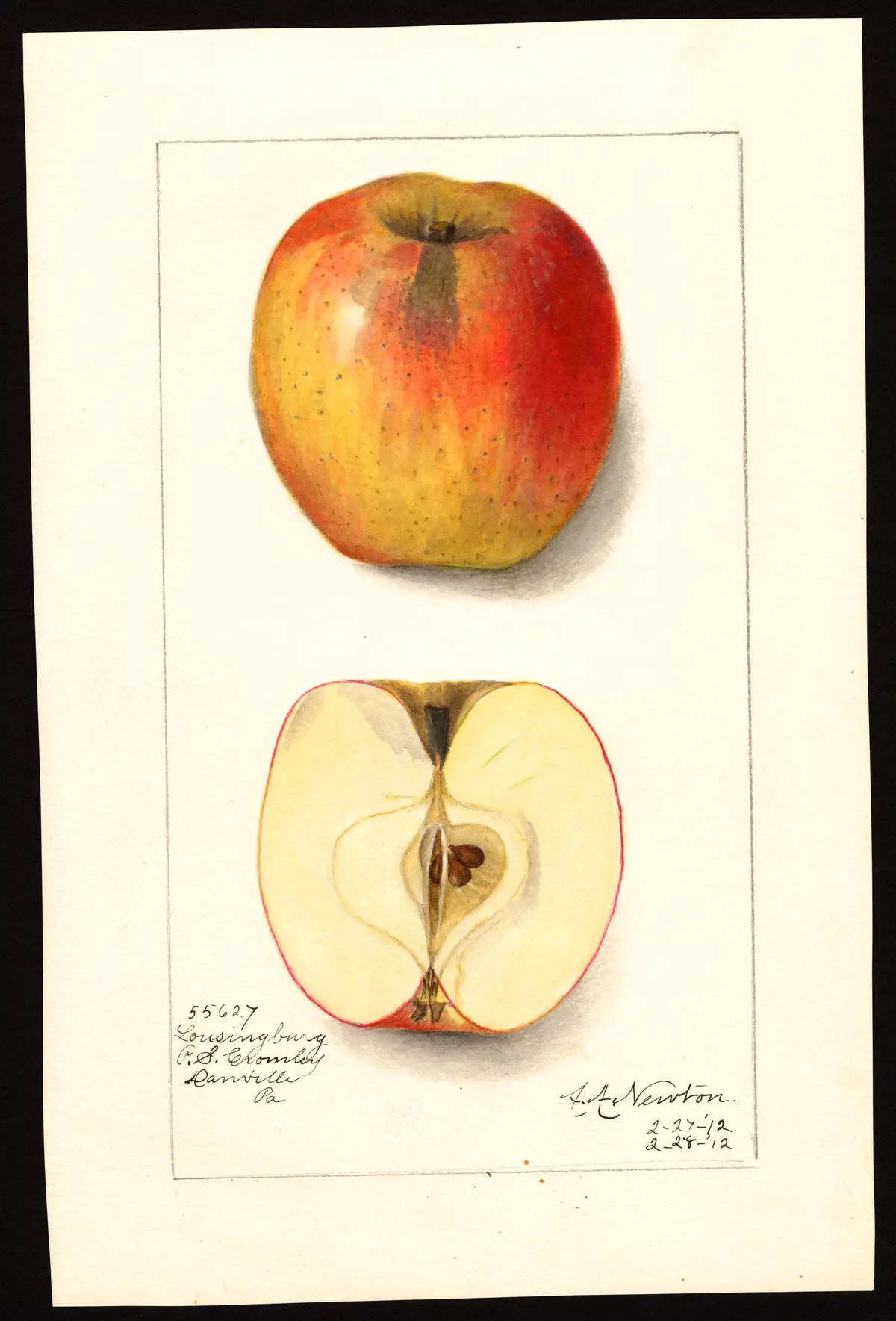
USDA Pomological Watercolor Collection
Origin & History
An old variety of unknown origin, first brought to notice in Ohio. It had been common about Cincinnati and along the Ohio River for many years by the time Warder described it in 1867. Grown to some extent in the Middle West as a late-keeping apple (Beach). It is sometimes called Rock or Red Rock in New York (Beach). Beach notes it was but little known in New York and not recommended for planting in that state.
Tree
Tree vigorous or moderately vigorous, upright. Downing describes the form as upright, spreading, and moderately productive. Warder characterizes it as "brushy and thorny, looking like a wilding," which Beach quotes. Twigs medium or below, rather stout, nearly straight; internodes short (Beach). Bark dull brownish-red overlaid with thick scarfskin, giving a grayish-brown effect, slightly pubescent (Beach). Lenticels rather numerous but not conspicuous, small to medium, the larger ones roundish (Beach). Buds medium, acute, somewhat pubescent, appressed (Beach).
Fruit
Size
Medium (Warder, Thomas) or medium or above (Beach).
Form
Roundish oblate, sometimes a little inclined to conic, obscurely ribbed, nearly symmetrical, often sides unequal, pretty uniform in shape (Beach). Warder describes it as conical, angular, oblique, often unequal. Thomas describes it as roundish conic.
Stem
Medium to short (Beach). Short (Warder).
Cavity
Acute, deep, broad, symmetrical or slightly furrowed, or sometimes compressed, russeted (Beach). Warder describes it as acute, irregular, rough with brown.
Calyx
Medium, open; lobes short, broad, obtuse (Beach). Warder describes the eye as small, closed.
Basin
Shallow to medium in depth, medium to wide, obtuse to somewhat abrupt, furrowed and wrinkled (Beach). Warder describes the basin as deep, plaited or folded.
Skin
Thick, very tough, slightly rough, rather dulled with faint bloom (Beach). Surface smooth (Warder). Yellow or greenish, deeply blushed or mottled with red, striped and splashed with dark carmine (Beach). Warder describes the color as green and yellow, bronzed and blushed, becoming very rich yellow and carmine, with an indistinct gray-striping that makes the ripe fruit appear to be striped yellow. Thomas describes it as yellow with a handsome red cheek. Downing's truncated entry reads "yellow, largely overspread with gray-" before cutting off. Prevailing effect red or striped red (Beach). Dots often areolar, green or yellow with gray or russet center, rather conspicuous (Beach). Warder describes dots as minute, indented, gray, with green bases.
Flesh & Flavor
Tinged with green or yellow, very firm, rather coarse, breaking, moderately tender, rather dry, mild subacid, becoming somewhat sweet, fair to good (Beach). Warder describes the flesh as firm, compact, with flavor "mild sub-acid, negative" and quality "scarcely good." Thomas describes it as firm, sub-acid, moderately rich. Beach summarizes from earlier references that it is "coarse in texture, sweetish in flavor and not good in quality."
Core & Seeds
Core medium to small, closed; core lines somewhat clasping. Carpels round approaching round cordate, emarginate, mucronate, slightly tufted. Seeds rather large, wide, flat, obtuse, slightly tufted (Beach). Warder describes the core as small, oval, closed, with seeds numerous and large.
Calyx Tube
Long, cone-shape or funnel-form with wide limb (Beach).
Season
December to May or June (Beach). Warder specifies it is suitable for the kitchen all winter, and "ornamental and eatable March to May, or later." Thomas says it keeps through spring.
Uses
Suitable for culinary use and for market (Beach). Warder lists use as market, ornamental, and cooking.
Subtypes & Variants
Not described in source.
Other
The Encyclopedia of Practical Horticulture (1914) lists this variety in a coded characteristic table:
Description absent; variety present in variety-characteristic table.
Lansingburg............................. M rfl r G m W
Book Sources
Described in 5 period pomological works
Nursery Catalog Sources
Found in 2 catalogs (1894–1901) from Missouri
- The Vineland Nurseries (Kelsey & Co. , Proprietors), St. Joseph, Missouri (Office: 13th and Atchison Sts., 2 Blocks East of the Citizens St. Car Line) — 1894
- Mountain Grove Nurseries (Tippin & Moore , Proprietors; Geo. T. Tippin, J. W. Tippin, J. C. Moore), Mountain Grove , Missouri — 1901
View original book sources (5)
— John A. Warder, American Pomology: Apples (1867)Lansingburgh.
The origin of this long-keeper has not been traced. It has been common about Cincinnati, and along the Ohio River, for many years.
Tree upright, vigorous, brushy and thorny, looking like a wilding.
Fruit medium, conical, angular, oblique, often unequal; Surface smooth, green and yellow, bronzed and blushed, becoming very rich yellow and carmine — an indistinct gray-striping makes the ripe fruit appear to be striped yellow; Dots minute, indented, gray, with green bases.
Basin deep, plaited or folded; Eye small, closed.
Cavity acute, irregular, rough with brown; Stem short.
Core small, oval, closed; Seeds numerous, large; Flesh firm, compact; Flavor mild sub-acid, negative; Quality scarcely good; Use, market, ornamental, cooking; Season in the kitchen all winter — ornamental and eatable March to May, or later.
— A.J. Downing, The Fruits and Fruit Trees of America (1900)Lansingburgh.
Origin unknown. Tree upright, spreading, vigorous, moderately productive.
Fruit medium, roundish oblate, yellow, largely overspread with gray-
— S.A. Beach, The Apples of New York, Vol. 1 (1905)LANSINGBURG.
REFERENCES. 1. Hooper, 1857:53. 2. Warder, 1867:540. 3. Downing, 1869:249. 4. Am. Pom. Soc. Cat., 1875:10. 5. Thomas, 1885:515. 6. Bailey, An. Hort., 1892:243. 7. Van Deman, Rural N. Y., 58:382. 1899. 8. Budd-Hansen, 1903:113. 9. Ragan, U. S. B. P. I. Bul. 56:173. 1905.
SYNONYMS. LANSINBURG (1). LANSINGBURGH (2, 3). Lansingburgh (9). Lansingburg Pippin (9). Red Rock. Rock Apple (9).
A late-keeping apple which is grown to some extent in the Middle West (6). Warder speaks of it as an old variety common in Cincinnati and along the Ohio river. Suitable only for culinary use and for market. Color greenish becoming rich yellow with a striped appearance and blushed with carmine. It is coarse in texture, sweetish in flavor and not good in quality (1, 2, 7). It is sometimes called Rock or Red Rock in New York.
Historical. An old variety which appears to have been first brought to notice in Ohio (1, 2). It is but little known in New York and is not recommended for planting in this state.
TREE. Tree vigorous or moderately vigorous. Form upright, "brushy and thorny, looking like a wilding" (2). Twigs medium or below, rather stout, nearly straight; internodes short. Bark dull brownish-red overlaid with thick scarfskin, giving a grayish-brown effect, slightly pubescent. Lenticels rather numerous but not conspicuous, small to medium, the larger ones roundish. Buds medium, acute, somewhat pubescent, appressed.
FRUIT. Fruit medium or above. Form roundish oblate sometimes a little inclined to conic, obscurely ribbed, nearly symmetrical, often sides unequal, pretty uniform in shape. Stem medium to short. Cavity acute, deep, broad, symmetrical or slightly furrowed, or sometimes compressed, russeted. Calyx medium, open; lobes short, broad, obtuse. Basin shallow to medium in depth, medium to wide, obtuse to somewhat abrupt, furrowed and wrinkled. Skin thick, very tough, slightly rough, rather dulled with faint bloom, yellow or greenish deeply blushed or mottled with red, striped and splashed with dark carmine. Dots often areolar, green or yellow with gray or russet center, rather conspicuous. Prevailing effect red or striped red. Calyx tube long, cone-shape or funnel-form with wide limb. Core medium to small, closed; core lines somewhat clasping. Carpels round approaching round cordate, emarginate, mucronate, slightly tufted. Seeds rather large, wide, flat, obtuse, slightly tufted. Flesh tinged with green or yellow, very firm, rather coarse, breaking, moderately tender, rather dry, mild subacid, becoming somewhat sweet, fair to good. Season December to May or June.
— Granville Lowther (ed.), Encyclopedia of Practical Horticulture (1914)Lansingburg............................. M rfl r G m W
— John J. Thomas, The American Fruit Culturist (1903)Lansingburg. Medium, roundish conic; yellow, with a handsome red cheek; flesh firm, sub-acid, moderately rich—keeps through spring. Ohio. New.