Decarie
Apple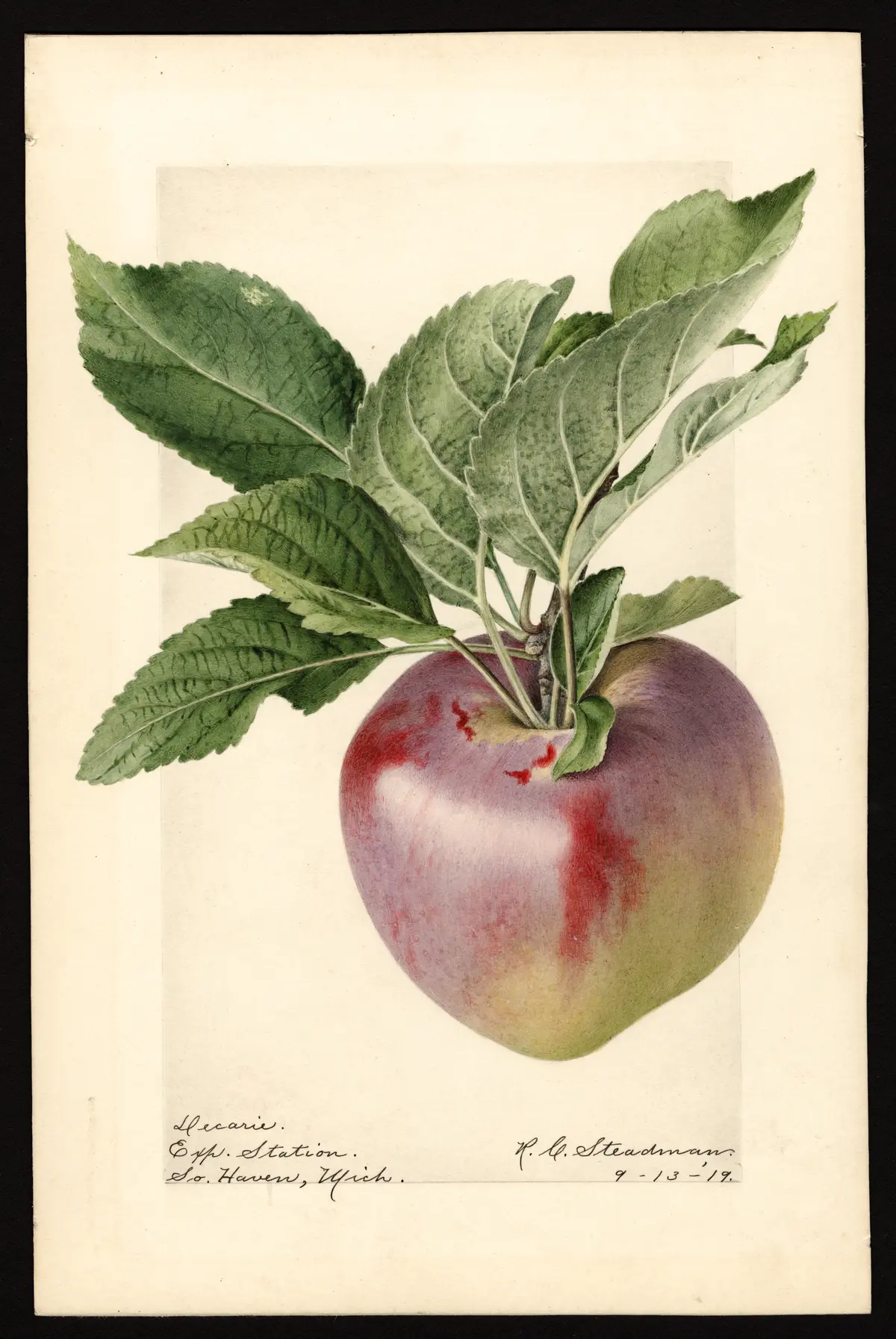
USDA Pomological Watercolor Collection
Origin/History
Originated in the orchard of Jeremie Decarie, in Coteau, St. Pierre, Province of Quebec. More than one hundred years old. A very handsome and very good apple.
Tree
Hardy, vigorous, and healthy. Forms an erect head which spreads out gradually. Bears heavy and light crops alternately.
Fruit
Size: Medium, or nearly so.
Form: Oblate, slightly conical, flattened at the base.
Skin: White, nearly covered with light and dark rich red, dark crimson in the sun. Moderately sprinkled with light and brown dots. Covered with a thin grayish bloom.
Stem: Short, rather stout.
Cavity: Large, deep, slightly russeted.
Calyx: Closed.
Basin: Round, deep, slightly corrugated.
Flesh/Flavor: Quite white, often stained next the skin and sometimes in the flesh. Fine, tender, juicy, sprightly subacid, having a slight peculiar, quince-like, agreeable flavor.
Core: Small.
Season
September, October.
Uses
Not described in source.
Subtypes/Variants
Not described in source.
Other
Downing notes that some believed this variety to be the same as the Red Autumn Calville, but he believed it to be distinct.
Book Sources
Described in 1 period pomological work
Nursery Catalog Sources
Found in 2 catalogs (1901–1913) from Illinois
- Benjamin Buckman (personal inventory) , Farmingdale , Illinois — 1901
- Benjamin Buckman (personal inventory) , Farmingdale , Illinois — 1913
View original book sources (1)
— A.J. Downing, The Fruits and Fruit Trees of America (1900)Decarie.
A very handsome and very good apple, said to have originated in the orchard of Jeremie Decarie, in Coteau, St. Pierre, Province of Quebec, and is more than one hundred years old. Tree hardy, vigorous, healthy, forming an erect head, which spreads out gradually, and bears heavy and light crops alternately; it is thought by some to be the same as the Red Autumn Calville, but I believe it to be distinct.
Fruit medium, or nearly so, oblate, slightly conical, flattened at the base; skin white, nearly covered with light and dark rich red, dark crimson in the sun, moderately sprinkled with light and brown dots, and covered with a thin grayish bloom; stalk short, rather stout; cavity large, deep, slightly russeted; calyx closed; basin round, deep, slightly corrugated; flesh quite white, often stained next the skin, and sometimes in the flesh, fine, tender, juicy, sprightly subacid, having a slight peculiar, quince-like, agreeable flavor; core small. September, October.