Mangum
Apple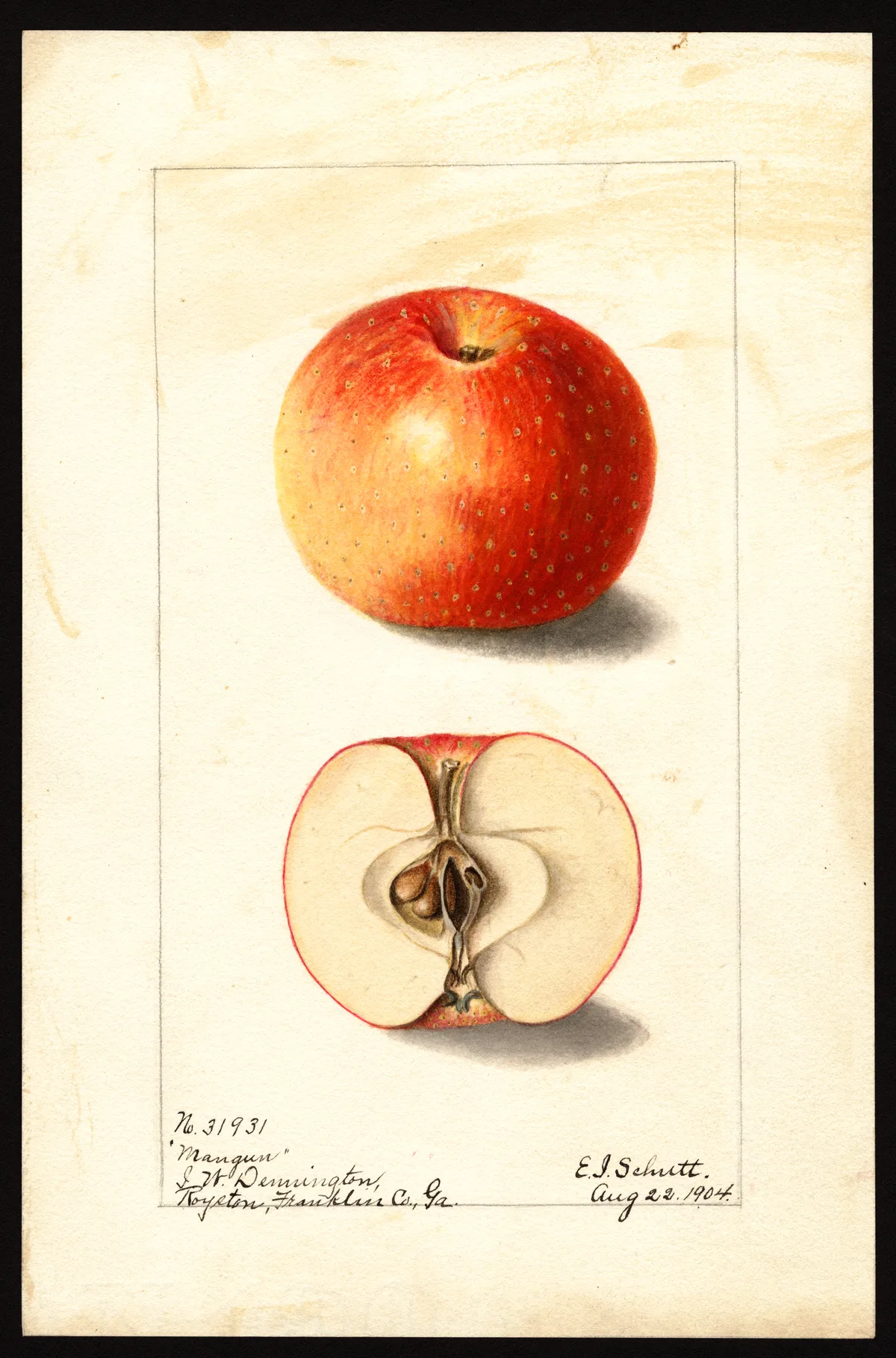
USDA Pomological Watercolor Collection
Mangum
Origin / History
A Southern variety of uncertain origin, associated with Georgia (Elliott) and Alabama (Thomas, Budd & Hansen). Downing notes it is "extensively cultivated in the South, where it is counted as one of the most desirable and reliable apples." Budd & Hansen echo that it is "extensively cultivated and highly prized in the South." Warder calls it "a first rate southern fruit... highly prized in Georgia and the South."
Warder's separate "Patton" entry preserves related historical context: specimens received from Dr. Jas. S. Blair of Limestone County, North Alabama, were described under the name Patton (given "because of the other Carters"), with the note that this fruit was equated with Carter of Alabama, Mangum, and the Alabama Pearmain of Peters.
Tree
A good, fair grower (Downing); thrifty (Warder, Thomas, Budd & Hansen); very productive (Warder, Downing, Thomas, Budd & Hansen). Young shoots grayish brown (Downing).
Fruit
Size: Medium (Elliott, Warder, Downing, Thomas, Budd & Hansen, Lowther). Thomas's separate "Carter" (Mangum) entry gives "medium to large." Warder's Patton entry (identified with Mangum) gives "large."
Form: Roundish, conical (Elliott); oblate, slightly conic, angular (Warder); oblate, slightly conic (Downing, Budd & Hansen); oblate, slightly conic, ribbed (Thomas); roundish oblate (Lowther). Warder's Patton entry: "roundish, somewhat flattened." Thomas's Carter entry: "roundish-ovate."
Stem / Stalk: Short and small (Elliott, Warder, Downing); small, set in a broad russeted cavity (Thomas); slender, short (Budd & Hansen). Warder's Patton entry describes the stem as "long to medium, inclined, red." Thomas's Carter entry gives "rather short."
Cavity: Broad, often russeted (Elliott); broad, surrounded by russet (Warder, Downing); broad, russeted (Thomas, Budd & Hansen). Warder's Patton entry: "deep, acute." Thomas's Carter entry: "deep."
Calyx / Eye: Closed (Elliott); partially closed (Warder, Downing); half open (Budd & Hansen). Warder's Patton entry: "eye medium, open." Thomas's Carter entry: "calyx large, open."
Basin: Medium (Elliott); slightly corrugated (Warder, Downing, Budd & Hansen); lightly furrowed (Thomas). Warder's Patton entry: "deep, abrupt, folded." Thomas's Carter entry: "wide, deep, somewhat furrowed."
Skin / Surface: Yellowish, striped and shaded with red, with whitish brown dots (Elliott). Yellowish, striped and mostly shaded with red, thickly sprinkled with whitish and bronze dots (Warder, Downing). Shaded and striped with red on yellow with numerous dots (Thomas). Surface yellowish, striped and mostly shaded with red; dots numerous, whitish and bronze (Budd & Hansen). Warder's Patton entry: "Surface smooth, mixed, marbled and splashed carmine on yellow; Dots scattered, distinct, yellow." Thomas's Carter entry: "red on orange yellow." Lowther codes the skin color as "ar."
Flesh / Flavor: Yellow, tender, juicy, mild sub-acid, excellent (Elliott). Yellow, very tender, juicy, mild sub-acid, excellent (Warder). Yellow, very tender, juicy, mild subacid, "very good to best" (Downing, Budd & Hansen). Yellow, very tender, with a mild sub-acid excellent flavor (Thomas). Warder's Patton entry: "Flesh yellow, firm, breaking, juicy; Flavor acid, agreeable; Quality good." Thomas's Carter entry: "flesh tender, mild, pleasant." Lowther rates quality "very good."
Core / Seeds: Core small (Elliott). Warder's Patton entry: "Core small, regular, closed, half clasping; Seeds plump and imperfect."
Season
October and November (Elliott, Warder, Downing, Budd & Hansen). Elliott adds that it is "Valued South as keeping until March." Warder's Patton entry gives "November to January." Thomas's Carter entry gives "October to January." Lowther classes the season as "winter."
Uses
Both kitchen and market (Lowther). Elliott notes its value in the South as a long-keeping apple (until March).
Subtypes / Variants
Not described in source. (The various names attached historically to this fruit — including Carter of Alabama and Alabama Pearmain of Peters — are treated as synonyms rather than distinct subtypes; Downing carries "Alabama Pearmain?" with a question mark.)
Other
Lowther reports the variety from 1 station in the Northern Division, with the asterisk indicating that it is also reported in another division.
Elliott (in his separate "Carter" entry, cross-referenced as a possible synonym) describes that fruit as "Royal Pippin, Southern. Fruit, above medium, roundish, yellow and red; flesh, tender, mild, pleasant; almost 'very good.' October to January."
Warder concludes his entry with the note (attributed to C. Downing): "Carter of Alabama may prove the same."
Book Sources
Described in 6 period pomological works
- Downing, Fruits and Fruit Trees of America (1900)
- Warder, American Pomology: Apples (1867)
- Budd & Hansen, Systematic Pomology (1914) — listed as Mangum (Gulley)
- Elliott, The Western Fruit Book (1865)
- Lowther (ed.), Encyclopedia of Practical Horticulture (1914)
- Thomas, The American Fruit Culturist (1903)
Nursery Catalog Sources
Found in 2 catalogs (1901–1913) from Arkansas, Illinois
- Yarbrough Bros. , Stephens , Arkansas — 1901
- Benjamin Buckman (personal inventory) , Farmingdale , Illinois — 1913
View original book sources (6)
— F.R. Elliott, The Western Fruit Book (1865)Mangum. Seago. | Maxfield.
From Georgia. Fruit, medium, roundish, conical; yellowish, striped and shaded with red; whitish brown dots; stem, short, small; cavity, broad, often russeted; calyx, closed; basin, medium; core, small; flesh, yellow, tender, juicy, mild sub-acid, excellent. October and November. Valued South as keeping until March.
[Additional entry in this volume: "Carter", pp. 135–135]
Carter. Royal Pippin, Southern. Fruit, above medium, roundish, yellow and red ; flesh, tender, mild, pleasant ; almost " very good." October to January.
— John A. Warder, American Pomology: Apples (1867)Mangum.
A first rate southern fruit. Tree thrifty, and very productive.
Fruit medium, oblate, slightly conic, angular; skin yellowish, striped and mostly shaded with red, thickly sprinkled with whitish and bronze dots; Stem short and small, inserted in a broad cavity surrounded by russet; Calyx partially closed; Basin slightly corrugated; Flesh yellow, very tender, juicy, mild sub acid, excellent, highly prized in Georgia and the South; October and November. Carter of Alabama may prove the same.”—[C. Downing.]
[Additional entry in this volume: "Patton", pp. 611–611]
Patton.
CARTER of Alabama— MANGUM— ALABAMA PEARMAIN of Peters.
This is a great favorite in the South, and deservedly so, on account of its good qualities. Specimens from Dr. Jas. S. Blair, Limestone County, North Alabama, afford me data for the following description. I have preferred the name Patton because of the other Carters:
Fruit large, roundish, somewhat flattened; Surface smooth, mixed, marbled and splashed carmine on yellow; Dots scattered, distinct, yellow.
Basin deep, abrupt, folded; Eye medium, open.
Cavity deep, acute; Stem long to medium, inclined, red.
Core small, regular, closed, half clasping; Seeds plump and imperfect; Flesh yellow, firm, breaking, juicy; Flavor acid, agreeable; Quality good; Season, November to January.
— A.J. Downing, The Fruits and Fruit Trees of America (1900)Mangum.
Fall Cheese of Va. Cheese. Seago. Gully. Carter of Ala. Maxfield. Carter's Winter. Patton. Johnston's Favorite. Alabama Pearmain? Sam Wingard. Blakely.
A Southern variety of uncertain origin. It is extensively cultivated in the South, where it is counted as one of the most desirable and reliable apples. Tree a good, fair grower, with young shoots of a grayish brown, very productive.
Fruit medium, oblate, slightly conic, yellowish, striped and mostly shaded with red, thickly sprinkled with whitish and bronze dots. Stalk short and small, inserted in a broad cavity surrounded by russet. Calyx partially closed. Basin slightly corrugated. Flesh yellow, very tender, juicy, mild subacid. Very good to best. October, November.
— John J. Thomas, The American Fruit Culturist (1903)Mangum. (Guiley.) Medium, oblate, slightly conic, ribbed; shaded and striped with red on yellow with numerous dots; stalk small, in a broad, russeted cavity; basins lightly furrowed; flesh yellow, very tender, with a mild sub-acid excellent flavor. A valuable Southern apple. Tree thrifty, productive. Alabama.
[Additional entry in this volume: "Carter", pp. 349–349]
Carter.* (Mangum.) Medium to large, roundish-ovate; red on orange yellow; stalk rather short, cavity deep, calyx large, open, in a wide, deep, somewhat furrowed basin; flesh tender, mild, pleasant. One of the best apples in the Southern States. Alabama.
— J.L. Budd & N.E. Hansen, American Horticultural Manual, Part II: Systematic Pomology (1914)Mangum (Gulley).—Origin, Alabama; extensively cultivated and highly prized in the South; tree thrifty, very productive.
Fruit medium, oblate, slightly conic; surface yellowish, striped, and mostly shaded with red; dots numerous, whitish and bronze; cavity broad, russeted; stem slender, short; basin slightly corrugated; calyx half open; flesh yellow, very tender, juicy, mild subacid, very good to best. October to November.
— Granville Lowther (ed.), Encyclopedia of Practical Horticulture (1914)Mangum is a medium-sized apple of roundish oblate form with skin color "ar". Quality is very good. Use is both kitchen and market. Season is winter. Reported by 1 station in the Northern Division; the asterisk indicates the variety is also reported in another division.