Smokehouse
Apple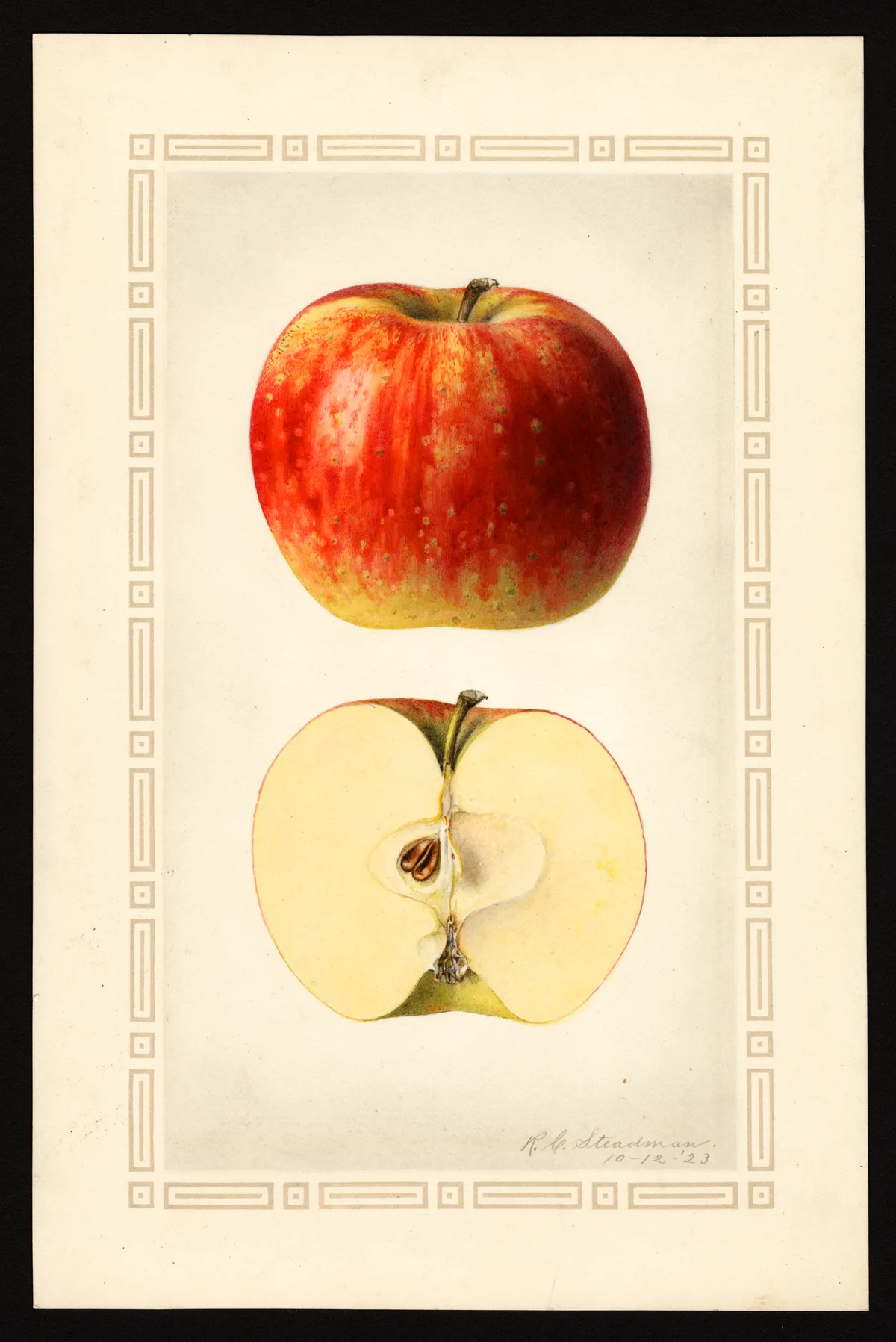
USDA Pomological Watercolor Collection
Smokehouse
Origin / History
Smokehouse originated on the farm of William Gibbons in Lampeter township, Lancaster County, Pennsylvania, near Millcreek. The variety took its name from the fact that the original tree grew near Gibbons's smokehouse. Thomas places the origin in Chester County, Pennsylvania, rather than Lancaster County. It is supposed to be a seedling of the old Pennsylvania (Delaware and Pennsylvania) Vandevere, which it much resembles — so closely, in fact, that Elliott (1854) fell into the error of calling it identical with Vandevere.
It is an old variety and was long popular in Pennsylvania. According to Beach, it was brought to notice about 1837 by Ashbridge, though it had long before been propagated in a nursery near the locality of its origin; Hedrick gives the date of first notice as 1848. Elliott (1865) records that it had then been in cultivation about twenty years. It has been grown more extensively in New Jersey and Pennsylvania than elsewhere; in New York it is cultivated to a limited extent but is not generally known among fruit growers there. Hedrick observes that although when its characters are set forth the variety seems almost perfect, it is nowhere very popular and is being less and less planted, probably because the apples lack high character in either flavor or appearance.
Lowther reports the variety from 1 station in the Northern Division, 12 stations in the Central Division, and 2 stations in the Southern Division, with the variety reported as adapted to more than one division.
Tree
Tree medium to large, moderately vigorous to vigorous (Downing and Budd-Hansen: "moderately vigorous"; Beach and Hedrick: "vigorous"; Elliott: "a free grower"; Central Experimental Farm: "a medium grower"). Healthy and hardy. Form roundish to wide-spreading, with a spreading head, dense; lateral branches willowy, slender. A good, reliable cropper, productive, alternating good with moderate crops; comes into bearing moderately young (Elliott: "bearing early and abundantly"). The fruit hangs well to the tree.
The tree tends to form a rather dense head and requires frequent pruning to keep the top sufficiently open to develop fruit of good color and good quality. It is somewhat subject to apple scab and requires thorough preventive treatment to insure clean fruit.
Twigs moderately long, straight, slender; internodes long. Young wood dull dark reddish brown. Bark reddish-brown mingled with olive-green, lightly streaked with scarf-skin, slightly pubescent. Lenticels very scattering, oblong, not raised. Buds set deeply in bark, medium in size, broad, flat, obtuse, appressed, pubescent.
Fruit
Size
Rather above medium to large; uniform in size and shape. Lowther: "large." Central Experimental Farm: "medium size." Thomas: "medium or rather large."
Form
Roundish oblate, or approaching oblate conic; regular, symmetrical or nearly so. Elliott calls it simply "flat"; Thomas, "oblate, regular"; Hedrick, "round-oblate or oblate-conic."
Stem / Stalk
Medium to long, slender, curved (Downing, Budd-Hansen: "rather long, curved"). Thomas gives the stalk as one inch long, slender. Elliott calls it "short, slender."
Cavity
Acute to acuminate, medium to rather deep, moderately narrow to rather wide; sometimes gently furrowed; often thinly russeted. Downing: "broad cavity." Budd-Hansen and Thomas: "wide, acute." Elliott: "narrow." Hedrick: "acute, deep, narrow, sometimes furrowed, often thinly russeted."
Calyx
Closed (Downing, Budd-Hansen, Elliott) or large and open or nearly so (Beach, Hedrick); lobes often flat, convergent, separated at the base. Calyx tube rather wide, short, obtusely cone-shape or approaching funnelform. Stamens median to basal (Hedrick: median).
Basin
Wide, moderately shallow to rather deep (Downing: "wide, of moderate depth"; Budd-Hansen: "wide, medium deep"; Beach: "moderately shallow to rather deep, rather wide"; Hedrick: "shallow, wide"; Elliott: "shallow"); sometimes compressed, somewhat abrupt, slightly wrinkled or corrugated. Thomas: "rather distinct."
Skin
Thin, tough, smooth or slightly roughened with capillary russet lines and russet dots. Ground color yellow or greenish yellow, shaded, mottled, and obscurely splashed with rather dull red and crimson, sometimes deepening to a solid bright red, indistinctly mottled, striped and splashed with carmine. Thomas notes "a slight greenish cast at the crown." Central Experimental Farm describes the skin as "greenish yellow, with a few splashes of red and many gray dots." Prevailing effect greenish-yellow, but in highly colored specimens, red.
Beach observes that the fruit is uniform in size, symmetrical and attractive in appearance when well colored, but too often its color lacks character, being neither distinctly yellow nor distinctly red.
Dots
Generally conspicuous, large, irregular, gray and brown or russet, becoming smaller and more numerous about the basin (Downing: "large gray and brown dots"; Budd-Hansen: "dots few, large, gray and brown"; Central Experimental Farm: "many gray dots").
Flesh / Flavor
Yellowish to slightly tinged with yellow, or yellowish white (Elliott, Thomas, Budd-Hansen); somewhat firm to rather firm, moderately fine, crisp, moderately tender, juicy. Flavor mild subacid, delicately aromatic, rich, with an agreeable but not high flavor; good. Downing calls it "rather rich subacid"; Budd-Hansen, "rich, juicy, crisp, aromatic subacid"; Thomas, "rich, aromatic, fine sub-acid flavor"; Elliott, "crisp, juicy, delicate, aroma agreeable"; Central Experimental Farm, "firm, moderately juicy, of a pleasant mild acid character"; Hedrick, "firm, fine, crisp, tender, juicy, mild subacid, delicately aromatic."
Beach characterizes it as a very pleasant flavored dessert apple but hardly acid enough for most culinary uses (this is in some tension with Downing, who values it for culinary uses).
Core / Seeds
Core rather small, axile or nearly so; cells symmetrical, closed or partly open; core lines meeting or, with funnel-form calyx tube, clasping. Carpels flat, broadly elliptical to roundish or somewhat cordate, usually smooth. Seeds few, very dark, large, narrow, long, acute to acuminate, sometimes tufted. Elliott: "core, medium; seeds, long, brown."
Season
Sources disagree on the exact range but place the variety from autumn through late winter:
- Downing and Budd-Hansen: September to February.
- Beach: October to February or March.
- Hedrick: October to March.
- Elliott: October, November.
- Thomas: mid-autumn to winter.
- Central Experimental Farm: January and February.
- Lowther: winter.
Uses
Both kitchen and market (Lowther). Downing valued it for culinary uses. Beach considered it a very pleasant flavored dessert apple but hardly acid enough for most culinary uses. Some fruit growers regard it with favor as a commercial variety on account of its being reliably productive and yielding a very good grade of smooth fruit; but Beach notes it is not grown extensively in any part of New York, and its cultivation is not being extended.
Subtypes / Variants
Not described in source.
Other
Thomas notes the variety succeeds in the Middle States. Beach gives a quality rating of "good"; Lowther and Hedrick concur.
Book Sources
Described in 7 period pomological works
- Beach, The Apples of New York Vol. 1 (1905)
- Budd & Hansen, Systematic Pomology (1914)
- Downing, Fruits and Fruit Trees of America (1900)
- Elliott, The Western Fruit Book (1865)
- Lowther (ed.), Encyclopedia of Practical Horticulture (1914)
- Hedrick, Cyclopedia of Hardy Fruits (1922)
- Thomas, The American Fruit Culturist (1903)
Nursery Catalog Sources
Found in 21 catalogs (1890–1918) from Arkansas, Illinois, Maryland, Massachusetts, Missouri, New Jersey, Pennsylvania, Virginia, Washington
- William H. Moon Co. , Morrisville, Bucks County , Pennsylvania — 1890 — listed as Smoke House
- Rogers Nursery Co. , Moorestown , New Jersey — 1893 — listed as Smoke House
- The Vineland Nurseries (Kelsey & Co. , Proprietors), St. Joseph, Missouri (Office: 13th and Atchison Sts., 2 Blocks East of the Citizens St. Car Line) — 1894
- Stark Bros. Nurseries & Orchards Co. , Louisiana , Missouri — 1896
- The Salem Nursery (John A. Francis , Proprietor), Salem , Virginia — 1897
- Arthur J. Collins & Sons , Moorestown , New Jersey — 1898 — listed as Smoke House
- Reading Nursery , Jacob W. Manning, Proprietor, Reading , Massachusetts — 1898 — listed as Smoke House
- Stark Bros. Nurseries & Orchards Co. , Louisiana , Missouri — 1898
- Brown Brothers Co. , Continental Nurseries, Rochester, NY (also operated from Toronto, Canada) — 1899 — listed as Smoke House
- Central Experimental Farm , Dominion Department of Agriculture, Agassiz, British Columbia (under test; Bulletin No. 3, Second Series) — 1900 — listed as Smoke House
- Brown Brothers Co. , Continental Nurseries, Rochester, NY (also operated from Toronto, Canada) — 1901 — listed as Smoke House
- Benjamin Buckman (personal inventory) , Farmingdale , Illinois — 1901 — listed as Smoke House
- Yarbrough Bros. , Stephens , Arkansas — 1901
- Phoenix Nursery Company (W. E. Rossney , President; Sidney Tuttle, Vice-President), Bloomington , Illinois — 1904
- Wm. J. Corse (successor to Robert Sinclair / Sinclair Nurseries) , Baltimore , Maryland — 1909 — listed as Smoke House
- Stark Bros. Nurseries & Orchards Co. , Louisiana , Missouri — 1910
- Stark Bros. Nurseries & Orchards Co. , Louisiana , Missouri — 1911
- Ballygreen Nurseries , Hanford , Washington — 1912
- Vineland Nurseries Company , Clarkston , Washington — 1912
- Benjamin Buckman (personal inventory) , Farmingdale , Illinois — 1913 — listed as Smoke House
- Stark Bros. Nurseries & Orchards Co. , Louisiana , Missouri — 1918
View original book sources (8)
— A.J. Downing, The Fruits and Fruit Trees of America (1900)Millcreek Vandevere.
Smokehouse. Red Vandevere. English Vandevere.
Origin, Lancaster Co., Pa., near Millcreek, grew on the farm of Gibbons, near his smokehouse, hence its name. An old variety and popular in Pennsylvania. It somewhat resembles the old Pennsylvania Vandevere, and is supposed to be a seedling of it.
Tree moderately vigorous, with a spreading head, a good bearer. Young wood dull dark reddish brown.
Fruit rather above medium, roundish oblate, skin yellow, shaded and splashed with crimson, and thinly sprinkled with large gray and brown dots. Stalk rather long, curved, inserted in a broad cavity. Calyx closed, set in a wide basin, of moderate depth, slightly corrugated. Flesh yellowish, somewhat firm, juicy, crisp, rather rich subacid. Good. September to February. Valued for culinary uses.
— S.A. Beach, The Apples of New York, Vol. 1 (1905)SMOKEHOUSE.
REFERENCES. 1. Horticulturist, 2:482, 570. 1848. 2. Brinckle, Ib., 3:333. 1849. fig. 3. Thomas, 1849:152. 4. Horticulturist, 4:340, 414. 1850. 5. Am. Pom. Soc. Cat., 1852. 6. Horticulturist, 7:475. 1852. 7. Mag. Hort., 19:68. 1853. 8. Hovey, Ib., 22:558. 1856. fig. 9. Horticulturist, 11:289. 1856. 10. Downing, 1857:104. 11. Hooper, 1857:85. 12. Hoffy, N. A. Pom., 1860. col. pl. 13. Horticulturist, 15:184. 1860. 14. Warder, 1867:732. 15. Fitz, 1872:143, 153. 16. Leroy, 1873:815. figs. 17. Barry, 1883:355. 18. Wickson, 1889:244. 19. Lyon, Mich. Hort. Soc. Rpt., 1890:296. 20. Bailey, An. Hort., 1892:249. 21. Hicks, Rural N. Y., 53:205. 1894. 22. Alwood, Va. Sta. Bul., 130:6. 1901. 23. Dickens and Greene, Kan. Sta. Bul., 106:55. 1902. 24. Bruner, N. C. Sta. Bul., 182:22. 1903. 25. Budd-Hansen, 1903:177. fig.
SYNONYMS. English Vandevere (10). GIBBONS SMOKEHOUSE (1). Millcreek Vandevere (4, 9, 10, 16). Red Vandevere (16). SMOKE HOUSE (1, 2). Vandevere (12). Vandevere English (16).
Fruit uniform in size, symmetrical and attractive in appearance when well colored; but too often its color lacks character, being neither distinctly yellow nor distinctly red. It is a very pleasant flavored dessert apple but hardly acid enough for most culinary uses. The tree is a good, vigorous grower, healthy, hardy and usually a reliable cropper, alternating good with moderate crops. It comes into bearing moderately young. The fruit hangs well to the tree. It is somewhat subject to apple scab and requires thorough preventive treatment to insure clean fruit. The tree tends to form a rather dense head and requires frequent pruning to keep the top sufficiently open to develop fruit of good color and good quality. Some fruit growers regard it with favor as a commercial variety on account of its being reliably productive and yielding a very good grade of smooth fruit; but it is not grown extensively in any part of the state, and, so far as we can learn, its cultivation is not being extended.
Historical. Originated with William Gibbons, Lampeter township, Lancaster county, Pa. (2, 12). It took its name from the fact that the original tree grew near his smokehouse. It was brought to notice about 1837 by Ashbridge though it had long before been propagated in a nursery near the locality of its origin. It is supposed to be a seedling of the old Vandevere of Delaware and Pennsylvania as it much resembles that variety; in fact Elliott fell into the error of calling it identical with Vandevere.¹ It has been grown more extensively in New Jersey and Pennsylvania than it has in this state. It is cultivated to a limited extent in many portions of New York but is not generally known among New York fruit growers.
TREE.
Tree medium to large, vigorous. Form roundish to wide-spreading, dense; lateral branches willowy, slender. Twigs moderately long, straight, slender; internodes long. Bark reddish-brown mingled with olive-green, lightly streaked with scarf-skin, slightly pubescent. Lenticels very scattering, oblong, not raised. Buds set deeply in bark, medium in size, broad, flat, obtuse, appressed, pubescent.
FRUIT.
Fruit above medium to large, uniform in size and shape. Form roundish oblate or approaching oblate conic, rather regular, symmetrical or nearly so. Stem medium to long, slender. Cavity acute to acuminate, medium to rather deep, moderately narrow to rather wide, sometimes gently furrowed, often thinly russeted. Calyx large, open or nearly so; lobes often flat, convergent, separated at the base. Basin moderately shallow to rather deep, rather wide, sometimes compressed, somewhat abrupt, slightly wrinkled.
¹ Elliott, 1854:113.
Skin thin, tough, smooth or slightly roughened with capillary russet lines and russet dots; color yellow or greenish mottled with rather dull red, sometimes deepening to a solid bright red, indistinctly mottled, striped and splashed with carmine. Dots generally conspicuous, large, irregular, gray or russet, becoming smaller and more numerous about the basin. Prevailing effect greenish-yellow, but in highly colored specimens, red.
Calyx tube rather wide, short, obtusely cone-shape or approaching funnelform. Stamens median to basal.
Core rather small, axile or nearly so; cells symmetrical, closed or partly open; core lines meeting or with funnel-form calyx tube, clasping. Carpels flat, broadly elliptical to roundish or somewhat cordate, usually smooth. Seeds few, very dark, large, narrow, long, acute to acuminate, sometimes tufted.
Flesh slightly tinged with yellow, rather firm, moderately fine, crisp, moderately tender, juicy, mild subacid, delicately aromatic, with an agreeable but not high flavor, good.
Season October to February or March.
— Granville Lowther (ed.), Encyclopedia of Practical Horticulture (1914)Smokehouse: size large; form roundish oblate; color yf; quality good; use both kitchen and market; season winter. Reported by 1 station in the Northern Division, 12 stations in the Central Division, and 2 stations in the Southern Division; the asterisk on all three division counts indicates the variety is reported as adapted to more than one division.
— F.R. Elliott, The Western Fruit Book (1865)Gibbon's Smathhouse, Gibbon's Smokehouse, Smathhouse, Millcreek Vandervere, English Vandervere, Millcreek.
Origin, Lancaster Co., Pa. Has been in cultivation about twenty years. Tree, a free grower, bearing early and abundantly. Fruit, above medium ; flat ; red, striped and mottled on greenish yellow ; stem, short, slender ; cavity, narrow ; calyx, closed ; basin, shallow ; core, medium ; seeds, long, brown ; flesh, yellowish white, crisp, juicy, delicate, aroma agreeable October, November.
— Central Experimental Farm, Central Experimental Farm, Agassiz BC — Catalogue of Fruit Trees under Test (Bulletin No. 3, 1900) (1900)Planted Spring 1894. Tree a medium grower. Fruit of medium size, roundish, oblate. Skin greenish yellow, with a few splashes of red and many gray dots. Flesh yellowish, firm, moderately juicy, of a pleasant mild acid character, quality good. Season January and February.
— John J. Thomas, The American Fruit Culturist (1903)Smokehouse.* Medium or rather large, oblate, regular; mottled, and indistinctly striped with red on yellow ground; a slight greenish cast at the crown; stalk one inch long, slender, cavity wide, acute; basin rather distinct; flesh yellowish white, rich, aromatic, fine sub-acid flavor. Mid-autumn to winter. Origin, Chester County, Pa. Succeeds in the Middle States.
— J.L. Budd & N.E. Hansen, American Horticultural Manual, Part II: Systematic Pomology (1914)Smokehouse.—Origin, Pennsylvania; tree of moderately vigorous spreading growth, productive.
Smokehouse.
Fruit rather large, roundish oblate, regular; surface yellow, shaded, mottled, and obscurely splashed with red and crimson; dots few, large, gray and brown; cavity wide, acute; stem rather long, slender, curved; basin wide, medium deep, slightly corrugated; calyx closed; flesh yellowish white, firm, rich, juicy, crisp, aromatic subacid, good. September to February.
— U.P. Hedrick, Cyclopedia of Hardy Fruits (1922)SMOKEHOUSE. Fig. 51. English Vandevere. Red Vandevere. When the characters of Smokehouse are set forth, the variety seems almost perfect; yet it is nowhere very popular and it is being less and less planted. It is passing out, probably, because the apples lack high character in either flavor or appearance. The trees are vigorous, hardy, healthy, productive, come into bearing young, and hold their crop well. The variety originated on the farm of William Gibbons, Lancaster County, Pennsylvania, and was first brought to notice in 1848.
Tree medium to large, vigorous, wide-spreading, dense; lateral branches willowy, slender. Fruit medium to large, uniform in size and shape, round-oblate or oblate-conic, regular, symmetrical; stem medium to long, slender; cavity acute, deep, narrow, sometimes furrowed, often thinly russeted; calyx large, open; lobes often flat, convergent, separated at the base; basin shallow, wide, sometimes compressed, abrupt, wrinkled; skin thin, tough, smooth, or roughened with capillary russet lines and russet dots; color yellow mottled with dull red, sometimes deepening to a solid red, indistinctly mottled, striped and splashed with carmine; dots conspicuous, irregular, gray or russet, becoming smaller and more numerous about the basin; prevailing effect greenish-yellow, in highly-colored specimens red; calyx-tube wide, short, obtusely cone-shape; stamens median; core small, axile; cells symmetrical, closed or open; core-lines meeting; carpels flat, broadly elliptical to round or cordate, usually smooth; seeds few, very dark, large, narrow; flesh yellow, firm, fine, crisp, tender, juicy, mild subacid, delicately aromatic; good; October to March.