Press Ewing
Apple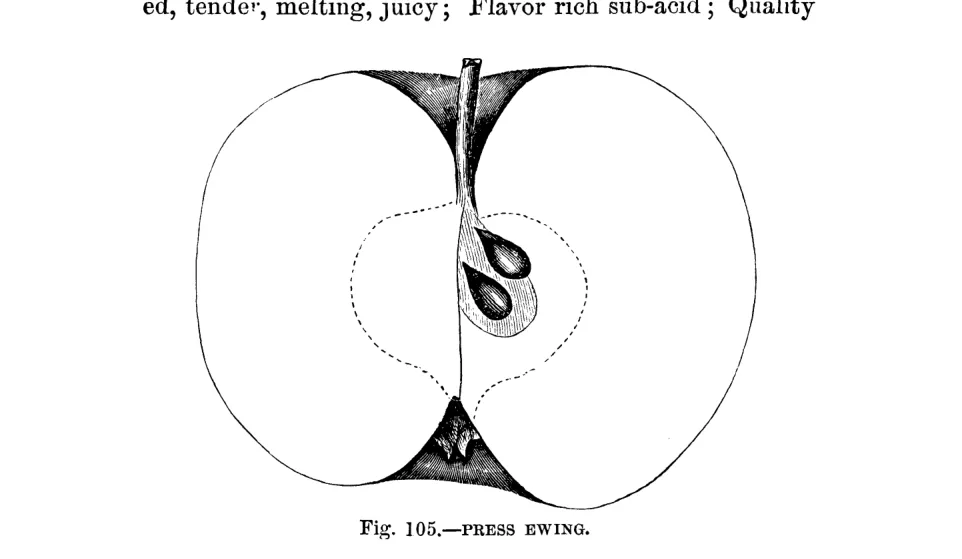
Press Ewing
Origin/History
Originated in Christian County, Kentucky, and introduced to notice by J. S. Downer. Warder notes that the apple was sent to him by Downer, from whom trees were also procured that had already borne fruit. The fruit bears a resemblance to the Smokehouse (Warder).
Tree
Hardy, vigorous, and productive. Described by Warder as healthy and early productive; by Downing as irregular and spreading, with dark brown young shoots. Elliott concurs: hardy, vigorous, and productive.
Fruit
Size and Form
Medium. Warder describes the form as roundish-oblate and regular. Downing gives oblate. Elliott offers the most detailed account: roundish, flattened at base and crown, angular, and slightly oblique.
Stem
Warder describes the stem as long and slender. Downing and Elliott both give it as medium in length.
Cavity
There is a conflict among sources on the character of the cavity. Warder describes it as wide, wavy, and brown. Downing describes it as broad and deep. Elliott, however, describes it as very deep and narrow — conflicting with both Warder and Downing on width.
Calyx and Basin
Warder describes the eye as medium and open, with the calyx reflexed, and the basin wide, wavy, regular, and rather deep. Downing and Elliott both describe the calyx as closed, set in an uneven, deep, abrupt basin; Elliott adds that the basin is peculiar in character. The calyx character — open with reflexed segments (Warder) versus closed (Downing, Elliott) — is a direct conflict between sources.
Skin
All three sources agree the ground color is yellow, thickly covered with dots having a dark center. Warder specifies the ground as greenish yellow (rather than pure yellow) and describes the overcolor as bright red, mixed, striped, and splashed. Downing describes the overcolor as shaded and obscurely splashed with crimson. Elliott describes it as shaded and striped with crimson. Warder specifies the dots as numerous, brown and yellow; Downing and Elliott note only that the dots are numerous and dark-centered. Warder notes the surface is smooth.
Flesh and Flavor
All sources agree the flesh is yellowish in color, juicy, and tender, with a subacid flavor. There is a textural conflict: Warder describes the flesh as fine-grained, tender, and melting; Downing and Elliott both describe it as firm and crisp — a character difficult to reconcile with Warder's "melting." Downing adds "mild" and rates quality as good to very good. Warder rates quality as nearly first rate. Elliott adds that the flavor is very agreeable and aromatic — the only source to note this quality.
Core and Seeds
Described only by Warder: core medium, closed, meeting the eye; axis short; seeds numerous, angular, and pointed.
Season
Sources conflict on season. Warder places the fruit in use for the table in December and January. Downing and Elliott both give February through April.
Uses
Table fruit (Warder). Implied dessert quality by all sources.
Subtypes/Variants
Not described in source.
Other
Not described in source.
Book Sources
Described in 3 period pomological works
View original book sources (3)
— John A. Warder, American Pomology: Apples (1867)Press Ewing.
This Kentucky apple was sent me by J. S. Downer, from whom trees were also procured which have already borne fruit.
Tree vigorous, healthy, and early productive.
Fruit resembles Smokehouse, medium, roundish-oblate, regular; Surface smooth, bright red, mixed, striped, and splashed, on greenish yellow; Dots numerous, brown and yellow.
Basin wide, wavy, regular, rather deep; Eye medium, open; calyx reflexed.
Cavity wide, wavy, brown; Stem long, slender.
Core medium, closed, meeting the eye; Axis short; Seeds numerous, angular, pointed; Flesh yellow, fine-grained, tender, melting, juicy; Flavor rich sub-acid; Quality nearly first rate; Use for table in December and January.
— A.J. Downing, The Fruits and Fruit Trees of America (1900)Press Ewing. Originated in Christian Co., Ky., and introduced to notice by J. S. Downer. Tree hardy, vigorous, irregular, spreading. Young shoots dark brown, productive. Fruit medium, oblate, yellow, shaded and obscurely splashed with crimson, and thickly covered with dots, having a dark centre. Stalk medium, inserted in a broad, deep cavity. Calyx closed, set in an uneven, deep, abrupt basin. Flesh yellowish, firm, juicy, crisp, tender, mild, agreeable subacid. Good to very good. February till April.
— F.R. Elliott, The Western Fruit Book (1865)Press Ewing.
Origin, Kentucky. Tree, hardy, vigorous, and productive. Fruit, medium, roundish, flattened at base and crown, angular, slightly oblique ; skin, yellow, shaded and striped with crimson, and thickly covered with dots, having a dark centre ; stalk, medium, inserted in a very deep, narrow cavity ; calyx, closed, set in an uneven, abrupt, peculiar basin; flesh, yellowish, firm, juicy, crisp, tender, with a very agreeable sub-acid flavor, aromatic. February till April. (Downing.)