Loddington
Apple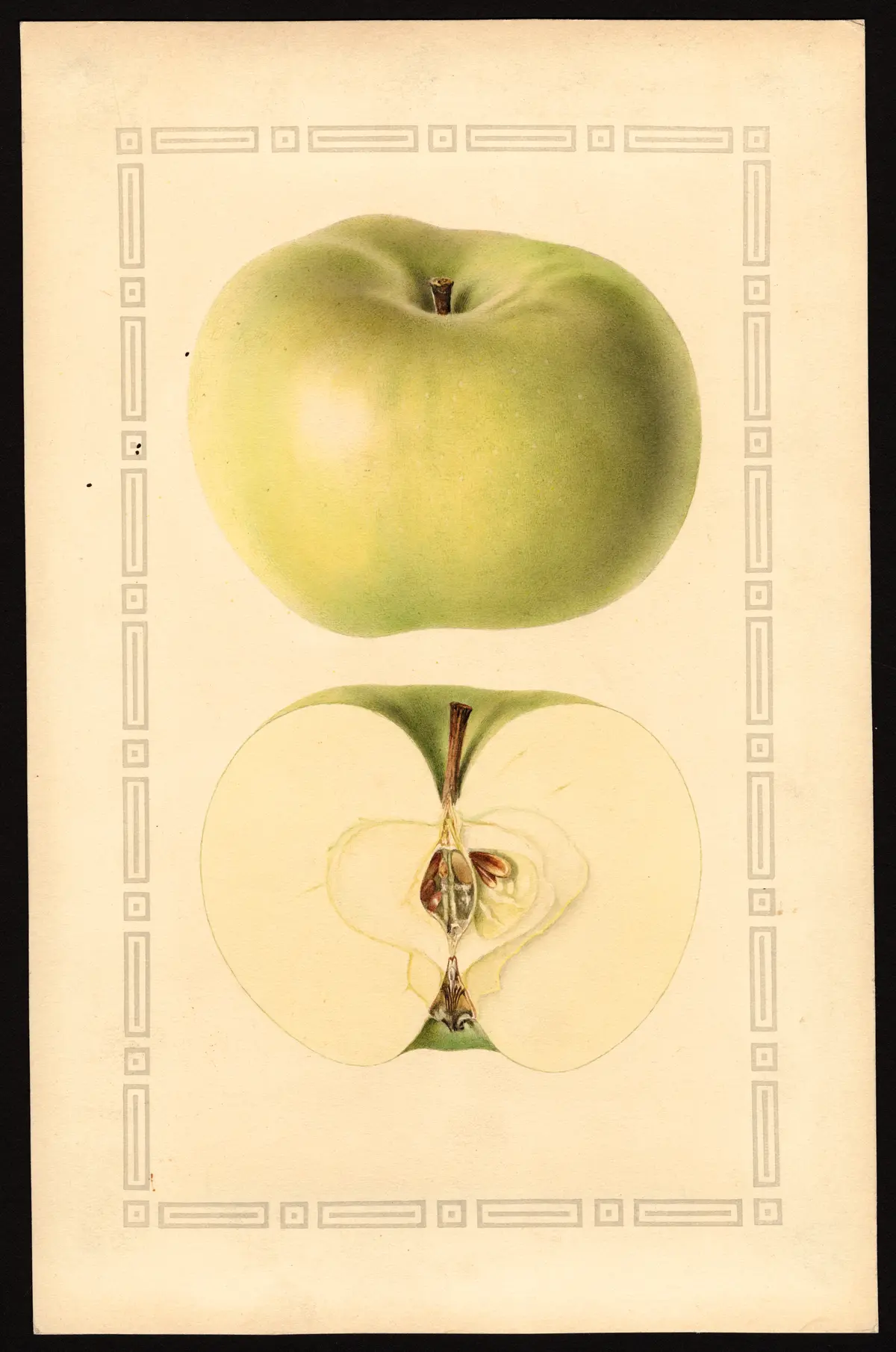
USDA Pomological Watercolor Collection
Loddington
Origin / History
Loddington takes its name from the village of Loddington, near Maidstone, Kent. The original tree grows on the farm of Mr. Stone at Loddington, and is stated to have been brought from a nursery garden at Bath roughly sixty years before 1885 by a niece of Mr. Robert Stone, who had accompanied her uncle there. Mr. Stone recognized its great merit and gave grafts to his neighbours, after which it spread through the orchards of the adjoining villages under the name Stone's Apple. In 1877 it was exhibited by Mr. Lewis A. Killick, of Langley, before the Fruit Committee of the Royal Horticultural Society and was awarded a first-class certificate. It is figured in the Florist and Pomologist, Plate 467, as Stone's Apple. By the time of the Herefordshire Pomona's account (1885), its cultivation was becoming more and more extended through the country. Bunyard (1920) notes it as a useful fruit but remarks it is rather apt to canker and by then little planted.
Tree
The sources offer partially conflicting characterizations of tree habit. The Herefordshire Pomona (1885) describes the habit as compact and medium-sized, noting that when in bearing the tree continues forming an abundance of fruit spurs without making much new wood, and bears freely every year. Bunyard (1920) characterizes growth as vigorous and the tree as very fertile. Both sources agree on high productivity.
The leaf is described by Bunyard as very large, dark, nearly flat, and very boldly serrate.
The Herefordshire Pomona notes that because of its compact spur-bearing habit and consistent cropping, Loddington answers well for grafting onto the branches of large trees of unproductive kinds.
Fruit
Size
Large. The Herefordshire Pomona gives the diameter as varying from three to three and three-quarter inches. Bunyard gives dimensions of 3 inches by 2¾ inches (diameter by height).
Form
The sources differ somewhat in their characterization of shape. The Herefordshire Pomona describes the fruit as roundish, slightly flattened, and narrowing abruptly towards the eye, with obtuse ribs on the sides that become more distinct toward the eye, where they form ridges around the crown. Bunyard describes it as oblong conical and slightly irregular.
Stem
Half an inch to three-quarters of an inch long, slender for the size of the fruit (Bunyard: rather thin).
Cavity
Deep, wide, and funnel-shaped, lined with pale, thin, ashy russet that extends over the base of the fruit (Bunyard: a very deep cavity).
Calyx / Eye
Closed, with convergent, leaf-like segments (Bunyard: large, closed). The Herefordshire Pomona describes the segments as convergent and leaf-like.
Basin
Deep and prominently plaited or ribbed (Bunyard: very deep ribbed basin).
Skin
Smooth and shining. At first grass-green with a brownish-red cheek; after gathering it becomes a fine lemon yellow with a pale crimson cheek, marked with broken streaks of dark crimson. The surface is strewn more or less with minute russet spots. Bunyard describes the color as pale yellowish-green with a brown-red flush and broad broken stripes, which corresponds to the gathered state described in the Herefordshire Pomona.
Flesh / Flavor
The sources differ in their characterization of texture and acidity. The Herefordshire Pomona describes the flesh as very tender with a pleasant subacid flavour. Bunyard describes it as crisp, white, very juicy, and acid.
Core / Seeds
Not described in source.
Season
Comes into use in September, following the early Codlins, Lord Suffield, and Yorkshire Beauty. The Herefordshire Pomona states it will keep until Christmas; Bunyard extends this, listing it as a culinary apple usable until January.
Uses
An early culinary apple of great excellence and a good market variety. The Herefordshire Pomona notes it is not so tender in the skin as Lord Suffield and does not bruise so readily in travelling. Bunyard concurs in its culinary classification.
Other
Bunyard records that Loddington is rather apt to canker and was, by 1920, little planted.
Book Sources
Described in 2 period pomological works
- The Herefordshire Pomona (1876–1885)
- Bunyard, A Handbook of Hardy Fruits (1920) — listed as Stone's
Nursery Catalog Sources
Found in 8 catalogs (1900–1917) from England, Illinois
- George Bunyard & Co. , Royal Nurseries, Maidstone, Kent , England — 1900 — listed as Stone's Apple
- Central Experimental Farm , Dominion Department of Agriculture, Agassiz, British Columbia (under test; Bulletin No. 3, Second Series) — 1900
- Benjamin Buckman (personal inventory) , Farmingdale , Illinois — 1901 — listed as Stone's Apple
- James Veitch & Sons , Ltd., Royal Exotic Nursery, Chelsea, London (also Coombe Wood, Langley, and Feltham) , England — 1911 — listed as Stone's or Loddington Seedling
- Thomas Rivers & Son , Sawbridgeworth, Hertfordshire , England — 1913 — listed as Stone's Apple
- Benjamin Buckman (personal inventory) , Farmingdale , Illinois — 1913 — listed as Stone's Apple
- George Bunyard & Co. , Royal Nurseries, Maidstone, Kent , England — 1914 — listed as Stone's Apple
- George Bunyard & Co. , Royal Nurseries, Maidstone, Kent , England — 1917 — listed as Stone's Apple
View original book sources (2)
— Woolhope Naturalists Field Club, The Herefordshire Pomona (1885)
- LODDINGTON.
[Syn: Loddington Seedling; Stone's Apple; Killick's Apple.]
This apple takes its name from the Village of Loddington, near Maidstone. The original tree grows on the farm of Mr. Stone, at Loddington. It is stated to have been brought from a nursery garden at Bath about 60 years since by a niece of Mr. Robert Stone, who had accompanied her uncle there. Mr. Stone soon saw its great merit, and gave grafts to his neighbours. It thus got the name of Stone's Apple, and spread through the orchards of the adjoining villages. In 1877 it was exhibited by Mr. Lewis A. Killick, of Langley, before the Fruit Committee of the Royal Horticultural Society, and was awarded a first-class certificate. Its cultivation is now becoming more and more extended through the country. It is figured in the "Florist and Pomologist," Plate 467, as Stone's Apple.
Description.—Fruit: large, varying from three to three and three-quarter inches in diameter, roundish, slightly flattened, and narrowing abruptly towards the eye; it has obtuse ribs on the sides, which become more distinct towards the eye, where they form ridges round the crown. Skin: smooth and shining, grass-green at first, with a brownish red cheek; but after being gathered it becomes a fine lemon yellow, with a pale crimson cheek, marked with broken streaks of dark crimson; the surface is strewed more or less with minute russet spots. Eye: closed, with convergent leaf-like segments, set in a deep and prominently plaited or ribbed basin. Stalk: half an inch to three-quarters long, slender for the size of the fruit, and inserted in a deep, wide, funnel-shaped cavity, which is lined with pale, thin, ashy russet extending over the base of the fruit. Flesh: very tender, with a pleasant subacid flavour.
Loddington is an early culinary apple, of great excellence, and a good market variety. It comes into use in September after the early Codlins, Lord Suffield, and Yorkshire Beauty, and will keep till Christmas. It is not so tender in the skin as Lord Suffield, and does not bruise so readily in travelling. The habit of the tree is compact and medium sized. It bears freely every year, and when in bearing, keeps on forming an abundance of fruit spurs without making much wood: for these reasons it answers well to graft on the branches of large trees of unproductive kinds.
— E.A. Bunyard, A Handbook of Hardy Fruits (1920)STONE'S. Her. Pom., 20. (Loddington, Killick's Apple.) Culinary, till January, large, 3 by 2¾, oblong conical, slightly irregular. Colour, pale yellowish-green with brown-red flush and broad broken stripes. Flesh, crisp, white, very juicy, acid. Eye, large, closed in a very deep ribbed basin. Stem, rather thin, in a very deep cavity. Growth, vigorous; very fertile. Leaf, very large, dark, nearly flat, very boldly serrate. Origin, raised at Loddington, near Maidstone, by Mr. Stone. A useful fruit, but rather apt to canker and now little planted.