Arctic
Apple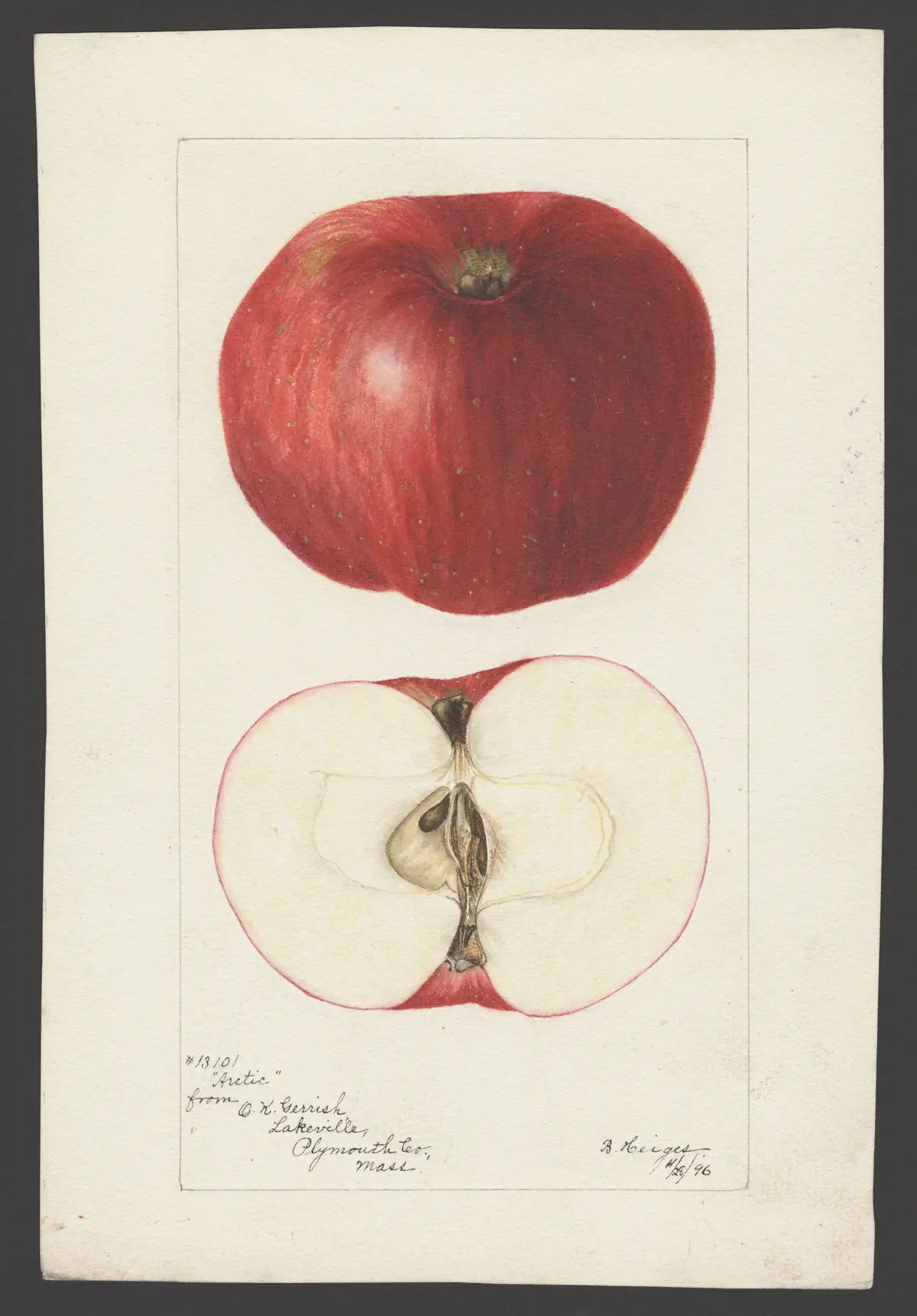
USDA Pomological Watercolor Collection
Arctic
Origin/History
Arctic originated as a chance seedling on the farm of John H. Esseltyne, near Cape Vincent, New York, about 1862. The variety was introduced by O. K. Gerrish, later of Lakeville, Massachusetts, who purchased the original tree from Esseltyne around 1887. After taking propagating wood from it, Gerrish destroyed the tree to prevent theft of scions. Arctic was subsequently planted more extensively in Northern New York, New England, and Canada than in any other regions. It is reported as being pretty hardy in Central Iowa, where the climate is too severe for Baldwin, Rhode Island Greening, and other varieties of similar hardiness. Munson considers it worthy of trial wherever Baldwin will not succeed. It is considerably hardier than Baldwin or Northern Spy, though not so hardy as several of the Russian apples. In some parts of Northern New York the variety was being grafted over to other sorts at the time of Beach's writing; Waugh similarly noted this trend in the Isle La Motte region of Vermont, though he believed Arctic would continue to be grown there in moderate quantities for years to come.
Tree
Beach and Hedrick describe the tree as a moderate grower with a spreading, open form — Beach comparing it to Tompkins King — with long, moderately stout branches. Budd-Hansen, by contrast, describes the tree as a strong, upright grower. Hedrick describes the trees as vigorous, healthy, and usually productive; Beach notes that in some districts the tree has the reputation of being productive, while in others it is called a shy bearer; Budd-Hansen describes it as an early bearer.
Twigs short, stocky; internodes medium length; slightly pubescent near the tips. Bark dark reddish-brown, streaked and mottled with thin scarf-skin. Lenticels scattering, conspicuous, medium to large, roundish to somewhat elongated, raised. Buds medium to large, broad, obtuse, flat, free, pubescent. Leaves large, dark green, broad and rather thick.
Fruit
Size and Form
Above medium to large (Beach, Hedrick); Budd-Hansen simply says large. Form oblate, sometimes roundish conic, often faintly ribbed; pretty uniform in size and shape. Budd-Hansen adds that in large specimens the fruit is often distinctly angular or five-sided.
Stem
Short and stout to medium thick (Beach: short and rather thick to medium; Budd-Hansen: short, stout; Hedrick: short and thick).
Cavity
Moderately shallow to rather deep (Beach), or shallow (Hedrick), broad, usually symmetrical or slightly furrowed, with outspreading rays of red or green russet. Budd-Hansen describes it as regular, wide, and obtuse, with some radiating green or russet.
Calyx
Medium to rather large (Beach), or large (Hedrick). Segments broad, obtuse. Beach says closed or partly open; Budd-Hansen and Hedrick describe the calyx as closed, with Budd-Hansen noting the segments as flat and convergent.
Basin
Abrupt; Beach describes it as medium to wide and deep; Hedrick as wide and deep; Budd-Hansen as rather shallow. Often compressed or slightly furrowed and corrugated (Beach, Hedrick); Budd-Hansen describes it as somewhat irregular.
Skin
Nearly smooth, slightly roughened by the light russet or whitish dots (Beach, Hedrick); Budd-Hansen describes the dots as distinct, few, and gray. The ground color is deep yellow or greenish-yellow, often almost wholly covered with a bright red that obscures stripes of deeper red (Beach, Hedrick). Budd-Hansen describes the surface as dark solid red, obscurely marbled and mixed, with a little yellow ground color visible on the shady side and a delicate bloom present. The fruit somewhat resembles Baldwin in size and color but is more oblate, and the skin is of a somewhat lighter and brighter red than Baldwin (Beach). The dots are round, scattering, whitish, often areolar, and not elongated in the region of the cavity as they often are on the Baldwin; the cavity is often marked with outspreading rays of reddish or green russet, also as in the Baldwin (Beach).
Calyx Tube and Stamens
Calyx tube short, conical, varying to funnel-form (Beach); funnel-shaped (Budd-Hansen); short and conical (Hedrick). Stamens median (Beach, Hedrick); basal (Budd-Hansen).
Core and Seeds
Core medium (Beach, Hedrick) or small (Budd-Hansen), axile or nearly so. Cells closed or partly open (Beach, Hedrick); Budd-Hansen describes them as ovate and slit, with the core closed. Core lines clasping the cylinder of the tube (Beach, Hedrick). Carpels broadly roundish to nearly obcordate, emarginate, slightly tufted (Beach); Hedrick similarly describes them as broadly round to obcordate, emarginate, tufted.
Seeds often abortive. When normally developed: medium to rather large (Beach), or large (Hedrick), flat, obtuse, sometimes slightly tufted (Beach) or tufted (Hedrick), dark. Budd-Hansen describes the seeds simply as plump.
Flesh and Flavor
Yellow (Beach: somewhat tinged with yellow), firm, moderately coarse (Beach) to coarse (Hedrick), crisp, juicy (Beach: moderately juicy per Budd-Hansen), mild subacid, good in quality. All three sources agree on this flavor profile.
Season
October to February, or later (Beach, Hedrick). When grown farther north, the season is later than in Western New York. Budd-Hansen gives the season simply as midwinter.
Uses
Adapted rather for market and culinary uses than for dessert (Beach).
Subtypes/Variants
Not described in source.
Other
The variety does not keep so well as the Hubbardston (Beach). The fruit is considered very attractive and mild subacid, good but not high in quality; it is valued primarily for its hardiness rather than for the excellence of its fruit (Beach, Hedrick).
Book Sources
Described in 3 period pomological works
Nursery Catalog Sources
Found in 3 catalogs (1900–1913) from Illinois
- Central Experimental Farm , Dominion Department of Agriculture, Agassiz, British Columbia (under test; Bulletin No. 3, Second Series) — 1900
- Benjamin Buckman (personal inventory) , Farmingdale , Illinois — 1901
- Benjamin Buckman (personal inventory) , Farmingdale , Illinois — 1913
View original book sources (3)
— S.A. Beach, The Apples of New York, Vol. 2 (1905)ARCTIC.
REFERENCES. 1. N. Y. Sta. An. Rpt., 8:347. 1889. 2. Munson, Me. Sta. Rpt., 1896:70. 3. Waugh, Vt. Sta. Bui., 61:29. 1897. 4. Am. Pom. Soc. Cat., 1899:15. 5. Beach, W. N. Y. Hort. Soc. Rpt., 1900:34. 6. Waugh, Vt. Sta. An. Rpt., 14:286. 1901. 7. Me. Sta. Rpt., 1902:83, 89, 95, 96. 8. Budd-Hansen, 1903:39. 9. Powell and Fulton, U. S. B. P. I. Bui., 48:36. 1903.
SYNONYMS. None.
One of the most valuable characteristics of the Arctic is its ability to endure cold climates. It has probably been planted more extensively in Northern New York, New England and Canada than in any other regions. It is reported as being pretty hardy in Central Iowa where the climate is too severe for Baldwin, Rhode Island Greening and other varieties of a similar grade of hardiness. Munson (7) states that it is worthy of trial where Baldwin will not succeed. The tree is vigorous. In some districts it has the reputation of being productive, in others it is called a shy bearer. The fruit is very attractive, mild subacid, good but not high in quality. It somewhat resembles Baldwin in size and color, but is more oblate, and the skin is of a somewhat lighter and brighter red than that of Baldwin. The cavity is often marked with outspreading rays of reddish or green russet as in the Baldwin. The dots are round, scattering, whitish, often areolar and not elongated in the region of the cavity as they often are on the Baldwin. It does not keep so well as the Hubbardston. In Western New York its season may extend from October to February, but when grown farther north is later (6, 7). In some parts of Northern New York it is being grafted over to other sorts. Waugh (6) states that this is also being done in the Isle La Motte region of Vermont, nevertheless he believes it will be grown there in moderate quantities for years to come.
Historical. The Arctic was introduced by Mr. O. K. Gerrish, now of Lakeville, Mass. He states that it originated as a chance seedling in a garden near Cape Vincent, N. Y., about 1862. About 1887 he bought the tree from Mr. John H. Esseltyne on whose farm it was growing. After taking propagating wood from it, he destroyed the tree to prevent theft of scions.
TREE. Tree a moderate grower with long, moderately stout branches. Form spreading and open somewhat like Tompkins King. Twigs short, stocky; internodes medium length; slightly pubescent near tips. Bark dark reddish-brown, streaked and mottled with thin scarf-skin. Lenticels scattering, conspicuous, medium to large, roundish to somewhat elongated, raised. Buds medium to large, broad, obtuse, flat, free, pubescent. Leaves large, dark green, broad and rather thick.
FRUIT. Fruit above medium to large. Form oblate, sometimes roundish conic, often faintly ribbed; pretty uniform in size and shape. Stem short and rather thick to medium. Cavity moderately shallow to rather deep, broad, usually symmetrical or slightly furrowed, and having outspreading rays of red or green russet. Calyx medium to rather large; segments broad, obtuse, closed or partly open. Basin abrupt, medium to wide and deep, often compressed or slightly furrowed and corrugated. Skin nearly smooth, slightly roughened by the light russet or whitish dots; deep yellow or greenish-yellow, often almost wholly covered with a bright red obscuring the stripes of deeper red. Calyx tube short, conical varying to funnel-form. Stamens median. Core medium, axile or nearly so; cells closed or partly open; core lines clasping the cylinder of the tube. Carpels broadly roundish to nearly obcordate, emarginate, slightly tufted. Seeds often abortive; when normally developed they are medium to rather large, flat, obtuse, sometimes slightly tufted, dark. Flesh somewhat tinged with yellow, firm, moderately coarse, crisp, juicy, mild subacid, good in quality.
Uses. Adapted rather for market and culinary uses than for dessert. Season October to February or later.
— J.L. Budd & N.E. Hansen, American Horticultural Manual, Part II: Systematic Pomology (1914)Arctic.— Origin, Cape Vincent, New York; tree a strong, upright grower and early bearer. Fruit large, regular, roundish oblate, often distinctly angular, or five-sided in large specimens; surface dark solid red, obscurely marbled and mixed, a little yellow ground-color on shady side, with delicate bloom; dots distinct, few, gray; cavity regular, wide, obtuse, with some radiating green or russet; stem short, stout; basin rather shallow, abrupt, somewhat irregular; calyx closed; segments flat convergent. Core small, closed; cells ovate, slit; tube funnel-shaped; stamens basal; seeds plump; flesh yellow, firm, moderately juicy, crisp, mild subacid, good. Midwinter.
— U.P. Hedrick, Cyclopedia of Hardy Fruits (1922)ARCTIC. Arctic, as the name implies, is an apple for cold climates, much hardier than Baldwin or Northern Spy, but not so hardy as several of the Russian apples. The trees are vigorous, healthy, and usually productive; but the fruit, while pleasing in appearance, is far from good in quality. Arctic originated as a seedling on the farm of John H. Esseltyne, Cape Vincent, New York, about 1862.
Tree a moderate grower, spreading and open, with long, stout branches. Leaves large, dark green, broad and thick. Fruit large, oblate, sometimes round-conic, often faintly ribbed, uniform in size and shape; stem short and thick; cavity shallow, broad, usually symmetrical or furrowed and having outspreading rays of red or green-russet; calyx large, segments broad, obtuse, closed; basin abrupt, wide and deep, often compressed or furrowed and corrugated; skin smooth, slightly roughened by light russet or white dots, deep yellow almost wholly covered with bright red obscuring stripes of deeper red; calyx-tube short, conical; stamens median; core medium, axile; cells closed or partly open; core-lines clasping; carpels broadly round to obcordate emarginate, tufted; seeds often abortive, large, flat, obtuse, sometimes tufted, dark; flesh yellow, firm, coarse, crisp, juicy, mild subacid; good in quality; October to February.