Autumn Pearmain
Apple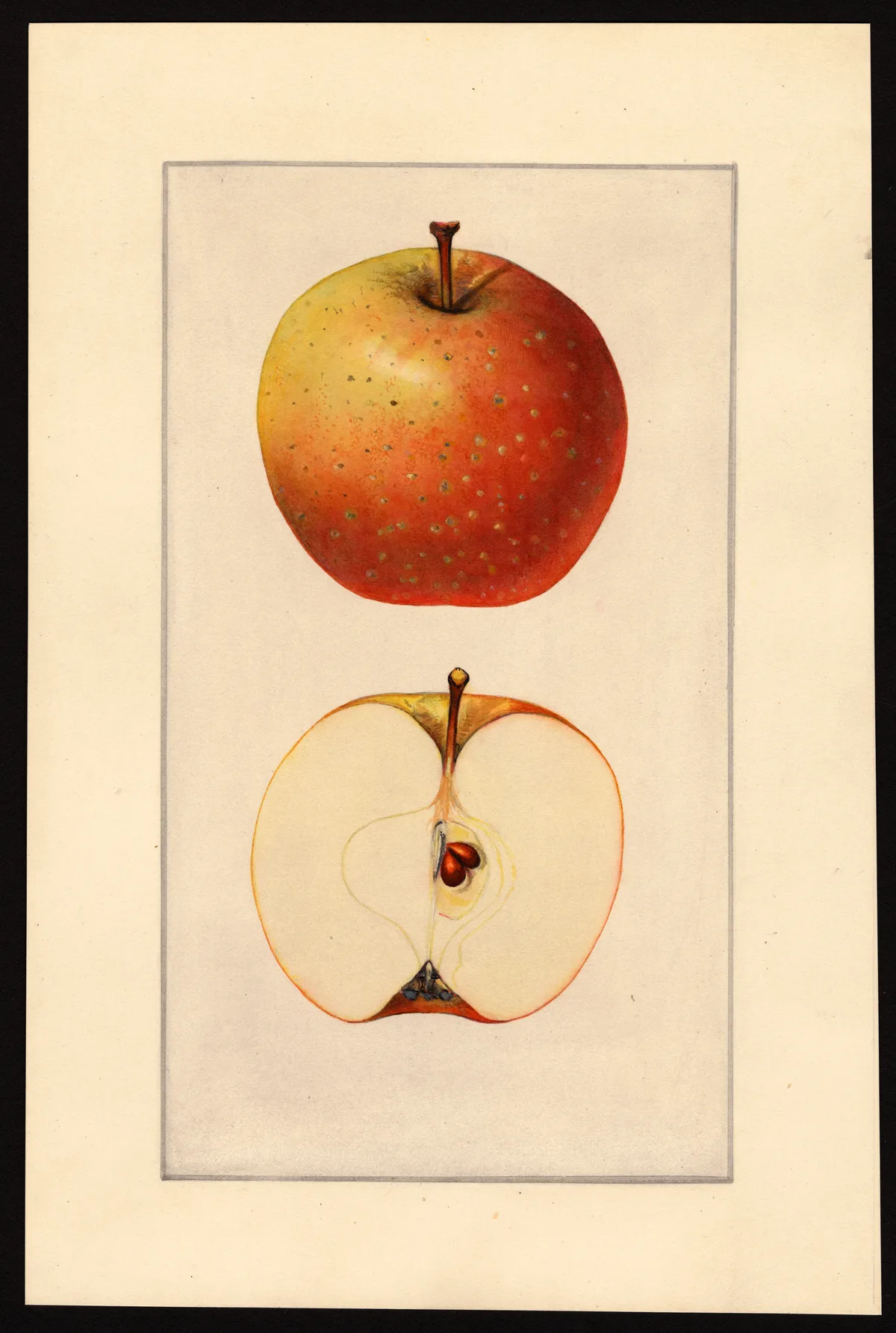
USDA Pomological Watercolor Collection
Autumn Pearmain
Origin / History
An Old English variety mentioned by Parkinson in 1629 (Bunyard). Of foreign origin, formerly popular in Kentucky and the South (Elliott). Bunyard notes it is the Summer Pearmain of Hogg, but not of Continental authors, and references Ronalds, p. 22 (as Royal Pearmain).
Tree
A slow-growing tree (Elliott; Downing), but attains a large size (Downing). Habit slender and irregular (Elliott), with slender, spreading branches (Downing). Bunyard describes growth as vigorous, upright, and fertile, and notes it makes a fine standard tree. The George Bunyard catalog (1914) calls the tree hardy and a good bearer, of medium size. Leaf roundish, pale, upfolded, undulated, and finely serrate (Bunyard).
Fruit
Size: Medium (Elliott; Downing; Bunyard; George Bunyard catalog). Bunyard gives dimensions of 2¾ by 2 inches.
Form: Sources differ on form. Elliott calls it oblong conical; Downing describes it as roundish, narrowing gradually toward the eye; Bunyard gives conical, fairly regular; the George Bunyard catalog describes it as roundish.
Stem / Stalk: Short (Elliott; Downing); obliquely planted under a fleshy lip (Downing). Bunyard describes the stem as slender, set in a moderate cavity, always with a fleshy bump on one side that forces the stem sideways.
Cavity: Moderate, with a characteristic fleshy bump or lip on one side (Downing; Bunyard).
Calyx / Eye: Calyx small (Downing), set in a broad, shallow basin (Elliott; Downing), which is slightly plaited (Elliott) or obscurely plaited (Downing); Downing notes the basin is sometimes scarcely sunk at all. Bunyard describes the eye as open, in a very shallow, faintly ribbed basin.
Basin: Broad and shallow (Elliott; Downing); very shallow and faintly ribbed (Bunyard).
Skin / Color: Brownish-yellow and green, with red blended with yellow in the sun, and small brown specks (Elliott). Downing describes the color as brownish-yellow, mixed with green on the shaded side, but next the sun reddish, blended with yellow, streaked with deeper red, and sprinkled with numerous small brown specks. Bunyard gives the color as golden-yellow, partly covered with russet which is netted, and a slight flush. The George Bunyard catalog describes it as pale yellow with red stripes and dots.
Flesh / Flavor: Flesh pale yellow and crisp (Elliott; Downing); firm (Downing; Bunyard); a little dry, but rich and high flavored (Downing); highly flavoured (Bunyard); yellow (Bunyard). Elliott rates the flavor as nearly "best"; Downing rates quality as very good.
Core / Seeds: Core rather small (Downing). Seeds not described in source.
Season
September (Elliott). October to March (Downing). September to October (Bunyard; George Bunyard catalog).
Uses
Dessert or culinary (Bunyard); dessert (George Bunyard catalog).
Subtypes / Variants
Not described in source.
Other
Bunyard notes the designations "American Pearmain" and "Royal Pearmain" have been applied in error. The George Bunyard catalog tags the variety with the codes "(H, B.T., P.)".
Book Sources
Described in 3 period pomological works
Nursery Catalog Sources
Found in 2 catalogs (1901–1913) from Illinois
- Benjamin Buckman (personal inventory) , Farmingdale , Illinois — 1901
- Benjamin Buckman (personal inventory) , Farmingdale , Illinois — 1913
View original book sources (4)
— F.R. Elliott, The Western Fruit Book (1865)Autumn Pearmain. English Summer Pearmain, Summer Pearmain, Royal Pearmain, Parmain d'Ete, Sigler's Red. Foreign. Tree, slender, slow growth, irregular, popular in Kentucky and South : fruit, medium, oblong conical, brownish yellow and green, red, blended with yellow, in sun. small brown specks: stalk, short; calyx, in a broad, shallow basin, slightly plaited ; flesh, pale yellow, crisp; nearly "best." September.
— A.J. Downing, The Fruits and Fruit Trees of America (1900)Autumn Pearmain. Winter Pearmain. A slow-growing tree, but attains a large size. Branches slender, spreading. Fruit of medium size, roundish, narrowing gradually toward the eye. Color brownish-yellow, mixed with green on the shaded side, but next the sun reddish, blended with yellow, streaked with deeper red, and sprinkled with numerous small brown specks. Stalk short, obliquely planted under a fleshy lip. Calyx small, set in a broad shallow basin, which is sometimes scarcely at all sunk, and obscurely plaited. Flesh pale yellow, crisp, firm, a little dry, but rich and high flavored. Core rather small. Quality very good. October to March.
— E.A. Bunyard, A Handbook of Hardy Fruits (1920)AUTUMN PEARMAIN. Ronalds, p. 22. (as Royal Pearmain). F., Pearmain d'Été. G., Sommer Parmaene. [American Pearmain, Royal Pearmain (in error).] Dessert or culinary, September to October medium, 2¾ by 2, conical, fairly regular. Colour, golden-yellow, partly covered with russet which is netted, and slight flush. Flesh, firm, yellow, highly flavoured. Eye, open in a very shallow, faintly ribbed basin. Stem, slender in a moderate cavity, always with a fleshy bump on one side, forcing the stem sideways. Growth, vigorous, upright, fertile. Leaf, roundish, pale, upfolded, undulated, finely serrate. Origin, an Old English variety mentioned by Parkinson, in 1629. It is the Summer Pearmain, of Hogg, but not of Continental Authors. It makes a fine standard tree.
— George Bunyard & Co., George Bunyard Catalog of Fruit Trees (1914) (1914)Dessert; Sept-Oct. Medium, roundish, pale yellow with red stripes and dots. Tree hardy and a good bearer. Medium size (H, B.T., P.)