CLAYGATE PEARMAIN
Apple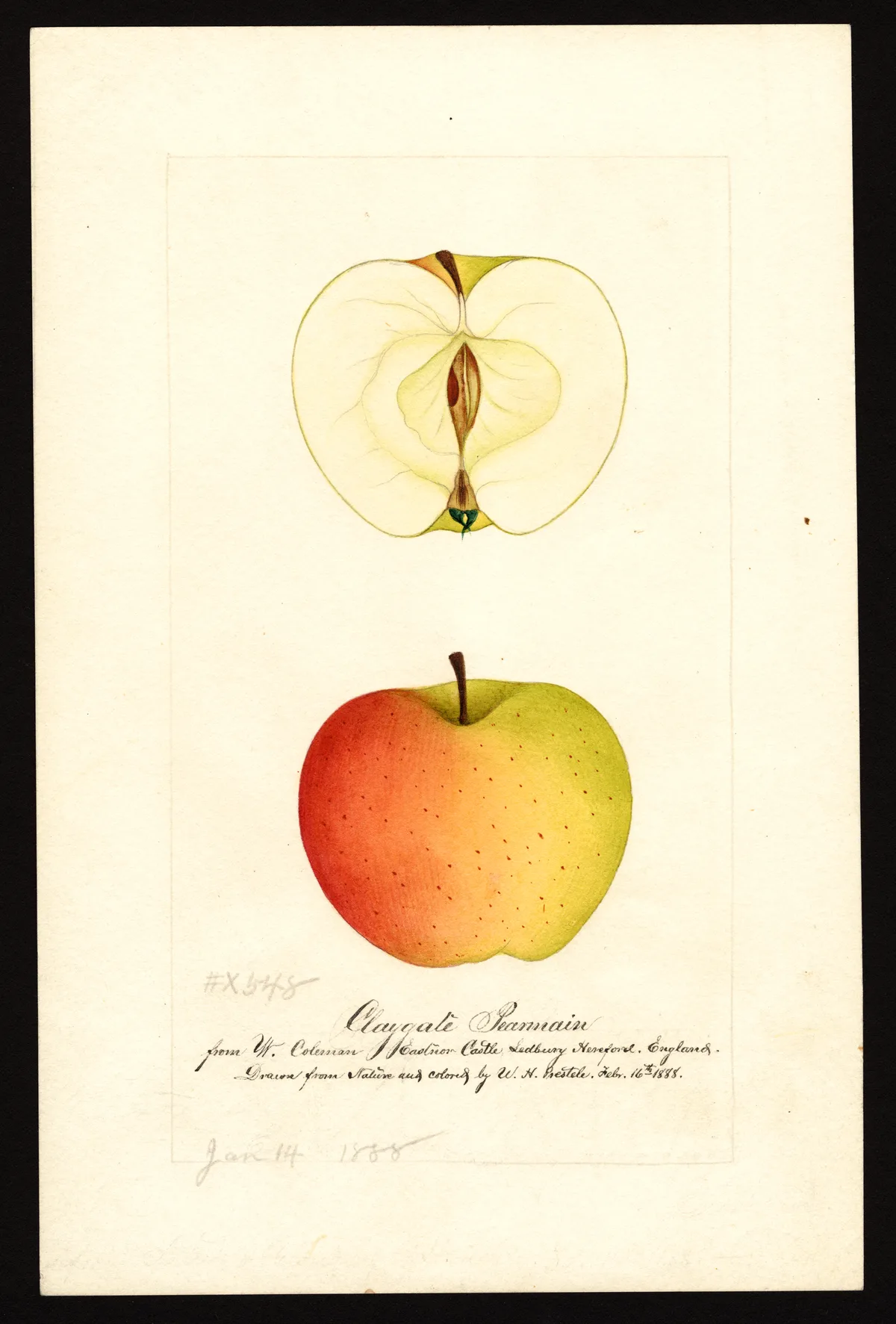
USDA Pomological Watercolor Collection
CLAYGATE PEARMAIN
Origin / History
An English apple. Found in a hedge near Claygate by Mr. John Braddick, of Thames Ditton (Bunyard, Handbook of Hardy Fruits, 1920).
Tree
Growth moderate (Bunyard 1920); medium growth (George Bunyard Catalog, 1914). Fertile. Leaf rather large, horizontal, upfolded, sharply curved serrate (Bunyard 1920).
Fruit
Size
Medium. Bunyard gives dimensions of 2½ by 2 inches (1920). Veitch's Fruit Trees (1911) and the George Bunyard Catalog (1914) also describe it as medium size.
Form
Roundish conical (Downing, 1900); roundish, flattened, regular (Bunyard, 1920).
Stem
Rather long and thick (Bunyard, 1920).
Cavity
Wide, only slightly russeted (Bunyard, 1920).
Calyx / Eye
Eye half open (Bunyard, 1920).
Basin
Wide, rather shallow (Bunyard, 1920).
Skin
Sources describe the colour somewhat differently:
- Downing (1900): greenish yellow, nearly covered with brownish red.
- Bunyard (1920): dull green, with a faint red flush and thin russet.
- George Bunyard Catalog (1914): dull olive-green, slightly striped and marbled with darker red.
Flesh / Flavour
Flesh yellow (Downing, 1900); crisp, greenish-white, juicy (Bunyard, 1920). Tender, rich, aromatic, and of excellent flavour — Downing rates it "Good" (1900); Bunyard calls it "of the highest quality" and "one of the best late dessert apples" (1920). Veitch's Fruit Trees (1911) describes it as "richly flavoured and highly aromatic, the flavour is exquisite." The George Bunyard Catalog (1914) calls it "An excellent dessert apple. Fine flavour and fairly hardy."
Core / Seeds
Not described in source.
Season
Sources differ on the in-use season:
- Downing (1900): November to March.
- Bunyard (1920): December to February (dessert).
- George Bunyard Catalog (1914): October (dessert).
Uses
Dessert apple (Bunyard 1920; George Bunyard Catalog 1914).
Subtypes / Variants
Not described in source.
Other
George Bunyard Catalog (1914) appends the parenthetical code "(H, B.T., P.)" to the entry. Bunyard's Handbook (1920) cross-references the illustration in Lauche II., 72, and notes the French name "Pomme de Claygate" and the German "Claygate Parmane," with a parenthetical reference to "(Ribston Pearmain.)"
Book Sources
Described in 2 period pomological works
- Bunyard, A Handbook of Hardy Fruits (1920)
- Downing, Fruits and Fruit Trees of America (1900) — listed as Clatgate Pearmain
Nursery Catalog Sources
Found in 9 catalogs (1897–1917) from England, Illinois
- Kelway & Son , Langport, Somerset , England — 1897
- George Bunyard & Co. , Royal Nurseries, Maidstone, Kent , England — 1900
- Central Experimental Farm , Dominion Department of Agriculture, Agassiz, British Columbia (under test; Bulletin No. 3, Second Series) — 1900
- Benjamin Buckman (personal inventory) , Farmingdale , Illinois — 1901
- James Veitch & Sons , Ltd., Royal Exotic Nursery, Chelsea, London (also Coombe Wood, Langley, and Feltham) , England — 1911
- Thomas Rivers & Son , Sawbridgeworth, Hertfordshire , England — 1913
- Benjamin Buckman (personal inventory) , Farmingdale , Illinois — 1913
- George Bunyard & Co. , Royal Nurseries, Maidstone, Kent , England — 1914
- George Bunyard & Co. , Royal Nurseries, Maidstone, Kent , England — 1917
View original book sources (4)
— A.J. Downing, The Fruits and Fruit Trees of America (1900)Clatgate Pearmain. An English Apple. Fruit medium, roundish conical, greenish yellow, nearly covered with brownish red. Flesh yellow, tender, rich, aromatic. Good. November to March.
— E.A. Bunyard, A Handbook of Hardy Fruits (1920)CLAYGATE PEARMAIN. Lauche II., 72. F., Pomme de Claygate, G. Claygate Parmane. (Ribston Pearmain.) Dessert, December to February, medium, 2½ by 2, roundish, flattened, regular. Colour, dull green, faint red flush with thin russet. Flesh, crisp, greenish-white, juicy and of excellent flavour. Eye, half open in a wide, rather shallow basin. Stem, rather long, thick in a wide cavity only slightly russeted. Growth, moderate; fertile. Leaf, rather large, horizontal, upfolded, sharply curved serrate. Origin, found in a hedge, near Claygate, by Mr. John Braddick, of Thames Ditton. This is one of the best late dessert apples and is of the highest quality.
— James Veitch & Sons, Veitch's Fruit Trees (1911) (1911)medium size, richly flavoured and highly aromatic, the flavour is exquisite
— George Bunyard & Co., George Bunyard Catalog of Fruit Trees (1914) (1914)Dessert; Oct. Medium, dull olive-green, slightly striped and marbled with darker red. An excellent dessert apple. Fine flavour and fairly hardy. Medium growth. (H, B.T., P.)