Summer Rose
Apple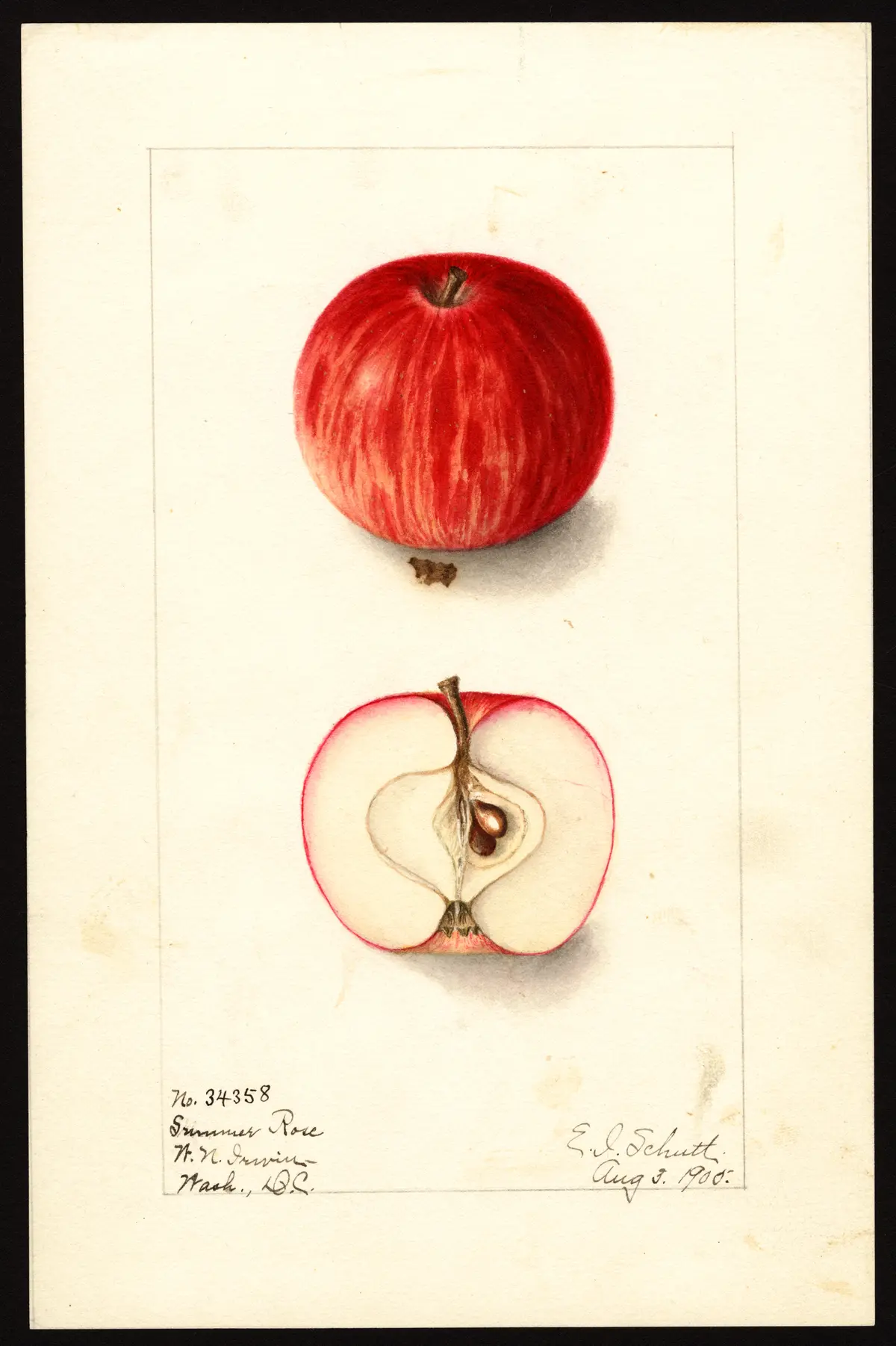
USDA Pomological Watercolor Collection
Summer Rose
Origin / History
An old New Jersey apple (Warder; Budd-Hansen; Thomas; Beach). Coxe (1817) described it as "an apple of singular beauty and excellence, both for eating and stewing," and it was brought to market in July under the name of the Harvest apple for stewing purposes. Beach notes it was still occasionally listed by nurserymen at the turn of the 20th century but was by then seldom or never planted in New York. Thomas rated it better in quality for the table than Early Harvest but less productive and too small for general value.
Tree
Sources disagree on vigor: Warder and Budd-Hansen call the tree "vigorous, healthy, spreading, productive, an early bearer"; Downing calls it "moderately vigorous, productive"; Elliott describes it as "a slow grower, diverging," with downy shoots, requiring "rich, strong soil, lime and phosphate to perfect the fruit, or keep the tree healthy," and a "moderate, regular bearer"; Thomas calls it "a slow grower but productive." Beach summarizes the consensus as "a moderately vigorous or slow grower but is hardy, comes into bearing young and is productive." Coxe describes the tree as "of a spreading form, giving a good exposure to the sun, and is very fruitful."
Shoots: Stout (Warder); downy (Elliott). Foliage: Large, glaucous (Warder).
Fruit
Size
Moderate (Coxe); small (Warder); scarcely of medium size (Downing); small to nearly medium (Beach); rather small (Budd-Hansen); medium or rather small (Elliott; Thomas). Lowther reports size "not reported." Thomas and Beach (citing Thomas) note it is too small for market/general value but good for home use.
Form
Flat (Coxe); roundish, flattened, regular (Warder); roundish (Downing); roundish, somewhat oblate (Beach); roundish oblate, regular (Budd-Hansen); roundish, sometimes flattened (Elliott); roundish-oblate (Thomas); round (Lowther).
Stem / Stalk
Rather short and slender (Downing); medium (Warder); rather short to medium, varying from stout to slender (Beach); rather short, slender (Budd-Hansen); varying from stout to slender, short (Elliott); rather short (Thomas).
Cavity
Acute, regular (Warder); shallow, acute, regular (Beach); regular, acute (Budd-Hansen); shallow (Elliott).
Calyx / Eye
Small, closed (Warder; Budd-Hansen); closed (Downing); small, closed or partly open (Beach); partially closed (Elliott).
Basin
Abrupt, wide, regular (Warder); even (Downing); regular, wide, abrupt, slightly furrowed (Beach); abrupt, wide, nearly smooth (Budd-Hansen); round, slightly furrowed (Elliott); round, slightly plaited (Thomas).
Skin
Smooth (Coxe; Warder; Downing; Beach; Budd-Hansen). Coxe describes it as "of a beautiful yellow resembling wax, blended with red in streaks and blotches." Warder: "polished, very pale yellow, striped and splashed distinctly bright red and carmine." Downing: "rich waxen yellow, streaked and blotched with a little red on the sunny side." Beach: "waxen, very pale yellow, striped and splashed distinctly with bright red and carmine on the exposed cheek." Budd-Hansen: "polished, clear rich pale waxen yellow, with distinct bright red and crimson stripes and splashes on sunny side." Elliott: "rich glossy yellow, blotched and streaked with red." Thomas: "yellowish, blotched, and streaked with red." Lowther: yellow-red.
Dots
Minute (Warder; Beach; Budd-Hansen).
Flesh / Flavor
White (Warder; Beach; Budd-Hansen; Elliott). Coxe: "sweet, sprightly and juicy." Warder: "crisp, fine grained, juicy; Flavor sub-acid, agreeable, not rich." Downing: "tender, abounding with sprightly juice. Very good or best." Beach: "fine-grained, crisp, very tender, sprightly, juicy, subacid, agreeable but not rich, suitable for either culinary or dessert use." Budd-Hansen: "very tender, fine-grained, very juicy, sprightly subacid, excellent." Elliott: "tender, crisp, juicy, sprightly," with the variety's "juicy, sprightly, sub-acid character" making it very desirable for the dessert. Thomas: "very tender, slightly crisp, texture fine, mild sub-acid, juicy, excellent." Lowther: quality "best."
Core / Seeds
Core large, regular, closed, meeting the eye (Warder); medium to large, cells closed, core lines meeting (Beach); large, closed, meeting (Budd-Hansen); medium (Elliott). Seeds numerous, short, plump (Warder); ovate, numerous, short, plump (Beach); many, short, plump (Budd-Hansen); ovate (Elliott).
Season
Does not become fully ripe till August, but is an excellent stewing apple in July (Coxe). June to August, ripening gradually (Warder). Ripens early in August (Downing). Suitable for culinary use in July, ripe in August (Beach). June to early August, ripening in succession (Budd-Hansen). Last of July and August (Elliott). "Begins to ripen with wheat harvest, and continues a month" (Thomas). Summer (Lowther).
Uses
Family, table and kitchen (Warder); dessert (Downing; Elliott; Beach — "a little dessert apple"); culinary or dessert use (Beach); home use (Thomas); family (Lowther). Coxe notes it is "an apple of singular beauty and excellence, both for eating and stewing" and was brought to market in July for stewing under the name of the Harvest apple. Elliott explicitly notes it "is not valuable for market purposes." Thomas: "Too small for market but good for home use."
Subtypes / Variants
Not described in source.
Other
Lowther's station survey reports the variety from 5 stations in the Northern Division, 20 stations in the Central Division, and 3 stations in the Southern Division (with the variety also reported in more than one division in each case).
Book Sources
Described in 8 period pomological works
- Budd & Hansen, Systematic Pomology (1914)
- Downing, Fruits and Fruit Trees of America (1900)
- Elliott, The Western Fruit Book (1865)
- Warder, American Pomology: Apples (1867)
- Beach, The Apples of New York Vol. 2 (1905)
- Coxe, A View of the Cultivation of Fruit Trees (1817)
- Lowther (ed.), Encyclopedia of Practical Horticulture (1914)
- Thomas, The American Fruit Culturist (1903)
Nursery Catalog Sources
Found in 2 catalogs (1900–1901) from Illinois
- Central Experimental Farm , Dominion Department of Agriculture, Agassiz, British Columbia (under test; Bulletin No. 3, Second Series) — 1900
- Benjamin Buckman (personal inventory) , Farmingdale , Illinois — 1901
View original book sources (8)
— William Coxe, A View of the Cultivation of Fruit Trees (1817)NO. 6. SUMMER ROSE.
This is an apple of singular beauty and excellence, both for eating and stewing: the size is moderate, the form flat, the skin smooth, of a beautiful yellow resembling wax, blended with red in streaks and blotches; the flesh is sweet, sprightly and juicy; it does not become fully ripe till August, but is an excellent stewing apple in July, and is brought to market for that purpose, under the name of the Harvest apple: the tree is of a spreading form, giving a good exposure to the sun, and is very fruitful.
— John A. Warder, American Pomology: Apples (1867)Summer Rose.
Origin New Jersey. Tree vigorous, healthy, spreading, productive, early bearer; Shoots stout; Foliage large, glaucous.
Fruit small, roundish, flattened, regular; Surface smooth, polished, very pale yellow, striped and splashed distinctly bright red and carmine; Dots minute.
Basin abrupt, wide, regular; Eye small, closed.
Cavity acute, regular; Stem medium.
Core large, regular, closed, meeting the eye; Seeds numerous, short, plump; Flesh white, crisp, fine grained, juicy; Flavor sub-acid, agreeable, not rich; Quality, one of the best early apples; Use, family, table and kitchen; Season, June to August — ripening gradually.
— A.J. Downing, The Fruits and Fruit Trees of America (1900)Summer Rose.
Woodman's Harvest. Lippincott's Early.
A very pretty and very excellent Apple, highly esteemed as a dessert fruit. Tree moderately vigorous, productive.
Summer Rose.
Fruit scarcely of medium size, roundish, smooth, rich waxen yellow, streaked and blotched with a little red on the sunny side. Stalk rather short and slender. Calyx closed, set in an even basin. Flesh tender, abounding with sprightly juice. Very good or best. Ripens early in August.
— S.A. Beach, The Apples of New York, Vol. 2 (1905)SUMMER ROSE.
REFERENCES.
- M'Mahon, Amer. Gard. Cal., 1806:584. 2. Coxe, 1817:103. fig. 3. Buel, N. Y. Bd. Agr. Mem., 1826:476. 4. Wilson, 1828:136. 5. Fessenden, 1828:131. 6. Kenrick, 1832:29. 7. Manning, 1838:47. 8. Downing, 1845:77. 9. Horticulturist, 2:483. 1848. 10. N. Y. Agr. Soc. Trans., 1848:277. fig. 11. Thomas, 1849:141. fig. 12. Cole, 1849:101. fig. 13. Waring, 1851:31. 14. Barry, 1851:282. 15. Am. Pom. Soc. Cat., 1852. 16. Elliott, 1854:107. fig. 17. Gregg, 1857:39. 18. Hooper, 1857:87. 19. Horticulturist, 14:425. 1859. 20. Warder, 1867:616. 21. Fitz, 1872:143, 160. 22. Ill. Hort. Soc. Rpt., 1875:112. 23. Downing, 1881:11 index, app. 24. Van Deman, U. S. Pom. Rpt., 1887:630. col. pl. 25. Lyon, Mich. Hort. Soc. Rpt., 1890:298. 26. Bailey, An. Hort., 1892:250. 27. Alwood, Va. Sta. Bul., 130:122. 1901. 28. Waugh, Vt. Sta. An. Rpt., 14:309. 1901. 29. Farrand, Mich. Sta. Bul., 205:46. 1903. 30. Budd-Hansen, 1903:183. fig.
SYNONYMS. French Reinette (10). Harvest Apple (2, 3, 6). Lippincott (10, 13, 16). Lodge's Early (23). SUMMER ROSE (2, 3, 4, 5, 6, 7, 8, 9, 10, 11, 12, 13, 14, 15, 16, 17, 18, 19, 20, 21, 22, 23, 24, 25, 26, 27, 28, 29, 30). Wolman's Harvest (16). Woolman's Early (11, 14, 17). WOOLMAN'S HARVEST (1). Woolman's Harvest (8, 10, 16). Woolman's Striped Harvest (11).
A little dessert apple. Thomas rated it better in quality for the table than Early Harvest but less productive and too small for general value (11). The tree is a moderately vigorous or slow grower but is hardy, comes into bearing young and is productive. Suitable for culinary use in July, ripe in August.
Historical. This is an old New Jersey apple which Coxe described as of singular beauty and excellent for both eating and stewing; the size is moderate, the form flat, the skin smooth, of a beautiful yellow resembling wax, blended with red in streaks and blotches (2). It is still occasionally listed by nurserymen (26) but is now seldom or never planted in New York.
FRUIT (8, 11, 16, 20, 23, 30). Fruit small to nearly medium. Form roundish, somewhat oblate. Stem rather short to medium, varying from stout to slender. Cavity shallow, acute, regular. Calyx small, closed or partly open. Basin regular, wide, abrupt, slightly furrowed. Skin smooth, waxen, very pale yellow, striped and splashed distinctly with bright red and carmine on the exposed cheek. Dots minute. Core medium to large; cells closed; core lines meeting. Seeds ovate, numerous, short, plump. Flesh white, fine-grained, crisp, very tender, sprightly, juicy, subacid, agreeable but not rich, suitable for either culinary or dessert use.
— Granville Lowther (ed.), Encyclopedia of Practical Horticulture (1914)Summer Rose: size not reported; form round; skin color yellow-red; quality best; use family; season summer. Reported by 5 stations in the Northern Division (variety also reported in more than one division), 20 stations in the Central Division (variety also reported in more than one division), and 3 stations in the Southern Division (variety also reported in more than one division).
— F.R. Elliott, The Western Fruit Book (1865)SUMMER ROSE.
Wolman's Harvest, Woolman's Harvest, Lippincott.
This variety is not valuable for market purposes, but its juicy, sprightly, sub-acid character makes it very desirable for the dessert. Tree, a slow grower, diverging — shoots downy ; requires rich, strong soil, lime and phosphate to perfect the fruit, or keep the tree healthy. Moderate, regular bearer.
Fruit, medium, or rather small ; form, roundish, sometimes flattened ; color, rich glossy yellow, blotched and streaked with red ; stem, varying from stout to slender, short ; cavity, shallow; calyx, partially closed ; basin, round, slightly furrowed ; flesh, white, tender, crisp, juicy, sprightly ; core, medium ; seeds, ovate. Last of July and August.
— John J. Thomas, The American Fruit Culturist (1903)Summer Rose.* (Woolman's Early, Lippincott's Early, Woolman's Striped Harvest.) Medium or rather small, roundish-oblate; yellowish, blotched, and streaked with red; stalk rather short; basin round, slightly plaited; flesh very tender, slightly crisp, texture fine, mild sub-acid, juicy, excellent. Begins to ripen with wheat harvest, and continues a month. Tree a slow grower but productive. Too small for market but good for home use. New Jersey. Fig. 365.
— J.L. Budd & N.E. Hansen, American Horticultural Manual, Part II: Systematic Pomology (1914)Summer Rose. — Origin, New Jersey; tree vigorous, spreading, productive, an early bearer.
Fruit rather small, roundish oblate, regular; surface smooth, polished, clear rich pale waxen yellow, with distinct bright red and crimson stripes and splashes on sunny side; dots minute; cavity regular, acute; stem rather short, slender; basin abrupt, wide, nearly smooth; calyx small, closed. Core large, closed, meeting; seeds many, short, plump; flesh white, very tender, fine-grained, very juicy, sprightly subacid, excellent. June to early August, ripening in succession.