Oslin
Apple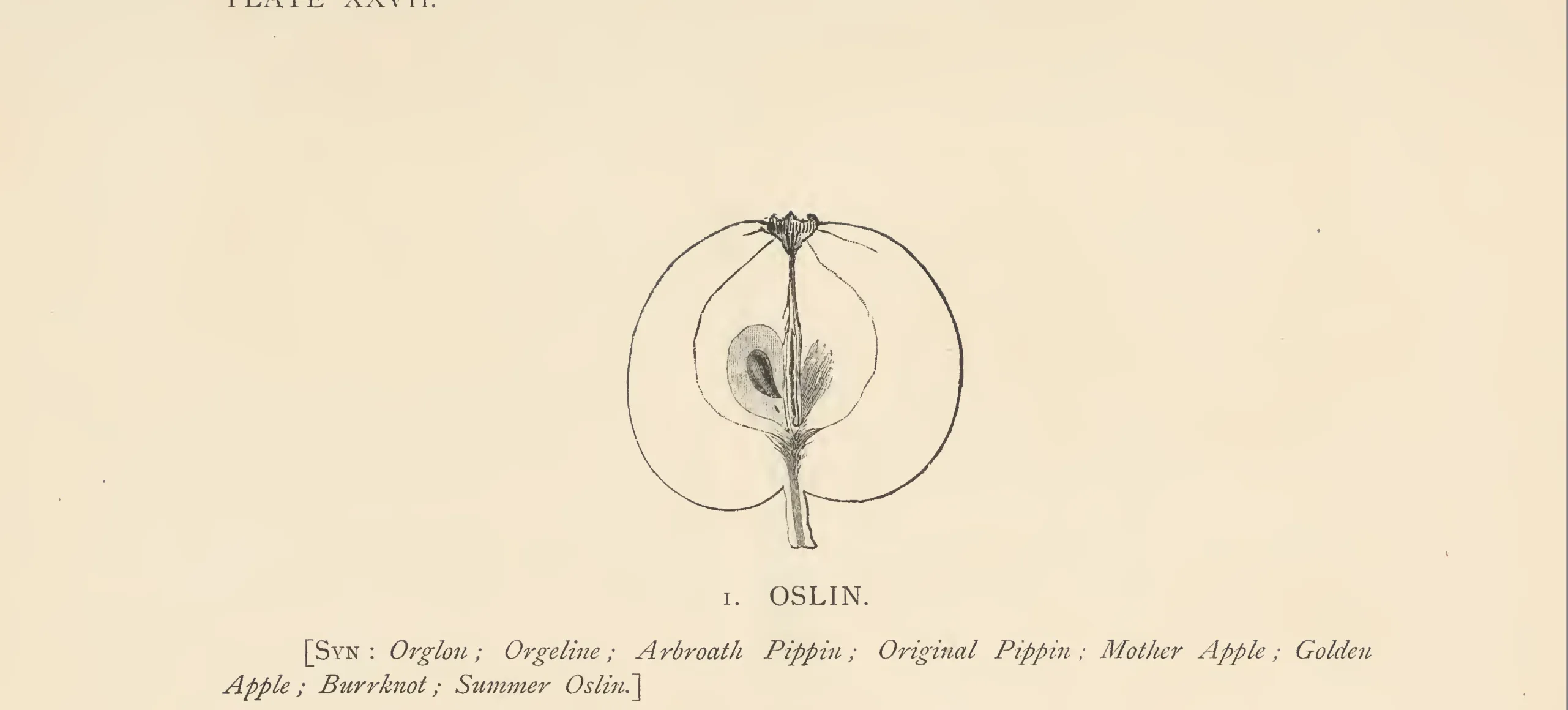
Oslin
Origin / History
A very old Scotch apple, connected with Arbroath in Angusshire, whence it is occasionally called the Arbroath Pippin. By tradition it was brought to Scotland from France by the monks of the Abbey of Arbroath.
Lindley (1841) judged it "more probable that it was raised there from seed." He gave two reasons: it was not to be found at the present day among the continental varieties, and a kind so much superior to the greater part of the apples of France, Germany, and Holland would not have been lost in the country of its production.
The Herefordshire Pomona (1885) held the French introduction "in all probability, the correct one." It allowed that neither this name nor any of its synonyms was to be met with in any modern French list. It pointed to an apple named "Orgeran" in the "Jardinier Francois" of 1651, so similar in pronunciation to "Orgeline" that it may be the same name with a change of orthography, "especially as our ancestors were not over particular in preserving unaltered the names of foreign introductions." Elliott (1865) lists Oslin as "Foreign." Downing (1900) calls it "an excellent Scotch Apple." Bunyard (1920) gives the origin as "Scotch? (possibly French)," probably dating from the seventeenth century.
According to Nicol, as reported by Lindley, the name Original Pippin came from its growing freely by the branches when stuck into the ground. Oslin was well figured in the Pomological Magazine, Pl. 5, and appears in the Herefordshire Pomona as Plate XXVII.
Lindley called it the best of all the early autumn apples except the Kerry Pippin, and "indispensable to every fruit-garden, however small." The Herefordshire Pomona quotes this verdict with "early Summer Apples" in place of Lindley's "early autumn apples." It also quotes Nicol: "This is an excellent apple … as to flavour, it is out-done by none but the Nonpareil; over which it has this advantage, that it will ripen in a worse climate and a worse aspect." Bunyard dismissed it as "Of no particular merit."
Tree
Grows freely, with good growth; vigorous (Downing); upright in habit. Lindley calls it remarkable for its hardiness. The Herefordshire Pomona finds it subject to canker as it grows old.
Wood strong, stiff, erect, dull grayish purple, downy when young, with a few whitish specks that increase considerably in number as the wood becomes older (Lindley). Branches generally covered with a number of knobs or burrs, which take root readily when planted in the ground and produce a fresh plant (Herefordshire Pomona).
Leaves medium (Bunyard), round or nearly round, cordate at the base, collapsing, green and downy beneath, turning yellow in autumn; petioles downy, slightly tinged with purple; stipules subulate (Lindley). Lindley calls the serration even, Bunyard irregular. Flowers middle-sized, slightly tinged with pink (Lindley).
A great bearer, bearing freely; productive, of good fertility.
Fruit
Size: Small to medium, measured at 2¼ to 2½ inches wide and 2 inches high (Bunyard; Herefordshire Pomona), both of whom call it medium. Elliott calls it small, Downing below medium.
Form: Roundish, depressed or oblate, flattened round, evenly and regularly formed, without angles.
Stem: Short and thick.
Cavity: Very shallow and narrow; stem not deeply inserted.
Calyx: Eye closed (Bunyard), rather prominent, with a few moderately sized plaits (Lindley); scarcely at all depressed (Herefordshire Pomona).
Basin: Shallow (Bunyard).
Skin: Thick and tough, "remarkably" so in Lindley's words; rather tough (Downing); membranous (Herefordshire Pomona). Fine pale yellow to clear lemon yellow when quite ripe; Lindley gives pale bright lemon when fully ripe, intermixed with a little bright green. Very frequently cracked, forming large and deep sinuosities on the fruit (Herefordshire Pomona). Lindley remarks on its beauty.
Dots: Numerous, thickly strewn over the skin, bright green like the green intermixed in the skin (Lindley) or brown (Herefordshire Pomona). Downing alone describes them as few and grayish green.
Flesh and flavor: Yellowish, firm, hard, crisp, and juicy. Very rich, sugary, and sweet, highly flavored, with a highly aromatic, spicy flavor peculiar to this apple. Lindley calls the flesh "rich high-flavoured" and "strongly perfumed with the aroma of anise." Elliott alone calls it acid.
Lindley says that if suffered to hang on the tree until fully ripe and eaten immediately after gathering, it "is scarcely equalled by any apple of any season." The Herefordshire Pomona ranks it "of the highest excellence." Downing rates it "Good"; Bunyard calls it "Of no particular merit."
Core and seeds: Not described in source.
Season
Middle of August into September. Most authors give August; Lindley puts ripeness about the middle of the month. The Herefordshire Pomona gives ripe by the end of August and continuing through September, but says it "does not last long." Downing gives September. Lindley says it keeps much better than most of the fruits ripening about the same time.
Uses
A dessert apple, classed as such by the Herefordshire Pomona and Bunyard.
Subtypes / Variants
Not described in source.
Other
Not described in source.
Book Sources
Described in 5 period pomological works
Nursery Catalog Sources
Found in 4 catalogs (1845–1913) from Illinois, Massachusetts
- Winship's Nursery (Brighton Nurseries , operated by the Winship family), Brighton (Boston) , Massachusetts — 1845
- Central Experimental Farm , Dominion Department of Agriculture, Agassiz, British Columbia (under test; Bulletin No. 3, Second Series) — 1900
- Benjamin Buckman (personal inventory) , Farmingdale , Illinois — 1901
- Benjamin Buckman (personal inventory) , Farmingdale , Illinois — 1913
View original book sources (5)
— John Lindley, Pomologia Britannica, Vol. 1 (1841)THE OSLIN APPLE.
Oslin Apple. Hort. Soc. Fruit Catalogue, p. 134. Oslin Pippin. Nicol's Fruit and Kitchen Gardener, ed. 4. p. 255. Gardener's Calendar, ed. 4. p. 164. Original Pippin, of some. Oslin Pippin or Arbroath Pippin. Forsyth's Treatise, ed. 7. p. 119. Orgeline or Orgiline. Forsyth's Treatise on Fruit Trees, ed. 5. p. 119.
This delicious variety is the best, except the Kerry Pippin, of all the early autumn apples. It ripens about the middle of August, and is remarkable for its hardiness, beauty, and rich high-flavoured flesh, which is strongly perfumed with the aroma of anise: it possesses also the valuable property of keeping much better than most of the fruits that ripen about the same time. It is a great bearer; and if suffered to hang upon the tree until fully ripe, and eaten immediately after being gathered, is scarcely equalled by any apple of any season: in short, it is indispensable to every fruit-garden, however small.
There is a tradition that it was originally brought to Scotland, from France, by the monks of the Abbey of Arbroath in Angusshire, whence it is occasionally called the Arbroath Pippin: but it is more probable that it was raised there from seed, as it is not to be found at the present day among the continental varieties; and it is not to be supposed that a kind so much superior to the greater part of the apples of France, Germany, and Holland, would have been lost in the country where it was first produced.
According to Nicol, this is also called the Original Pippin, from the circumstance of its growing freely by the branches when stuck into the ground.
WOOD strong, stiff, erect, dull grayish purple, downy when young, with a few whitish specks, which increase considerably in number as the wood becomes older.
LEAVES nearly round, cordate at the base, evenly serrated, collapsing, green, and downy beneath, turning yellow in the autumn; petioles downy, slightly tinged with purple; stipules subulate.
FLOWERS middle-sized, slightly tinged with pink.
FRUIT roundish, depressed, without angles; eye rather prominent, with a few moderately sized plaits; STALK short, thick, not deeply inserted; COLOUR pale bright lemon when the fruit is fully ripe, intermixed with a little bright green, and sprinkled with numerous spots of the same. SKIN remarkably thick and tough. FLESH inclining to yellow, hard, crisp, juicy, very rich, and highly flavoured.
— F.R. Elliott, The Western Fruit Book (1865)OSLIN. Arbroath Pippin. Foreign. Small, roundish, pale yellowish ; flesh, firm, crisp, acid. August.
— Woolhope Naturalists Field Club, The Herefordshire Pomona (1885)PLATE XXVII.
OSLIN.
[Syn : Orglon; Orgeline; Arbroath Pippin; Original Pippin; Mother Apple; Golden Apple ; Burr knot; Summer Oslin.]
This is a very old Scotch Apple, supposed to have originated at Arbroath ; or to have been introduced from France by Monks of the Abbey, which formerly existed at that place. The latter opinion is in all probability, the correct one ; although this name, or any of the synonyms above given, are not now to be met with in any modern French lists. But in the "Jardinier Francois" which was published in 1651, an apple is mentioned under the name "Orgeran" which is so similar in pronunciation to "Orgeline," that it is not unlikely it may be the same name with a change of orthography, especially as our ancestors were not over particular in preserving unaltered the names of foreign introductions. This apple has been well figured in the Pomological Magazine, Pl. 5.
Description.—Fruit : medium sized, two inches and a half wide, and two inches high ; roundish oblate, evenly and regularly formed. Skin : thick and membranous, of a fine pale yellow colour, and thickly strewed with brown dots ; very frequently cracked, forming large and deep sinuosities on the fruit. Eye : scarcely at all depressed. Stalk : short and thick, inserted in a very shallow cavity. Flesh : yellowish, firm, crisp and juicy, rich and sugary, with a highly aromatic flavour, which is peculiar to this apple.
A dessert apple of the highest excellence ; ripe by the end of August, and continues through September, but does not last long. "This is an excellent apple," says Nichol, "as to flavour, it is out-done by none but the Nonpareil; over which it has this advantage, that it will ripen in a worse climate and a worse aspect." Lindley says of it "This delicious variety is the best, except the Kerry Pippin, of all the early Summer Apples."
The tree grows freely, but is subject to canker as it grows old ; it has an upright habit, and bears freely. The branches are generally covered with a number of knobs, or burrs, which when planted in the ground take root readily and produce a fresh plant.
— A.J. Downing, The Fruits and Fruit Trees of America (1900)Oslin. White Oslin. Arbroath Pippin. An excellent Scotch Apple. Tree vigorous and productive. Fruit below medium size. Form oblate. Skin rather tough, clear lemon yellow when quite ripe, and sprinkled with a few grayish green dots. Flesh yellowish, firm, crisp, juicy, spicy aromatic. Good. September.
— E.A. Bunyard, A Handbook of Hardy Fruits (1920)OSLIN. Ronalds, p. 6. (Arbroath Pippin, Burr Knot, Mother, Original Pippin, Summer Oslin.) Dessert, August, medium, 2¼ by 2, flattened round, regular. Colour, pale yellow, thickly spotted. Flesh, crisp, yellowish, sweet, aromatic. Eye, closed, in a shallow basin. Stem, short in a narrow cavity. Growth, good; fertility, good. Leaf, medium, round, irregularly serrate. Origin, Scotch? (possibly French) probably dating from the seventeenth century. Of no particular merit.