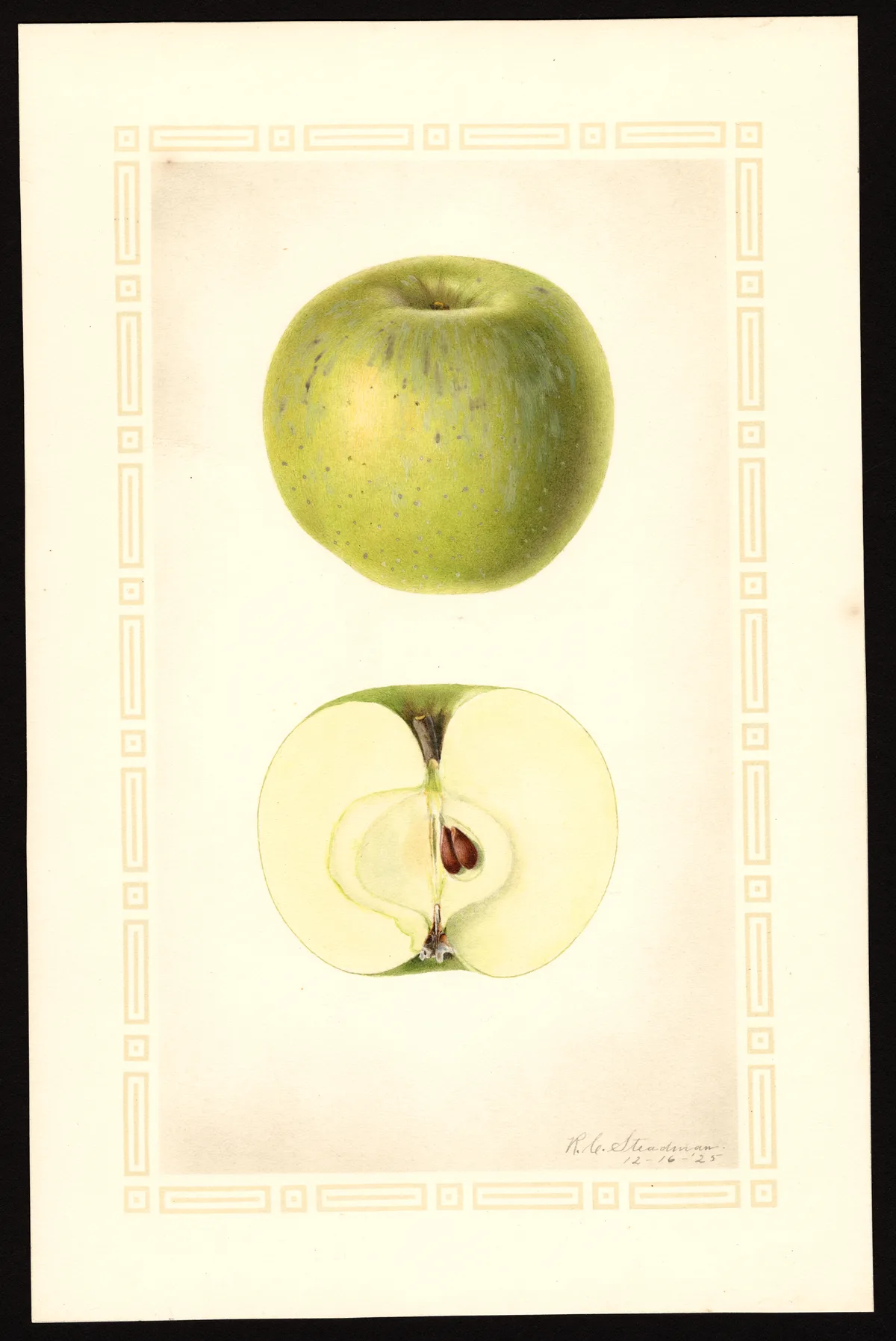
Pumpkin Sweet
AppleOrigin & History
Originated in the orchard of S. Lyman, Manchester, Connecticut (Beach, Warder). Downing states it was received from Mr. S. Lyman, of Manchester, Conn. Elliott calls it "an old Connecticut fruit." Beach reports it had been distributed throughout New York State for more than fifty years by 1905, but was nowhere largely planted. "Generally speaking it is not grown so extensively now as it was formerly, but in a few localities its cultivation for commercial purposes is increasing somewhat" (Beach). Warder notes the fruit was exhibited at the Ohio State Fair at Zanesville, where it was known as "Sweet Russet of Ohio."
Downing observes that "there are also several other Apples under the name of Pumpkin Sweet," and describes two distinct varieties under this name (see Subtypes/Variants below). Beach confirms this confusion, noting: "So far as we know all other varieties which have been cultivated under the name Pumpkin Sweet are either russeted or marked with red," distinguishing the true Lyman variety from all others bearing the name.
Tree
Tree medium to large, vigorous, with long, moderately stout branches (Beach). Form upright spreading or roundish, open (Beach). Downing concurs: "Tree upright, spreading." A good strong grower, rather long-lived, fairly hardy and generally healthy, but it sometimes suffers from winter injury, sunscald and canker (Beach). Appears to thrive particularly well on well-fertilized gravelly or sandy loam, with well-drained subsoil (Beach). In wet soils or heavy clay, liable to be water-cored (Elliott).
Under right conditions it is a pretty reliable cropper, yielding good crops biennially (Beach). Elliott says it "bears regularly, and evenly distributed." The crop ripens somewhat unevenly and often there is a considerable loss from water-cored fruit and from windfalls, but on the other hand there is a small percentage of loss in undersized or deformed apples. In order to lessen the loss from windfalls it is well to plant this variety in a location that is sheltered from prevailing winds (Beach).
Twigs: Medium to short, straight or nearly so, stout to moderately slender; internodes short to medium (Beach). Bark: Reddish olive-green varying to brownish-red, uniformly mottled with thin scarf-skin, pubescent (Beach). Downing describes the young wood as brown. Lenticels: Scattering, rather inconspicuous, small, roundish, not raised (Beach). Buds: Medium or below, plump, acute, free, slightly pubescent (Beach).
Fruit
Size
Large to very large, pretty uniform in size and shape (Beach). All sources agree the fruit is large to very large. Thomas: "Very large."
Form
Globular to roundish conic, sometimes irregularly elliptical or prominently ribbed (Beach). Downing: "roundish, more or less furrowed or ribbed, especially near the stalk." Elliott: "roundish, ribbed at base." Thomas: "roundish, ribbed most toward the stalk." Warder: "regular, roundish, conical."
Stem
Very short, stout, often inserted under a lip or having itself a fleshy protuberance (Beach). Elliott and Thomas both describe the stem as short. Warder, however, describes the stem as "long, slender" — this conflicts with all other sources and may reflect his description of a different variety bearing the Pumpkin Sweet name (see Subtypes/Variants).
Cavity
Acuminate, moderately shallow to rather deep, narrow to moderately wide, often somewhat furrowed or lipped, sometimes russeted and with outspreading russet (Beach). Elliott: "deep, greenish, russeted." Warder: "deep, narrow, regular."
Calyx
Medium to rather large, open; lobes often separated at the base, short, broad, acute (Beach). Elliott and Thomas both describe the calyx as small.
Basin
Small to medium in size, moderately shallow to rather deep, narrow to moderately wide, abrupt to somewhat obtuse, often slightly furrowed or wrinkled (Beach). Thomas: "basin abrupt." Elliott: "irregular." Warder: "medium, regular."
Skin
Rather thin, tough, smooth, at first green but eventually clear yellow marbled with greenish-yellow (Beach). Stripes of whitish scarf-skin radiate from the cavity. Well-colored specimens occasionally show a brownish-red blush but never a distinct red color. Dots conspicuous, whitish, often areolar with russet center (Beach). Beach emphasizes: "It is never marked with red, nor is it russeted except about the cavity."
Downing describes it as "pale green, with obscure whitish streaks near the stalk, and numerous white dots near the eye, sometimes becoming a little yellow next the sun." Elliott: "yellowish green, whitish dots and streaks." Thomas: "pale green."
Beach describes the market appearance: "marbled with light and dark green and streaked over the base with whitish scarf-skin; well colored specimens eventually become quite yellow and sometimes are faintly bronzed on the exposed cheek."
Warder describes the skin as "dull green, covered with a rough coat of russet" — this conflicts sharply with Beach's statement that the true Pumpkin Sweet is never russeted except about the cavity, and likely describes a different variety (see Subtypes/Variants).
Flesh & Flavor
Tinged with yellow, firm, medium in texture, crispness and juiciness, decidedly sweet with a peculiar flavor; good for culinary use and especially esteemed for baking (Beach). Downing: "Flesh white, very sweet, but not very juicy. Good." Thomas: "flesh white, sweet, tender, not juicy, of moderate quality." Elliott: "flesh, white tender, sweet; 'good.'" Warder: "spongy, light; Flavor sweet; Quality scarcely good."
Beach notes it is "rather coarse and has a peculiar flavor" and that "generally it is not valued for dessert." Downing states it is "perhaps, inferior to the Jersey Sweet or the Summer Sweet Paradise for the table, but is a very valuable apple for baking, and deserves a place on this account in every orchard."
Core & Seeds
Core medium to rather large, axile; cells symmetrical, closed or somewhat open, not uniformly developed; core lines clasping. Carpels thin, broadly roundish, but slightly emarginate if at all, often tufted. Seeds medium to rather small, wide, plump, acute, light brown, tufted (Beach). Calyx tube rather wide, conical or elongated cone-shape or sometimes slightly funnel-form. Stamens median to basal (Beach).
Warder: "Core medium, regular; Seeds numerous, small, plump."
Season
Beach: October to January. "As grown in Western New York it comes in season early in October. The rate of loss in ordinary storage is usually high during the fall, and the season closes in December or early January, although in some years a considerable portion of the fruit may remain sound till midwinter or later." Downing: September to December. Elliott: September to November. Thomas: "Ripens through autumn, into winter." Warder: autumn. Beach notes that "its keeping qualities differ greatly in different localities and in different seasons."
Uses
Esteemed as one of the best sweet apples of its season for baking and for canning or stewing with quinces, but generally not valued for dessert because it is rather coarse and has a peculiar flavor (Beach). Downing: "a very valuable apple for baking, and deserves a place on this account in every orchard." Warder: baking and stock-feeding. Thomas: "A valuable culinary sort." Elliott: "valued for baking."
Beach notes it "often sells well in local or special markets, and there is a limited demand for it in the general trade." It was commonly known in Central and Western New York as Pound Sweet and "commonly appears under this name in market quotations" (Beach).
Subtypes & Variants
Downing describes a second distinct variety also called Pumpkin Sweet, found in Connecticut and Massachusetts: "the tree of which is a strong, upright grower, and very productive. Young wood reddish brown, slightly downy. Fruit large, roundish oblate, rich yellow, frequently with considerable russet. Flesh yellowish white, breaking, rich, sugary, sweet, ripening in September and October. Very valuable for baking or stock feeding." Downing adds: "There are also several other Apples under the name of Pumpkin Sweet, but we consider the two above described as the best we have known."
Warder's description — "dull green, covered with a rough coat of russet," with a long slender stem, spongy flesh, and quality "scarcely good" — does not match the Lyman variety described by Beach, Downing, Elliott, and Thomas. It may represent the Ohio "Sweet Russet" variant, another of the several apples cultivated under the Pumpkin Sweet name. Warder himself notes: "This apple has never commended itself very highly to my notice in the limited opportunities I have had for its examination, but it is esteemed in some parts of the country for baking and for stock-feeding."
McCarty is identified by Beach as a distinct strain: "identical with Pumpkin Sweet in general characters and is sold as Pumpkin Sweet, but it appears to differ enough from the type in certain characteristics to entitle it to recognition as a distinct strain. As compared with typical Pumpkin Sweet the fruit of McCarty averages smaller, is not so yellow and keeps longer." B. J. Case, Sodus, N.Y., who grew McCarty commercially, reported: "The tree does not produce any water-cored fruit except when the crop is light. It appears to be fully as productive as Pumpkin Sweet. In common storage it is not unusual to keep McCarty later than January. In quality it is not so good as Pumpkin Sweet. The origin of this type is unknown" (Beach).
Other
Lowther's Encyclopedia of Practical Horticulture (1914) lists Pumpkin Sweet in a variety-characteristic table:
Description absent; variety present in variety-characteristic table.
Pumpkin Sweet (17)........... L rob yr G b W 6* 2*
Book Sources
Described in 6 period pomological works
Nursery Catalog Sources
Found in 15 catalogs (1890–1921) from Maryland, Massachusetts, New Jersey, Oregon, Pennsylvania, Washington
- William H. Moon Co. , Morrisville, Bucks County , Pennsylvania — 1890
- Rogers Nursery Co. , Moorestown , New Jersey — 1893
- Reading Nursery , Jacob W. Manning, Proprietor, Reading , Massachusetts — 1898
- Brown Brothers Co. , Continental Nurseries, Rochester, NY (also operated from Toronto, Canada) — 1899
- Brown Brothers Co. , Continental Nurseries, Rochester, NY (also operated from Toronto, Canada) — 1901
- Russellville Nursery Co. , Montavilla Station, Portland, OR (three miles east of Portland, one mile from Montavilla car line) — 1907
- Carlton Nursery Co. , Carlton , Oregon — 1909
- Wm. J. Corse (successor to Robert Sinclair / Sinclair Nurseries) , Baltimore , Maryland — 1909
- Vineland Nurseries Company , Clarkston , Washington — 1912
- Island Nurseries & Fruit Farm , Vashon (Vashon Island) , Washington — 1914
- Island Nurseries & Fruit Farm , Vashon (Vashon Island) , Washington — 1915
- Union Nurseries , J.B. Weaver & Sons, Union , Oregon — 1915
- Island Nurseries & Fruit Farm , Vashon (Vashon Island) , Washington — 1916
- Island Nurseries & Fruit Farm , Vashon (Vashon Island) , Washington — 1917
- Benedict Nursery Co. , Portland , Oregon — 1921
View original book sources (6)
— John A. Warder, American Pomology: Apples (1867)Pumpkin Sweet. SWEET RUSSET, of Ohio.
Fruit was exhibited at the Ohio State Fair at Zanesville. Fruit large, regular, roundish, conical; Surface dull green, covered with a rough coat of russet. Basin medium, regular; Eye medium, closed. Cavity deep, narrow, regular; Stem long, slender. Core medium, regular; Seeds numerous, small, plump; Flesh spongy, light; Flavor sweet; Quality scarcely good; Use, baking, stock; Season, autumn. This apple has never commended itself very highly to my notice in the limited opportunities I have had for its examination, but it is esteemed in some parts of the country for baking and for stock-feeding.
— A.J. Downing, The Fruits and Fruit Trees of America (1900)Pumpkin Sweet. Vermont Pumpkin Sweet. Lyman's Pumpkin Sweet. Pound Sweet A very large sweet Apple, which we received from Mr. S. Lyman, of Manchester, Conn. It is, perhaps, inferior to the Jersey Sweet or the Summer Sweet Paradise for the table, but is a very valuable apple for baking, and deserves a place on this account in every orchard. Tree upright, spreading. Young wood brown. Fruit very large, roundish, more or less furrowed or ribbed, especially near the stalk. Color pale green, with obscure whitish streaks near the stalk, and numerous white dots near the eye, sometimes becoming a little yellow next the sun. Flesh white, very sweet, but not very juicy. Good. September to December. There is also in Connecticut and Massachusetts another Pumpkin Sweet, the tree of which is a strong, upright grower, and very productive. Young wood reddish brown, slightly downy. Fruit large, roundish oblate, rich yellow, frequently with considerable russet. Flesh yellowish white, breaking, rich, sugary, sweet, ripening in September and October. Very valuable for baking or stock feeding. There are also several other Apples under the name of Pumpkin Sweet, but we consider the two above described as the best we have known.
— S.A. Beach, The Apples of New York, Vol. 2 (1905)PUMPKIN SWEET.
REFERENCES. 1. N. E. Farmer, 1834 (cited by 20). 2. Downing, 1845:89. fig. 3. Emmons, Nat. Hist. N. Y., 3:48. 1851. 4. Mag. Hort., 20:241. 1854. 5. Elliott, 1854:152. 6. Hooper, 1857:56. 7. Am. Pom. Soc. Cat., 1862. 8. Horticulturist, 17:150. 1862. 9. Warder, 1867:527. 10. Barry, 1883:339. 11. Thomas, 1885:216. 12. Lyon, Mich. Hort. Soc. Rpt., 1890:296. 13. Bailey, An. Hort., 1892:247. 14. Munson, Me. Sta. Rpt., 1893:133. 15. Miller, Rural N. Y., 53:278. 1894. 16. Taylor, Am. Pom. Soc. Rpt., 1895:198. 17. Powell and Fulton, U. S. B. P. I. Bul., 48:53. 1903. 18. Budd-Hansen, 1903:155. fig. 19. Beach and Clark, N. Y. Sta. Bul., 248:139. 1904. 20. Ragan, U. S. B. P. I. Bul., 56:244. 1905.
SYNONYMS. Lyman's Large Yellow (20). LYMAN'S PUMPKIN SWEET (2, 3, 6, 9, 10, 11). Lyman's Pumpkin Sweet (5, 14, 17, 19, 20). Pound Sweet (9, 11, 12, 14, 17, 18, 19). PUMPKIN SWEET (1, 4, 5, 7, 8, 12, 13, 14, 15, 16, 17, 18, 19, 20). Pumpkin Sweet (10, 11). Pumpkin Sweeting (20). Rhode Island Sweet (20). Round Sweet (20). Sweet Lyman's Pumpkin (20). Vermont Pumpkin Sweet (10, 20). Vermont Sweet (20). Yankee Apple (5, 20).
Fruit large to very large, marbled with light and dark green and streaked over the base with whitish scarf-skin; well colored specimens eventually become quite yellow and sometimes are faintly bronzed on the exposed cheek. It is never marked with red, nor is it russeted except about the cavity. So far as we know all other varieties which have been cultivated under the name Pumpkin Sweet are either russeted or marked with red.
This is the variety generally known in Central and Western New York as Pound Sweet, and it commonly appears under this name in market quotations. By many it is esteemed as one of the best sweet apples of its season for baking and for canning or stewing with quinces, but generally it is not valued for dessert because it is rather coarse and has a peculiar flavor. It often sells well in local or special markets, and there is a limited demand for it in the general trade. Its keeping qualities differ greatly in different localities and in different seasons. As grown in Western New York it comes in season early in October. The rate of loss in ordinary storage is usually high during the fall, and the season closes in December or early January, although in some years a considerable portion of the fruit may remain sound till midwinter or later (19).
The tree is a good strong grower, rather long-lived, fairly hardy and generally healthy, but it sometimes suffers from winter injury, sunscald and canker. It appears to thrive particularly well on well fertilized gravelly or sandy loam, with well drained subsoil. Under right conditions it is a pretty reliable cropper, yielding good crops biennially. The crop ripens somewhat unevenly and often there is a considerable loss from water-cored fruit and from windfalls, but on the other hand there is a small percentage of loss in undersized or deformed apples. In order to lessen the loss from windfalls it is well to plant this variety in a location that is sheltered from prevailing winds.
Historical. Originated in the orchard of S. Lyman, Manchester, Conn. (9). It has been distributed throughout this state for more than fifty years, but nowhere has it been largely planted. Generally speaking it is not grown so extensively now as it was formerly, but in a few localities its cultivation for commercial purposes is increasing somewhat.
TREE. Tree medium to large, vigorous, with long, moderately stout branches. Form upright spreading or roundish, open. Twigs medium to short, straight or nearly so, stout to moderately slender; internodes short to medium. Bark reddish olive-green varying to brownish-red, uniformly mottled with thin scarf-skin, pubescent. Lenticels scattering, rather inconspicuous, small, roundish, not raised. Buds medium or below, plump, acute, free, slightly pubescent.
FRUIT. Fruit large to very large, pretty uniform in size and shape. Form globular to roundish conic, sometimes irregularly elliptical or prominently ribbed. Stem very short, stout, often inserted under a lip or having itself a fleshy protuberance. Cavity acuminate, moderately shallow to rather deep, narrow to moderately wide, often somewhat furrowed or lipped, sometimes russeted and with outspreading russet. Calyx medium to rather large, open; lobes often separated at the base, short, broad, acute. Basin small to medium in size, moderately shallow to rather deep, narrow to moderately wide, abrupt to somewhat obtuse, often slightly furrowed or wrinkled. Skin rather thin, tough, smooth, at first green but eventually clear yellow marbled with greenish-yellow. Stripes of whitish scarf-skin radiate from the cavity. Well colored specimens occasionally show a brownish-red blush but never a distinct red color. Dots conspicuous, whitish, often areolar with russet center. Calyx tube rather wide, conical or elongated cone-shape or sometimes slightly funnel-form. Stamens median to basal. Core medium to rather large, axile; cells symmetrical, closed or somewhat open, not uniformly developed; core lines clasping. Carpels thin, broadly roundish, but slightly emarginate if at all, often tufted. Seeds medium to rather small, wide, plump, acute, light brown, tufted. Flesh tinged with yellow firm, medium in texture, crispness and juiciness, decidedly sweet with a peculiar flavor; good for culinary use and especially esteemed for baking. Season October to January.
McCARTY is identical with Pumpkin Sweet in general characters and is sold as Pumpkin Sweet, but it appears to differ enough from the type in certain characteristics to entitle it to recognition as a distinct strain. As compared with typical Pumpkin Sweet the fruit of McCarty averages smaller, is not so yellow and keeps longer. B. J. Case, Sodus, N. Y., who grows McCarty commercially, reports: "The tree does not produce any water-cored fruit except when the crop is light. It appears to be fully as productive as Pumpkin Sweet. In common storage it is not unusual to keep McCarty later than January. In quality it is not so good as Pumpkin Sweet. The origin of this type is unknown."
— Granville Lowther (ed.), Encyclopedia of Practical Horticulture (1914)Pumpkin Sweet (17)........... L rob yr G b W 6* 2*
— F.R. Elliott, The Western Fruit Book (1865)Pumpkin Sweet.
Pound Sweet, French's Sweet, Lyman's Pumpkin Sweet, Yankee Apple.
An old Connecticut fruit, valued for baking. In wet soils or heavy clay, liable to be watered-cored. Bears regularly, and evenly distributed. Fruit, large, roundish, ribbed at base — yellowish green, whitish dots and streaks; stem, short; cavity, deep greenish, russeted; calyx, small; basin, irregular; flesh, white tender, sweet; "good." September to November.
— John J. Thomas, The American Fruit Culturist (1903)Pumpkin Sweet. (Lyman's.) Very large, roundish, ribbed most toward the stalk; pale green; stalk short; calyx small, basin abrupt; flesh white, sweet, tender, not juicy, of moderate quality. Ripens through autumn, into winter. A valuable culinary sort. Connecticut.