Sweet Romanite
Apple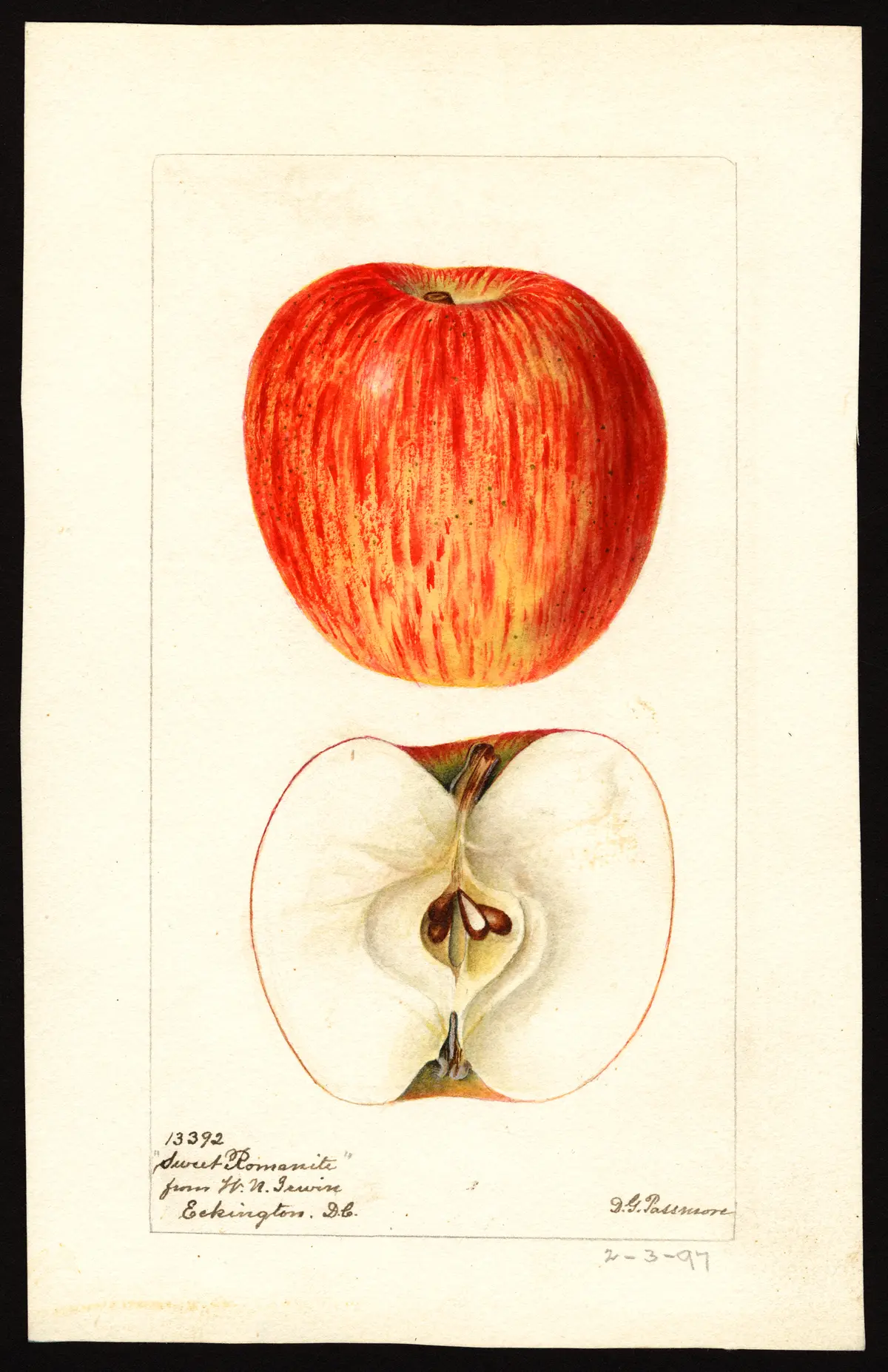
USDA Pomological Watercolor Collection
Sweet Romanite
Origin / History
Warder and Downing give the origin as unknown. Elliott records Sweet Romanite as introduced to the Ohio Pomological Society by W. B. Lipsey, of Morrow County, Ohio, and writes: "We have not been able to identify it with any variety heretofore described." He suggests the name was probably induced by the flesh, which is fine-grained and firm, "somewhat like the Gilpin or Romanite." In Illinois it was grown under the name "Sweet Nonsuch," having been introduced there under the erroneous name "Orange Sweet" (Elliott).
Warder likewise records it as grown in Illinois. There it was introduced at the State Society by "the lamented Cyrus R. Overman, President," and was "much esteemed by him." Thomas calls it "valuable at the West."
Tree
Hardy. A strong, upright grower (Downing). A moderate bearer; "moderate but regular" according to Elliott.
Fruit
Size: Medium.
Form: Roundish oblate or roundish flattened, regular; very regular according to Elliott. Warder gives it as round, sometimes flattened or truncate.
Stem: Short; slender according to Downing. Warder alone gives it as medium to long, and green.
Cavity: Open, regular, with little russet (Elliott). Deep, acute, wavy, brown (Warder).
Calyx: Large, with the segments in divisions, short, half erect (Elliott). Downing calls the segments erect and slightly recurved. Downing and Warder call the calyx closed, and Warder calls the eye small. Thomas calls it open.
Basin: Furrowed, corrugated, or folded and plaited. Elliott calls it broad and shallow. Warder calls it medium, or deep and abrupt.
Skin: Smooth, with a greenish-yellow ground, mostly striped and overspread with bright red, and covered with a fine bloom (Elliott). Downing calls it shaded, splashed, and striped with red. Warder describes it as blushed, mixed bright red and dull red, with the stripes indistinct.
Dots: Light (Downing). Warder calls them scattered and irregular, brown or fawn on the deeper colors.
Flesh and flavor: Flesh greenish yellow (Elliott), yellow (Warder), or yellowish white (Downing). It is fine-grained, firm, compact, crisp, breaking, tender, and juicy. Flavor sweet; Warder calls it "very sweet," and Downing calls it "rich, sweet." Elliott judges it "superior to Ramsdell's or Danvers' Sweeting." Warder and Downing both rate the quality "good to very good."
Core and seeds: Core small (Downing), or "medium, or rather small" (Elliott). Elliott calls it compact, with the center slightly hollow. Warder calls it roundish, closed, and clasping. Seeds ovate, oblong pyriform (Elliott); numerous, plump, and angular (Warder).
Season
Winter. The recorded season runs from November into April. Elliott and Downing give November to March, and Warder gives December to April. Thomas says it keeps through winter.
Uses
Baking, cider, table, and stock (Warder).
Subtypes / Variants
Elliott records another Sweet Romanite grown in the Western States. It is oblong, with a long, slender stem. Elliott gives its color as "core, light yellow, striped with red." Its flesh is more yellow and dry, and he judges it "an inferior or unworthy variety."
He also records a different Sweet Nonsuch. It is flat, with a slender stem and a deep cavity, and is light red on pale yellow. Its flesh is white, sweet, dry, and tough; he calls it "inferior."
Other
Thomas illustrates the variety as Fig. 405.
Book Sources
Described in 4 period pomological works
Nursery Catalog Sources
Found in 2 catalogs (1901–1913) from Illinois
- Benjamin Buckman (personal inventory) , Farmingdale , Illinois — 1901
- Benjamin Buckman (personal inventory) , Farmingdale , Illinois — 1913
View original book sources (4)
— F.R. Elliott, The Western Fruit Book (1865)Sweet Romanite. Sweet Nonsuch, | Orange Sweet, erroneously.
This is a variety introduced to the Ohio Pomological Society by W. B. Lipsey, of Morrow County, Ohio. We have not been able to identify it with any variety heretofore described. The flesh being fine-grained and firm—somewhat like the Gilpin or Romanite—probably induced the name. It is grown in Illinois, under the name of "Sweet Nonsuch," and introduced there under the erroneous name of "Orange Sweet." Tree, hardy, moderate but regular bearer.
Size, medium ; form, roundish flattened, very regular : color, greenish yellow ground, mostly striped and overspread with bright red, and covered with a fine bloom : stem, short ; cavity, open, regular, with little russet ; calyx, large, segments in divisions, short, half erect ; basin, broad, shallow, furrowed : flesh, greenish yellow, firm, crisp, juicy, sweet—superior to Ramsdell's or Danvers' Sweeting ; core, medium, or rather small, compact—centre, slightly hollow ; seeds, ovate, oblong pyriform. November to March.
There is another Sweet Romanite grown in the Western States, which is oblong ; stem, long and slender ; core, light yellow, striped with red ; flesh, more yellow and dry—an inferior or unworthy variety.
There is also a Sweet Nonsuch grown, which is flat, with slender stem ; cavity, deep, light red on pale yellow ; flesh, white, sweet, dry, and tough : inferior.
— John A. Warder, American Pomology: Apples (1867)Sweet Romanite.
Origin unknown. Grown in Illinois; introduced at the State Society by the lamented Cyrus R. Overman, President—much esteemed by him.
Fruit medium, round, sometimes flattened or truncate, regular; Surface smooth, greenish-yellow, blushed, mixed bright red and dull red, stripes indistinct; Dots scattered, irregular, brown or fawn on the deeper colors.
Basin medium, or deep and abrupt, folded, plaited; Eye small, closed.
Cavity deep, acute, wavy, brown; Stem medium to long, green.
Core roundish, closed, clasping; Seeds numerous, plump, angular; Flesh yellow, fine-grained, breaking, juicy; Flavor very sweet; Quality good to very good; Use, baking, cider, table and stock; Season, December to April.
— A.J. Downing, The Fruits and Fruit Trees of America (1900)Sweet Romanite.
Red Winter Sweet ? Sweet Nonsuch.
Origin unknown. Tree a strong, upright grower, hardy, moderate bearer.
Fruit medium, roundish oblate, greenish yellow, shaded, splashed, and striped with red, light dots. Stalk short, slender. Calyx closed. Segments erect, slightly recurved. Basin corrugated. Flesh yellowish white, compact, tender, juicy, rich, sweet. Good to very good. Core small. November to March.
— John J. Thomas, The American Fruit Culturist (1903)Sweet Romanite. (Sweet Nonsuch, of Illinois.) Size medium, roundish oblate, regular; striped and shaded with bright red on greenish yellow; stalk short; calyx large, open; basin shallow, furrowed; flesh greenish yellow, firm, crisp, juicy, sweet. Keeps through winter. Fig. 405. Valuable at the West.