Hog Island Sweet
Apple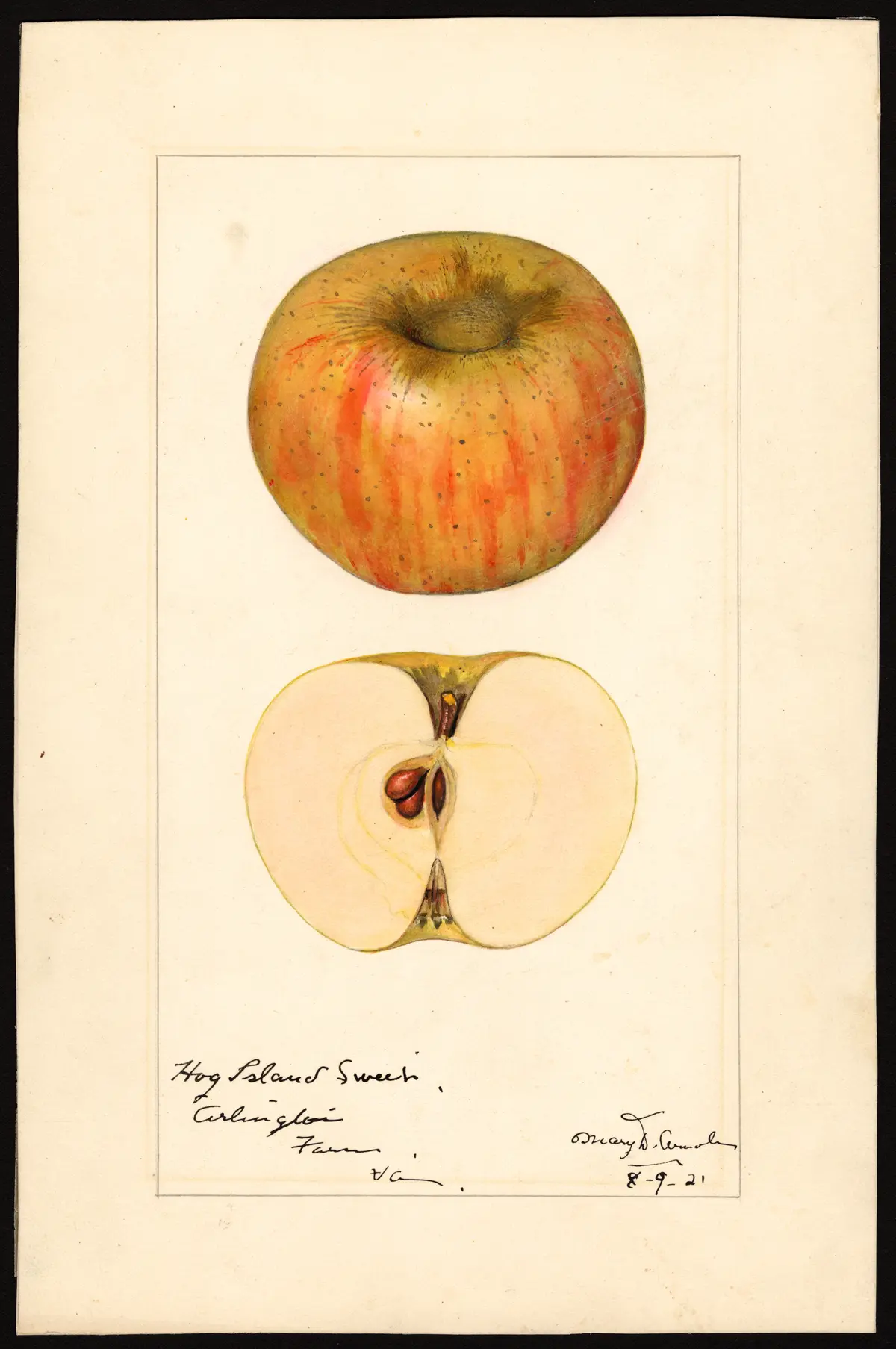
USDA Pomological Watercolor Collection
Hog Island Sweet
Origin / History
An old variety originating on Hog Island, adjoining Long Island, New York (Downing; Beach). It is but little known (Beach).
Tree
Vigorous and productive (Downing; Beach; Thomas). Wood dark brown, slightly downy, and short-jointed (Downing).
Fruit
Size: Downing and Thomas give medium size; Beach describes the fruit as medium to large, pretty uniform.
Form: Downing and Thomas describe the fruit as oblate. Beach gives a broader range: roundish conical to oblate, broad at the base, regular or obscurely ribbed.
Stem: Downing describes the stalk as rather short and slender. Beach gives it as short to medium and moderately thick.
Cavity: Downing: deep and abrupt. Beach: acute, deep, rather broad, heavily russeted and with outspreading russet rays.
Calyx: Downing: closed. Beach: medium to large, closed or partly open; lobes short, broad, acute.
Basin: Downing: broad, of moderate depth. Beach: shallow to medium in depth, narrow to moderately wide, abrupt, broadly furrowed.
Skin: Thick, rather tough, somewhat roughened with flecks and patches of russet; ground color pale yellow or greenish, washed and mottled with red, overlaid with broad and narrow stripes and splashes of carmine (Beach). Dots numerous, small, russet (Beach). Prevailing effect bright striped red over a yellow background (Beach). Downing describes the color as yellow striped with red, with a bright crimson cheek. Thomas: fine red.
Flesh / Flavor: Flesh tinged with yellow (Beach), moderately coarse (Beach), crisp, tender, juicy (Downing; Beach). Flavor very sweet, somewhat aromatic (Beach), slightly aromatic (Downing), rich (Downing; Thomas). Quality good to very good (Downing; Beach; Thomas).
Core / Seeds: Core small to medium, abaxile to nearly axile; cells somewhat unsymmetrical, open; core lines slightly clasping the funnel cylinder or meeting. Carpels roundish obovate to elliptical, emarginate. Calyx tube long, wide, conical to funnel-shape. Stamens basal to median. Seeds medium or below, sometimes tufted, rather wide, rather short, plump, acute to somewhat obtuse (all Beach).
Season
September to October (Downing); September to early winter (Beach); autumn (Thomas).
Uses
Valuable for family use and stock feeding (Downing).
Subtypes / Variants
Not described in source.
Other
Not described in source.
Book Sources
Described in 3 period pomological works
Nursery Catalog Sources
Found in 2 catalogs (1901–1913) from Illinois
- Benjamin Buckman (personal inventory) , Farmingdale , Illinois — 1901
- Benjamin Buckman (personal inventory) , Farmingdale , Illinois — 1913
View original book sources (3)
— A.J. Downing, The Fruits and Fruit Trees of America (1900)Hog Island Sweet.
Canada Sweet. Sweet Pippin. English Sweet, erroneously.
Origin, Hog Island, adjoining Long Island. Tree vigorous and productive. Wood dark brown, slightly downy, short-jointed, valuable for family use and stock feeding.
Fruit of medium size, oblate, yellow, striped with red, with a bright crimson cheek. Stalk rather short, slender, inserted in a deep, abrupt cavity. Calyx closed, set in a broad basin of moderate depth. Flesh yellow, juicy, crisp, tender, slightly aromatic, with a very sweet, rich, excellent flavor. Good to very good. September, October.
— S.A. Beach, The Apples of New York, Vol. 2 (1905)HOG ISLAND SWEET.
REFERENCES. 1. Downing, 1857:152. 2. Warder, 1867:721. 3. Downing, 1872:10 index, app. 4. Thomas, 1875:502. 5. Lyon, Mich. Hort. Soc. Rpt., 1890:292.
SYNONYMS. HOG ISLAND SWEET (1, 2, 3, 4, 5). Sweet Pippin (1). Van Kleek's Sweet (3).
A beautiful and excellent sweet apple in season from September to early winter. It is an old variety which had its origin on Hog Island, near Long Island, N. Y. (1). It is but little known. The tree is vigorous and productive.
FRUIT.
Fruit medium to large, pretty uniform. Form roundish conical to oblate, broad at the base, regular or obscurely ribbed. Stem short to medium, moderately thick. Cavity acute, deep, rather broad, heavily russeted and with outspreading russet rays. Calyx medium to large, closed or partly open; lobes short, broad, acute. Basin shallow to medium in depth, narrow to moderately wide, abrupt, broadly furrowed. Skin thick, rather tough, somewhat roughened with flecks and patches of russet, pale yellow or greenish washed and mottled with red overlaid with broad and narrow stripes and splashes of carmine. Dots numerous, small, russet. Prevailing effect bright striped red over a yellow background. Calyx tube long, wide, conical to funnel-shape. Stamens basal to median. Core small to medium, abaxile to nearly axile; cells somewhat unsymmetrical, open; core lines slightly clasping the funnel cylinder or meeting. Carpels roundish obovate to elliptical, emarginate. Seeds medium or below, sometimes tufted, rather wide, rather short, plump, acute to somewhat obtuse. Flesh tinged with yellow, moderately coarse, crisp, tender, juicy, very sweet, somewhat aromatic, good to very good. Season September to early winter.
— John J. Thomas, The American Fruit Culturist (1903)Hog Island Sweet. Medium, oblate, fine red; sweet, rich, very good. Autumn. Productive. N. Y.