Ramsdell Sweet
Apple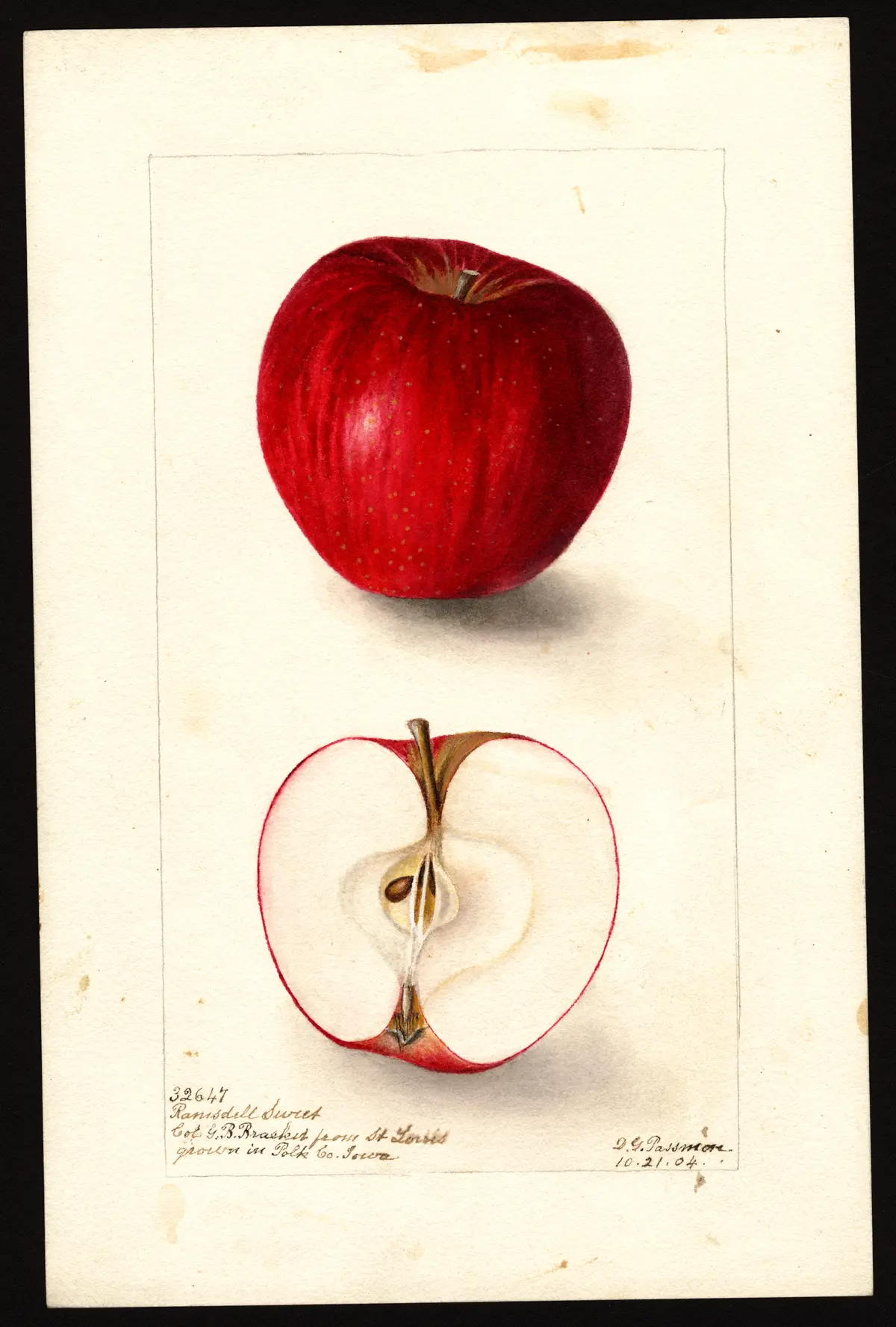
USDA Pomological Watercolor Collection
Ramsdell Sweet
Origin / History
Ramsdell Sweet was first brought to notice when the Rev. H. S. Ramsdell of Thompson, Connecticut, exhibited it before the Massachusetts Horticultural Society. It was named Ramsdell's Red Sweeting in compliment to him. Beach cites the Magazine of Horticulture for 1838 for this, and Hedrick dates the introduction to about 1838. Warder, Thomas, and Budd and Hansen give Connecticut as the place of origin; Elliott alone calls it "Foreign."
Downing described it in 1845 under the name Ramsdell's Sweeting. In his 1869 edition he described it under the name English Sweet, a name previously recognized by Elliott. Beach says of that name that "we have been unable to learn" upon what authority it rested. He adds that the variety "has been described by some leading pomologists under the name English Sweet." Elliott enters it as English Sweeting, Downing as English Sweet, and Warder as Ramsdell's Red. In 1862 it was entered on the catalogue of the American Pomological Society as Ramsdell Sweet, a name that catalogue retained up to Beach's time. According to Beach, it is commonly catalogued by nurserymen and generally known among nurserymen and fruit growers as Ramsdell or Ramsdell Sweet.
Downing calls it an "old variety" that "is esteemed where grown for the large crops which it bears." Beach calls it "an attractive red apple of good size and very good quality." Hedrick writes that Ramsdell Sweet "was once popular because of the handsome red color and good quality of the apples," and that "its culture is confined to the East and North."
Tree
Vigorous, upright. Downing calls it very vigorous and says it grows "remarkably straight and upright." Beach calls it vigorous or moderately vigorous and "a pretty good grower," of medium size, upright and open in form. Many branches (Warder).
Twigs long, curved, moderately stout; internodes medium. Bark brown, streaked with heavy scarf-skin, slightly pubescent near the tips. Lenticels scattering, small to medium, oval, raised. Buds medium size, plump, obtuse, free, pubescent (Beach). Young shoots slender and reddish (Warder); clear reddish brown, slightly grayish (Downing). Foliage rather light green (Warder).
An early bearer. Most authors call it productive, prolific, or a heavy bearer, and Downing says it "yields every year enormously." Beach dissents. He finds it yields some fruit annually or nearly annually, "but in many cases it is not satisfactorily productive." Hedrick says the trees "are not fruitful enough to give the variety value for commercial plantations."
Fruit
Size: Medium to large. Most authors place it above medium or rather large, and Beach adds "sometimes nearly large." Somewhat variable in size (Beach). In his introductory remarks Hedrick says the apples "are not uniform in size or shape." Downing writes, "In weight the apple is light."
Form: Oblong, regular, tapering slightly toward the eye, truncated (Warder; Budd and Hansen), obscurely conical (Thomas). Beach gives oblong conic to roundish conic, often somewhat elliptical and faintly ribbed, and calls it fairly uniform in shape. This conflicts with Hedrick's remark that the apples are not uniform in shape. Lowther's table alone gives the form as oblate.
Stem: Short to long. Most authors give short or short to medium. Warder gives medium to long, and Budd and Hansen short, medium, or long. Moderately slender (Beach). Often red.
Cavity: Deep, acute to acuminate. Warder calls it wavy, and Budd and Hansen regular. Often with some stellate russet; Budd and Hansen describe a large stellate russet patch. Beach calls it rather broad and quite symmetrical, while Elliott calls it narrow and angular, often with a fleshy knob.
Calyx: Small to medium, closed or slightly open; Budd and Hansen call it half open. Lobes narrow, acute to acuminate (Beach); segments short and stiff (Elliott), erect and convergent (Budd and Hansen). Calyx tube rather large, long, cylindrical to narrow funnel-shape (Beach); funnel-shaped (Budd and Hansen). Stamens median (Beach); median or basal (Budd and Hansen).
Basin: Narrow to medium in width, medium to rather deep, abrupt. Rather small, sometimes oblique (Beach). Its surface is described as round and regular (Elliott), even (Thomas), or nearly smooth (Budd and Hansen), against wavy (Warder) or faintly furrowed and wrinkled (Beach).
Skin: Thin, rather tough. Smooth (Warder, Beach, Budd and Hansen); Elliott calls it green and rough in shade. Yellow ground nearly or almost wholly overspread with dark red, described as attractive, rich, or solid. It may also be entirely red with obscure splashes and stripes of carmine (Beach), or the dark red may carry indistinct stripes and splashes (Budd and Hansen). Warder has yellow hidden by bright red, mixed and striped. Lowther's table gives yellow-red. Covered with a blue bloom, which Elliott places on the dark red of the sunny side. Prevailing effect red; showy and handsome.
Dots: Many, distinct, conspicuous, small to large, pale yellow, yellow, or grayish, often submerged. Budd and Hansen call them large, gray, and very conspicuous. Elliott and Downing describe fawn-colored specks.
Flesh and flavor: Flesh yellowish white to yellow, or tinged with yellow. Firm, fine, tender, juicy. Breaking (Warder); "very tender and mellow" (Downing). Very sweet and rich; Downing calls it "unusually sweet and rich."
Quality good to very good. Most authors rate it "very good" or "good to very good." Thomas rates it "good second quality," and Lowther's table "good."
Core and seeds: Core axile to somewhat abaxile, closed (Warder; Budd and Hansen). Warder says it is clasping the eye; Beach and Budd and Hansen describe the core lines as clasping. Warder calls the core large and oval and Elliott long and ovate, against small to medium in Beach. Cells symmetrical but not uniformly developed, closed or slightly open (Beach); elliptical, slit (Budd and Hansen). Carpels ovate to nearly roundish (Beach).
Seeds are large in Warder, against below medium, rather narrow, plump, and acute in Beach, and short and plump in Budd and Hansen. Elliott calls the seeds imperfect.
Season
The recorded season runs from September into February. Most authors give October to February, midautumn to midwinter, or late autumn and early winter. Warder gives September to December. Lowther's table says only winter.
Uses
A sweet apple for cooking, baking, market, and stock feeding. Downing calls it "a showy sweet apple for market, and profitable for stock feeding, as well as superior for cooking." Warder gives its use as baking and stock, and Lowther's table both kitchen and market.
Beach does not recommend it for commercial planting in New York. He finds the fruit "not very uniform in size and quality, so that there is a considerable loss from unmarketable fruit."
Subtypes / Variants
Not described in source.
Other
Not described in source.
Book Sources
Described in 8 period pomological works
- Beach, The Apples of New York Vol. 2 (1905)
- Warder, American Pomology: Apples (1867) — listed as Ramsdell's Red
- Budd & Hansen, Systematic Pomology (1914)
- Hedrick, Cyclopedia of Hardy Fruits (1922)
- Thomas, The American Fruit Culturist (1903)
- Downing, Fruits and Fruit Trees of America (1900) — listed as English Sweet
- Elliott, The Western Fruit Book (1865) — listed as English Sweet
- Lowther (ed.), Encyclopedia of Practical Horticulture (1914) — listed as Ramsdell's Sweet
Nursery Catalog Sources
Found in 3 catalogs (1901–1913) from Illinois
- Benjamin Buckman (personal inventory) , Farmingdale , Illinois — 1901 — listed as Ramsdell's Sweet
- Phoenix Nursery Company (W. E. Rossney , President; Sidney Tuttle, Vice-President), Bloomington , Illinois — 1904 — listed as Ramsdell's Sweet
- Benjamin Buckman (personal inventory) , Farmingdale , Illinois — 1913 — listed as Ramsdell's Sweet
View original book sources (8)
— F.R. Elliott, The Western Fruit Book (1865)English Sweeting.
Ramsdell's Sweeting, | Ramsdell's Red Pumpkin Sweet, | Avery Sweeting. Ramsdell's Sweet, | Red Pumpkin Sweet, |
Foreign. Tree, vigorous, upright, early, prolific bearer. Fruit, medium to large, oblong, tapering to the eye, green and rough in shade, dark red dotted with fawn specks, and with a blue bloom in sun; stem, short; cavity, narrow, angular, often a fleshy knob; calyx, with short stiff segments; basin, round, regular; core, long, ovate; seeds, imperfect; flesh, yellowish white, sweet; "very good." October to February.
— John A. Warder, American Pomology: Apples (1867)Ramsdell's Red.
Origin Connecticut. Tree vigorous, upright, many branches, productive, early bearer; Shoots slender, reddish; Foliage rather light green.
Fruit medium to large, oblong, regular, truncated; Surface smooth, yellow, hidden by bright red, mixed and striped; Dots numerous, yellow, distinct.
[Fig. 269.—Ramsdell's Red.]
Basin rather deep, abrupt, wavy; Eye small to medium, closed.
Cavity deep, acute, wavy; Stem medium to long, often red.
Core large, oval, closed, clasping the eye; Seeds large; Flesh yellow, breaking, juicy; Flavor very sweet, rich; Quality very good; Use, baking and stock; Season, September to December.
— A.J. Downing, The Fruits and Fruit Trees of America (1900)English Sweet.
Ramsdell's Sweet. Ramsdell's Sweeting. Hurlbut Sweet? Ramsdell's Red Pumpkin Sweet. Red Pumpkin Sweet. Avery Sweet. Randall's Red Winter.
This old variety is esteemed where grown for the large crops which it bears, and as a showy sweet apple for market, and profitable for stock feeding, as well as superior for cooking.
The tree is very vigorous, grows remarkably straight and upright, comes early into bearing, and yields every year enormously. Young shoots clear reddish brown, slightly grayish.
Fruit rather above medium size, oblong, regularly shaped, and tapering slightly towards the eye, dark red, dotted with fawn-colored specks, and covered with a blue bloom. Flesh yellowish, very tender and mellow, unusually sweet and rich. Good to very good. In weight the apple is light. October to February.
— John J. Thomas, The American Fruit Culturist (1903)Red Pumpkin Sweet. See Ramsdell's Sweet.
[Additional entry in this volume: "Ramsdell's Sweet", pp. 344–344]
Ramsdell's Sweet. (Ramsdell's Red Pumpkin Sweet.) Rather large, oblong, obscurely conical, regular; dark rich red, with a blue bloom; stalk short; basin rather deep, even; flesh yellowish, tender, sweet, rich, good second quality. Tree vigorous, upright, productive. Late autumn and early winter. Connecticut.
— S.A. Beach, The Apples of New York, Vol. 2 (1905)RAMSDELL SWEET.
References. 1. Mag. Hort., 4:47. 1838. 2. Manning and Ives, 1844:41. 3. Downing, 1845:137. 4. Mag. Hort., 12:475. 1846. 5. Thomas, 1849:161. 6. Cole, 1849:118. 7. Emmons, Nat. Hist. N. Y., 3:76. 1851. 8. Elliott, 1854:131. 9. Hooper, 1857:74. 10. Am. Pom. Soc. Cat., 1862. 11. Warder, 1867:664. fig. 12. Downing, 1869:163. 13. Fitz, 1872:121, 145. 14. Leroy, 1873:605. fig. 15. Barry, 1883:352. 16. Lyon, Mich. Hort. Soc. Rpt., 1890:296. 17. Bailey, An. Hort., 1892:247. 18. Burrill and McCluer, Ill. Sta. Bul., 45:337. 1896. 19. Farrand, Mich. Sta. Bul., 205:46. 1903. 20. Budd-Hansen, 1903:159. fig.
Synonyms. Avery Sweet (12, 14). Avery Sweeting (8). ENGLISH SWEET (12, 18). English Sweet (14, 15, 16, 20). ENGLISH SWEETING (4, 8). Hurlbut (14). Hurlbut Sweet (12). RAMSDALE'S SWEETING (9). RAMSDELL (14, 19). RAMSDELL'S RED (11). Ramsdell Red Sweet (18). RAMSDELL'S RED SWEETING (1). RAMSDELL SWEET (10, 15, 16, 17, 20). Ramsdell Sweet (3, 8, 12). RAMSDELL'S SWEETING (3, 5, 6, 7, 12, 13). Ramsdell's Sweeting (8, 14). RAMSDEL'S RED PUMPKIN SWEET (2). Ramsdel's Red Pumpkin Sweet (3, 5, 7, 8, 12). Randall's Red Winter (12, 14). Red Pumpkin Sweet (3, 8, 12). Red Pumpkin Sweeting (9). Reindell's Large (14).
This is an attractive red apple of good size and very good quality, in season from midautumn to midwinter. The tree is a pretty good grower and an early bearer, yielding some fruit annually or nearly annually, but in many cases it is not satisfactorily productive and the fruit is not very uniform in size and quality, so that there is a considerable loss from unmarketable fruit. Not recommended for commercial planting in New York.
Historical. This variety was first brought to notice by being exhibited before the Massachusetts Horticultural Society by the Rev. H. S. Ramsdell, Thompson, Conn., and was named Ramsdell's Red Sweeting in compliment to him (1). Downing described it in 1845 (3) under the name Ramsdell's Sweeting, but in the 1869 edition (12) it was described under the name English Sweet, the name previously recognized by Elliott (8) but upon what authority we have been unable to learn. In 1862 (10) it was entered on the catalogue of the American Pomological Society under the name Ramsdell Sweet which name has been retained in that catalogue up to the present time. It is also commonly catalogued by nurserymen under the name Ramsdell or Ramsdell Sweet (17).
Tree. Tree medium size, vigorous or moderately vigorous. Form upright, open. Twigs long, curved, moderately stout; internodes medium. Bark brown, streaked with heavy scarf-skin; slightly pubescent near tips. Lenticels scattering, small to medium, oval, raised. Buds medium size, plump, obtuse, free, pubescent.
Fruit. Fruit above medium, sometimes nearly large, somewhat variable in size, fairly uniform in shape. Form oblong conic to roundish conic, often somewhat elliptical and faintly ribbed. Stem short to medium in length, moderately slender, often red. Cavity acuminate, deep, rather broad, quite symmetrical, often with some stellate russet. Calyx small to medium, closed or slightly open; lobes narrow, acute to acuminate. Basin rather small, sometimes oblique, medium to rather deep, narrow to medium in width, abrupt, faintly furrowed and wrinkled. Skin thin, rather tough, smooth, yellow nearly overspread with attractive dark red, or entirely red with obscure splashes and stripes of carmine, overspread with blue bloom. Dots many, distinct, conspicuous, small to rather large, pale yellow or grayish, often submerged. Prevailing effect red, attractive. Calyx tube rather large, long, cylindrical to narrow funnel-shape. Stamens median. Core small to medium, axile to somewhat abaxile; cells symmetrical but not uniformly developed, closed or slightly open; core lines clasping. Carpels ovate to nearly roundish. Seeds below medium, rather narrow, plump, acute. Flesh tinged with yellow, firm, fine, tender, juicy, very sweet, good to very good. Season October to February.
[Additional entry in this volume: "ENGLISH SWEET", pp. 109–109]
ENGLISH SWEET.
Ramsdell or Ramsdell Sweet has been described by some leading pomologists under the name English Sweet. Ramsdell Sweet is the name accepted for this variety in the catalogue of the American Pomological Society, and it is generally known among nurserymen and fruit growers as Ramsdell or Ramsdell Sweet. For a description of this variety, the reader is referred to Ramsdell Sweet, page 175.
— J.L. Budd & N.E. Hansen, American Horticultural Manual, Part II: Systematic Pomology (1914)Ramsdell Sweet (English Sweet).—Origin, Connecticut; tree vigorous, upright, an early and heavy bearer.
Ramsdell Sweet.
Fruit above medium, regular, oblong, slightly tapering, truncated; surface smooth, yellow, almost wholly covered with solid dark red, with indistinct stripes and splashes, with blue bloom; dots many, large, gray, very conspicuous; cavity regular, deep, acute, with large stellate russet patch; stem short, medium or long, often red; basin narrow, abrupt, nearly smooth; calyx half open; segments erect convergent. Core closed, clasping; cells elliptical, slit; tube funnel-shaped; stamens median or basal; seeds short, plump; flesh yellow, tender, juicy, firm, rich, very sweet, very good. October to February,
— Granville Lowther (ed.), Encyclopedia of Practical Horticulture (1914)Ramsdell's Sweet. Size: medium. Form: oblate. Color: yellow-red. Quality: good. Use: both kitchen and market. Season: winter.
— U.P. Hedrick, Cyclopedia of Hardy Fruits (1922)RAMSDELL SWEET.
Hurlbut. Ramsdell's Red. Red Pumpkin Sweet.
Ramsdell Sweet was once popular because of the handsome red color and good quality of the apples, which, however, are not uniform in size or shape. The trees are not fruitful enough to give the variety value for commercial plantations. Ramsdell Sweet was brought to notice by Rev. H. S. Ramsdell, Thompson, Connecticut, about 1838. Its culture is confined to the East and North.
Tree vigorous, upright, open. Fruit medium or large, variable in size, uniform in shape, oblong-conic or round-conic, often elliptical and faintly ribbed; stem short, slender, often red; cavity acuminate, deep, broad, symmetrical, often russeted; calyx small, closed or open; lobes narrow, abrupt; basin faintly furrowed and wrinkled; skin thin, tough, smooth, yellow, overspread with dark red, with obscure splashes and stripes of carmine, overspread with bloom; dots many, distinct, conspicuous, large, pale yellow or gray, often submerged; prevailing effect red; calyx-tube large, long, cylindrical; stamens median; core small, axile or abaxile; cells symmetrical but not uniformly developed, closed or open; core-lines clasping; carpels ovate; seeds small, narrow, plump, acute; flesh yellow, firm, fine, tender, juicy, sweet; good to very good; October to February.