Pumpkin Russet
Apple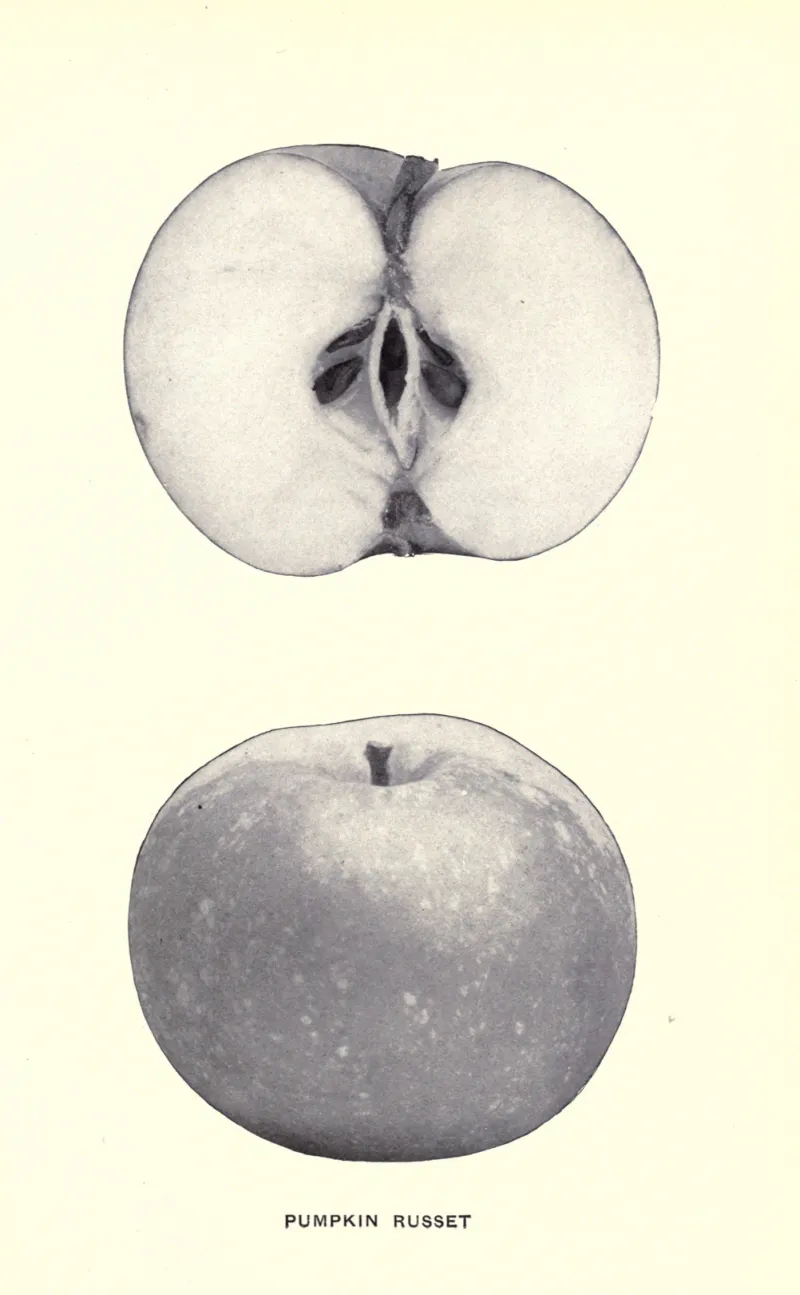
Origin/History
Pumpkin Russet is an old New England variety from Connecticut (Thomas), origin otherwise unknown (Downing). It has been grown in New England for a century (Hedrick, 1922) and appears to have been first described in 1832 by Kenrick under the name Pumpkin Sweeting of New England (Beach, Hedrick). In 1845 Downing described it under the name Pumpkin Russet, which is the name now generally accepted for it by pomologists (Beach). In 1849 Cole described it under the name Pumpkin Sweet, giving Pumpkin Russet as a synonym (Beach). It is still occasionally listed by nurserymen but is now seldom planted in New York (Beach). Formerly a great favorite in New England (Hedrick). Thomas notes it is distinct from the Sweet Russet cultivated through western New York, which is a more conical fruit.
Tree
Tree large, vigorous or very vigorous, at first upright but eventually becoming roundish or spreading, open; branches long, stout, curved. Twigs short, curved, stout; internodes long. Bark dark reddish-brown tinged with olive-green, lightly streaked with scarf-skin, pubescent. Lenticels quite numerous, oblong, slightly raised. Buds large, broad, plump, obtuse, free, pubescent. Hardy, moderately long-lived; yields fair to good crops biennially or in some cases almost annually (Beach). Hedrick notes the variety is hardly surpassed in tree-characters. Downing describes the trees as large and spreading.
Fruit
Size: Large (all sources).
Form: Accounts vary. Warder describes it as globular and regular; Downing and Elliott as round/roundish; Thomas as round, slightly flattened. Beach describes the form as oblate or somewhat inclined to conic, sometimes irregular, faintly ribbed, often compressed, fairly uniform in size and shape. Hedrick similarly describes it as large, uniform in size and shape, oblate or conic, sometimes irregular, faintly ribbed, often compressed.
Stem: Long (Downing, Elliott). Beach describes it as medium to short, moderately slender to thick. Hedrick gives stem short, slender.
Cavity: Wide and shallow (Downing, Elliott, Thomas). Beach describes the cavity as acute to acuminate, usually deep, moderately broad to rather narrow, nearly smooth, sometimes slightly furrowed. Hedrick gives cavity acute.
Calyx: Large, closed or slightly open; lobes long, narrow, acute to acuminate (Beach). Eye narrow, slightly sunk (Downing).
Basin: Small (Elliott, Thomas). Beach describes the basin as small to medium, rather shallow to moderately deep, medium in width, somewhat abrupt, slightly furrowed and wrinkled. Hedrick gives basin small, shallow, medium in width, abrupt, furrowed and wrinkled.
Skin: Surface covered with coarse russeting (Warder). Yellowish green, thinly russeted (Elliott); yellowish green, partly russetted (Thomas); pale yellowish green, slightly covered with russet (Downing). Beach describes the skin as thick, rather tough, greenish or yellowish sometimes with bronze blush on exposed cheek, more or less covered with russet patches or netted veins of russet. Hedrick gives skin thick, tough, pale yellow, sometimes with bronze blush on cheek, covered with russet patches or netted veins of russet.
Dots: Large and small, scattering, usually russet, irregular (Beach, Hedrick).
Flesh/Flavor: Spongy, light, very sweet (Warder); exceedingly rich and sweet, Good (Downing); dry, sweet, "good" (Elliott); flavor rich and sweet (Thomas). Beach describes the flesh as greenish-white or yellowish, firm, rather coarse, tender, juicy, sweet, good. Hedrick gives flesh greenish-white, firm, coarse, tender, juicy, sweet; good. Hedrick notes the apples are so coarse as to be fit only for cooking, and are none too good for culinary purposes.
Core/Seeds: Calyx tube short, wide, broadly conical to nearly urn-shape (Beach); Hedrick gives calyx-tube short, wide, broadly conical. Stamens median to basal (Beach); stamens median (Hedrick). Core above medium to below, abaxile (Beach); core medium, abaxile (Hedrick). Cells usually open, symmetrical but not uniformly developed; core lines slightly clasping (Beach) / clasping (Hedrick). Carpels broadly ovate, very slightly emarginate, sometimes tufted (Beach); broadly ovate, emarginate, sometimes tufted (Hedrick). Seeds moderately light brown, rather large, wide, flat, acute (Beach); light brown, large, wide, flat, acute (Hedrick).
Season
Autumn (Warder); September to January (Downing); September to December (Elliott); through autumn (Thomas); September and October, or in cold storage extending to January 1 (Beach, citing Beach and Clark, N.Y. Sta. Bul. 248:139, 1904); September and October (Hedrick).
Uses
Used for baking and apple butter (Warder). Very good for baking but of little value for other purposes (Beach). Not valuable, except for stock (Warder). Not a profitable commercial variety and now seldom cultivated even for home use (Beach). Apples so coarse as to be fit only for cooking, and none too good for culinary purposes (Hedrick).
Subtypes/Variants
Not described in source.
Other
Thomas explicitly distinguishes Pumpkin Russet from the Sweet Russet cultivated through western New York, which is a more conical fruit.
Book Sources
Described in 6 period pomological works
View original book sources (6)
— John A. Warder, American Pomology: Apples (1867)Pumpkin Russet.
Fruit large, globular, regular; Surface covered with coarse russeting; Flesh spongy, light, very sweet; Used for baking and apple butter; Season, autumn. Not valuable, except for stock.
— A.J. Downing, The Fruits and Fruit Trees of America (1900)Pumpkin Russet.
Sweet Russet. Pumpkin Sweet. Flint Russet. York Russet.
Origin unknown. Trees large and spreading.
Fruit large, round. Flesh pale yellowish green, slightly covered with russet. Stalk long, set in a wide, shallow cavity. Eye narrow, slightly sunk. Flesh exceedingly rich and sweet. Good. September to January.
— S.A. Beach, The Apples of New York, Vol. 2 (1905)PUMPKIN RUSSET.
REFERENCES. 1. Kenrick, 1832:137. 2. Mag. Hort., 1:363. 1835. 3. Downing, 1845:93. 4. Thomas, 1849:146. 5. Cole, 1849:115. 6. Elliott, 1854:152. 7. Hooper, 1857:73. 8. Warder, 1867:566. 9. Downing, 1881:11 index, app. 10. Bailey, An. Hort., 1892:247. 11. Powell and Fulton, U. S. B. P. I. Bul. 48:53. 1903. 12. Beach and Clark, N. Y. Sta. Bul., 248:139. 1904.
SYNONYMS. Flint Russet (3, 6). Kingsbury Russet (9). PUMPKIN RUSSET (3, 4, 6, 7, 8, 9, 10, 11, 12). Pumpkin Russet (5). PUMPKIN SWEET (5). Pumpkin Sweet (3). PUMPKIN SWEETING (2). PUMPKIN SWEETING of New England (1). Sweet Russet (3, 4, 6). York Russet (6).
This is a very large, round, yellowish-russet apple, sweet, rich, very good for baking but of little value for other purposes. The tree is a vigorous, rapid grower, hardy, moderately long-lived and yields fair to good crops biennially or in some cases almost annually. It is not a profitable commercial variety and is now seldom cultivated even for home use.
Historical. Pumpkin Russet is an old New England variety. Kenrick (1) in 1832 described it under the name Pumpkin Sweeting of New England. In 1849 Cole (5) described it under the name Pumpkin Sweet giving Pumpkin Russet as a synonym. In 1845 it was described by Downing (3) under the name Pumpkin Russet which is the name now generally accepted for it by pomologists. It is still occasionally listed by nurserymen but is now seldom planted in New York.
TREE. Tree large, vigorous or very vigorous, at first upright but eventually becoming roundish or spreading, open; branches long, stout, curved. Twigs short, curved, stout; internodes long. Bark dark reddish-brown tinged with olive-green, lightly streaked with scarf-skin, pubescent. Lenticels quite numerous, oblong, slightly raised. Buds large, broad, plump, obtuse, free, pubescent.
FRUIT. Fruit large, fairly uniform in size and shape. Form oblate or somewhat inclined to conic, sometimes irregular, faintly ribbed, often compressed. Stem medium to short, moderately slender to thick. Cavity acute to acuminate, usually deep, moderately broad to rather narrow, nearly smooth, sometimes slightly furrowed. Calyx large, closed or slightly open; lobes long, narrow, acute to acuminate. Basin small to medium, rather shallow to moderately deep, medium in width, somewhat abrupt, slightly furrowed and wrinkled. Skin thick, rather tough, greenish or yellowish sometimes with bronze blush on exposed cheek, more or less covered with russet patches or netted veins of russet. Dots large and small, scattering, usually russet, irregular. Calyx tube short, wide, broadly conical to nearly urnshape. Stamens median to basal. Core above medium to below, abaxile; cells usually open, symmetrical but not uniformly developed; core lines slightly clasping. Carpels broadly ovate, very slightly emarginate, sometimes tufted. Seeds moderately light brown, rather large, wide, flat, acute. Flesh greenish-white or yellowish, firm, rather coarse, tender, juicy, sweet, good. Season September and October or in cold storage extending to January 1 (12).
— F.R. Elliott, The Western Fruit Book (1865)Pumpkin Russet.
Sweet Russet, | York Russet, | Flint Russet.
Fruit, large, roundish, yellowish green, thinly russeted; stem, long; cavity, wide, shallow; basin, small; flesh, dry, sweet; "good." September to December.
— John J. Thomas, The American Fruit Culturist (1903)Pumpkin Russet. (Sweet Russet.) Large, round, slightly flattened ; yellowish green, partly russetted ; cavity wide, shallow; basin small; flavor rich and sweet. Through autumn. Distinct from the Sweet Russet cultivated through western New York, which is a more conical fruit. Connecticut.
— U.P. Hedrick, Cyclopedia of Hardy Fruits (1922)PUMPKIN RUSSET. Pumpkin Sweet. Pumpkin Sweeting. Sweet Russet. This old sort, formerly a great favorite in New England, is hardly surpassed in tree-characters, but the apples are so coarse as to be fit only for cooking, and are none too good for culinary purposes. The variety has been grown in New England for a century. It seems to have been described first in 1832. Tree large, vigorous, round or spreading, open; branches long, stout, curved. Fruit large, uniform in size and shape, oblate or conic, sometimes irregular, faintly ribbed, often compressed; stem short, slender; cavity acute; basin small, shallow, medium in width, abrupt, furrowed and wrinkled; skin thick, tough, pale yellow, sometimes with bronze blush on cheek, covered with russet patches or netted veins of russet; dots large and small, scattering, russet, irregular; calyx-tube short, wide, broadly conical; stamens median; core medium, abaxile; cells usually open, symmetrical but not uniformly developed; core-lines clasping; carpels broadly ovate, emarginate, sometimes tufted; seeds light brown, large, wide, flat, acute; flesh greenish-white, firm, coarse, tender, juicy, sweet; good; September and October.