Golden Ball
Apple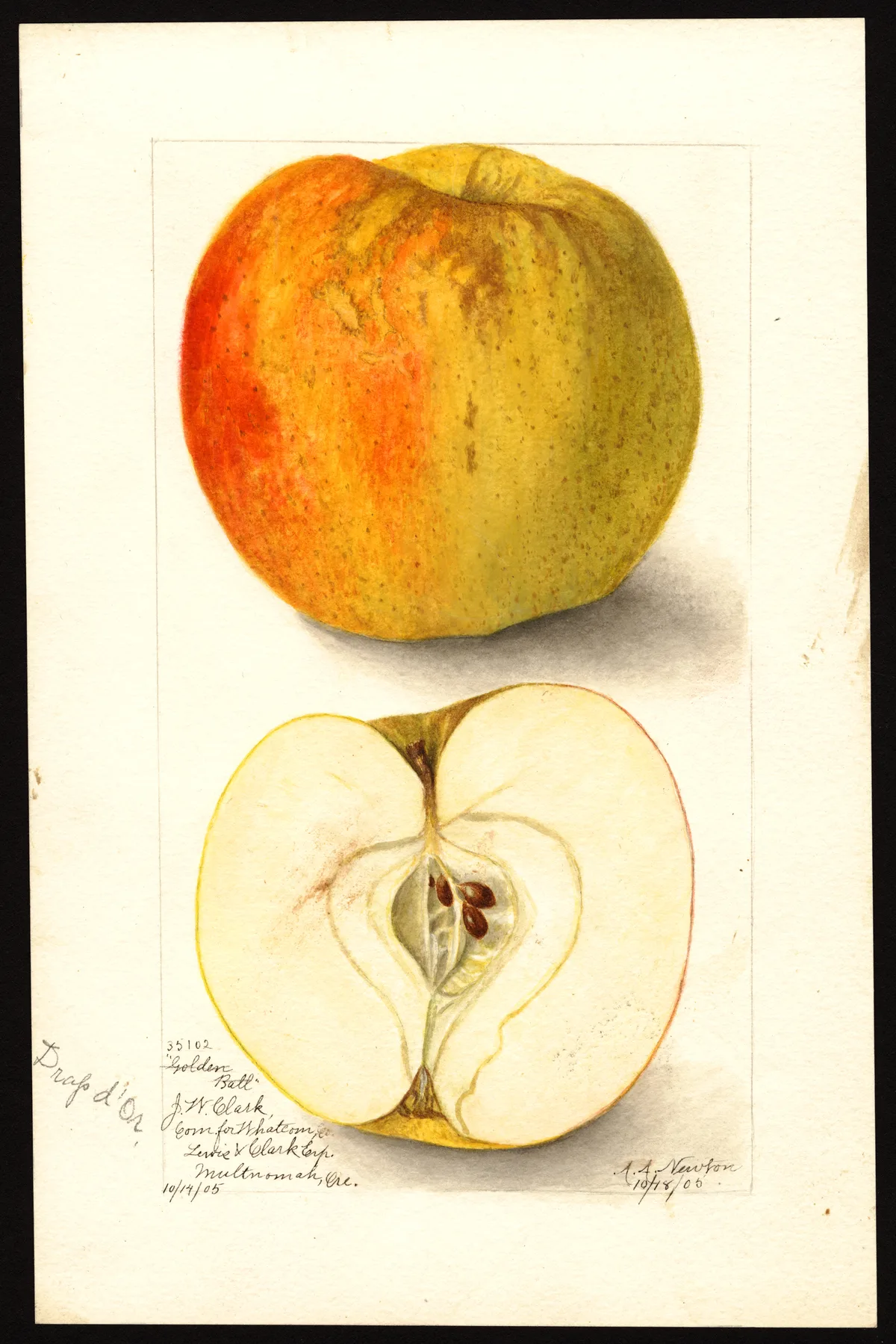
USDA Pomological Watercolor Collection
Golden Ball
Origin/History
The origin of this variety is somewhat in doubt. Elliott (1865) reports it is probably a native of Connecticut, from whence it has been largely distributed East, and cautions that "The Belle Bonne of Lindley is quite another fruit, and should not be confounded with this." Downing (1900) also gives the origin as Connecticut. Thomas (1903) reports it is cultivated chiefly in Maine, and Warder (1867) calls it "A favorite Maine apple." Hansen (1902) records a distinct provenance for the tree he studied: "Tree received from Ohio by R. P. Speer, Cedar Falls, Iowa," adding that Golden Ball was "Introduced by Rev. D. M. Hyde near Winona, Ohio, over thirty years ago" (i.e., ca. 1870, under the name Hyde's King of the West).
Tree
Hardy (Elliott, Thomas, Warder). Vigorous grower (Downing, Warder); productive (Warder). Elliott describes the tree as "forming a large round head, with large, glossy, rich green foliage," and notes it requires "a rich, strong, heavy soil."
Bearing habits are reported inconsistently: Elliott says "The trees do not bear well while young, but improve as they advance in years"; Downing calls it "only a moderate bearer"; Thomas calls it "a poor bearer"; Warder alone calls it "productive."
Fruit
Size: Large (Elliott, Downing, Thomas, Warder, Lowther); Thomas notes "often quite large" and adds that it is "Liable to vary in size and fairness." Hansen, describing his Ohio-via-Iowa specimen, gives the size as medium.
Form: Roundish (Elliott, Downing, Hansen, Thomas, Warder, Lowther). Elliott describes it as "roundish, narrowing to the eye." Thomas describes it as "roundish, remotely conical, ribbed." Downing notes "somewhat ribbed"; Warder notes "ribbed"; Hansen calls his specimen "round, regular."
Stem/Stalk and Cavity: Elliott: "stem, short, stout; cavity, broad." Thomas: "stalk short, slender, with fine green rays or furrows radiating from the centre of the cavity." Warder: "Cavity narrow; Stem medium." Hansen: "cavity wide, shallow, often lipped, sometimes almost flat; stem long."
Calyx/Eye and Basin: Elliott: "calyx, half closed; basin, shallow." Warder: "Basin deep, abrupt, folded; Eye large, closed." Thomas: "basin very shallow." Hansen: "basin wide, shallow, slightly ribbed; calyx closed."
Skin/Color and Dots: Color is rich or golden yellow (Elliott: "rich yellow, sometimes a faint blush near the stalk, and with rough dots"; Downing: "golden yellow, with a few dots"; Hansen: "golden yellow"; Thomas: "fine yellow"; Lowther: "yellow"). Warder describes the surface as smooth and "greenish yellow" with "Dots few, distinct, white bases." Hansen describes dots as "obscure, numerous, minute, white, with large white bases."
Flesh/Flavor: Yellowish (Elliott, Warder) or white (Hansen). Tender (Elliott, Downing, Thomas, Warder); crisp (Downing); juicy (Hansen, Warder); rich (Thomas, Warder); aromatic (Thomas); perfumed (Elliott). Flavor sub-acid (Downing, Hansen, Warder), with Elliott specifying "sub-acid, nearly acid, perfumed." Quality good (Downing, Hansen, Warder, Lowther).
Core and Seeds: Elliott: "core, medium; seeds, large and plump." Warder: "Core indistinct, open, clasping; Seeds defective." Hansen: "Core open, meeting; cells elliptical, abaxile, entire; tube conical; stamens basal; seeds long, pointed, flattened."
Season
October to December (Elliott). December to March (Downing). December to March in the North (Warder). Winter (Hansen). Thomas: "Ripens late in autumn, and keeps through winter." Lowther gives the season as "early autumn."
Uses
Table, kitchen, market (Warder); family (Lowther). "Exceedingly valuable for cooking" (Elliott); "Excellent for cooking" (Thomas).
Subtypes/Variants
Not described in source.
Other
Not described in source.
Book Sources
Described in 6 period pomological works
Nursery Catalog Sources
Found in 6 catalogs (1894–1913) from Illinois, Oregon
- Woodburn Nurseries , Woodburn, Marion Co. , Oregon — 1894 — listed as Hyde's King of the West
- Central Experimental Farm , Dominion Department of Agriculture, Agassiz, British Columbia (under test; Bulletin No. 3, Second Series) — 1900 — listed as Hyde's King of the West
- Central Experimental Farm , Dominion Department of Agriculture, Agassiz, British Columbia (under test; Bulletin No. 3, Second Series) — 1900
- Benjamin Buckman (personal inventory) , Farmingdale , Illinois — 1901
- Russellville Nursery Co. , Russellville, OR (three miles east of Portland, one mile from Montavilla car line) — 1903 — listed as Hyde's King of the West
- Benjamin Buckman (personal inventory) , Farmingdale , Illinois — 1913
View original book sources (6)
— F.R. Elliott, The Western Fruit Book (1865)Golden Ball.
Belle et Bonne, | Connecticut Apple.
The origin of this variety is somewhat in doubt, but it is probably a native of Connecticut, from whence it has been largely distributed East. The trees do not bear well while young, but improve as they advance in years. Tree, hardy, forming a large round head, with large, glossy, rich green foliage ; exceeding valuable for cooking ; requires a rich, strong, heavy soil.
Fruit, large ; form, roundish, narrowing to the eye ; color, rich yellow, sometimes a faint blush near the stalk, and with rough dots ; stem, short, stout ; cavity, broad ; calyx, half closed ; basin, shallow ; flesh, yellowish, tender, sub-acid, nearly acid, perfumed ; core, medium ; seeds, large and plump. October to December.
The Belle Bonne of Lindley is quite another fruit, and should not be confounded with this.
— John A. Warder, American Pomology: Apples (1867)Golden Ball.
A favorite Maine apple. Tree vigorous, productive, hardy.
Fruit large, round, ribbed; Surface smooth, greenish yellow; Dots few, distinct, white bases.
Basin deep, abrupt, folded; Eye large, closed.
Cavity narrow; Stem medium.
Core indistinct, open, clasping; Seeds defective; Flesh yellowish, tender, juicy; Flavor sub-acid, rich; Quality good; Use, table, kitchen, market; Season, December to March in the North.
— A.J. Downing, The Fruits and Fruit Trees of America (1900)Golden Ball.
Origin, Conn. Tree a vigorous grower, but only a moderate bearer.
Fruit large, roundish, somewhat ribbed, golden yellow, with a few dots. Flesh crisp, tender, subacid. Good. December, March.
— N.E. Hansen, A Study of Northwestern Apples (1902)Golden Ball—Tree received from Ohio by R. P. Speer, Cedar Falls, Iowa—Fruit medium, round, regular; surface smooth, golden yellow; dots obscure, numerous, minute, white, with large white bases; cavity wide, shallow, often lipped, sometimes almost flat; stem long; basin wide, shallow, slightly ribbed; calyx closed. Core open, meeting; cells elliptical, abaxile, entire; tube conical; stamens basal; seeds long, pointed, flattened; flesh white, juicy, subacid, good. Winter.
Golden Ball—Also known as Hyde's King of the West. Introduced by Rev. D. M. Hyde near Winona, Ohio, over thirty years ago.
— John J. Thomas, The American Fruit Culturist (1903)Golden Ball. Large, often quite large, roundish, remotely conical, ribbed; fine yellow; stalk short, slender, with fine green rays or furrows radiating from the centre of the cavity; basin very shallow; flesh tender, rich, aromatic. Ripens late in autumn, and keeps through winter. Liable to vary in size and fairness. Excellent for cooking. Tree very hardy; a poor bearer. Cultivated chiefly in Maine.
— Granville Lowther (ed.), Encyclopedia of Practical Horticulture (1914)Golden Ball. Size: large. Form: round. Color: yellow. Quality: good. Use: family. Season: early autumn.