Boskoop
Apple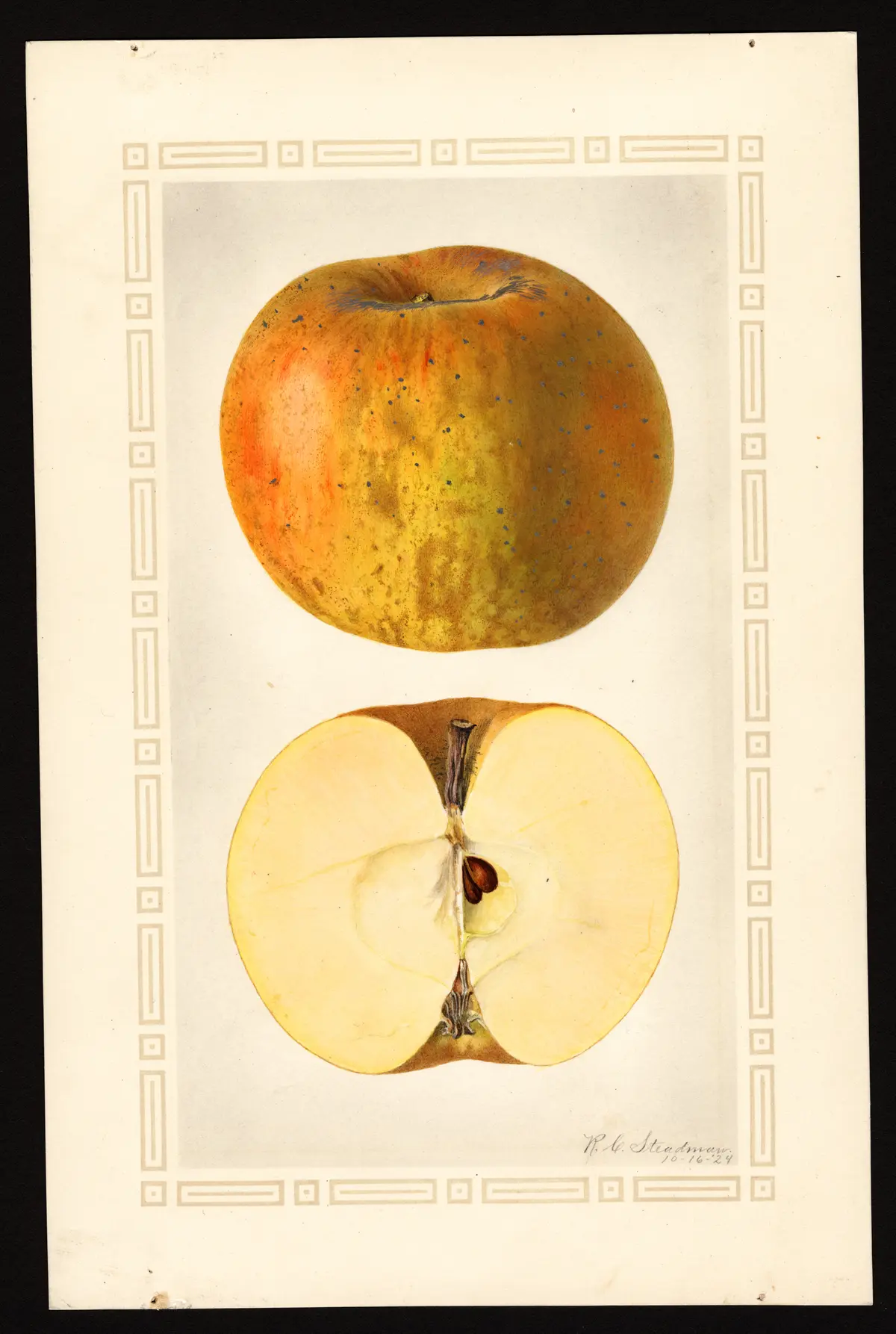
USDA Pomological Watercolor Collection
Boskoop
Origin / History
Boskoop is said to have originated from seed in 1856 in the nursery of the Ottolander family at Boskoop, Holland (Beach; Bunyard; Hedrick). Bunyard notes it must not be confused with the Calville von Boskoop, and that Reinette von Montfort is considered by some authorities to be the correct name; Palandt likewise found Boskoop identical with the variety described by Lauche and Oberdieck as "Reinette von Montfort" (Beach). Downing reports that he received trees from France and that the variety is said to be of Russian origin — a provenance contradicted by the other sources, which place its origin in Holland. Thomas also calls it "Russian." It was imported into America more than twenty-five years before Beach's 1905 account, the first published notice appearing in the Montreal Horticultural Report in 1881 (Beach; Hedrick), and was gradually disseminated to a limited extent in various portions of New York state. It is much grown for market in Holland and Germany (Bunyard).
Tree
Tree rather large, moderately vigorous (Beach) to vigorous (Hedrick; Central Experimental Farm), spreading (Downing; Central Experimental Farm), open, wide-spreading and drooping (Beach; Hedrick). Bunyard rates growth as moderate; fertile. Comes into bearing moderately early and produces abundantly in alternate years (Downing; Central Experimental Farm); Beach calls it a good bearer, and it appears to be pretty hardy — Hedrick notes that great hardiness makes it valuable in regions where it is otherwise capricious as to soils.
Branches long, moderately stout (Beach) to stout (Hedrick), crooked; lateral branches numerous and small. Form open, wide-spreading and drooping. Twigs rather short to long, straight, rather stout; internodes below medium to very long. Bark dark brownish-red, mingled with olive-green; somewhat pubescent. Lenticels numerous, conspicuous, small, oblong or roundish. Buds rather large, broad, plump, acute, free, slightly pubescent. Leaves large, broad (Beach; Hedrick); Bunyard describes the leaf as round, light, slightly upfolded, deeply curved serrate.
Fruit
Size. Medium to large (Downing; Bunyard; George Bunyard catalog), above medium (Thomas; Central Experimental Farm), or large (Beach; Hedrick). Bunyard gives dimensions of 2⅓ by 2⅓ inches. Pretty uniform in size and shape (Beach; Hedrick).
Form. Usually oblate (Beach; Hedrick), oblate to roundish oblate (Downing), or round-oblate (Hedrick); roundish (Thomas; George Bunyard catalog); roundish oval (Bunyard; George Bunyard catalog). Sometimes a little oblique, obscurely ribbed, sometimes with oblique axis (Beach; Hedrick); fairly regular (Bunyard).
Stem. Short, small (Downing); usually short and thick, sometimes rather long (Beach; Hedrick); medium (Bunyard).
Cavity. Rather large, often russeted, sometimes extending in rays out on the fruit (Downing); rather large to large, acute to acuminate, somewhat furrowed, often irregular, deep, russeted (Beach; Hedrick); deep, lined with russet (Bunyard).
Calyx. Closed, or partially open (Downing); large, segments long or very long, acuminate, closed or somewhat open, sometimes separated at the base (Beach; Hedrick). Eye closed or slightly open (Bunyard). Calyx tube large, cone-shape (Beach; Hedrick). Stamens median to basal (Beach); median (Hedrick).
Basin. Large, round, deep, slightly corrugated (Downing); abrupt, rather narrow, moderately shallow to rather deep, sometimes slightly furrowed (Beach); abrupt, narrow, shallow to deep, furrowed (Hedrick); rather deep (Bunyard).
Skin. Yellow, shaded with light and dark red over nearly the whole surface, with some rather obscure stripes and splashes on the shaded side, some specimens more or less mixed with russet, and many small and large yellowish-brown dots, with some irregular ones (Downing). Shaded and obscurely striped red on yellow skin (Thomas). Beach notes that in some locations the fruit becomes highly colored with attractive bright red predominating, but more often the color is not good, being predominantly dull green or yellow and more or less russeted. Beach and Hedrick describe the skin as dull green or yellowish (Beach) or dull green or yellow (Hedrick), sometimes blushed and mottled with rather bright red, and striped with deeper red, roughened with russet flecks, often irregularly overspread with russet. Bunyard gives the colour as golden-yellow with brick red flush and much thin russet. Central Experimental Farm describes the skin as greenish yellow, somewhat russeted, with a blush on the sunny side. Dots small and gray, mingled with others which are large, irregular and russet (Beach; Hedrick).
Flesh and flavor. A little coarse, crisp, tender, juicy, brisk subacid, rich, and of very good quality (Downing). Crisp, juicy, brisk sub-acid, rich, very good (Thomas). Tinged with yellow (Beach) / yellow (Hedrick), firm, somewhat coarse (Beach) / coarse (Hedrick), tender, juicy, crisp, brisk subacid, good to very good. Beach adds that the texture is somewhat coarse and the flavor rather too acid for an agreeable dessert apple, but late in the season its acidity becomes modified — making it more suitable for general market and culinary purposes than for dessert. Bunyard describes flesh as firm, yellowish, with flavour acid and aromatic; the George Bunyard catalog gives flesh as golden yellow, firm, somewhat coarse. Central Experimental Farm: flesh yellowish, firm, crisp, juicy, aromatic, quality very good.
Core and seeds. Core small and close (Downing); medium to small, somewhat abaxile (Beach) / small, abaxile (Hedrick); cells often unsymmetrical, closed or open; core lines slightly clasping (Beach) / clasping (Hedrick). Carpels roundish or obcordate (Beach) / round or obcordate (Hedrick), a little tufted (Beach) / tufted (Hedrick). Seeds apt to be abortive; when well developed they are long, irregular, obtuse to acute, somewhat tufted (Beach); when well developed long, irregular, obtuse, tufted (Hedrick).
Season
Sources disagree on season. Downing gives February to April; Thomas, late winter; Bunyard, December to April; Central Experimental Farm, mid-winter; George Bunyard catalog, September to February. Beach reports the commercial season as September to November, noting that when grown on warm soils in Southern New York it may be marketed in September, but in the more northern regions of the state it keeps into the winter, and as grown in Western New York generally some of the fruit may be kept till April. Hedrick gives September to April. Downing notes it keeps well.
Uses
More suitable for general market and culinary purposes than for dessert (Beach); a handsome fall apple with considerable merit as a market fruit for culinary purposes (Hedrick). A good culinary sort excellent for market and cooking (George Bunyard catalog). Bunyard classes it as culinary or dessert, a valuable fruit much grown for market in Holland and Germany and worthy of trial for this purpose in England. Beach considers it perhaps of sufficient merit to be worthy of testing but not yet ready to recommend for general planting; Hedrick judges it probably worth planting only in regions where its great hardiness makes it valuable.
Subtypes / Variants
Not described in source.
Other
Bunyard warns that Boskoop must not be confused with the Calville von Boskoop.
Book Sources
Described in 5 period pomological works
- Beach, The Apples of New York Vol. 2 (1905)
- Downing, Fruits and Fruit Trees of America (1900) — listed as Belle de Boskoop
- Hedrick, Cyclopedia of Hardy Fruits (1922)
- Bunyard, A Handbook of Hardy Fruits (1920) — listed as Belle de Boskoop
- Thomas, The American Fruit Culturist (1903) — listed as Belle de Boskoop
Nursery Catalog Sources
Found in 18 catalogs (1893–1921) from California, England, Illinois, Oregon, Washington
- Sherwood Hall Nursery Co. , Timothy Hopkins (Menlo Park Nurseries), San Francisco / Menlo Park , California — 1893 — listed as Belle de Boskoop
- Kelway & Son , Langport, Somerset , England — 1897 — listed as Belle de Boskoop
- George Bunyard & Co. , Royal Nurseries, Maidstone, Kent , England — 1900 — listed as Belle de Boskoop
- Central Experimental Farm , Dominion Department of Agriculture, Agassiz, British Columbia (under test; Bulletin No. 3, Second Series) — 1900 — listed as Belle de Boskoop
- Washington Nursery Co. , Toppenish , Washington — 1901 — listed as Belle de Boskoop
- Benjamin Buckman (personal inventory) , Farmingdale , Illinois — 1901 — listed as Belle de Boskoop
- Phoenix Nursery Company (W. E. Rossney , President; Sidney Tuttle, Vice-President), Bloomington , Illinois — 1904 — listed as Belle de Boskoop
- Washington Nursery Company , Toppenish , Washington — 1909 — listed as Belle de Boskoop
- James Veitch & Sons , Ltd., Royal Exotic Nursery, Chelsea, London (also Coombe Wood, Langley, and Feltham) , England — 1911 — listed as Belle de Boskoop
- Pacific Nursery Company , Portland , Oregon — 1912 — listed as Belle de Boskoop
- Vineland Nurseries Company , Clarkston , Washington — 1912 — listed as Belle de Boskoop
- Washington Nursery Company , Toppenish , Washington — 1912 — listed as Belle de Boskoop
- Thomas Rivers & Son , Sawbridgeworth, Hertfordshire , England — 1913 — listed as Belle de Boskoop
- Benjamin Buckman (personal inventory) , Farmingdale , Illinois — 1913 — listed as Belle de Boskoop
- George Bunyard & Co. , Royal Nurseries, Maidstone, Kent , England — 1914 — listed as Belle de Boskoop
- Union Nurseries , J.B. Weaver & Sons, Union , Oregon — 1915 — listed as Belle de Boskoop
- George Bunyard & Co. , Royal Nurseries, Maidstone, Kent , England — 1917 — listed as Belle de Boskoop
- Benedict Nursery Co. , Portland , Oregon — 1921 — listed as Belle de Boskoop
View original book sources (7)
— A.J. Downing, The Fruits and Fruit Trees of America (1900)Belle de Boskoop.
A new variety, trees of which I received from France; it is said to be of Russian origin. Tree vigorous, spreading, comes into bearing moderately early, and produces abundantly alternate years of fair fruit, good size, very good quality; keeps well, and is a promising variety.
Fruit medium to large, oblate to roundish oblate, sometimes a little oblique; skin yellow, shaded with light and dark red over nearly the whole surface, with some rather obscure stripes and splashes on the shaded side, some specimens more or less mixed with russet, and many small and large yellowish-brown dots, with some irregular ones; stalk short, small; cavity rather large, often russeted sometimes extending in rays out on the fruit; calyx closed, or partially open; basin large, round, deep, slightly corrugated; flesh a little coarse, crisp, tender, juicy, brisk subacid, rich, and of very good quality; core small and close. Season February to April.
— John J. Thomas, The American Fruit Culturist (1903)Belle de Boskoop. Above medium, roundish, shaded and obscurely striped red on yellow skin; crisp, juicy, brisk sub-acid, rich, very good. Late winter. Russian.
— S.A. Beach, The Apples of New York, Vol. 2 (1905)BOSKOOP
REFERENCES. 1. Berghuis, 1868: col. pl. No. 43. 2. Oberdieck, Monatshefte, 1869:193. 3. Oberdieck, Deutschlands beste Obstsorten, 212. 4. Lauche, Ergansungsband zum III. Handb., 265. 5. Montreal Hort. Soc. Rpt., 7:56, 155. 1881. 6. Downing, 1881:77 app. fig. 7. Budd, Ia. Hort. Soc., 1882: 8. Barry, 1883:342. 9. Willard, W. N. Y. Hort. Soc., 1889:171 (reprint in Mich. Hort. Soc. Rpt., 1889:329). 10. Palandt, Gartenflora, 38:425. 1889. col. pl. 11. Brodie, Can. Hort., 12:238. 1889. 12. Bailey, An. Hort., 1892:234. 13. Bailey, Amer. Gard., 14:501. 1893. 14. Craig, Can. Hort., 16:138. 1893. fig. 15. Bredsted, 1893:233. 16. Gaucher, Pomologie, 1894:No. 20. col. pl. 17. Beach and Clark, N. Y. Sta. Bul., 248:113. 1904.
SYNONYMS. BELLE DE BOSCOOP (11). BELLE OF BOSKOOP (9). BELLE DE BOSKOOP (6, 7, 8, 12, 13, 14, 15). Belle de Boskoop (16, 17). BOSKOOP (5, 17). Reinette Belle de Boskoop (16). Reinette Monstrueuse (16). Reinette von Montfort (16). SCHONER VON BOSKOOP (2, 3, 4, 10, 16). SCHOONE VON BOSKOOP (1). Schoone van Boskoop (16).
In some locations this fruit becomes highly colored with attractive bright red predominating, but more often the color is not good, being predominantly dull green or yellow and more or less russeted. It is more suitable for general market and culinary purposes than for dessert. It is of good size but does not rank high in quality; the texture is somewhat coarse, and the flavor rather too acid for an agreeable dessert apple, but late in the season its acidity becomes modified. It appears to be pretty hardy and a good bearer. When grown on warm soils in Southern New York it may be marketed in September, but in the more northern regions of the state it keeps into the winter. It is perhaps of sufficient merit to be worthy of testing but we are not yet ready to recommend it for general planting.
Historical. This variety is said to have originated from seed in 1856 in the nursery of the Ottolander family at Boskoop (1, 4). Palandt finds that it is identical with the variety described by Lauche and Oberdieck as "Reinette von Montfort" (4). It was imported into this country more than twenty-five years ago (5) and has gradually been disseminated to a limited extent in various portions of New York state.
TREE.
Tree rather large, moderately vigorous; branches long, moderately stout, crooked; lateral branches numerous and small. Form open, wide-spreading and drooping. Twigs rather short to long, straight, rather stout; internodes below medium to very long. Bark dark brownish-red, mingled with olive-green; somewhat pubescent. Lenticels numerous, conspicuous, small, oblong or roundish. Buds rather large, broad, plump, acute, free, slightly pubescent. Leaves large, broad.
FRUIT.
Fruit large. Form usually oblate, sometimes roundish oblate, obscurely ribbed, sometimes with oblique axis; pretty uniform in size and shape. Stem usually short and thick, sometimes rather long. Cavity rather large, acute to acuminate, somewhat furrowed, often irregular, deep, russeted. Calyx large; segments long or very long, acuminate, closed or somewhat open, sometimes separated at the base. Basin abrupt, rather narrow, moderately shallow to rather deep, sometimes slightly furrowed.
Skin dull green or yellowish, sometimes blushed and mottled with rather bright red, and striped with deeper red, roughened with russet flecks, often irregularly overspread with russet. Dots small and gray, mingled with others which are large, irregular and russet.
Calyx tube large, cone-shape. Stamens median to basal.
Core medium to small, somewhat abaxile; cells often unsymmetrical, closed or open; core lines slightly clasping. Carpels roundish or obcordate, a little tufted. Seeds apt to be abortive; when well developed they are long, irregular, obtuse to acute, somewhat tufted.
Flesh tinged with yellow, firm, somewhat coarse, tender, juicy, crisp, brisk subacid, good to very good.
Season. Commercial season September to November (17). As grown in Western New York generally some of the fruit may be kept till April.
— E.A. Bunyard, A Handbook of Hardy Fruits (1920)BELLE DE BOSKOOP. Ned. Boom., 43. G., Schoener aus Boskoop. (Reinette Monstreuse, Reinette von Montfort.) Culinary or dessert, December to April, medium to rather large, 2⅓ by 2⅓, roundish oval, fairly regular. Colour, golden-yellow, brick red flush, with much thin russet. Flesh, firm, yellowish, flavour acid and aromatic. Eye, closed or slightly open in a rather deep basin. Stem, medium in a deep cavity lined with russet. Growth, moderate; fertile. Leaf, round, light, slightly upfolded, deeply curved serrate. Originated at Boskoop in Holland in 1856. It must not be confused with the Calville von Boskoop. Reinette von Montfort is considered by some authorities to be the correct name. A valuable fruit much grown for market in Holland and Germany, and worthy of trial for this purpose in England.
— U.P. Hedrick, Cyclopedia of Hardy Fruits (1922)BOSKOOP.
Belle de Boscoop.
Well grown, Boskoop is a handsome fall apple with considerable merit as a market fruit for culinary purposes. The variety is capricious as to soils, however, and probably is worth planting only in regions where its great hardiness makes it valuable. It is said to have originated from seed planted at Boskoop, Holland, in 1856. The first account of it in America was published in the Montreal Horticultural Report in 1881.
Tree large, vigorous, open, wide-spreading and drooping; branches long, stout, crooked, lateral branches numerous and small. Leaves large, broad. Fruit large, oblate, or round-oblate, obscurely ribbed, sometimes with oblique axis, uniform in size and shape; stem short and thick, sometimes long; cavity large, acute, furrowed, often irregular, deep, russeted; calyx large, segments long or very long, acuminate, closed or open, separated at the base; basin abrupt, narrow, shallow to deep, furrowed; skin dull green or yellow, blushed and mottled with red striped with deeper red, roughened with russet flecks, often irregularly overspread with russet; dots small, gray, mingled with others which are large, irregular and russet; calyx-tube large, cone-shape; stamens median; core small, abaxile; cells often unsymmetrical, closed or open; core-lines clasping; carpels round or obcordate, tufted; seeds when well developed long, irregular, obtuse, tufted; flesh yellow, firm, coarse, tender, juicy, crisp, brisk subacid; good to very good; September to April.
— Central Experimental Farm, Central Experimental Farm, Agassiz BC — Catalogue of Fruit Trees under Test (Bulletin No. 3, 1900) (1900)Planted Spring 1890. Tree a vigorous and spreading grower, and very productive in alternate years. Fruit above medium size. Skin greenish yellow, somewhat russeted, and a blush on sunny side. Flesh yellowish, firm, crisp, juicy, aromatic, quality very good. Season mid-winter.
— George Bunyard & Co., George Bunyard Catalog of Fruit Trees (1914) (1914)Medium to large, roundish, oval, flesh golden yellow, firm, somewhat coarse. Period of use, Sept. to Feb. A good culinary sort excellent for market and cooking.