Wood's Greening
Apple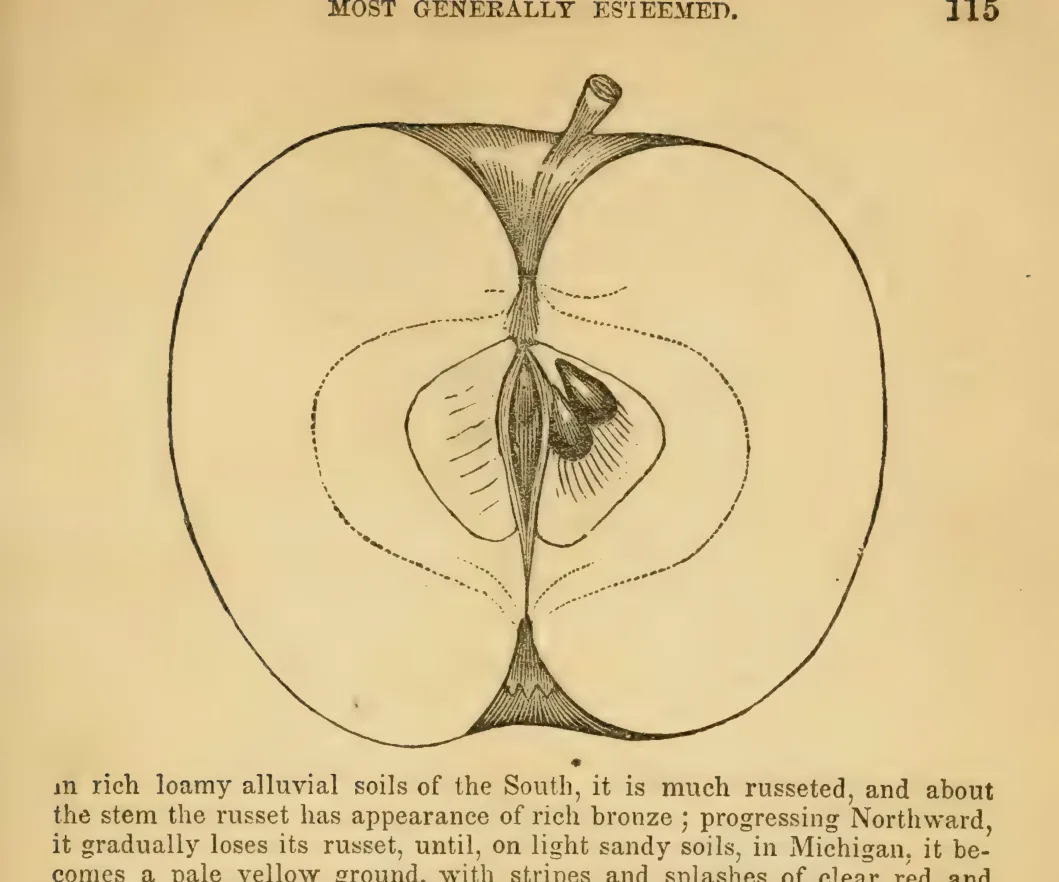
Origin/History
A native of New Jersey. First described by Coxe (1817), from whose nursery it was introduced to the West by Prof. Kirtland, about 1820. Elliott (1865) noted that this variety had been too little noticed and recommended it be extensively planted in the Southwestern States and territories, finding it well adapted to strong, heavy soils.
Tree
Hardy, with moderate to slender growth, becoming somewhat spreading and productive. Elliott describes it as an abundant producer of uniform, always fair fruit of "best" quality. Coxe likewise calls it a very abundant bearer.
Fruit
Size: Medium according to Coxe, Downing, and Elliott. Thomas describes it as large.
Form: Roundish oblate (Downing); roundish conical, flattened (Elliott); large, roundish, little oblique, slightly flattened, obscurely conical (Thomas). Coxe describes the form as resembling a Newton Pippin but more pointed at the blossom end.
Stem: Short (Downing, Elliott). Coxe describes it as thick and short, deeply planted. Thomas says very short.
Cavity: Acuminate (Elliott, Thomas). Coxe describes the stem as deeply planted, consistent with a deep cavity.
Calyx: Large (Downing); rather large (Elliott, Thomas). Coxe describes the crown as hollow.
Basin: Slightly plaited (Elliott); distinct, slightly plaited (Thomas).
Skin: Pale green, smooth (Coxe). Yellowish green with rough spots or patches (Downing). Pale green becoming yellowish, with a few rough spots (Elliott). Pale green, smooth (Thomas).
Flesh/Flavor: White, juicy, and sprightly (Coxe). Greenish white, fine-grained, tender, juicy, slightly subacid — very good; core small (Downing). Greenish white, fine-grained, juicy, tender, sprightly, subacid; core small; seeds ovate (Elliott). Greenish white or nearly white, fine-grained, slightly crisp, tender; flavor very agreeable, mild subacid, first-rate, but not very rich (Thomas).
Core/Seeds: Core small (Downing, Elliott). Seeds ovate (Elliott).
Season
An excellent winter fruit (Coxe). January, February (Downing). January to March (Elliott). Thomas does not specify a season.
Uses
Not described in source.
Subtypes/Variants
Not described in source.
Other
Elliott considered it well adapted to strong, heavy soils and urged extensive planting in Southwestern States and territories, suggesting particular climatic and soil suitability.
Book Sources
Described in 4 period pomological works
View original book sources (4)
— William Coxe, A View of the Cultivation of Fruit Trees (1817)NO. 76. WOODS GREENING.
This apple is of medium size—the colour a pale green—the form resembling a Newton Pippin, but more pointed at the blossom end—the skin smooth, the flesh white, juicy, and sprightly—an excellent winter fruit—the stem is thick and short, and deeply planted—the crown hollow; a very abundant bearer.
— A.J. Downing, The Fruits and Fruit Trees of America (1900)Wood's Greening.
Coate's Greening. Onstine. Cooke's Greening.
A native of New Jersey. Tree a moderate grower, hardy, somewhat spreading, productive.
Fruit medium, roundish oblate, yellowish green, with rough spots or patches. Stalk short. Calyx large. Flesh greenish white, fine-grained, tender, juicy, slightly subacid. Very good. Core small. January, February.
— F.R. Elliott, The Western Fruit Book (1865)Wood's Greening.
Coate's Greening, | Onstine.
American : native of New Jersey. First described by Coxe, from whose nursery it was introduced to the West by Prof. Kirtland, about 1820. This variety has been too little noticed. It should be extensively planted in our Southwestern States and territories. Tree, hardy, slender growth, becoming somewhat spreading. It is well adapted to strong, heavy soils, producing abundantly fruit of uniform medium size, and always fair and of "best" quality.
Fruit, medium ; form, roundish conical, flattened ; color, pale green, becoming yellowish, with a few rough spots ; stem, short ; cavity, acuminate ; calyx, rather large; basin, slightly plaited: flesh, greenish white, fine-grained, juicy, tender, sprightly, sub-acid ; core, small; seeds, ovate. January to March.
— John J. Thomas, The American Fruit Culturist (1903)Wood's Greening. Large, roundish, little oblique, slightly flattened, obscurely conical; pale green, smooth; stalk very short, cavity acuminate; calyx rather large, basin distinct, slightly plaited; flesh greenish white or nearly white, fine-grained, slightly crisp, tender; flavor very agreeable, mild sub-acid, first-rate, but not very rich.