Eiser
Apple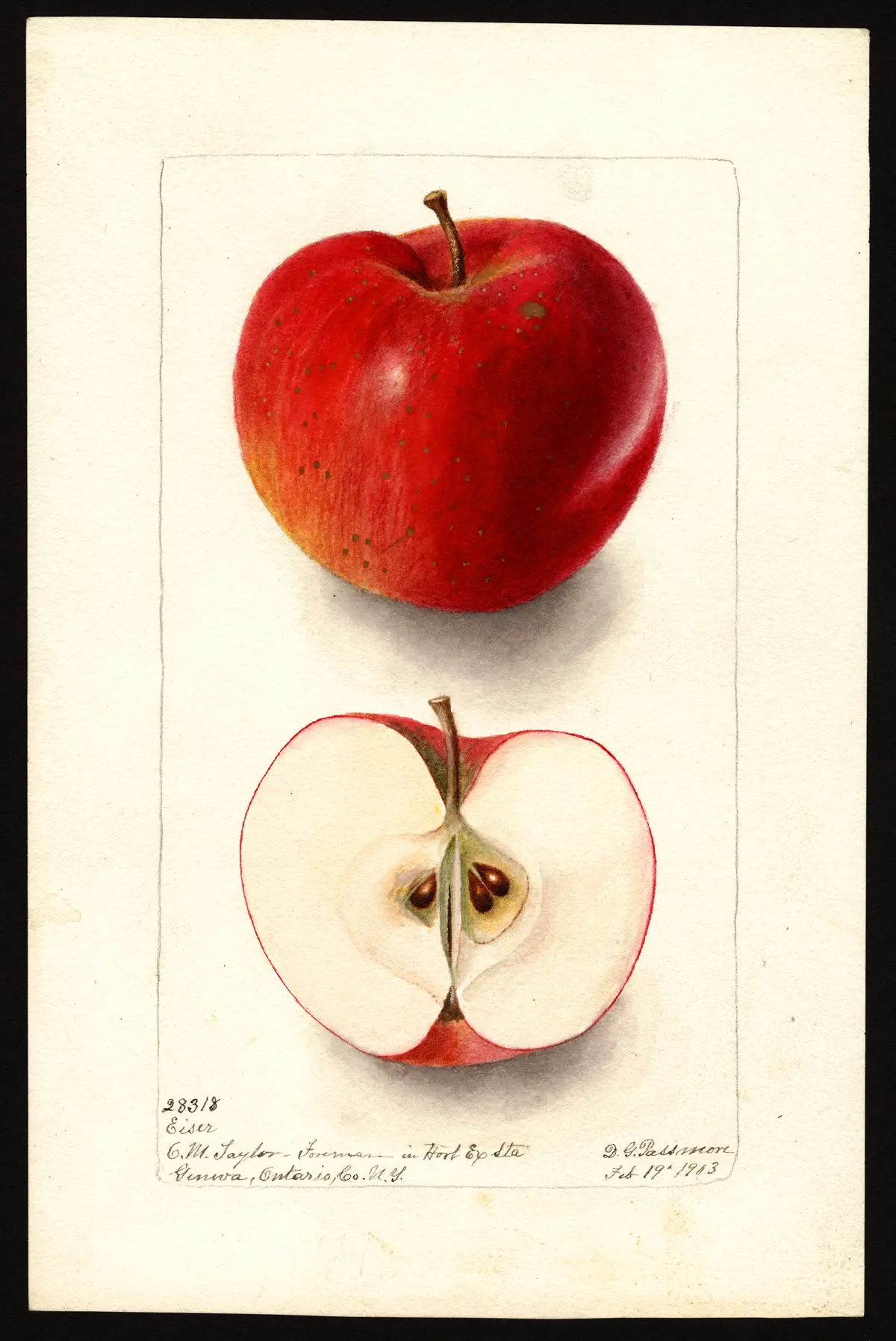
USDA Pomological Watercolor Collection
Origin and History
A German variety that has been in cultivation for more than a century. The variety was imported from Austria by Prof. Budd for the Iowa Agricultural College in 1884 and 1885.
Tree
Moderately vigorous. Branches long and moderately stout. Form upright spreading to roundish and open. Twigs long, moderately stout, nearly straight, with long internodes. Bark olive-brown tinged with red and streaked with grayish scarf-skin, heavily pubescent. Lenticels scattering, small, round, and raised. Buds large, broad, obtuse, free, and pubescent. Foliage dense and dark green.
Fruit
Size and Form: Medium to nearly large. Conical and broad at the base, often elliptical with unequal sides and somewhat ribbed.
Stem: Short and thick to long and rather slender.
Cavity: Very large to large, acute, deep, broad. Sometimes symmetrical, often compressed or furrowed. Lined with outspreading green russet.
Calyx: Medium to large, closed or partly open. Lobes acute to acuminate.
Basin: Often oblique and irregular. Rather shallow to moderately deep, narrow, abrupt. Roughly furrowed and wrinkled.
Skin: Thick, tough, smooth, and slightly waxy. Ground color yellow mottled with orange-red and almost covered with bright pinkish-red, sometimes deepening to purplish. Inconspicuously striped with deep carmine. Covered with a thin whitish bloom. Prevailing effect: attractive bright red.
Dots: Conspicuous and numerous, particularly abundant toward the eye. Larger, more irregular, and more scattering toward the cavity. Color grayish-white or yellow, sometimes with russet areolar.
Calyx Tube: Long, funnel-shaped or approaching conical.
Stamens: Median to basal.
Core: Medium to above in size. Hollow cylinder, nearly axile. Cells symmetrical, closed or partly open. Core lines clasping the funnel cylinder.
Carpels: Roundish or elongated. Not emarginate or only slightly so. Tufted.
Seeds: Medium to above in size. Rather wide, long, and somewhat acute. Tufted. Often somewhat abortive.
Flesh and Flavor: Whitish, slightly tinged with yellow. Very firm, moderately fine, crisp, breaking. Moderately juicy. Mild subacid. Quality good.
Season
January to June or later.
Storage and Shipping
Possesses a tough skin that does not readily show bruises. Stands shipping well. An excellent keeper, much superior to Baldwin in this respect.
Uses
Suitable for general uses.
Bearing and Productivity
Almost annual bearer. Productivity varies by location: at the Kansas Station not a good cropper, though Leroy reports it is satisfactorily productive. As tested at the New York Station, moderately productive with comparatively little loss from drops and culls.
Book Sources
Described in 1 period pomological work
Nursery Catalog Sources
Found in 1 catalog (1900)
- Central Experimental Farm , Dominion Department of Agriculture, Agassiz, British Columbia (under test; Bulletin No. 3, Second Series) — 1900
View original book sources (1)
— S.A. Beach, The Apples of New York, Vol. 1 (1905)EISER.
REFERENCES. 1. Diel, Kernobstsorten, 5:175. 1802. (cited by 3). 2. Oberdieck, Ill. Handb. der Obst., 4:353. 1865. (cited by 3). 3. Leroy, 1873:285. fig. 4. Lauche, 1: col. pl. No. 10. 1882. 5. Eneroth-Smirnoff, 1901:170. 6. Kan. Sta. Bul., 106:54. 1902.
SYNONYMS. Arsapple (5). Eiser Rouge (3). Durable Trois ans (3). Red Eisen (6). Rother Eiser (2). Rother Eiser (3). Rother Eisenapfel (4). Rouge Rayée (1, 3).
Fruit very attractive, of good size, very beautiful color and good quality; suitable for general uses. It has a tough skin which does not readily show bruises. It stands shipping well and is an excellent keeper, being much superior to Baldwin in this respect. At the Kansas Station it has not been a good cropper (6), but Leroy states that it is satisfactorily productive (3). As tested at this Station the tree is a good grower and almost an annual bearer, but only moderately productive. There is comparatively little loss from drops and culls. It has not been tried here long enough to justify an unqualified recommendation, but it shows merit enough to make it worthy of further testing.
Historical. A German variety which has been in cultivation more than a century (1, 2, 3). Our stock came from Prof. Budd who imported the variety from Austria for the Iowa Agricultural college, in 1884 and 1885.
TREE.
Tree moderately vigorous; branches long, moderately stout. Form upright spreading, or roundish, open. Twigs long, moderately stout, nearly straight; internodes long. Bark olive-brown, tinged with red, streaked with grayish scarf-skin; heavily pubescent. Lenticels scattering, small, round, raised. Buds large, broad, obtuse, free, pubescent. Foliage dense, dark green.
FRUIT.
Fruit medium to nearly large. Form conical, broad at the base, often elliptical, sides unequal, somewhat ribbed. Stem short and thick to long and rather slender. Cavity very large to large, acute, deep, broad, sometimes symmetrical, often compressed or furrowed, with outspreading green russet. Calyx medium to large, closed or partly open; lobes acute to acuminate. Basin often oblique, irregular, rather shallow to moderately deep, narrow, abrupt, roughly furrowed and wrinkled. Skin thick, tough, smooth, slightly waxy, yellow mottled with orange-red and almost covered with bright pinkish-red, sometimes deepening to purplish, inconspicuously striped with deep carmine, covered with a thin whitish bloom. Dots conspicuous, numerous toward the eye, larger, more irregular and more scattering towards the cavity, grayish-white or yellow, sometimes russet areolar. Prevailing effect attractive bright red. Calyx tube long, funnel-shape or approaching conical. Stamens median to basal. Core medium or above with hollow cylinder, nearly axile; cells symmetrical, closed or partly open; core lines clasping the funnel cylinder. Carpels roundish or elongated, not emarginate or but slightly so, tufted. Seeds medium to above, rather wide, long, somewhat acute, tufted, often somewhat abortive. Flesh whitish, slightly tinged with yellow, very firm, moderately fine, crisp, breaking, moderately juicy, mild subacid, good. Season January to June or later.